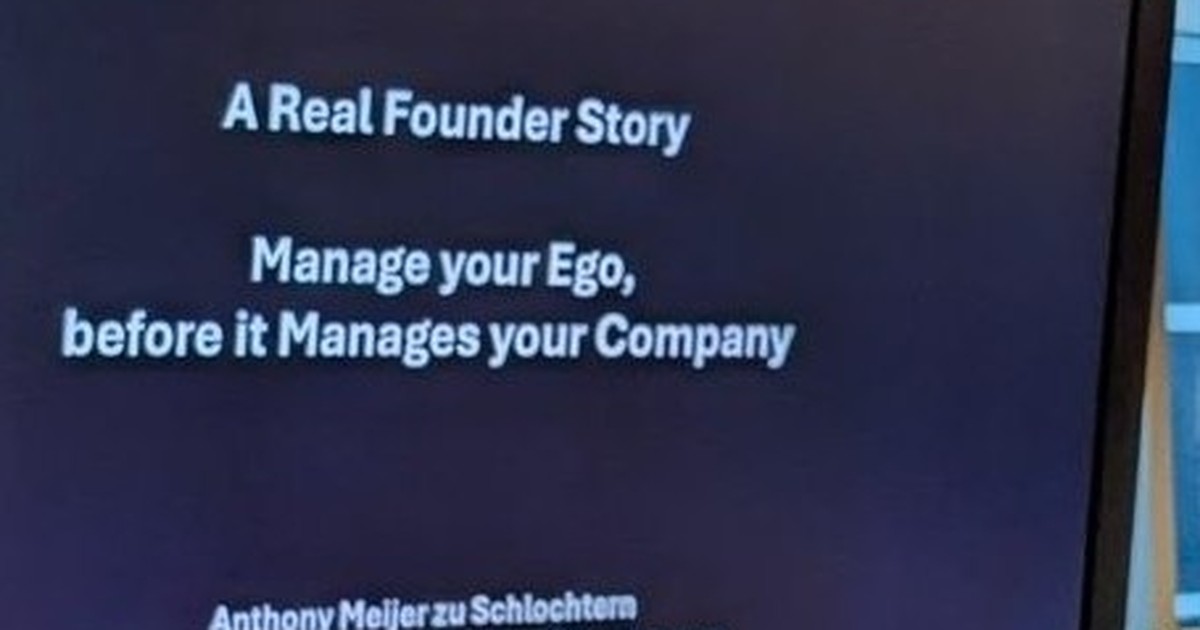
On 23 April 2026 I went to a short evening talk in Amsterdam titled “A Real Founder Story: Manage your Ego, before it Manages your Company”. The title slide named the speaker as Anthony Meijer zu Schlochtern, Serial Entrepreneur and Founder of ZEAL Partners. The slides did not show an organiser, so I will not guess who hosted. This is a non-technical post, but founders in infrastructure and AI companies run into exactly the patterns he described.
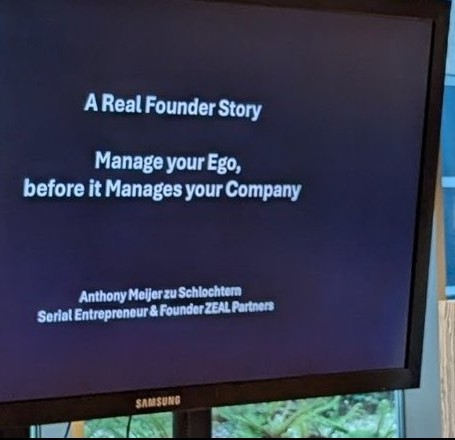 The title slide. The talk opened with the speaker’s own story as a founder.
A founder who recognises the failure modes
The story slide, headed “And I…”, listed behaviours the speaker presented as his own as a founder:
- was bossing around everyone
- was overpromising to clients
- was overworking and expected everyone to do the same
- was very on edge
- was checking the bank account hourly
The list is useful because it is concrete. These are behaviours, not personality types, and anyone running a company will recognise at least two of them.
The model: Brains, Power, Social effectiveness
The framework was drawn as a house. The roof is B for Brains, and the two rooms below it are P for Power and S for Social effectiveness.
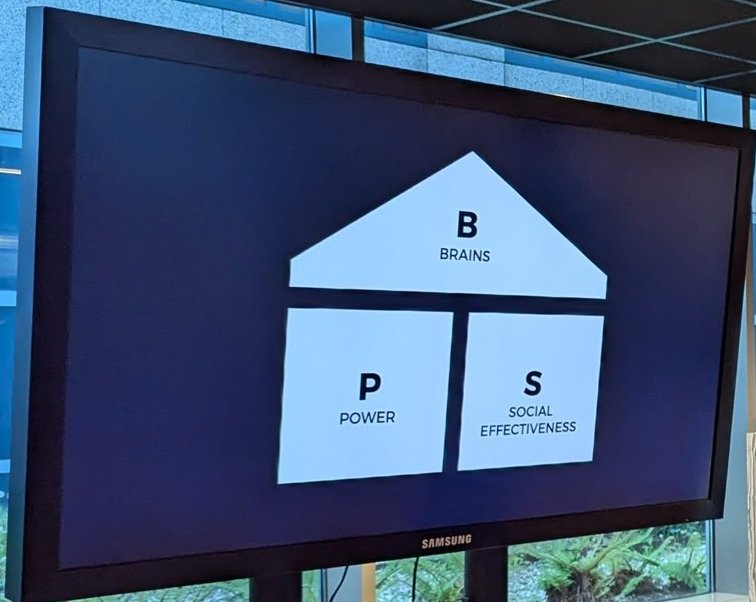 The Brains, Power, Social effectiveness house.
Two slides then listed typical behaviours for each side, positive and negative. For S (Social effectiveness) the positives were: I am vulnerable, I offer support, I am patient, I am thinking in options. The negatives were: I please others, I am postponing, I don’t ask my price, I am judgemental.
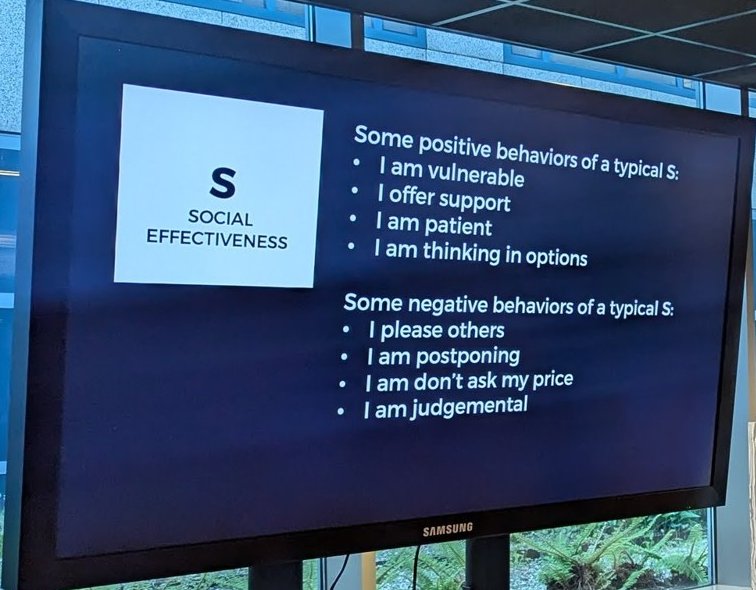 Typical S behaviours, positive and negative.
For P (Power) the positives were: I show courage, I am decisive, I am applying focus, I am modest. The negatives were: I take too much on my plate, I am in a hurry, I am micromanaging, I am showing off.
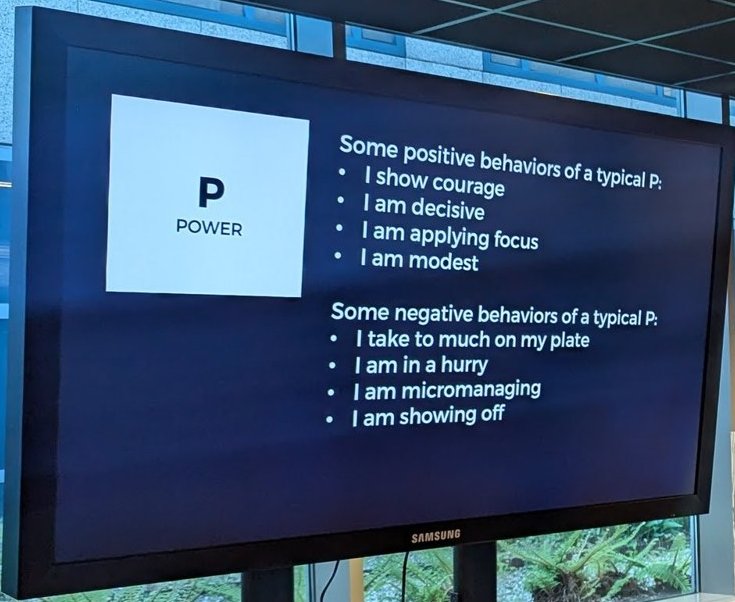 Typical P behaviours: the same drive that makes a founder decisive can turn into micromanaging.
The point of the two lists is that each strength has a shadow. A power-type founder’s decisiveness and a social-type founder’s patience each tip into the negative column under stress.
The positive and negative version of the house
A second version of the house split every part into a plus and a minus side, divided by a band called “The wall of doubt and shame”:
- B+ Wisdom at the top, B- Stubbornness (spelled “Stubbornes” on the slide) at the bottom
- P+ Experience of abundance against P- Experience of scarcity
- S+ Experience of unity against S- Experience of rejection
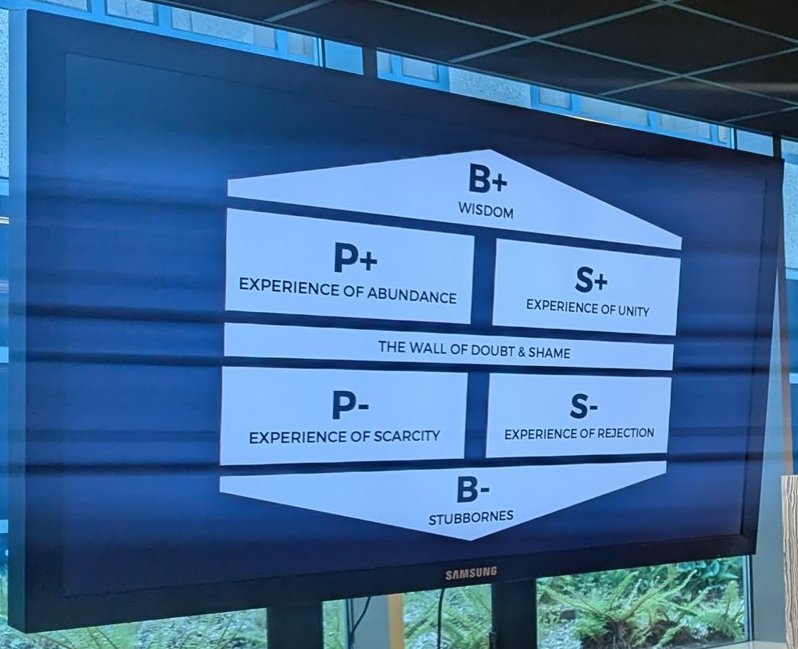 The wall of doubt and shame separates the plus side from the minus side.
From the house to a company
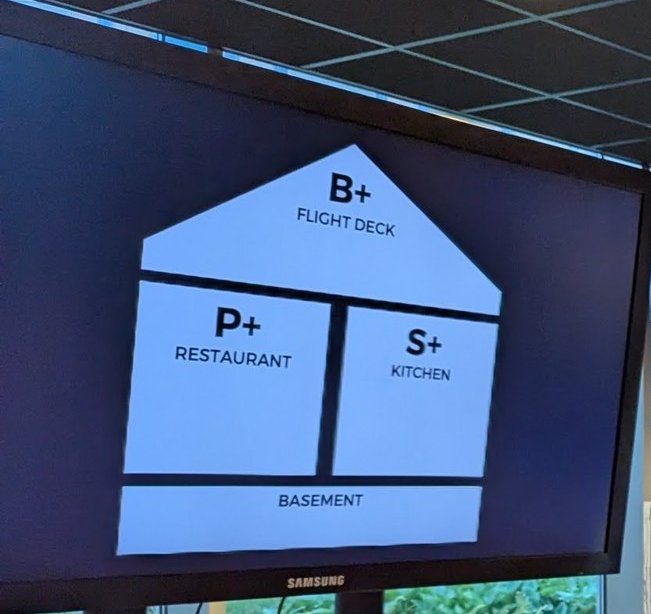 The same house as a company metaphor: flight deck, restaurant, kitchen, basement.
The last part mapped the house onto a business: B+ is the flight deck, P+ the restaurant, S+ the kitchen, and the basement is the foundation. A following slide listed Promise, External Fire Power, Trial and Money on the left and a second column on the right (partly hidden in my photo, with “Internal Safety Net” legible), connected by a two-way arrow. My reading, not the speaker’s words, is that it is about the balance between what a founder promises outside and what the company can back up inside.
The final slides promoted ZEAL Academy, with a slide reading “Start New Cohort September 2026” (the Dutch headline read “Pak je volledige potentieel”). The speaker and Ole van der Straaten are listed as co-authors of the Dutch book ZEAL: Groeitaal voor ondernemers, published on 23 April 2025 by Santasado, on Managementboek.
My take
The checking-the-bank-account-hourly slide was the honest one. In my consulting work, the same shadows show up as over-promising on delivery dates and taking on too much of the architecture work personally. A model like this is not science, but a shared vocabulary for “this is my power-side stress pattern” makes it easier to talk about with a team. For a more startup-oriented evening, see Tech Makers Monthly Tech Drinks and Pitching in Amsterdam.