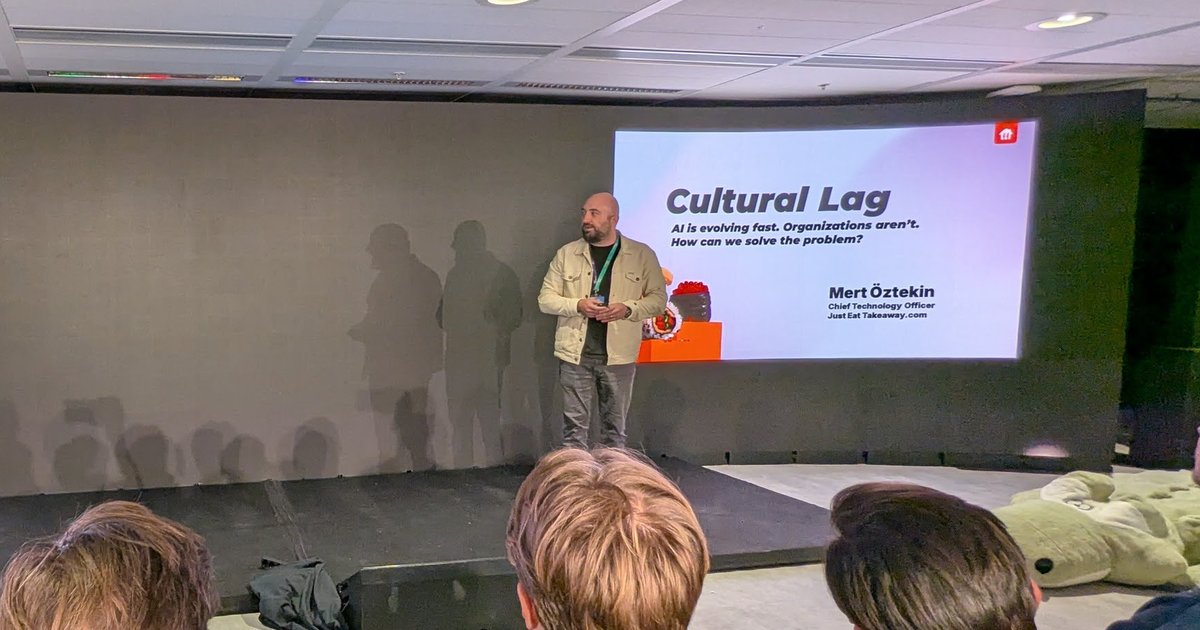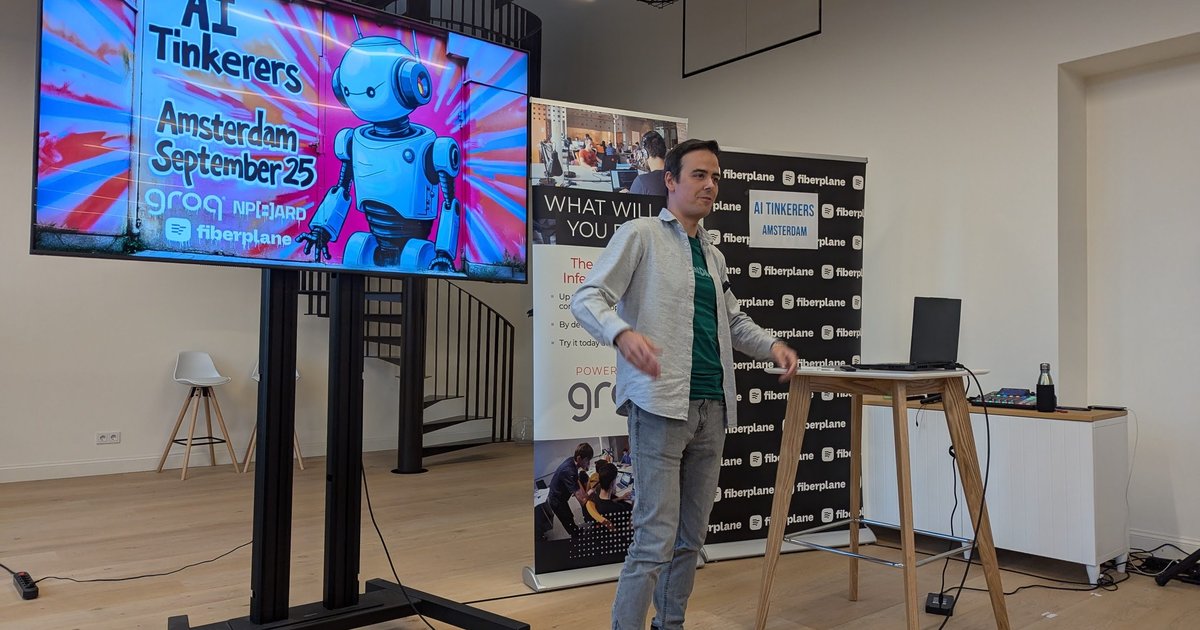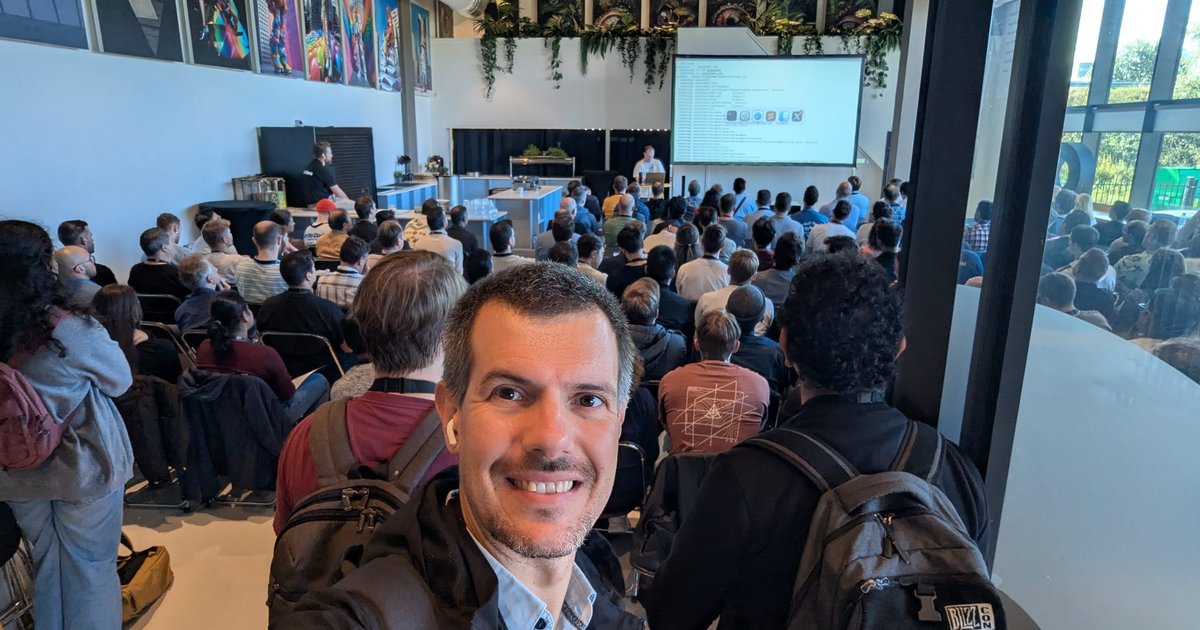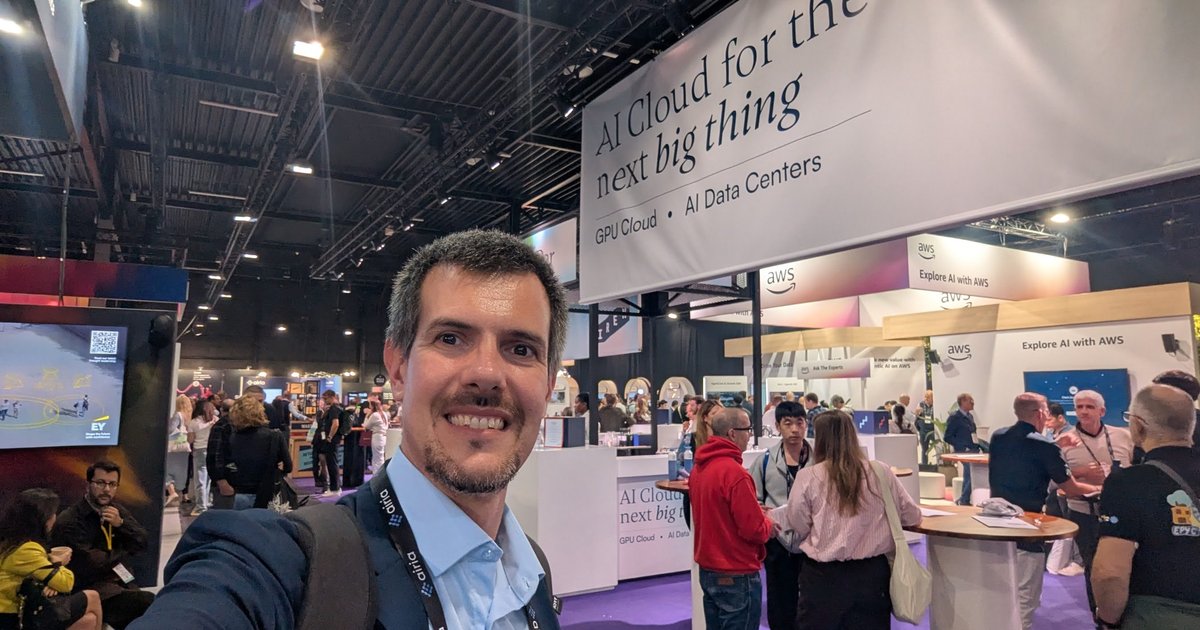
On 8 and 9 October 2025 I spent two days at World Summit AI in Amsterdam. The event homepage at the time gave the dates as 8–9 October 2025 and the venue as Taets Art & Event Park, with “Back to the future: It’s about time” as the theme of World AI Week 2025. Both evenings I went on to smaller side sessions: a JetBrains evening on the 8th and a Fin × LangChain fireside on agentic AI on the 9th.
These notes come from my photos of the slides and signs, plus a few short videos I recorded on the expo floor and at the JetBrains evening. I only name speakers whose names appeared on a slide or poster, and I paraphrase what people told me on camera.
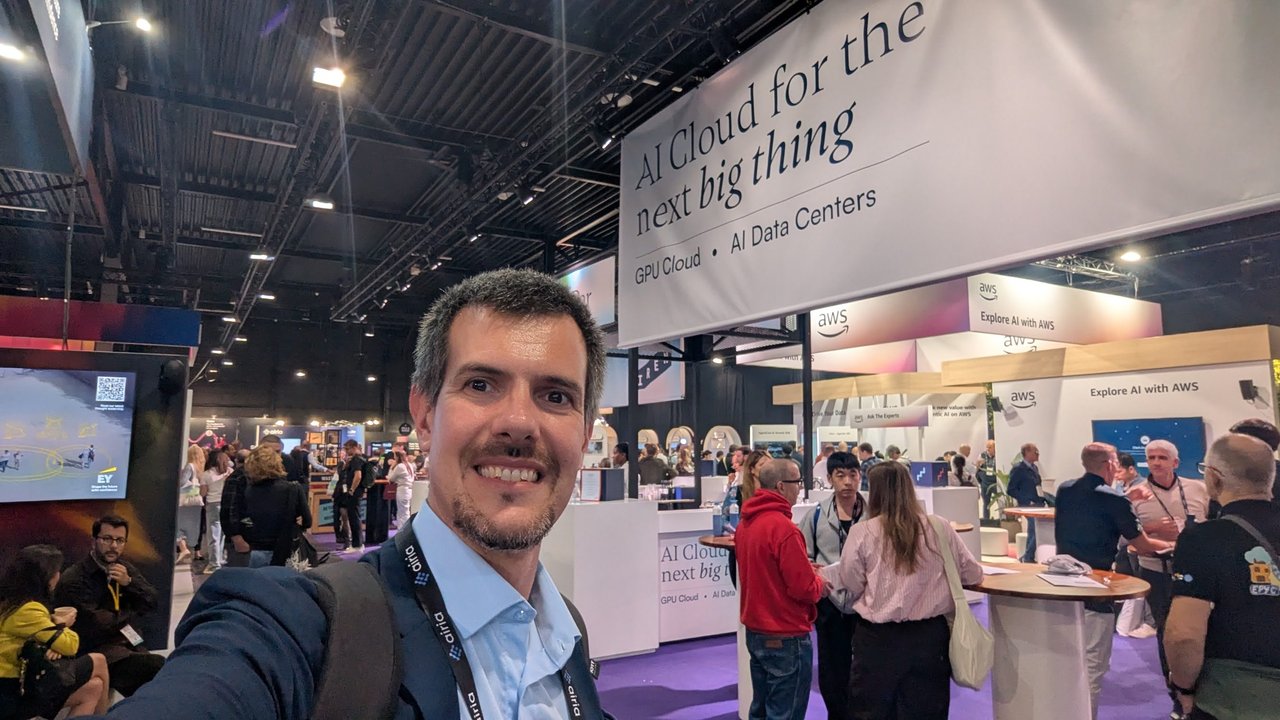
Day one in the expo hall. GPU clouds and AI data centres were the loudest message on the stands.
Opening: welcome to Amsterdam
The main stage opened with Alexander Scholtes, Deputy Mayor of the City of Amsterdam, under a “Welcome to Amsterdam” slide. The chair was Isabelle Kumar, introduced on screen as an award-winning journalist, presenter, host and moderator, who gave the welcome and opening remarks. One of her slides was already looking ahead: “World Summit AI 10th anniversary – get involved!”, with an invitation to join again next year. The official site now lists that 10th-anniversary edition for 7–8 October 2026, again at Taets.
Karen Hao: Dreams & Nightmares in the Empire of AI
The first keynote I photographed was “Dreams & Nightmares in the Empire of AI” by Karen Hao. It wasn’t a product talk. It was a hard look at what the AI build-out costs, and the slides moved from “data” and “compute” to money and water.
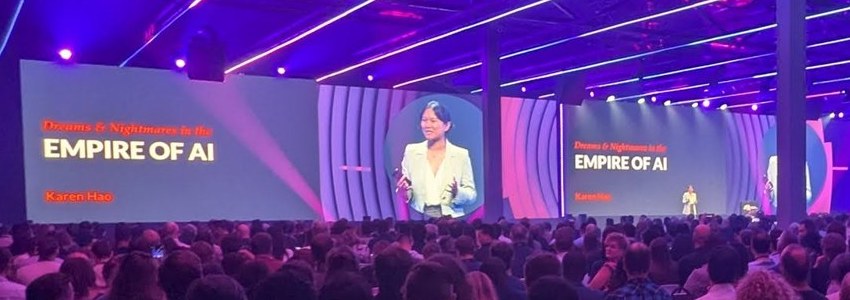
Karen Hao’s keynote title on the main-stage screens.
The capex slide, sourced to McKinsey & Company, was headed: “Capital investments to support AI-related data center capacity demand could range from about $3 trillion to $8 trillion by 2030.” It split global AI-driven data-centre capital expenditure for 2025–30 into data-centre infrastructure, IT equipment and power, under three scenarios:
| Scenario | Infrastructure | IT equipment | Power | Total ($T) | AI capacity added (GW) |
|---|---|---|---|---|---|
| Accelerated demand | 2.6 | 4.7 | 0.6 | 7.9 | 205 |
| Continued momentum | 1.6 | 3.3 | 0.3 | 5.2 | 124 |
| Constrained momentum | 1.0 | 2.5 | 0.2 | 3.7 | 78 |
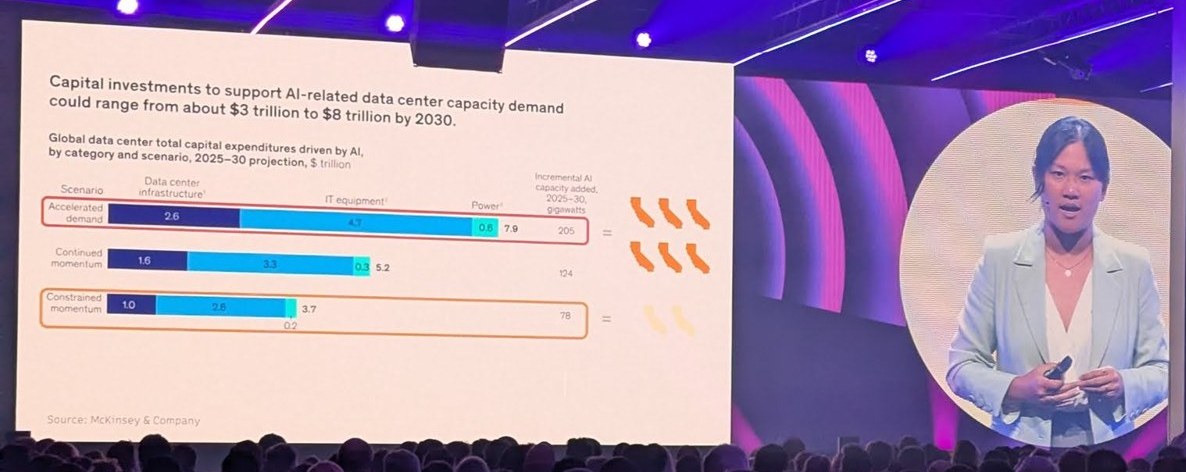
Three scenarios, one pattern: IT equipment is the biggest slice in every one of them.
The next slides, sourced to Bloomberg (data from DC Byte and the World Resources Institute, through Q1 2025), were about water. “As Data Centers Become More Ubiquitous, Water-Stressed Areas See the Most Growth” plotted the number of US facilities by year and water-stress zone from 1995 to 2025, with “Release of ChatGPT” marked near the right edge. The companion chart, “Data Centers Proliferating Globally in Water-Stressed Areas”, repeated the exercise for China, Germany, France, the UK, India, Canada, Australia, Italy, Spain, the Netherlands and ten more countries.
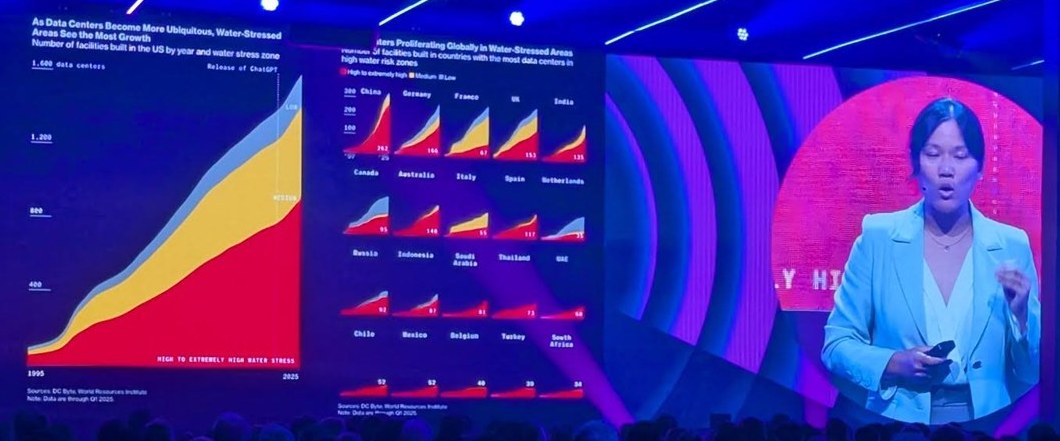
The largest band in the US chart is “high to extremely high water stress”.
My take: as a platform engineer I usually see the bottom of this stack as a GPU quota and a monthly bill. The keynote was a reminder that the 205 GW scenario has to be built somewhere, often where water is already scarce. That makes utilisation an engineering responsibility, not only a finance one. The cheapest GPU is the one you didn’t need to schedule, which is why I keep pushing inference cost optimisation on Kubernetes before anyone asks for more capacity.
The expo: sovereignty, security and “metal-to-model”
Between sessions I walked the expo floor. The stands told their own story about where the money was going:
- Red Hat: “Sovereign AI everywhere”.
- Varonis: “Data security for the AI era”.
- Mirantis: “Unleash AI infrastructure at scale” and “From metal-to-model”.
- WEKA: “Faster AI”, next to Mirantis.
- HP: “Are you going to outsource your future or are you going to own it?”
- AWS: “Explore AI with AWS”; Google: “AI Connect, in partnership with Techleap”, plus a Gemini-powered barista on day two that made you a “personalised brew” and a shareable coffee card.
- IEEE: “Raising the world’s standards” and CertifAIEd; DataStax: “Secure your data for AI”; and an AI House stand.
The partner wall listed IBM, Google, AWS, EY, Atlassian, Glean, Nebius, Retool, Writer, Unframe, Varonis and Prosus, among many others. Most of my conversations on the floor were less about products than about ethics, the future of work and keeping a human in the loop. Some of the biggest stands, like AWS and Google, were mostly selling services such as Gemini to B2B buyers, so I found it more useful to talk with the engineers behind the products than to collect brochures.
I also recorded a few short stand conversations. Here is what I took from them.
Red Hat. The stand’s message was “Sovereign AI”. My own summary on camera was that it’s no longer enough to control your data: you also need control over your models and the infrastructure they run on. Red Hat’s answer was its AI portfolio: RHEL AI with InstructLab, OpenShift AI to run models at scale on Kubernetes, and the newer Red Hat AI Inference Server, all from open source components you can trace through the supply chain.
Mirantis. A principal cloud solutions architect at Mirantis explained that the problem they’re solving is getting the most out of GPU hardware that a company already owns. They showed k0rdent AI, which “cloudifies” an on-premises AI factory: teams consume local GPU, network and storage resources through APIs, the way they would in a public cloud, in a multi-tenant setup where each tenant is isolated and can reserve its own capacity. He pointed out that k0rdent itself is an open source project you can download and try. A Mirantis press release from August 2025 describes k0rdent AI the same way: multi-tenant, AI-ready infrastructure “from Metal-to-Model”.
HP. On the HP stand I tried a ZBook running an AMD Ryzen AI Max+ PRO 395. Windows Task Manager showed an NPU next to the CPU and the Radeon 8060S GPU, with 32 GB of dedicated GPU memory and 47.9 GB of shared memory. The point of the demo was local AI: the NPU and GPU together accelerate models on the laptop itself, without a round trip to a cloud endpoint.
Startups. At the Sentiva stand, the brand and growth manager described an AI-native HR platform built around “sentient workplaces” that sense and adapt in real time instead of reacting. It has three products: Sentiva Talent for hiring, Sentiva People for day-to-day HR and engagement, and Sentiva Ascend, which combines performance management with a personal growth plan that both the manager and the employee can see. Her position on jobs was clear: AI should give people time back, not replace them. At the SubsidAI stand, the founder and CEO said their tool for Dutch subsidy applications cuts application time in half and saves customers around €2,000 per FTE per year. Those are the company’s own numbers.
On day two I went back to the Red Hat stand for Ansible Automation Platform 2.6. A Red Hat specialist showed me the Ansible Lightspeed intelligent assistant: a chat panel inside the platform UI that is context-aware. It answers questions about the platform from the current documentation, and it can also look into your own installation, for example to tell you how many jobs ran yesterday. He stressed that it’s read-only, that you bring your own LLM so it can run fully on-premises, and that an MCP interface was coming next as a technology preview, so an external LLM could query the platform. Red Hat’s AAP 2.6 release notes now list the MCP server as a technology preview. I went through the setup in Ansible Intelligent Assistant & MCP Server: BYOK RAG.
My take: “sovereign” and “metal-to-model” were on stands from very different vendors, and I think that’s the real trend. Enterprises in Europe want to own the stack from the GPU up to the model endpoint, or at least be able to move it. I wrote about the policy side in Digital Sovereignty in Europe, and the Dutch angle came up again at the MLOps Community meetup on AI sovereignty and GPT-NL.
Groq: AI is sovereign and global
Late on day one, Chris Stephens, introduced on his slide as VP, CTO @ Groq, took the main stage. His map slide, “AI is Sovereign & Global”, put the flags of the United States, the European Union, Saudi Arabia and China on a world map.
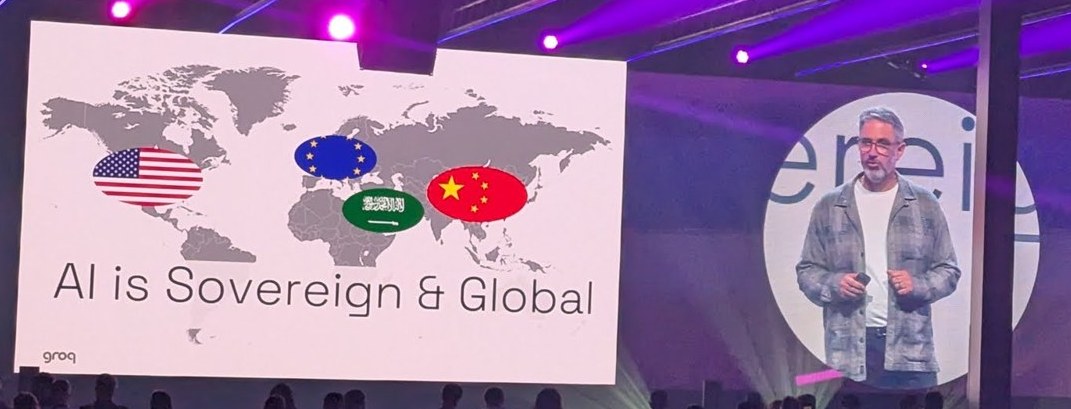
Groq’s framing: every region wants its own AI capacity, and every one of them is part of a global market.
A later slide, “Groq v GPU – 50M People by the Numbers”, claimed 12x economic efficiency, 75% lower running cost, 10x optimised ownership and 5x energy efficiency. Those are vendor numbers, and the slide didn’t show the workload behind them.
My take: I’d want to see those numbers per workload and per SLO before I believed them for a client. But the shape of the argument matches the capex keynote that morning: if inference grows like the slides say, energy per token becomes a board-level metric. Groq-powered apps were already on show at AI Tinkerers Amsterdam in 2024, and the way I’d test a claim like this is benchmarking against latency SLOs with GuideLLM.
Day two: encryption modernisation and the quantum clock
On 9 October the main stage included a fireside chat titled “The power of tech convergence: From quantitative AI to quantum tech for global impact”, with Fernando Dominguez Pinuga, moderated by Natalia Rodriguez Martin. The slides alongside it were headed “Encryption Modernisation” and carried the SandboxAQ footer. They quoted headlines such as “EU reinforces its cybersecurity with post-quantum cryptography”, “Quantum computers will redefine encryption” and EY’s “Why organizations should prepare for quantum computing cybersecurity now”.
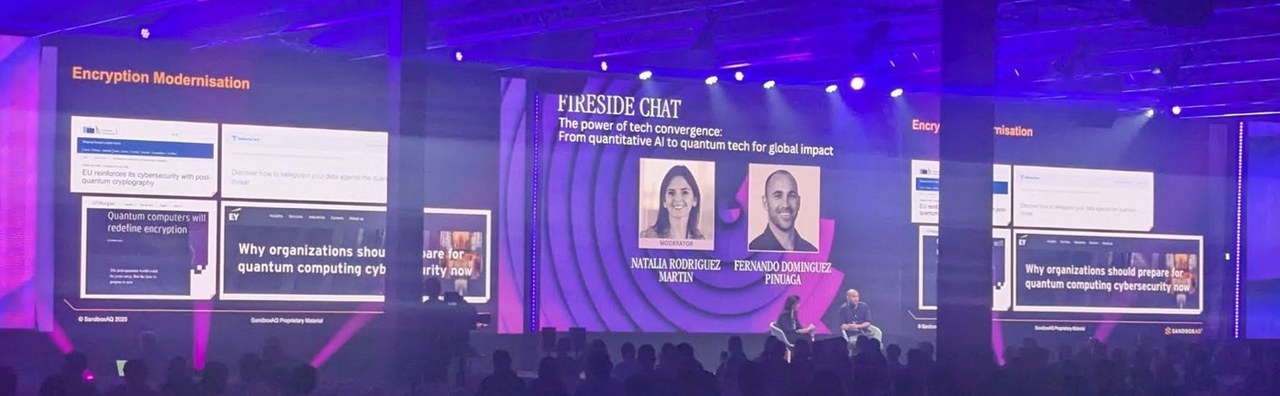
The fireside title in the middle, the “Encryption Modernisation” slides on either side.
My take: this was the most practical session I saw that day for infrastructure teams. Post-quantum migration is mostly an inventory problem: certificates, TLS endpoints, SSH keys and libraries spread across clusters. I covered the steps in Quantum-Safe Cryptography: Your Enterprise Migration.
Evening, 8 October: JetBrains on enterprise agents and EE-Bench
After day one I went to an evening session with JetBrains talks, in a bar with a “Buena Vista” neon sign. The first talk opened with “Fact 2: AI is overhyped. Developers know this.” and a large 95%, “of enterprise AI implementations fail to deliver meaningful results”.
I recorded part of this talk. The speaker noted that JetBrains isn’t venture-funded, so it has no reason to talk AI up. They also cited the Stack Overflow developer survey: only 29% of developers trust the accuracy of AI tools, which matches the 2025 survey results. The message for technical leads was to sit between two extremes. AI is disruptive and already useful for many industrial tasks, so you can’t be a Luddite. But you can’t be a hype chaser either. JetBrains put that middle ground into three principles. I caught two of them, control and transparency. Control meant experimenting with AI against clear benchmarks and trials before committing to it. The speaker said some companies are finding that after six to nine months of heavy “vibe coding” they’re left with uncontrolled systems and incidents in production.
The speaker then moved to JetBrains’ own slides: an “AI-native software development cloud platform” with an AI governance control panel, an agentic platform and ProductOps. Another slide announced “Claude Agent. Now in JetBrains IDEs”, with an agent picker showing both Junie by JetBrains and Claude Agent.
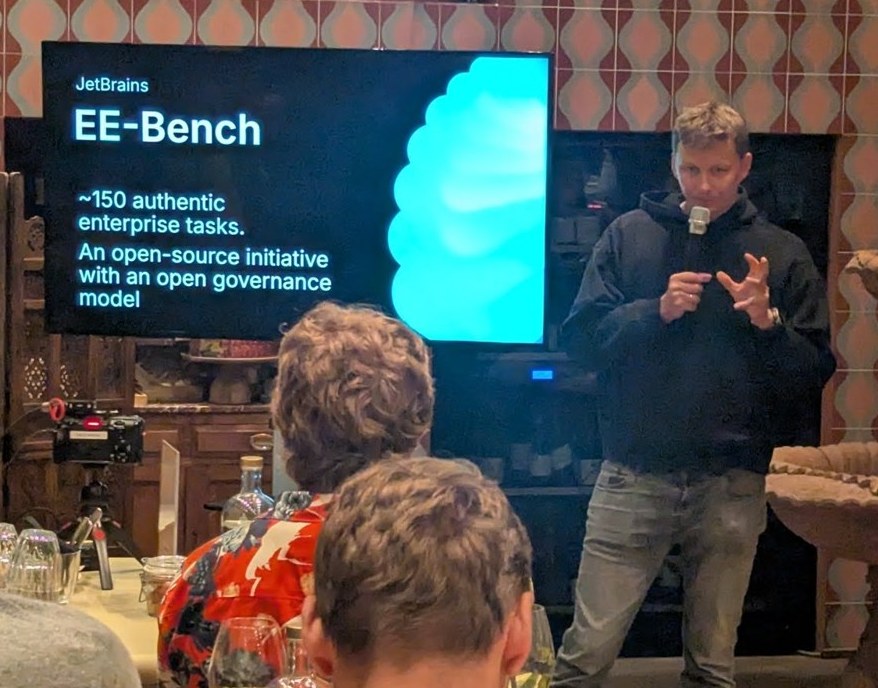
EE-Bench: a benchmark built from enterprise tasks, with open governance.
The slide I came away with was EE-Bench: “~150 authentic enterprise tasks. An open-source initiative with an open governance model.”
The second talk carried the Miro logo. It opened with Miro’s scale (“over 100 million users and 250,000 organizations” over “the past 15 years”) and the line “AI is shifting a paradigm how teams build new products. For most it is a transformation journey…”. It then described three stages. “Early adopters” run faster with AI, where “context is the king” and teams go from idea to prototype in three days. “Disruptors” build a “new system of orchestrating work”: team × agents collaboration, continuous agent-led prototyping, smaller teams and more agents. The arrow at the bottom read: “As agentic flows emerge, companies that intertwine human intelligence, artificial intelligence and data will innovate at least 3-5x faster.”
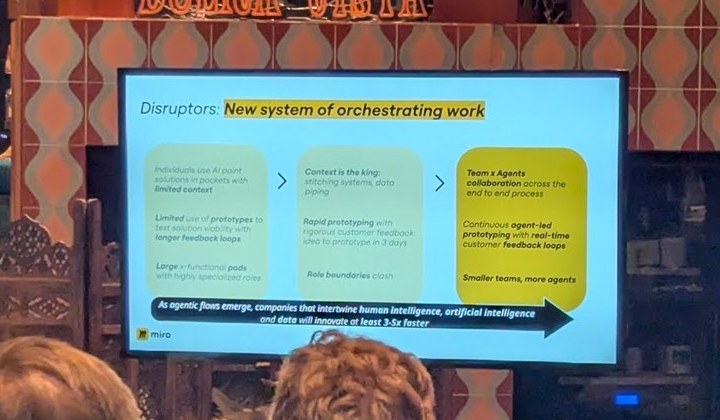
From individuals with AI point solutions to “smaller teams, more agents”.
Its “Opportunity / Solutions” slide named “limited value from agentic coding tools” as a problem and “A+ context for agentic coding tools” as the fix.
My take: the 95% slide, the “control” principle and the EE-Bench slide belong together. Most enterprise AI pilots fail on the boring parts, like their own repos, permissions and context, not on public leaderboards. A benchmark of real enterprise tasks under open governance is the right idea. I’ll judge it on whether teams can run it against their own code. That’s the same argument I made about what coding benchmarks actually measure.
Evening, 9 October: Fin × LangChain on building agentic AI
The second evening was “A Fireside on Building Agentic AI”, a Fin × LangChain event. The poster listed Fergal Reid, Chief AI Officer at Intercom, building Fin, and Marco Perini, Deployed Engineer at LangChain. The room was a small lounge with sofas, a camera on a tripod and the Fin × LangChain logo on the projector. A Fin booklet described the product as “The #1 AI Agent for customer service”. One slide pointed to fin.ai/research (“Follow our research blog”).
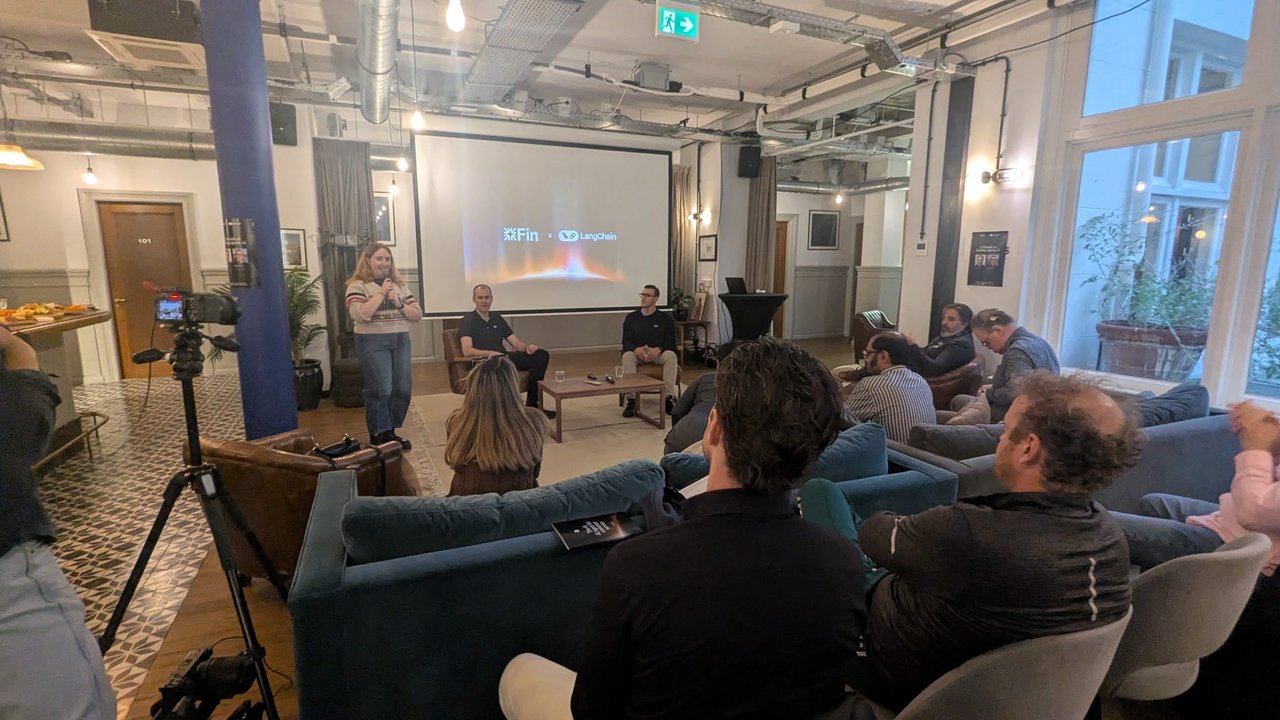
A Fireside on Building Agentic AI, with Fin and LangChain.
I don’t have a recording of this one, so I won’t paraphrase what was said. What stayed with me was the format: an AI-native product team sharing a sofa with the people who build the agent framework.
My take: customer-service agents are where agentic AI meets production constraints first: real users, real SLAs, real escalation paths. On the platform side, that needs the same things as any other critical workload: tracing, evaluation and safe rollouts. I described how I run that on Kubernetes in Agentic AI: Autonomous Workflows on Kubernetes.
Takeaways
World Summit AI 2025 was a big, polished production. The thread I followed across both days was physical rather than hype: trillions in data-centre capex, water-stressed regions, energy per token, encryption that has to be replaced, and enterprise tasks that agents still struggle with. The evening sessions were where the tools appeared: benchmarks, agent platforms and frameworks. That gap between the main stage and the side rooms is where platform teams work.
On day one I also recorded a short on-camera interview about AI and careers. One question was what every company should understand before starting with AI. My answer was data: the AI will only be as good as its input data, and most companies keep that data in silos (sales, engineering, HR) that don’t talk to each other. Before buying anything, I’d set one measurable goal, like cutting shipping costs by a fixed percentage in a logistics company, connect the data that goal needs, and keep a human as the gatekeeper of the system. Nothing I saw on the main stage changed my mind about that.