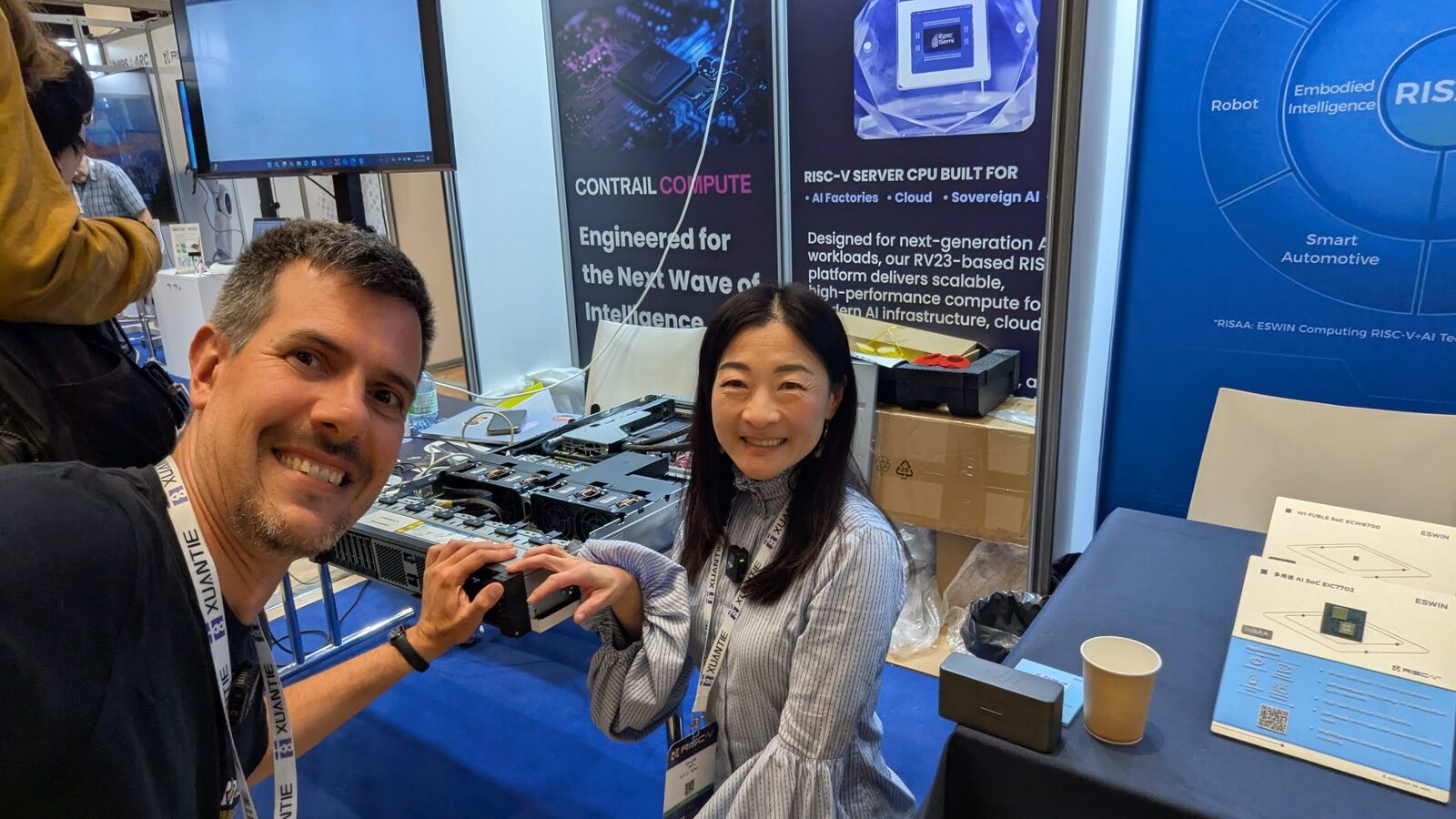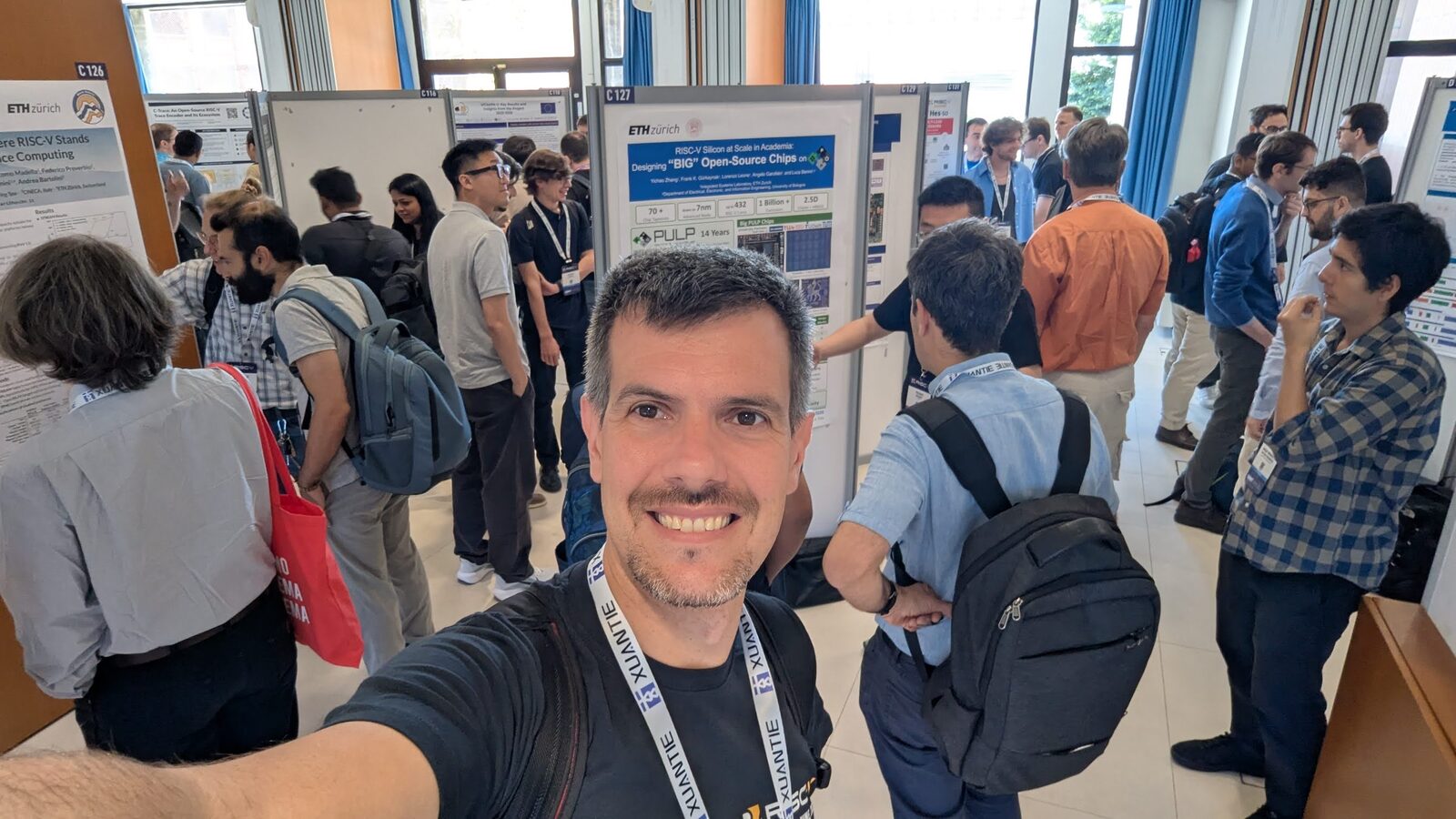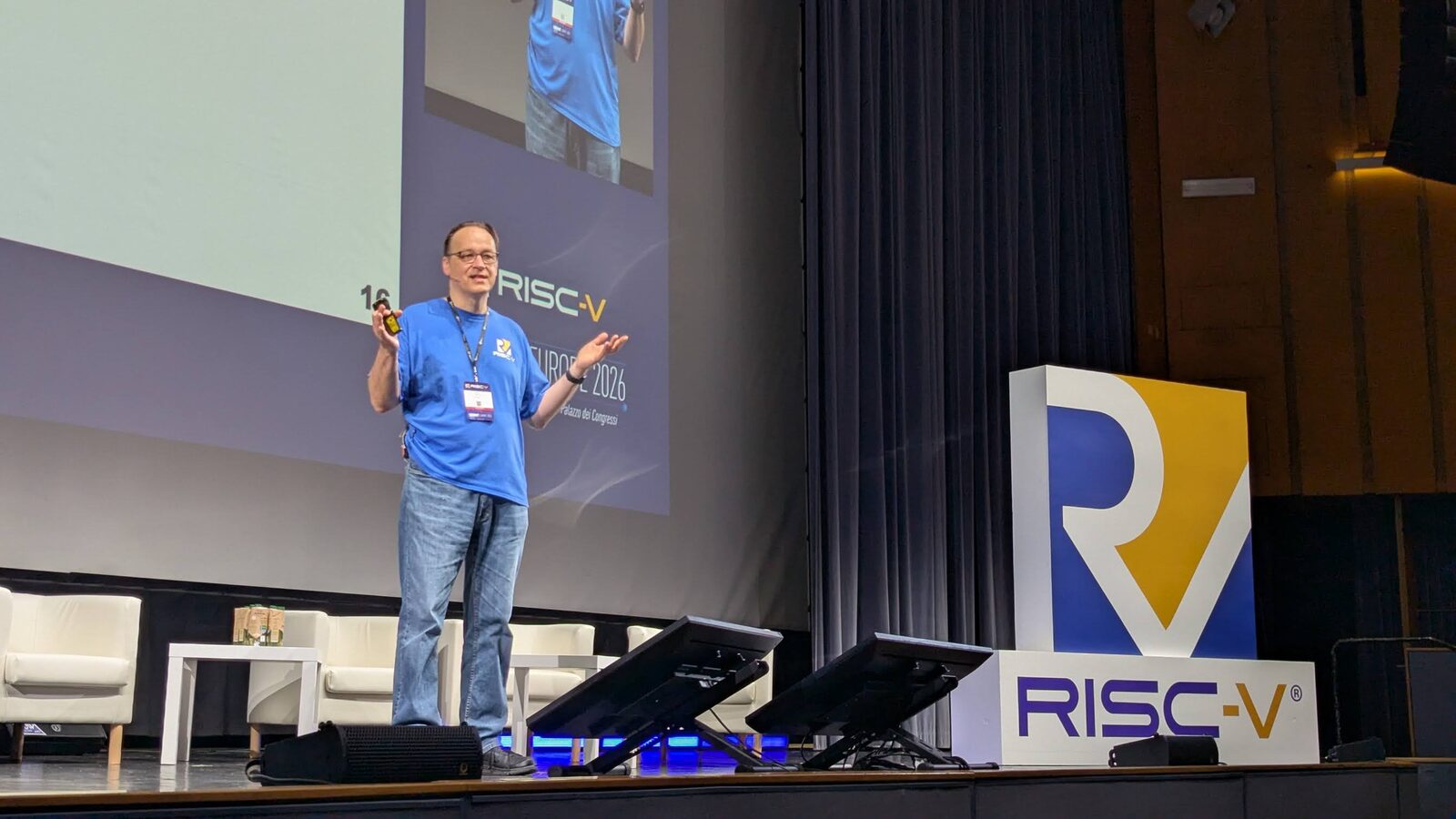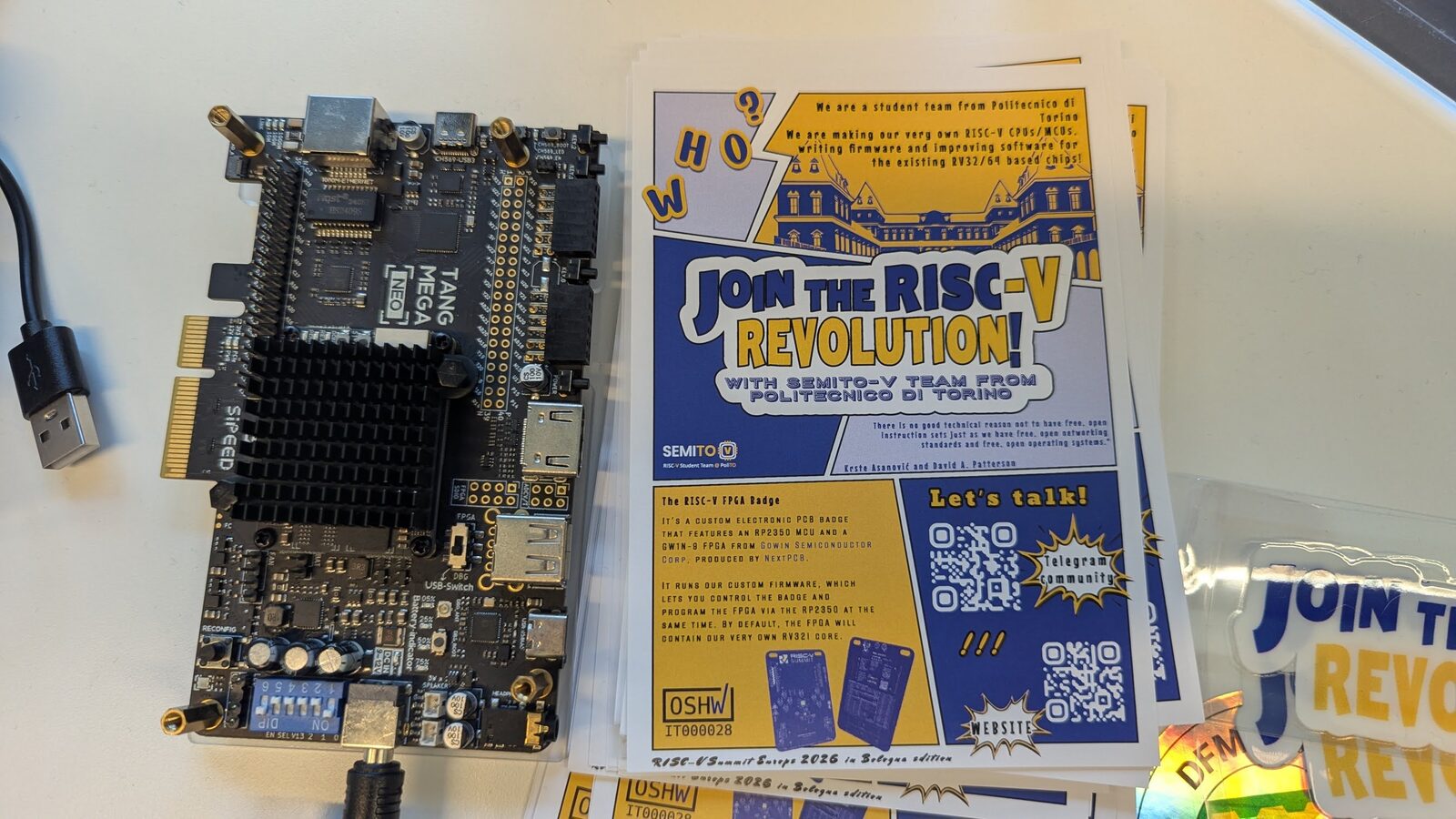

If you follow hardware news, you have probably seen the term RISC-V appear more and more often — in datacenter announcements, AI accelerators, automotive chips, and university research. At RISC-V Summit Europe 2026 in Bologna, the message was clear: the open-source silicon movement has gone mainstream. But what is RISC-V, exactly, and why does it matter?
This post is a plain-English introduction for developers, engineers, and curious technologists.
RISC-V Is an Instruction Set Architecture
At its core, RISC-V is an instruction set architecture (ISA) — the contract between hardware and software. The ISA defines the vocabulary a processor understands: the instructions it can execute (add, load, store, branch), the registers it has, and how memory and privilege levels work.
Every program you run, after compilation, becomes a stream of these instructions. The ISA is what lets a compiler turn C, Rust, or Go into something a chip can execute. ARM and x86 are the two ISAs that dominate phones and PCs respectively. RISC-V is the open alternative.
The crucial difference is openness. ARM and x86 are proprietary — you must license them (and pay royalties) to build a compatible chip. RISC-V is published as an open standard under royalty-free terms. Anyone — a student, a startup, a national lab, or a trillion-dollar company — can design a RISC-V processor without asking permission or paying a fee.
A Short History
RISC-V started in 2010 as a research project at the University of California, Berkeley, led by Krste Asanović and his students. The goal was a clean, modern ISA for teaching and research, free from the legal and technical baggage of older architectures.
It worked so well that it outgrew academia. In 2015 the RISC-V Foundation was formed to steward the standard; it later became RISC-V International, a non-profit now headquartered in Switzerland to keep the standard neutral and globally accessible. Today thousands of member organizations — from SiFive and Tenstorrent to Google, NVIDIA, and Alibaba — collaborate on the specification.
The “V” is simply the Roman numeral five: it is the fifth RISC design from Berkeley, building on decades of Reduced Instruction Set Computer research that traces back to the 1980s.
Modular by Design
What makes RISC-V genuinely different is its modular structure. Instead of one giant, monolithic ISA, RISC-V is a small mandatory base plus a menu of optional extensions.
The base integer ISAs come in a few flavors:
- RV32I — 32-bit base integer instructions
- RV64I — 64-bit base (the most common for Linux-capable systems)
- RV32E — a reduced base for tiny embedded cores
- RV128I — a forward-looking 128-bit base
On top of the base, you add only the extensions you need, each identified by a letter:
- M — integer multiplication and division
- A — atomic operations (for concurrency)
- F / D — single- and double-precision floating point
- C — compressed (16-bit) instructions for code density
- V — the vector extension, ratified as RVV 1.0, central to AI and HPC workloads
- B — bit-manipulation
- H — the hypervisor extension for virtualization
A common shorthand is RV64GC, where G (“general”) bundles IMAFD plus the Zicsr and Zifencei essentials, and C adds compressed instructions. That combination is what most general-purpose Linux RISC-V chips implement.
This modularity is a superpower for specialization. A microcontroller for a smart sensor might implement only RV32IMC, keeping the silicon tiny and power-frugal. A datacenter CPU implements RV64GC plus vectors, virtualization, and security extensions. Same ISA family, wildly different chips — and they all share a software ecosystem.
Profiles: Taming the Combinations
Modularity is powerful, but unchecked it creates fragmentation: if every vendor picks a different mix of extensions, software portability suffers. RISC-V solves this with profiles — standardized bundles of extensions that operating systems and toolchains can target.
The application processor profiles — RVA20, RVA22, and especially RVA23 (ratified in 2024) — define exactly what a chip must implement to run a portable OS like Linux. RVA23 made the vector and hypervisor extensions mandatory, which is a big deal: it means a single Linux binary can run across compliant RISC-V application processors without per-chip rebuilds. There are parallel profiles for embedded and bare-metal use as well.
Profiles are how RISC-V keeps the freedom of modularity while still delivering the “write once, run anywhere” experience software developers expect.
Privilege Levels and Security
RISC-V defines clean privilege levels: Machine (M), Supervisor (S), and User (U) mode. M-mode is the most privileged (firmware, SBI), S-mode runs the OS kernel, and U-mode runs applications. The hypervisor (H) extension adds virtualization on top, enabling cloud and confidential-computing use cases that were a recurring theme at the Summit.
Because the ISA is open, the security community can audit it directly — there is no proprietary black box. This transparency is a key argument for RISC-V in sovereignty-sensitive applications, a topic I explore in RISC-V and European Digital Sovereignty.
Why Openness Changes the Game
The open model unlocks things proprietary ISAs cannot:
- No licensing fees or gatekeepers — startups and universities can build real silicon. The One Student One Chip program takes students all the way to tape-out precisely because the ISA is free.
- Customization — add your own instructions for AI, DSP, or cryptography without breaking compatibility.
- Supply-chain resilience and sovereignty — nations and companies can build chips without dependence on a single foreign vendor.
- A shared software ecosystem — Linux, GCC, LLVM, QEMU, Debian, Fedora, and openEuler all support RISC-V upstream.
Where RISC-V Already Is
RISC-V is not a future promise — it ships today. It is in billions of embedded cores (Espressif’s ESP32-C series, storage controllers, power-management units), in single-board computers you can buy now, in cloud servers and HPC clusters, and in AI accelerators from companies like Tenstorrent.
Getting Started
The best part: you do not need hardware to start. You can emulate a full RISC-V Linux system on your laptop with QEMU — I walk through it step by step in Getting Started with RISC-V on QEMU. When you are ready for real silicon, see my RISC-V development boards guide for 2026.
The Bottom Line
RISC-V is an open, modular, royalty-free instruction set architecture — the “Linux of hardware.” It is not a single chip or a single company; it is a shared foundation that anyone can build on. That openness is why, fifteen years after a Berkeley research project, RISC-V has become one of the most important stories in computing.
Want the full picture from the show floor? Read my RISC-V Summit Europe 2026 highlights and the deep dive on open hardware meeting AI.