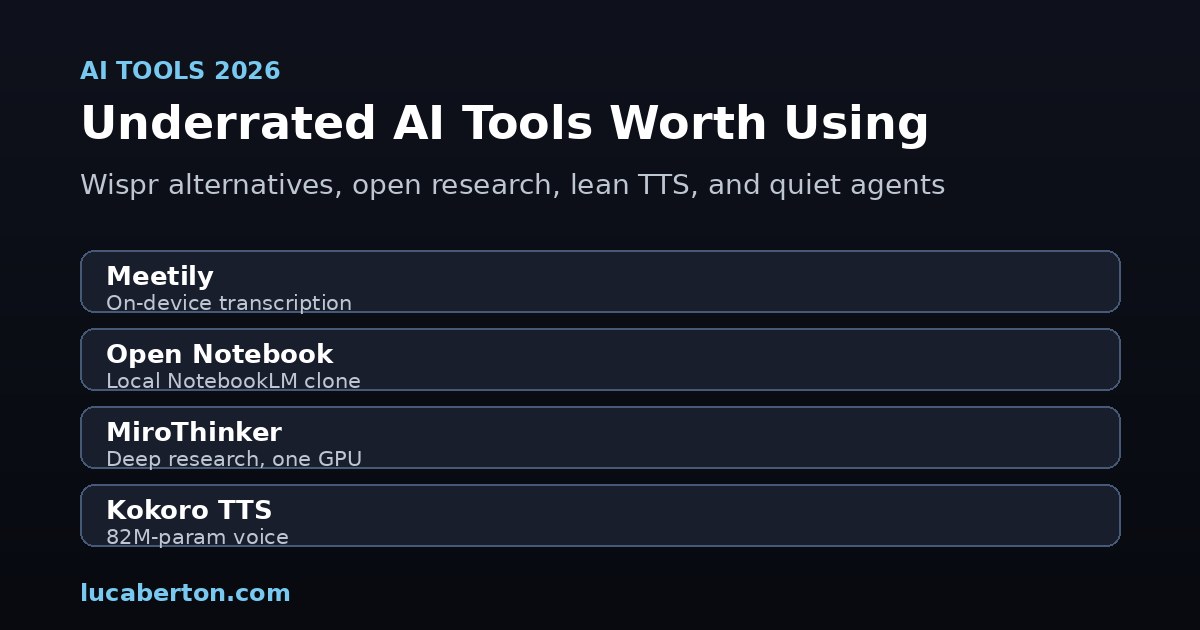
Not every tool needs a thousand followers to be brilliant. Some of the best products in 2026 are quietly outpacing the hype, quietly replacing workflows that cost ten times more, and quietly running on hardware that was supposed to be obsolete by now.
This is a collection of those tools — the ones that earn a spot in my daily stack not because of a press release, but because they keep shipping.
Meetily: Whisper-Level Transcription, Zero Cloud Required
If Wispr Flow is the polished commercial option, Meetily is the one that runs entirely on your device. It records, transcribes, and summarizes meetings with everything processed locally — audio and data never leave the machine.
That matters more than most product pages admit. A week of client calls, an investor update, a design critique — none of it needs to touch a server. It is GDPR- and HIPAA-ready by construction, and the open-source core means you can audit what it does.
It works with Zoom, Teams, and Meet over a desktop capture layer, and the same engine handles a 10-minute huddle or a recorded 90-minute workshop. The output is a clean transcript plus a generated summary, speaker-attributed and trimmed of filler. When transcription is something you pay for per seat, that changes the math fast.
Try it at meetily.ai.
Open Notebook: NotebookLM Without the Google Account
Most NotebookLM alternatives either require a Google sign-in or run everything through an LLM vendor’s API. Open Notebook is the one that does neither.
It is an open-source, privacy-respecting platform built for people who want AI-assisted note-taking and research without surrendering their data. You upload a PDF, a video, an audio file, or a folder of web pages, and it ingests them locally. The AI layer is pluggable — bring your own keys or run a local model, and the notes stay on your machine.
That is the entire thesis: NotebookLM’s strength is synthesis, Open Notebook’s strength is keeping the source material where you left it. For anyone whose notes touch client work, internal strategy, or anything they would not post to a shared drive, that difference is the whole reason to switch.
Try it at open-notebook.ai.
MiroThinker: A Deep-Research Agent That Ships Open Source
If you have been reading the deep-research agent space, MiroThinker has been quietly climbing benchmark leaderboards. The latest iteration, MiroThinker-1.7, hits 74.0 on BrowseComp and 75.3 on BrowseComp Zh — and the whole stack is open source.
Where the category has trended toward closed APIs and per-call pricing, MiroThinker goes the other direction. It is a search-centric agent that forms hypotheses, retrieves evidence, and iterates in real time. The accompanying MiroFlow framework is designed to run on a single RTX 4090, which puts real deep research within reach of a developer’s desktop rather than an enterprise credit line.
The GitHub repo is actively maintained, the paper is on arXiv, and the demo is a click away. For anyone building agents that need to go deeper than a web search, it is the most complete open offering at the moment.
Try the demo at dr.miromind.ai, read the repo.
Kokoro TTS: 82 Million Parameters, Studio Results
Kokoro is a text-to-speech model with 82 million parameters — small enough to run locally, good enough to sound like a professional read. It is built on the StyleTTS 2 architecture, supports multiple languages, and ships with a catalog of voice packs including American and British English, French, Korean, Japanese, and Mandarin.
The irony is that the smallest model in the category often sounds the most natural. Where other projects reach for parameter counts in the billions, Kokoro stays lean and still outpaces older, heavier options on clarity and speed. Real-time generation on an NVIDIA GPU, an OpenAI-compatible endpoint, and a permissive Apache 2.0 license make it easy to drop into a pipeline.
For podcasts, training materials, or any application where a stock voice reads like a stock voice, Kokoro is the gap that has been missing.
Try the demo at kokorottsai.com, read the repo.
Krea: Image Generation Without the Ceremony
Krea has quietly become the most useful image tool in my daily flow. Where other platforms bury you in model pickers and parameter sliders, Krea gives you a single, fast surface: type a prompt, get a result, iterate without ceremony.
It also hosts the Krea Agent, a template-driven workflow layer that can turn a single photo into a product shoot, a sketch into a 3D render, or a loose brief into a branded asset set. The templates do the heavy lifting of prompt engineering, and the results stay editable — you are composing, not just consuming.
For concept work, moodboarding, and anything that sits between “I have a vague idea” and “I need a final asset,” it is the tool I reach for first.
Try it at krea.ai.
Fish Audio: ElevenLabs Without the Price Tag
Fish Audio’s core claim is simple and verifiable: the same quality voices as ElevenLabs, at roughly 70% lower cost. The comparison table on their site breaks it down — pay-as-you-go pricing at four cents per 1,000 characters, sub-300-millisecond streaming latency, 83 languages, and 60+ emotion tags.
What makes it worth a look is the migration path. If your pipeline already uses an ElevenLabs voice, you can drop a 10-second sample into Fish Audio, get a production-ready voice in seconds, and swap one API endpoint. The workflow does not change — only the bill does.
They raised a $52 million seed round last year and have been iterating fast on the developer experience since.
Read more at fish.audio.
CrewAI: Multi-Agent Automation That Actually Scales
CrewAI is the open-source framework that turns “agent” from a demo trick into a production pattern. You define agents with roles and tools, chain them into crews that collaborate autonomously, and orchestrate the whole thing through event-driven flows with guardrails and observability built in.
It is the framework I point teams at when they need more than a single prompt and less than a platform. The abstractions stay out of the way — Pydantic models for structured output, native support for 700,000+ workflow patterns learned from the community, and a control plane that surfaces every interaction.
For anyone building automation that runs unattended, CrewAI is the closest thing to a standard.
Read the docs at crewai.com.
Granola: Note-Taking Without the Hype
Granola looks like every other AI note-taking app until you use it past the first week. It does not try to be a second brain or a canvas or a workspace — it records what you say, tags it, and makes it findable. The AI summarizer is good, but the real value is in the reliability: it works the same way in a 10-minute call and a multi-hour workshop.
That is the bar the category should hold itself to, and Granola is one of the few that clears it.
Try it at granola.so.
Why These Tools Matter
The pattern in this list is not accidental. Each tool solves a real job — transcription, note-taking, research, voice, image generation, agent automation — and each does it without the surrounding platform, the mandatory signup, the paywall, or the cloud dependency that turns a utility into a service you have to negotiate with every month.
The best ones also tend to be the quietest. They ship updates, fix bugs, and integrate with the tools you already use. They do not run conference keynotes or seed-round announcements.
Choosing What Fits
Pick one from each category and build a week around it:
- Transcription: Meetily if privacy matters, Granola if convenience does.
- Research: MiroThinker for deep, local research; Open Notebook when your source material cannot leave your machine.
- Voice: Kokoro TTS for a self-hostable model; Fish Audio when you need 83-language coverage and predictable pricing.
- Image: Krea when you need speed and editable results.
- Agents: CrewAI when you need multi-agent automation that holds up in production.
None of these is a novelty. Each one is a tool that earned its place in the stack, quietly, by doing the work it promised to do.
Related Articles
- GPT-5-mini with GitHub Copilot Pro: Free SOTA Models for Your Agent
- Soup: Fine-Tune an 8B Model on a 4 GB GPU
- Google’s AI Evolution: Maps, Photos, Chrome, and Project Genie
- The Inference Economy: How Venture Is Betting on the Agentic Era
Sources
- Meetily — Privacy-first AI meeting assistant
- Open Notebook — open-source NotebookLM alternative
- MiroThinker — deep research agent
- Kokoro TTS — 82M parameter text-to-speech
- Krea — AI image generation and agents
- Fish Audio — ElevenLabs alternative
- CrewAI — multi-agent orchestration framework
- Granola — AI note-taking app