tox-ansible is a tox plugin that turns one Ansible collection into a test matrix: sanity, unit and (when present) integration and Molecule tests, each run against several ansible-core and Python combinations in its own virtual environment. You run the same environments on your laptop and in CI, and the plugin can print that list as a GitHub Actions matrix, so your workflow file stops hard-coding versions. This tutorial builds the setup from a fresh collection skeleton, runs it, and covers the failures I hit along the way.
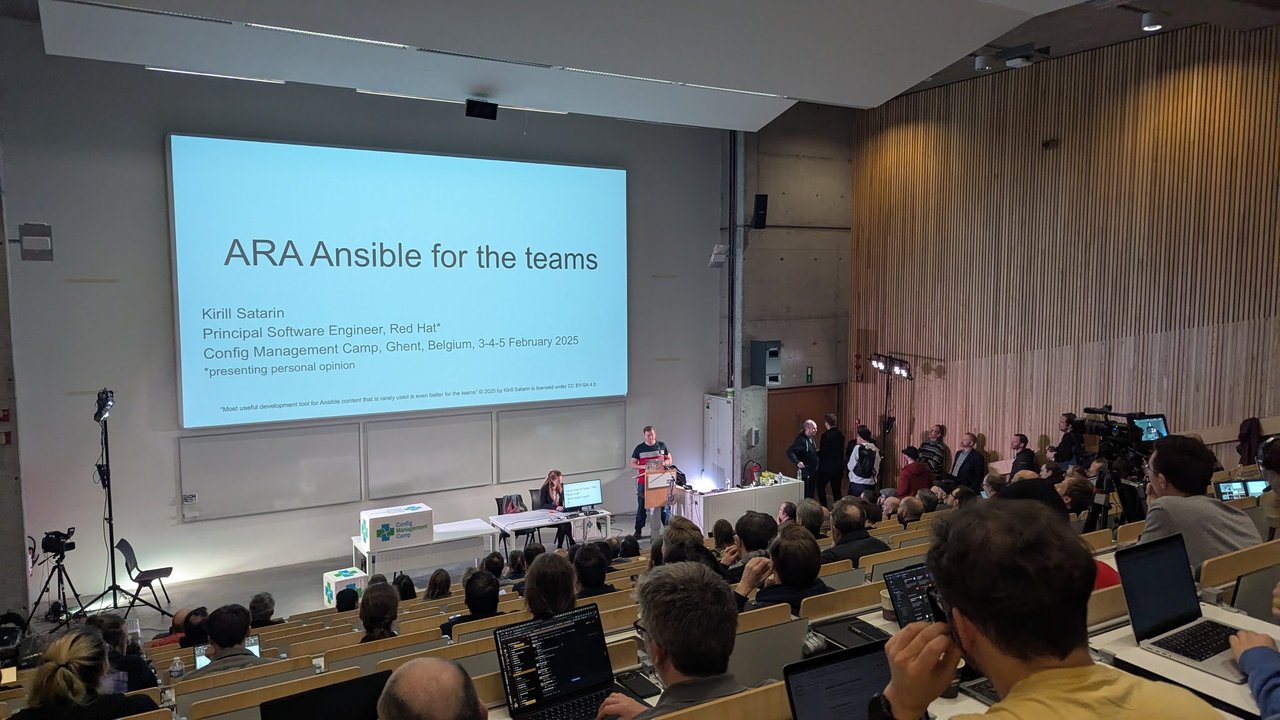
The tox-ansible talk at CfgMgmtCamp 2025 in Ghent got me thinking about this. Under the heading “Taking CI/CD testing to the next level (Option 3)”, the speaker made the point that tox-ansible isn’t only for local testing: it can generate the GitHub test matrix jobs too, so you control the matrix locally and no longer edit workflows for each new Ansible or Python release. I summarised the talk in my CfgMgmtCamp 2025 talks recap. This post is the hands-on version.
Versions: everything below was run with tox-ansible 26.9.0 (September 2026), tox 4.64.7, ansible-dev-environment 26.9.0 and ansible-core 2.21.4, and checked against the tox-ansible README, its documentation and the ansible-test sanity docs. tox-ansible uses CalVer (YY.MM.MICRO), and the matrix changes between releases, so check yours with tox list --ansible.
What tox-ansible does
For every environment, tox-ansible creates a virtualenv under .tox/, then uses ansible-dev-environment (ade install) to install the requested ansible-core, build and install your collection into that venv’s site-packages/ansible_collections/, and pull in the collection’s Python dependencies. Then it runs the test command for that environment type:
| Environment | Command it runs |
|---|---|
sanity-* | ansible-test sanity --local --requirements --python X.Y inside the installed collection |
unit-* | pytest (with pytest-ansible) on tests/unit |
integration-* | pytest (with pytest-ansible) on tests/integration |
molecule-* | python3 -m molecule test --all |
galaxy | builds the collection and runs galaxy-importer on it |
Environment names follow type-pyX.Y-core, for example sanity-py3.13-2.21. The core factor is a stable branch (2.19, 2.20, 2.21) or milestone or devel.
One thing surprised me. The matrix isn’t derived from your collection’s metadata. It’s a list built into the plugin that tracks the ansible-core support matrix. In 26.9.0 it covers Python 3.11 to 3.14 and ansible-core 2.19, 2.20, 2.21, milestone and devel, with Python 3.14 only from 2.20 onwards. galaxy.yml only supplies the namespace and name. I set requires_ansible: ">=2.21.0" in meta/runtime.yml and the 2.19 environments were still listed. If your collection doesn’t support a version, you remove it with skip.
Integration and Molecule environments are detected automatically. integration-* only appears if tests/integration/targets/ isn’t empty or tests/integration/ contains pytest modules. molecule-* only appears if extensions/molecule/ has at least one scenario with a molecule.yml.
Install tox-ansible in a virtual environment
python3 -m venv .venv
source .venv/bin/activate
pip install "tox-ansible==26.9.0"
This pulls in tox, pytest, pytest-xdist and pytest-ansible. Each test environment installs ansible-dev-environment itself. tox-ansible needs Python 3.10 or newer to run, and every interpreter in your matrix must already be installed on the machine (the README’s example is sudo dnf install python3.10).
For a throwaway lab I created a skeleton collection:
pip install ansible-core
ansible-galaxy collection init demo.toxlab
cd demo/toxlab
Then I added a small module in plugins/modules/hello.py (with DOCUMENTATION, EXAMPLES and RETURN), a pytest file in tests/unit/plugins/modules/test_hello.py that imports it via ansible_collections.demo.toxlab.plugins.modules.hello, and requires_ansible in meta/runtime.yml.
Configure tox-ansible: pyproject.toml or tox-ansible.ini
The docs recommend a [tool.tox-ansible] table in pyproject.toml. tox also needs a [tool.tox] table so it picks that file as its configuration:
# pyproject.toml
[tool.tox]
requires = ["tox>=4.2"]

[tool.tox-ansible]
skip = ["py3.11", "devel", "milestone"]
The legacy alternative is an [ansible] section in a separate tox-ansible.ini, which you then pass with --conf on every command. A separate file is useful when the repo already has a tox.ini for other things:
# tox-ansible.ini
[ansible]
skip =
    py3.11
    devel
    milestone
What the keys do:
skip: a plain substring match against environment names.develdrops every devel environment,sanity-py3.13drops sanity on Python 3.13 only, andgalaxydrops the galaxy environment. It’s not a glob or a regex.downstream = true: adds the ansible-core versions supported by Red Hat Ansible Automation Platform that the community has already retired (2.16 and 2.18 in 26.9.0) on top of the upstream list. It extends the matrix; it doesn’t replace it.coverage = true: adds pytest-cov coverage for files underplugins/in theunit-*environments.--coverageand--no-coverageoverride it for one run.molecule:auto(default),trueorfalse, plusmolecule_appendormolecule_commandsto change the Molecule command.
If both files have tox-ansible settings, pyproject.toml wins for the whole section. Don’t put the config in a plain tox.ini with no pyproject.toml config: the plugin warns that this can override its generated environment settings.
List and run the tox-ansible environments
With the tox-ansible.ini above, listing gives:
tox list --ansible --conf tox-ansible.inidefault environments:
galaxy -> Build collection and run galaxy-importer on it
sanity-py3.12-2.19 -> Sanity tests using ansible-core 2.19 and python 3.12
sanity-py3.12-2.20 -> Sanity tests using ansible-core 2.20 and python 3.12
...
sanity-py3.14-2.21 -> Sanity tests using ansible-core 2.21 and python 3.14
unit-py3.12-2.19 -> Unit tests using ansible-core 2.19 and python 3.12
...
unit-py3.14-2.21 -> Unit tests using ansible-core 2.21 and python 3.14That’s 17 environments: galaxy plus 8 sanity and 8 unit. Without the skip list it was 27. There are no integration or Molecule environments because the skeleton has neither.
Running them:
# one environment
tox -e sanity-py3.13-2.21 --ansible --conf tox-ansible.ini

# several
tox -e sanity-py3.13-2.21,unit-py3.13-2.21 --ansible --conf tox-ansible.ini

# every unit environment, in parallel
tox -f unit --ansible --conf tox-ansible.ini -p auto

# only one test type, using the plugin's own scope option
tox --ansible --conf tox-ansible.ini --matrix-scope sanity

# show the generated commands, deps and env vars
tox config --ansible --conf tox-ansible.ini -e unit-py3.13-2.21
Anything after -- goes to the underlying tool. For sanity that’s ansible-test, so you can run one sanity test while iterating:
tox -e sanity-py3.13-2.21 --ansible --conf tox-ansible.ini -- --test validate-modulesFor unit and integration it’s pytest, for example -- --junit-xml=tests/output/junit/unit.xml.
Environments stay in .tox/ after a run, so you can activate one and debug. ansible-test needs the collection under an ansible_collections/NAMESPACE/NAME path, which is why tox-ansible runs the sanity command inside the installed copy in .tox/ENV/lib/pythonX.Y/site-packages/ansible_collections/, not in your working tree.
My first sanity run on the fresh skeleton failed, which is a useful example of what sanity catches:
ERROR: Found 1 yamllint issue(s) which need to be resolved:
ERROR: galaxy.yml:70:1: empty-lines: too many blank lines (1 > 0)
FATAL: The 1 sanity test(s) listed below (out of 24) failed.
yamllint
The galaxy.yml that ansible-galaxy collection init generated (ansible-core 2.21.4) ends with a blank line, and the yamllint sanity test rejects it. After removing it, both the sanity and unit environments passed.
Generate a GitHub Actions matrix with —gh-matrix
--gh-matrix (it requires --ansible) prints the environment list as JSON instead of running anything:
tox --ansible --conf tox-ansible.ini --gh-matrix --matrix-scope sanity[
{
"description": "Sanity tests using ansible-core 2.19 and python 3.12",
"factors": ["sanity", "py3.12", "2.19"],
"name": "sanity-py3.12-2.19",
"python": "3.12"
}
]When GITHUB_OUTPUT is set, as it is in a GitHub Actions step, the plugin writes the list to that file under the key envlist instead of printing it. A two-job workflow then builds the matrix in the first job and fans out in the second:
# .github/workflows/tox-ansible.yml
name: tox-ansible
on:
  pull_request:
  push:
    branches: [main]

jobs:
  matrix:
    runs-on: ubuntu-latest
    outputs:
      envlist: ${{ steps.generate.outputs.envlist }}
    steps:
      - uses: actions/checkout@v7
      - uses: actions/setup-python@v7
        with:
          python-version: "3.14"
      - run: python -m pip install "tox-ansible==26.9.0"
      - id: generate
        run: python -m tox --ansible --gh-matrix --conf tox-ansible.ini

  test:
    needs: matrix
    name: ${{ matrix.entry.name }}
    runs-on: ubuntu-latest
    strategy:
      fail-fast: false
      matrix:
        entry: ${{ fromJSON(needs.matrix.outputs.envlist) }}
    steps:
      - uses: actions/checkout@v7
      - uses: actions/setup-python@v7
        with:
          python-version: ${{ matrix.entry.python }}
      - run: python -m pip install "tox-ansible==26.9.0"
      - name: Run ${{ matrix.entry.name }}
        env:
          TOX_ENV: ${{ matrix.entry.name }}
          GITHUB_TOKEN: ${{ secrets.GITHUB_TOKEN }}
        run: python -m tox --ansible --conf tox-ansible.ini -e "$TOX_ENV"
The parts that matter:
id: generateandoutputs.envlist: the plugin appendsenvlist=...to$GITHUB_OUTPUT, and the job output re-exports it.fromJSON(...)turns that string back into a list, so each entry becomes one job.matrix.entry.nameis the tox environment andmatrix.entry.pythonis the interpreter setup-python installs for it.fail-fast: falsekeeps one failing combination from cancelling the others, which is the whole point of a matrix.TOX_ENVpasses the name through an environment variable instead of interpolating it into the shell line.GITHUB_TOKENis in the plugin’spass_envlist, so it reaches the test environment if a step needs it.
You can split sanity and unit into separate workflows with --matrix-scope. If you’d rather not maintain this file, the ansible/ansible-content-actions repository publishes reusable sanity.yaml, unit.yaml and integration.yaml workflows that run the same tox --ansible --gh-matrix --matrix-scope ... steps.
tox-ansible vs ansible-test vs Molecule
They don’t compete. tox-ansible is the orchestrator:
- ansible-test is ansible-core’s own testing tool. tox-ansible calls
ansible-test sanityfor sanity, but runs unit and integration tests with pytest and pytest-ansible, notansible-test unitsoransible-test integration. If your CI calls ansible-test directly, as in the pipeline in my Ansible collections post, you pick the versions yourself, usually with--docker. - Molecule tests roles and playbooks against real instances or containers. tox-ansible runs your Molecule scenarios across the same Python and ansible-core matrix. For Molecule itself, see testing Ansible with Molecule and GitHub Actions.
- tox-ansible owns the matrix, the per-environment virtualenvs and the GitHub Actions JSON.
Common tox-ansible failures
could not find python interpreter matching any of the specs py3.11: that interpreter isn’t installed. Install it, or addpy3.11toskip. In CI the matching setup-python step handles this.The --gh-matrix option requires --ansible: add--ansible. Every tox-ansible command needs it.- yamllint failures in
galaxy.yml: see the blank line above. Run-- --test yamllintto iterate on that one test. galaxy.ymlmodified after a unit run: unit and integration environments install the collection in editable mode, and ade then adds.venv,collectionsand.toxtobuild_ignore. With ade 26.9.0 and the skeleton’sbuild_ignore: [], it appended list items under the inline empty list and left invalid YAML, so the next run failed with ayaml.parser.ParserError. Writingbuild_ignore:as a block list (one- entryper line) avoids it. Commit the entries ade adds.git config --global init.defaultBranch main: the sanity environments run this beforegit initinside the installed collection. It writes to your global Git config. On a shared machine, setGIT_CONFIG_GLOBALto a throwaway file when you run tox.- No
integration-*environments: there are no targets intests/integration/targets/and no pytest modules intests/integration/. That’s expected. - The matrix changed after an upgrade: new tox-ansible releases add new ansible-core and Python versions and drop old ones. That’s the feature, but it can turn CI red on a day you didn’t touch your collection.
My take: pin tox-ansible in CI and bump it in a pull request of its own, so a new ansible-core showing up in your matrix is a reviewed change, not a surprise on an unrelated PR. Combine that with a short skip list of the versions you’ve decided not to support.