
From RAG to strategic systems that don’t just talk — they operate.
A few years ago, “AI” in most people’s minds meant a chatbot: you typed a question, it typed back an answer. Useful, sure. But also limited — like a brilliant intern locked in a room with no internet, no company handbook, and no permission to do anything besides write.
That era is ending.
Today’s most interesting AI systems don’t just respond. They retrieve, interpret, act, and increasingly, choose their actions with long-term goals in mind. If you’ve been hearing terms like RAG, agentic AI, contextual AI, and strategic AI tossed around like everyone already knows what they mean — here’s the guide to what’s actually going on, and why it matters.
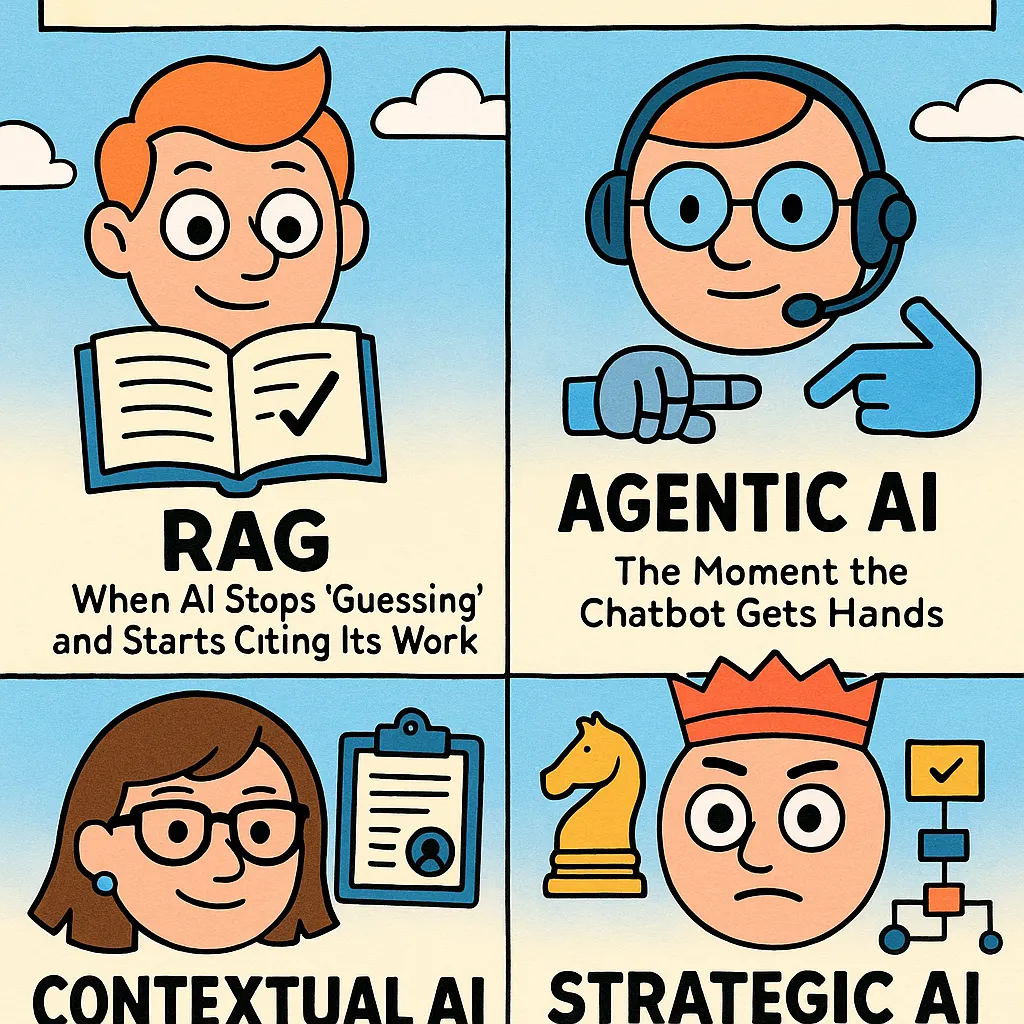
RAG: When AI Stops “Guessing” and Starts Citing Its Work
Let’s start with the most practical upgrade: RAG, short for Retrieval-Augmented Generation.
A language model is a pattern machine. It’s great at writing. It’s great at sounding confident. But ask it about the latest policy update buried in your company wiki, or the one clause in a contract template that changed last month, and it may do what humans do under pressure: improvise.
RAG fixes that by giving the model access to your information at the moment it answers. Instead of replying from memory alone, it searches relevant documents — knowledge bases, PDFs, ticket histories, product specs — and then generates a response based on what it finds.
Think of it like this:
A normal chatbot is a talented speaker. A RAG system is a talented speaker who brings receipts.
The difference isn’t subtle in the real world. Customer support becomes less “creative writing” and more “accurate guidance.” Internal tools stop acting like fortune tellers and start acting like librarians with a sense of humor.
But RAG has a catch: retrieval is only as good as what it can find. If your documents are outdated, poorly organized, or written in a way no one can search, your AI will still struggle — just more politely.
Agentic AI: The Moment the Chatbot Gets Hands
Now imagine your AI can do more than talk. Imagine it can click, call, file, schedule, and execute. That’s where agentic AI comes in.
“Agentic” doesn’t mean sentient. It doesn’t mean free will. It means something simpler — and more powerful:
The system can take actions in the world using tools.
Instead of answering, “You should reset your password,” an agentic system might:
- Check your account status
- Generate a reset link
- Confirm it’s delivered
- Log the action in the support ticket
- Ask whether you want to enable multi-factor authentication while it’s there
This is the shift from AI as a writer to AI as an operator.
It’s also where things get spicy — because action introduces risk. A model that makes a factual mistake is annoying. A model that takes the wrong action is expensive. The best agentic systems are designed with seatbelts: permissions, confirmation steps, audit trails, and strict rules about what tools can do.
Contextual AI: The Difference Between “Smart” and “Useful”
Here’s a truth that product teams learn quickly: even accurate AI can feel dumb if it doesn’t understand the situation.
That’s what people mean by contextual AI — systems that respond based on the user’s actual context: who they are, what they’re doing, what they’ve already done, what tools they have access to, what policies apply, and what constraints matter right now.
Context can be:
- Your role (“finance” vs. “sales”)
- Your permissions (what you’re allowed to see or change)
- Your history (preferences, past decisions, current projects)
- Your environment (time, location, language, device)
- Your task (“draft an email” vs. “resolve a billing dispute under policy”)
Contextual AI is what makes the assistant feel less like a generic search box and more like a colleague who’s been in the meeting.
But context is also a trap. Too little context, and you get bland answers. Too much context, and the system gets distracted, confused, or slow. The art isn’t collecting every detail — it’s choosing the right details at the right moment.
Strategic AI: When the System Plays the Long Game
If RAG is about evidence, and agentic AI is about action, and contextual AI is about situational awareness — then strategic AI is about something bigger: making decisions over time.
Strategic AI is designed to optimize for outcomes, not just produce a good paragraph or complete a single task. It weighs trade-offs. It plans. It checks progress. It changes course when reality changes.
For example, consider an AI system helping a company reduce customer churn:
| Basic Bot | Agent | Strategic System |
|---|---|---|
| Answer questions | Open tickets, issue refunds | Identify churn risk signals |
| Prioritize which customers get proactive outreach | ||
| Choose interventions based on cost and likely impact | ||
| Escalate high-risk cases to humans early | ||
| Measure what worked | ||
| Adjust the playbook month by month |
That’s not just “automation.” That’s management logic — encoded into a system that can move through time with intention.
Strategic AI is also where governance matters most: objectives, safety boundaries, compliance rules, and “when do we stop and ask a human?” become first-class design decisions.
Putting It Together: The AI Stack That Actually Works
In practice, these four ideas often show up together, like parts of a single machine:
| Component | Function |
|---|---|
| RAG | Supplies trustworthy information |
| Context | Makes that information relevant |
| Agentic tools | Turn answers into outcomes |
| Strategy | Turns outcomes into sustained results |
Or, in one line:
RAG helps AI know. Context helps it understand. Agents help it do. Strategy helps it choose.
The Real Story: This Isn’t a Model Upgrade — It’s a Systems Upgrade
Here’s the part that rarely makes the headline: the future of AI isn’t just bigger models. It’s better systems around models.
The winners won’t be the teams who can generate the most impressive demos. They’ll be the teams who can:
- Retrieve the right information consistently
- Operate safely with tools and permissions
- Evaluate success end-to-end
- Build long-horizon feedback loops that improve over time
Because once AI can retrieve, act, and plan, the question changes from “Can it answer?” to:
“Can we trust it to operate?”
And that’s the question that will define the next decade.