
“Will RISC-V replace ARM and x86?” is the question I get most often after talking about open silicon. It is also the wrong question. The three architectures are not in a winner-take-all race — they occupy overlapping but distinct positions. This post compares RISC-V, ARM, and x86 across the dimensions that actually matter when you are choosing a platform in 2026.
If you are new to RISC-V, start with What Is RISC-V? for the fundamentals.
The Licensing Model: The Real Difference
The headline difference is not technical — it is legal and economic.
- x86 is effectively a duopoly. Only Intel and AMD can produce x86 CPUs, thanks to decades of cross-licensing and patents. You cannot license x86 to build your own chip.
- ARM licenses its ISA and its core designs. You pay an upfront license fee plus per-unit royalties. ARM controls who gets access and on what terms — as recent industry disputes have shown, that control is real.
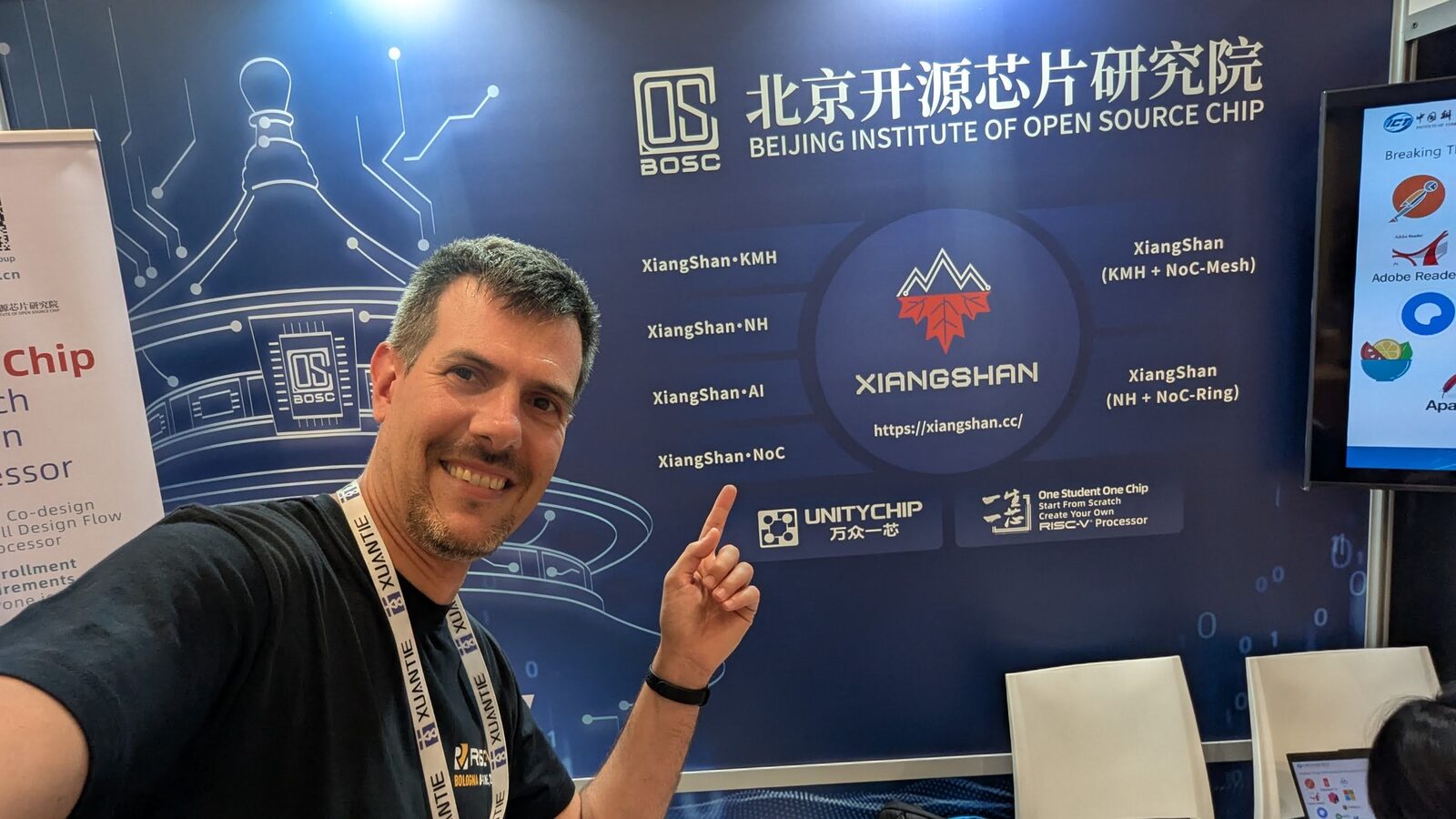
- RISC-V is an open standard. There are no royalties and no gatekeeper. You can implement the ISA yourself, buy a core from a vendor like SiFive or Andes, or use an open-source core like CVA6 or XiangShan.
This single difference cascades into everything else: who can innovate, who controls the roadmap, and who depends on whom.
Customization and Specialization
With x86 you get what Intel and AMD ship. With ARM you can license cores and, with an architecture license, design your own — but you cannot freely extend the ISA.
RISC-V is built for extension. The base ISA is small, and you add standard extensions (M, A, F, D, C, V, B, H) or even your own custom instructions for AI, DSP, or cryptography. At the Summit, vendor after vendor showed domain-specific RISC-V cores — from ultra-low-power edge AI to 64-core HPC chips — all sharing one software ecosystem. That ability to specialize silicon to a workload without forking the toolchain is RISC-V’s structural advantage.
Performance in 2026
Here is the nuance people miss: an ISA does not have a performance number. Performance comes from the implementation — the microarchitecture, process node, cache hierarchy, and clock speed.
- x86 still holds the crown for peak single-thread performance in high-end desktops and servers, with mature, very wide out-of-order cores.
- ARM dominates mobile efficiency and has become a serious datacenter contender through Neoverse cores (powering AWS Graviton, Ampere, and NVIDIA Grace).
- RISC-V spans the widest range — from sub-milliwatt microcontrollers to ambitious server cores like Ventana Veyron and SiFive’s P-series. The high end is catching up fast. At the Summit, the Monte Cimone v3 HPC cluster (built on the SG2044 platform with RVV 1.0) reached roughly 91% of NVIDIA Grace and 46% of Intel normalized performance at 16 cores — remarkable for an ecosystem this young.
The honest 2026 verdict: for raw top-end performance, x86 and ARM still lead. For performance-per-watt in specialized workloads, and for the freedom to tune the chip to the job, RISC-V is increasingly compelling.
Software Ecosystem Maturity
Software is where incumbents have the deepest moat — and where RISC-V has made the fastest progress.
| Layer | x86 | ARM | RISC-V |
|---|---|---|---|
| Compilers (GCC, LLVM) | Mature | Mature | Production-ready |
| Linux kernel | Mature | Mature | Upstream, RVA23-ready |
| Major distros | All | All | Debian, Fedora, Ubuntu, openEuler ports |
| Emulation (QEMU) | Full | Full | Full system + user mode |
| Proprietary app long-tail | Vast | Large | Growing |
The toolchain and OS layers are solid — you can compile, boot Linux, and run containers on RISC-V today. The remaining gap is the long tail of closed-source, pre-built commercial software. The RVA23 profile is the key accelerant here: by standardizing exactly what an application processor must implement, it gives ISVs a single, stable target to build against.
Power, Cost, and Supply Chain
- Power: ARM set the bar for efficiency; RISC-V’s modularity lets designers strip an implementation down to only what a workload needs, which can win at the extreme low-power edge.
- Cost: No royalties lowers the bill of materials, especially at high volume — a major reason RISC-V already ships in billions of embedded controllers.
- Supply chain and sovereignty: RISC-V removes single-vendor dependency. For governments and strategic industries, building on an open ISA is a hedge against export controls and licensing risk — the central argument in RISC-V and European Digital Sovereignty.
Where Each Architecture Wins Today
- Choose x86 for legacy enterprise workloads, Windows desktops, and peak single-thread server performance.
- Choose ARM for mobile, mature cloud-native ARM64 deployments, and a deep, ready-made ecosystem.
- Choose RISC-V for embedded and IoT at scale, custom accelerators, education and research, AI silicon, and anywhere licensing freedom or sovereignty is a first-class requirement.
The Trajectory Matters More Than the Snapshot
A static comparison favors the incumbents — they have had decades. But the slope favors RISC-V. The ecosystem is compounding: more vendors, more boards, more upstream software, and standardized profiles that make portability real. The same pattern played out with Linux against proprietary Unix, and with open source against closed software generally.
You do not have to bet the company to explore it. Spin up a RISC-V Linux system in minutes with QEMU, or grab an affordable dev board and see for yourself.
This comparison draws on what I saw firsthand at RISC-V Summit Europe 2026, where the gap between “interesting research” and “production silicon” looked smaller than ever.