Most RISC-V coverage focuses on the technology — the clean ISA, the extensions, the open cores. But RISC-V’s momentum is ultimately driven by something less glamorous and more powerful: economics. The business case is so compelling that it pulls in everyone from chip startups to NVIDIA and Google. Let me make that case plainly.
What “Free” Actually Means
First, a precise definition, because “free” causes confusion. What is free is the ISA itself — the specification. You can implement RISC-V without paying a license fee or per-chip royalty, and without legal permission.
What is not automatically free: building a good chip still costs real money. You either license a commercial RISC-V core (e.g. from SiFive — with its own commercial terms), use an open-source core, or design your own — and then pay for verification, software, and fabrication. The revolution is that the ISA tax — the license fees and royalties owed just for the right to use the instruction set — drops to zero.
The Royalty Math
For comparison, proprietary ISAs typically involve two costs: a large up-front license fee (often millions) and a per-unit royalty on every chip shipped. At scale, the royalty dominates:
- A part selling for a few cents that ships in the billions cannot absorb a per-unit royalty — which is exactly why RISC-V conquered embedded first.
- Even for high-value chips, eliminating royalties improves margins or lets you undercut competitors.
Zero royalties changes which products are economically viable at all.
Beyond Cost: Strategic Value
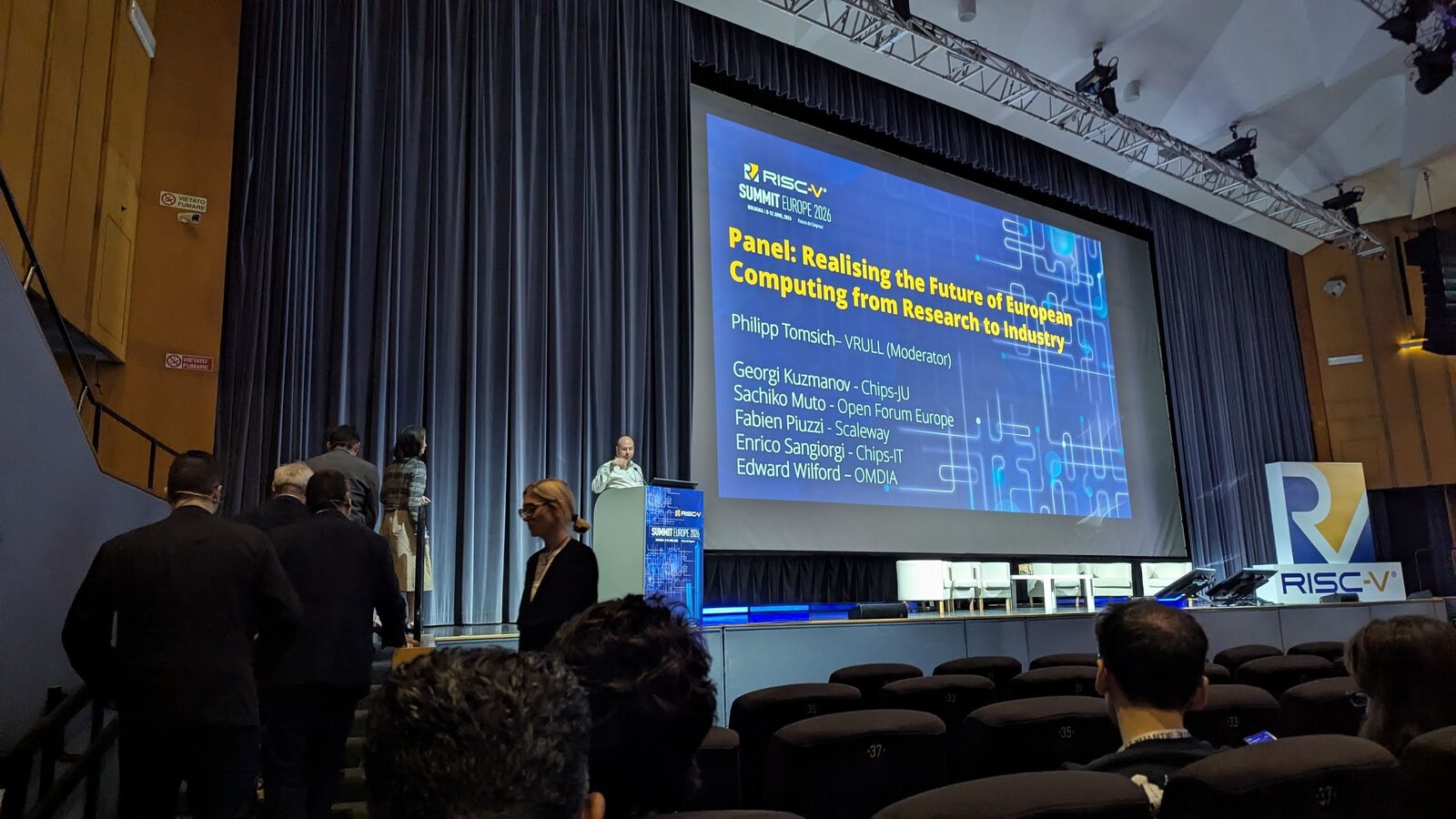
The deeper driver, repeated by company after company at RISC-V Summit Europe 2026, is risk reduction:
- No vendor lock-in — you are not hostage to one ISA owner’s pricing, roadmap, or corporate fate. The chip shortages made this lesson visceral across the automotive and electronics industries.
- Second-sourcing — multiple vendors can build compatible RISC-V silicon, so supply is resilient.
- Geopolitical neutrality — RISC-V International’s neutral governance makes the ISA attractive to governments and firms wary of export controls — the heart of the digital-sovereignty argument.
- Architectural longevity — a stable, frozen base protects decade-long software investments.
These are boardroom concerns, not engineering ones — which is why RISC-V adoption is a strategy decision, not just a technical one.
Customization as a Profit Lever
An open ISA lets a company add custom instructions for its specific workload — a sensor pipeline, a crypto routine, an AI kernel — without negotiating a license. That customization can deliver large performance or power advantages, which translate directly into competitive products. In a world of domain-specific accelerators, the freedom to tailor silicon is a genuine economic moat.
Why the Giants Are In
It is telling who is investing. Google, NVIDIA, Qualcomm, Western Digital, and others use RISC-V — often not as their headline application core, but as the embedded brain inside their chips: storage controllers, power-management units, GPU microcontrollers, and accelerator hosts. At the volumes these firms ship, replacing a royalty-bearing core with RISC-V saves enormous sums and gives them control over their own roadmap. The five-company Quintauris joint venture is the same logic applied to automotive.
The Ecosystem Flywheel
Economics also explains the momentum. Every company that adopts RISC-V funds tools, cores, and software that the next adopter inherits for free. That shared investment lowers the barrier further, attracting more adopters — a classic flywheel. It is why the ecosystem is compounding rather than merely growing, and why open-source cores and toolchains keep improving.
The Honest Caveats
The business case is strong but not unconditional:
- Software maturity still trails x86/Arm in places (though closing fast).
- Top-end performance for application cores is catching up, not yet leading.
- Fragmentation risk is real if vendors over-customize — which is exactly why profiles like RVA23 exist to keep the ecosystem coherent.
These are manageable, and the trajectory is clearly favorable.
The Bottom Line
RISC-V’s rise is, at heart, an economic story. The ISA is royalty-free, which is decisive at volume; but the bigger prize is strategic control — no lock-in, resilient second-sourcing, geopolitical neutrality, and the freedom to customize silicon as a competitive weapon. That is why the adopters range from one-person startups to the largest chipmakers on Earth. The technology is excellent, but it is the business case that turned RISC-V from a good idea into an unstoppable industry shift.
Part of my RISC-V series. See also the 2026 ecosystem overview and What Is RISC-V?