Meeting Reijer van Wegen at Huawei Summit 2026
At the Huawei Summit 2026, I had the pleasure of sitting down with Reijer van Wegen, CEO of Veldwerk — a company providing crucial ICT solutions for the hospitality, transport, and education sectors.
Veldwerk at the partner awards
Veldwerk also appeared on the partner-summit stage. At the awards ceremony of the Benelux & Ireland Partner Summit at Lake Como on 15 April 2026, the screen named Veldwerk for the “Best Solution Sales Partner of the Year” award.

The award slide: “Best Solution Sales Partner of the Year”, Veldwerk B.V.
The partner-certification part of the ceremony also listed Veldwerk B.V. as a Huawei Enterprise Business Partner at Silver Reseller level, alongside Proximus NXT IT NV SA and CITIC Telecom CPC Netherlands B.V.
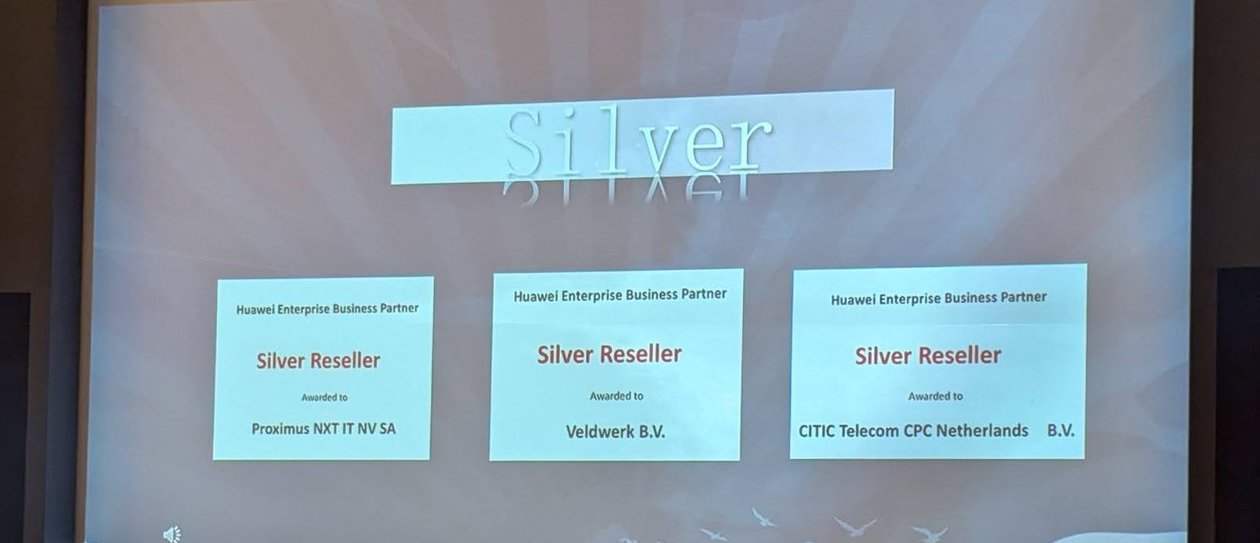
The Silver Reseller certificates on screen. See the full summit overview for the rest of the event.
The pace of change is unprecedented
I asked Reijer for his biggest takeaway from the summit, and his answer was clear:
“The world of technology is moving incredibly fast, and the scale at which AI and new innovations are being adopted right now is absolutely amazing.”
This is a sentiment I hear repeatedly from industry leaders — but hearing it from someone who runs a company delivering ICT infrastructure to hotels, transport operators, and schools gives it a different weight. These are not Silicon Valley startups chasing hype. These are organizations where technology has to work reliably every single day for thousands of end users.
Veldwerk — ICT where it matters
Veldwerk operates in sectors where technology directly impacts people’s daily experiences:
Hospitality — Hotels and hospitality businesses depend on network infrastructure for everything from guest Wi-Fi and booking systems to IoT-connected room management, digital signage, and payment processing. Downtime is not an abstract metric — it is a guest standing at reception unable to check in.
Transport — Transport networks require robust, always-on connectivity. Whether it is passenger information systems, fleet management, or real-time scheduling, the ICT backbone must handle high availability across distributed locations with varying network conditions.
Education — Schools and educational institutions are increasingly digital-first. Remote learning, digital classrooms, student management systems, and campus-wide connectivity all depend on ICT infrastructure that scales to thousands of concurrent users.
What makes Veldwerk’s position interesting is that they sit at the intersection of enterprise ICT and real-world operations. The technology they deploy has to survive the chaos of hospitality peak seasons, rush-hour transport loads, and hundreds of students streaming video simultaneously.
AI adoption across traditional sectors
Reijer’s observation about the speed of AI adoption reflects a broader trend. Sectors that were traditionally slower to adopt new technology are now moving rapidly:
- Predictive maintenance — AI models analyzing network equipment health to prevent failures before they impact operations
- Intelligent network management — automated optimization of bandwidth allocation, traffic routing, and security policies
- Personalization at scale — hospitality companies using AI to customize guest experiences across properties
- Operational efficiency — transport operators using AI for route optimization, energy management, and demand forecasting
The common thread: AI is not replacing the core ICT infrastructure — it is making it smarter and more autonomous. The network still needs to work. But now it can also predict problems, optimize itself, and adapt to changing conditions without manual intervention.
Digital transformation at enterprise scale
What stood out from our conversation was the reality of digital transformation outside the tech bubble. For companies like Veldwerk and their customers:
- Reliability is non-negotiable — you cannot move fast and break things when a hotel has 500 guests
- Integration complexity is real — hospitality, transport, and education each have legacy systems, regulatory requirements, and unique operational constraints
- The skills gap is a bottleneck — finding engineers who understand both modern cloud/AI technologies and sector-specific operational requirements is increasingly difficult
- Scale demands different solutions — what works for a single location does not automatically work for a nationwide deployment
This is where partnerships with technology providers like Huawei become critical. The Huawei Summit brings together the ecosystem — hardware vendors, software providers, system integrators, and end customers — to align on how these challenges are being solved at scale.
Key takeaways
- AI adoption is accelerating in traditional sectors — hospitality, transport, and education are moving faster than many expect
- Reliability remains the foundation — new technology must enhance, not compromise, operational stability
- ICT infrastructure is the backbone of digital transformation — without solid networking and compute, AI initiatives fail
- The pace of change is the biggest challenge — keeping up requires strong partnerships and continuous investment
Big thanks to Reijer for sharing his time and insights at the Huawei Summit 2026.
🔗 Learn more about Veldwerk: www.veldwerk.nl
Community Reactions
Luca shared the conversation on LinkedIn:
“I had the pleasure of sitting down with the CEO of Veldwerk, a company providing crucial ICT solutions for the hospitality, transport, and education sectors. His biggest takeaway from the summit was clear: The world of technology is moving incredibly fast, and the scale at which AI and new innovations are being adopted right now is absolutely amazing.”