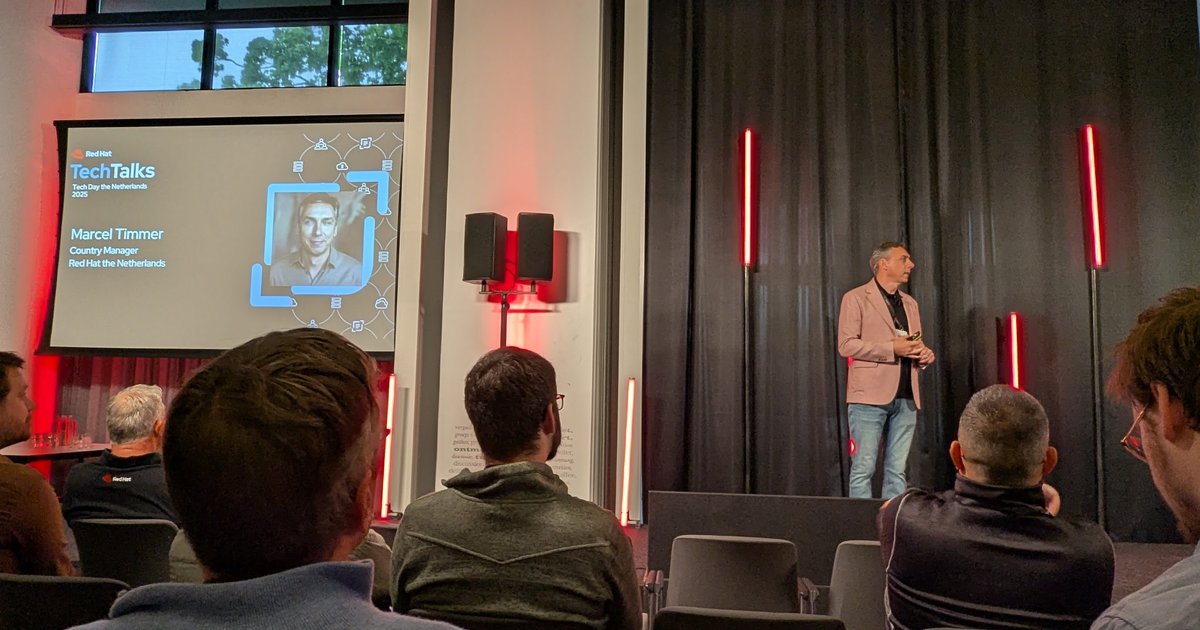
On 4 June 2025 I went to Red Hat Tech Day Netherlands in Bunnik, branded “TechTalks” on the slides. A year later I went back for Red Hat Tech Day Netherlands 2026, which was almost entirely about agents. The 2025 edition sat between two eras: RHEL 10 had just been released, and the AI content was about fine-tuning and running models on your own infrastructure.
This is a throwback post written from my photos and recordings of the sessions I attended. I only name speakers whose names appear on their own slides.
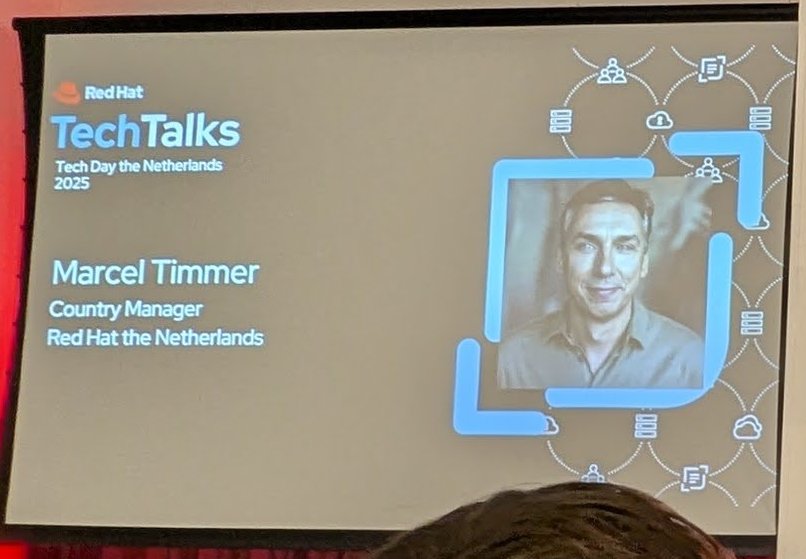
The opening: Marcel Timmer, Country Manager, Red Hat the Netherlands, as shown on his slide.
Opening: choice and digital sovereignty
The opening talk covered digital sovereignty, which the speaker called a hot topic in the Dutch tech industry. The framing was Red Hat’s “keep your options open” strategy: where is my data, where does my networking and service come from, and how do I explain it to a compliance officer. The same questions applied to AI: whether a model can run on-prem, be made smaller and cheaper, and be embedded in your own products.
Managing hubs and clusters with ACM
A management session proposed that everything people mean by “management” reduces to nine things: deployment, lifecycle, knowing what is going on, inventory, configuration and state, security, continuity, observability and cost. The speaker argued that cost is now a first-class management concern, and that continuity has shifted from “take a backup” to time to recovery and ransomware.
The slides then dived into Advanced Cluster Management for Kubernetes, the multicluster global hub. The architecture slide shows a global hub with Grafana, PostgreSQL, a hub manager and Kafka, above regional ACM hubs that each run a hub agent and manage OpenShift clusters, OpenShift Virtualization and single-node OpenShift. Its stated jobs: inventory of all managed hubs and clusters, policy compliance status and trend, and alerts on irregular policy behaviour. Backup and restore was marked Tech Preview. The ACM documentation describes the same idea: managing multiple hub clusters from one global hub.
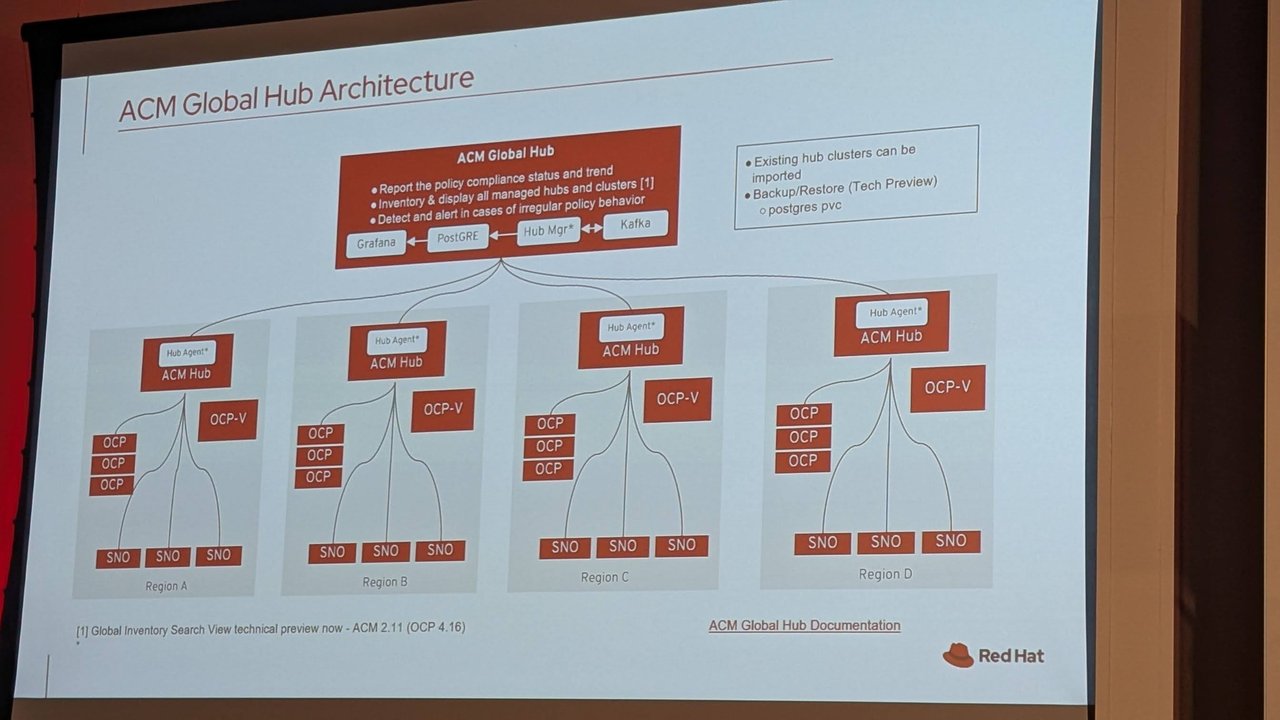
ACM Global Hub architecture: one hub over regional hubs, each managing its own clusters.
Secrets on OpenShift with Vault
A session on OpenShift secrets management with Vault compared three integration options on one slide: the Vault Secrets Operator, which syncs Vault data into Kubernetes secrets and caches it; the Vault Agent Injector, which injects secrets into pods through a sidecar into ephemeral volumes; and the Vault CSI Provider, which mounts secrets as ephemeral volumes through the CSI driver. The speaker stressed that secrets are more than passwords: SSH access, generated TLS certificates and dynamic credentials too. He also covered Vault enterprise namespaces, which can be paired with OpenShift projects to give a team an isolated landing zone, plus disaster recovery and performance replication.
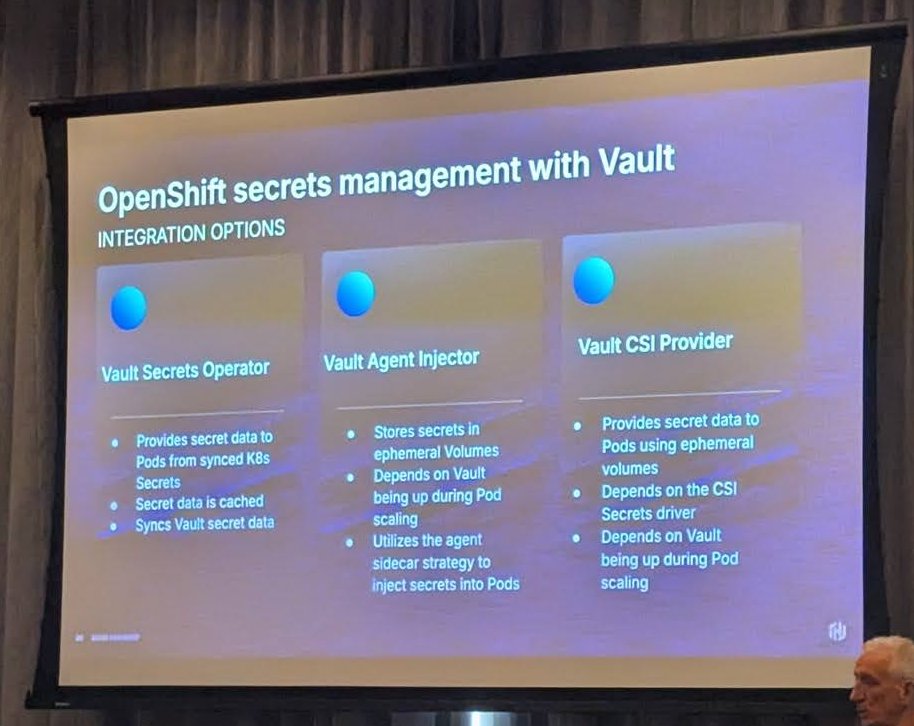
Three ways to get Vault secrets into pods, side by side.
AI on Azure Red Hat OpenShift workshop
The morning workshop was “AI on Azure Red Hat OpenShift Workshop”, led by Andy Repton (Managed OpenShift Black Belt, per his slide), co-branded Red Hat and Microsoft. The agenda slide ran from a welcome through “Build, Deploy and Scale AI-Enabled Apps with Azure Red Hat OpenShift” to a hands-on lab about a fictional insurance company, Parasol Insurance. From the recording: the lab runs a small language model locally inside the cluster alongside a hosted model, so you can compare them side by side and swap models without changing the workflow. It also explained embeddings and vector search through a simple two-axis example, in Jupyter notebooks, and positioned OpenShift AI as built on RHEL and Kubernetes for hybrid cloud portability.
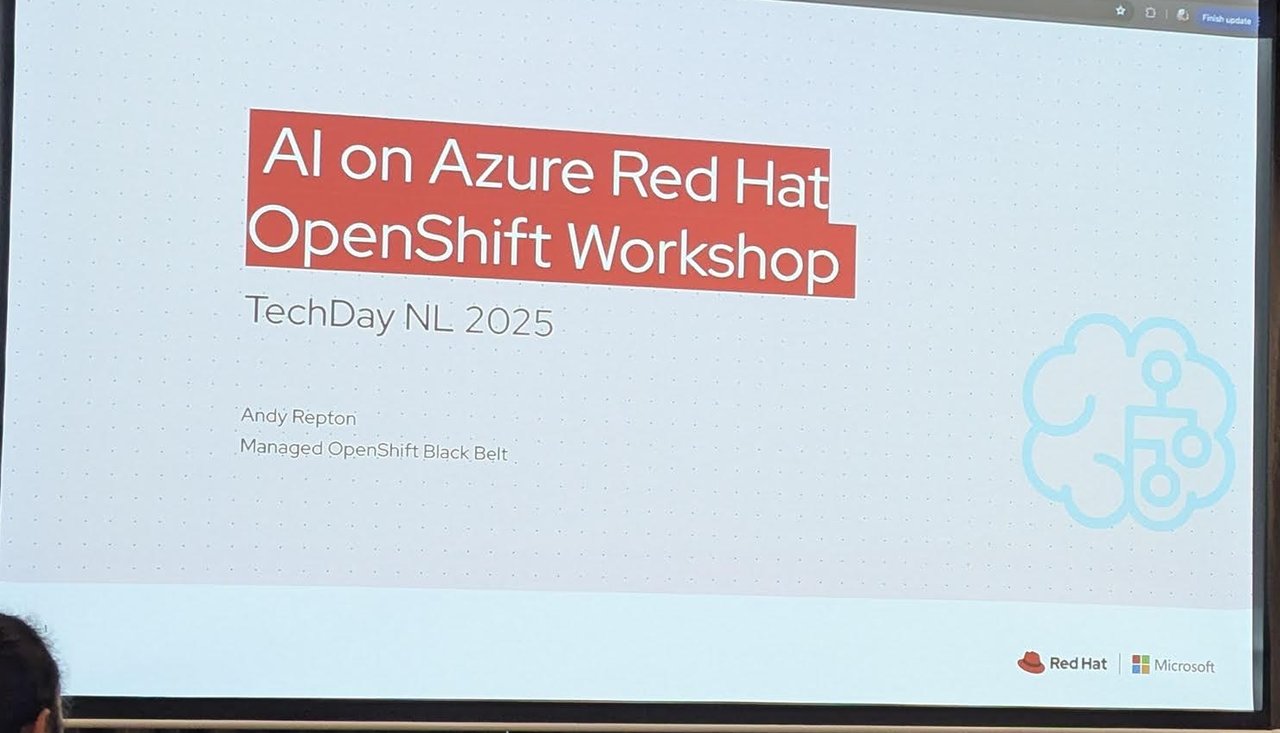
The title slide of the AI on Azure Red Hat OpenShift workshop.
Image mode, Satellite and RHEL 10
The afternoon RHEL session started from the Red Hat Satellite 6.17 slide (support for RHEL 10, image mode, Flatpak content, secure boot and IPv6), which I photographed from too far back to read well. Image mode for RHEL is, according to the Red Hat documentation, a deployment method that manages the operating system as an OCI container image built on bootc, with a read-only root filesystem and transactional updates with rollback.
The demo I recorded pushed a new image tag to a registry (rel9, rel10 and latest) and ran the upgrade through Satellite’s remote execution. The system fetched only the changed layers, staged them and waited for a reboot, “exactly like your phone”. Rollback is a switch of boot entries, so it is quick. The presenter’s use case was updating many identical machines, such as the workstations in a branch. A related talk argued for building images per workload (SAP, database, web server) from blueprints rather than one golden image, with compliance profiles such as OpenSCAP, CIS Level 2 and PCI DSS applied at build time. The same session touched on post-quantum cryptography work in RHEL 10.
My take: image mode turns OS patching into the same pull-request-and-registry workflow as applications, which is where platform teams are heading anyway. The caveat is that you need a registry and a build pipeline you trust for the OS itself.
Hands-on with InstructLab
The afternoon workshop was Hands-On with InstructLab: Fine-Tune Generative AI LLMs Using Your Data on Your Infrastructure, presented by Adnan Drina according to the title slide. InstructLab is described in its documentation as a model-agnostic open source project for contributing skills and knowledge to LLMs, using a taxonomy, synthetic data generation and training on a Granite base model.
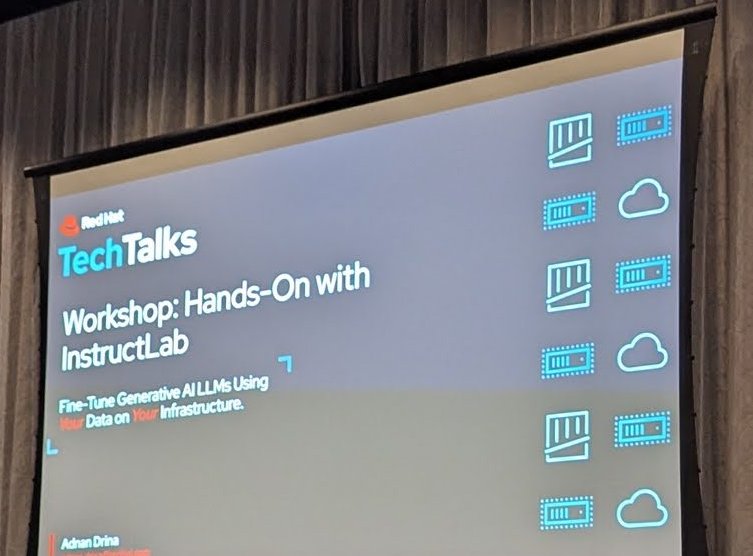
The title slide of the InstructLab workshop.
What I took from the recording:
- Synthetic data with a quality gate. A model generates training data from your seed examples, and evaluation models then check that the generated set is meaningful before training starts.
- Hardware reality. Training on four to eight GPUs completes in under 20 hours according to the presenter, which is why the workshop did not run a full training and used a provisioned lab of 30 spots instead.
- Laptop-friendly inference. Quantized models run on macOS Silicon, Linux and Windows with CPUs only, so you can explore a model locally without GPUs.
- Setup. InstructLab is a Python application, installed in a virtual environment so the dependencies stay isolated.
Red Hat Summit Boston session
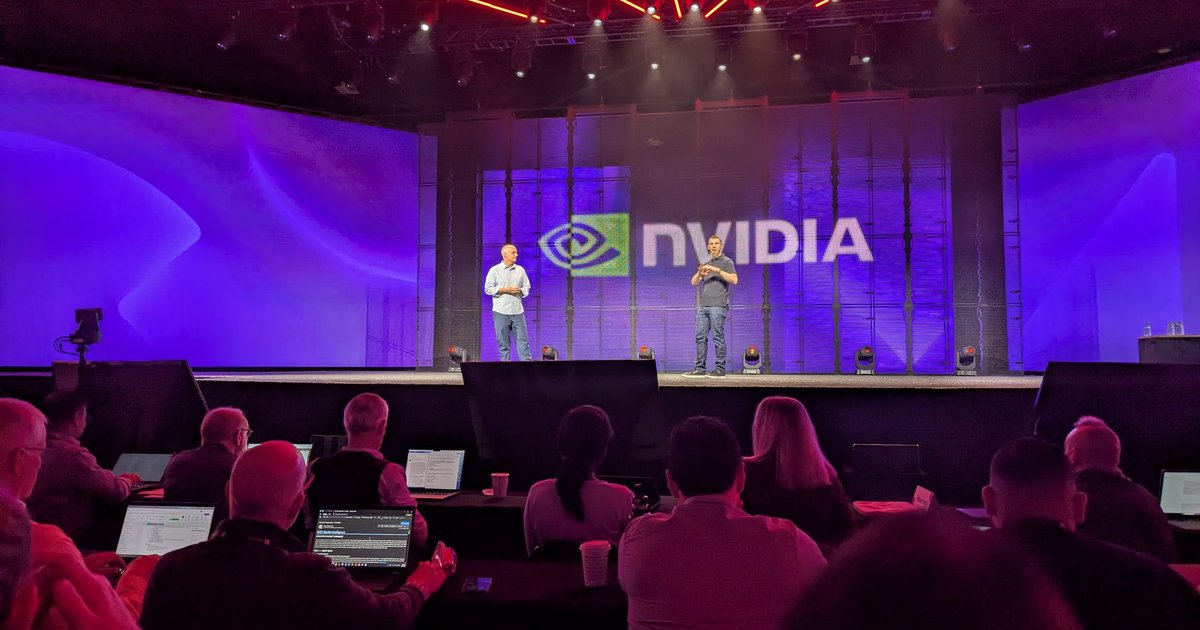
Before one of the sessions, the screens in the main hall showed a “Red Hat Summit Boston” slide with a panel of Red Hat specialists covering OpenShift and virtualization, AI, Ansible automation and Enterprise Linux. I have written up the Dutch Summit Connect events separately in Red Hat Summit Connect Utrecht 2025.
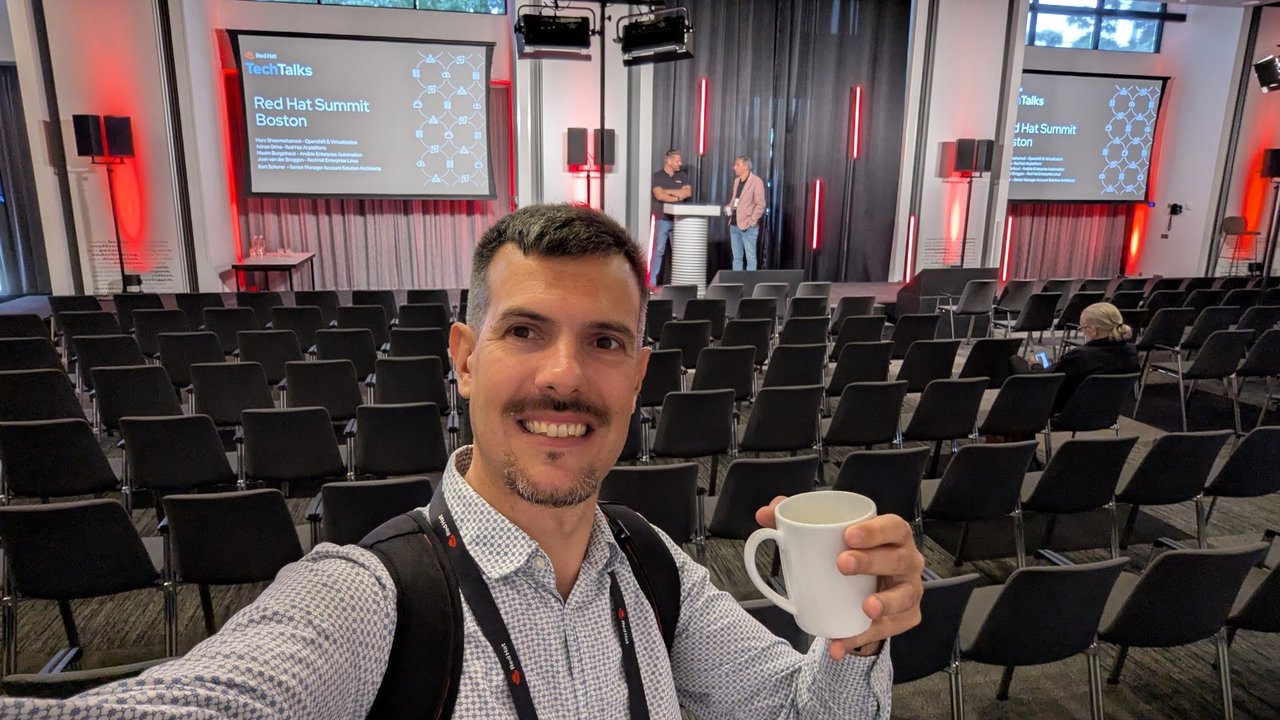
The main hall before the Summit Boston session.