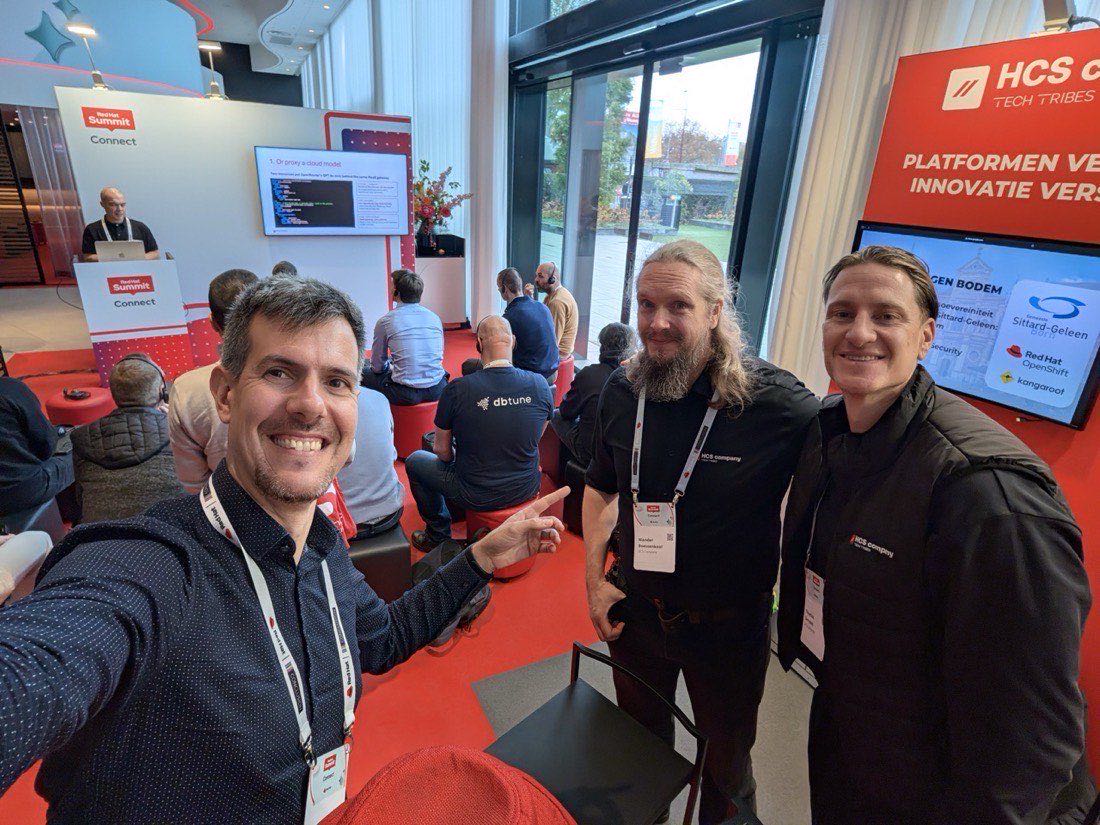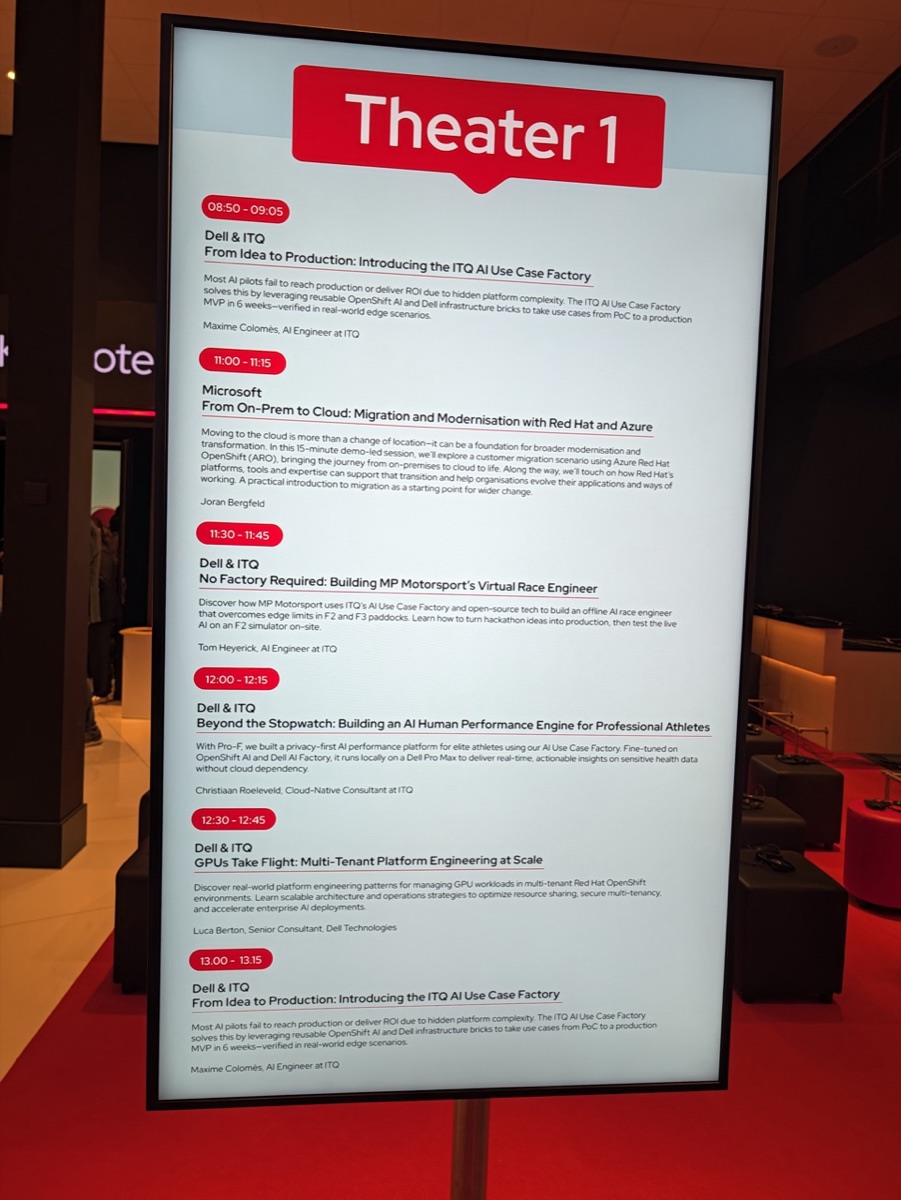
The two-theater program was the headline, but at Red Hat Summit: Connect 2026 in Utrecht the real signal was on the floor. Between sessions I ran a series of short booth interviews — 1,200 people had registered, and the conversations everywhere circled the same five questions: how do we put AI in our SDLC safely, where do the models live, what do we do with the legacy, how fast does the patching window move, and can we keep up?
Here is what I heard.
AI is moving into the SDLC — but only with a strong business case
The most repeated line of the day: AI is no longer an experiment, it is entering production — but the teams that get value are not the ones pushing it from the technology side. One partner that had run a “use-case factory” across several regulated customers put it plainly: if you try to push AI into a company purely as a technology initiative, “that is bound to fail.” You need a real business owner behind a real use case and a sponsor for it.
The interesting shift, echoed by several people, is the moving bottleneck. Coding is no longer the bottleneck — it used to be “how fast can people type and write code,” and AI removed that. The bottleneck has moved further down the pipeline, into testing, integration, operations and the rest of the lifecycle. The teams winning are not the ones accelerating a single step; they are the ones modelling the whole flow around fleets of AI agents, a “generative-AI organizational reset” rather than a single-process speed-up.
Legacy modernization just became feasible
A second theme kept coming back: for the first time, you can modernize the legacy nobody understands anymore. COBOL and mainframe applications that no one can maintain because the people who wrote them have retired can now be understood by generating documentation with AI, then rebuilt with lower risk. One partner with delivery centers across Serbia, Ukraine and Romania (working with customers on AWS and Azure) was emphatic that this is the moment — the effort and the risk are now low enough that the “impossible” legacy rewrites are finally on the table.
Private, on-prem AI for the regulated data
Healthcare and other regulated industries kept showing up, and the answer was the same: bring the models to where the data lives. Medical data — scans and imagery that grow into terabytes — should not be moved to a public cloud service, for both regulatory and cost reasons. Several partners described private, on-prem AI platforms as the right model: the data stays put, the models come to it. Sovereignty and guardrails, people agreed, are two sides of the same coin — and AI has moved from a lab topic to a boardroom topic, where the questions are is it safe, is it auditable, am I OK if I do this?
One caution came up too: shadow AI — people installing their own AI tools on their own desktops — is already happening, with or without policy.
OpenShift 5: virtualization maturity and predictable maintenance
On the platform side, the talk was OpenShift 5. People were genuinely surprised by how mature OpenShift’s virtualization has become — live migration in real time, in-place upgrades, and a predictable, extended maintenance window compared with OpenShift 4. A recurring pattern: organizations are now evaluating OpenShift because of its virtualization, landing a workload as a container, and then modernizing the rest. The through-line everyone appreciated: predictability — knowing what the platform will look like over the coming years — is something too many software vendors do not offer.
On safe AI delivery the answer was consistent: use your own models or small language models, keep the human in the loop, and lean on the partner ecosystem — it is not enough to install a platform, you also have to manage it and make it a way of working.
The new patching race
The one line that stuck with me: one partner told me they used to patch customer software on an eight-week cadence, and now they have to respond the same day. With AI agents now on both sides, the coming years will be “a race — agentic software as the attacker, and agentic software as the defender.” It is a new arms race that a lot of intelligence will have to win for all of us to stay secure.
The floor in one line
Three months ago “any agent, any model, any cloud, any location” was a talking point; on the floor it was a requirement. The floor at Summit: Connect was not about demos — it was about how we operate. And the teams that are keeping up, they told me, are the ones that keep skilling up: training, reading, and not falling behind.
More from Summit: Connect 2026 in Utrecht in the other posts in this series.