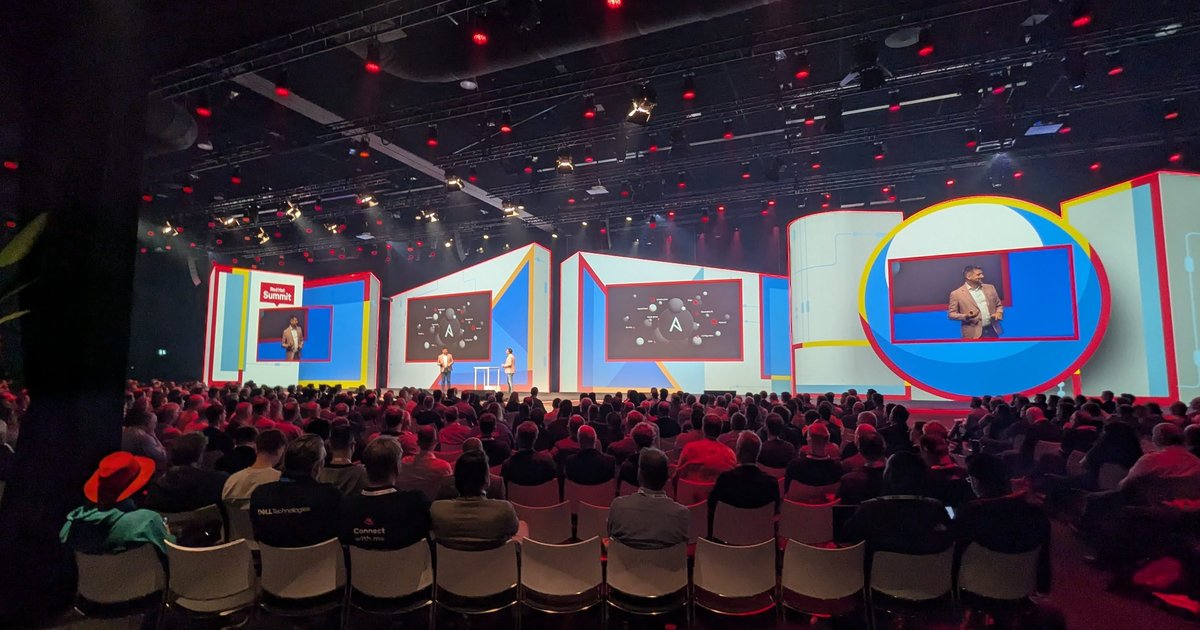
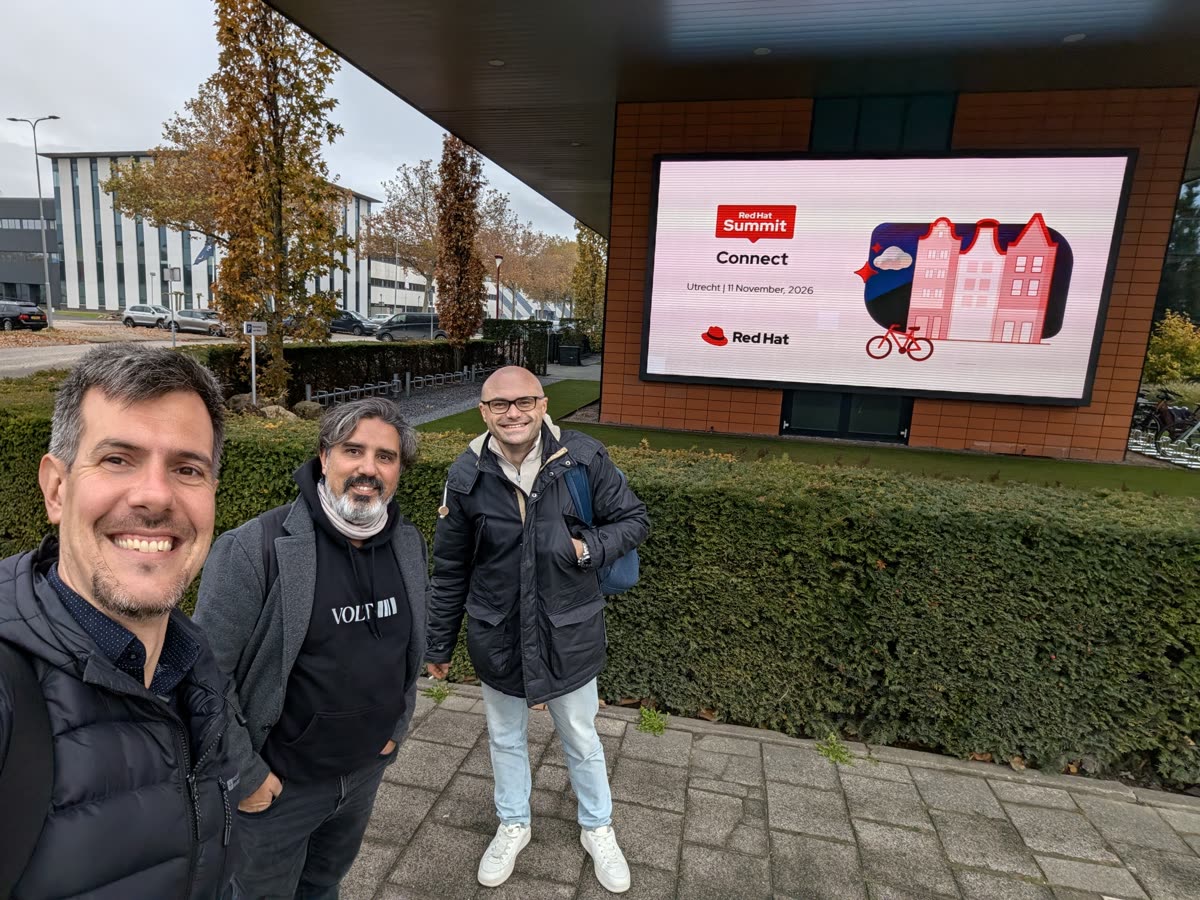
On Wednesday I went to NBC Nieuwegein, next to Utrecht, for Red Hat Summit: Connect 2026 Utrecht, Red Hat’s one-day event for the Netherlands. It ran from 08:00 to 18:00: an opening keynote at 09:30, four rounds of breakout sessions, demos in “silent theaters”, and a closing reception in the expo hall. My photos run from 09:20 to 10:25, from the entrance to the middle of the keynote, which lasted until 11:00, so these notes follow its slides. Five speakers shared the stage, and a name slide announced each of them.
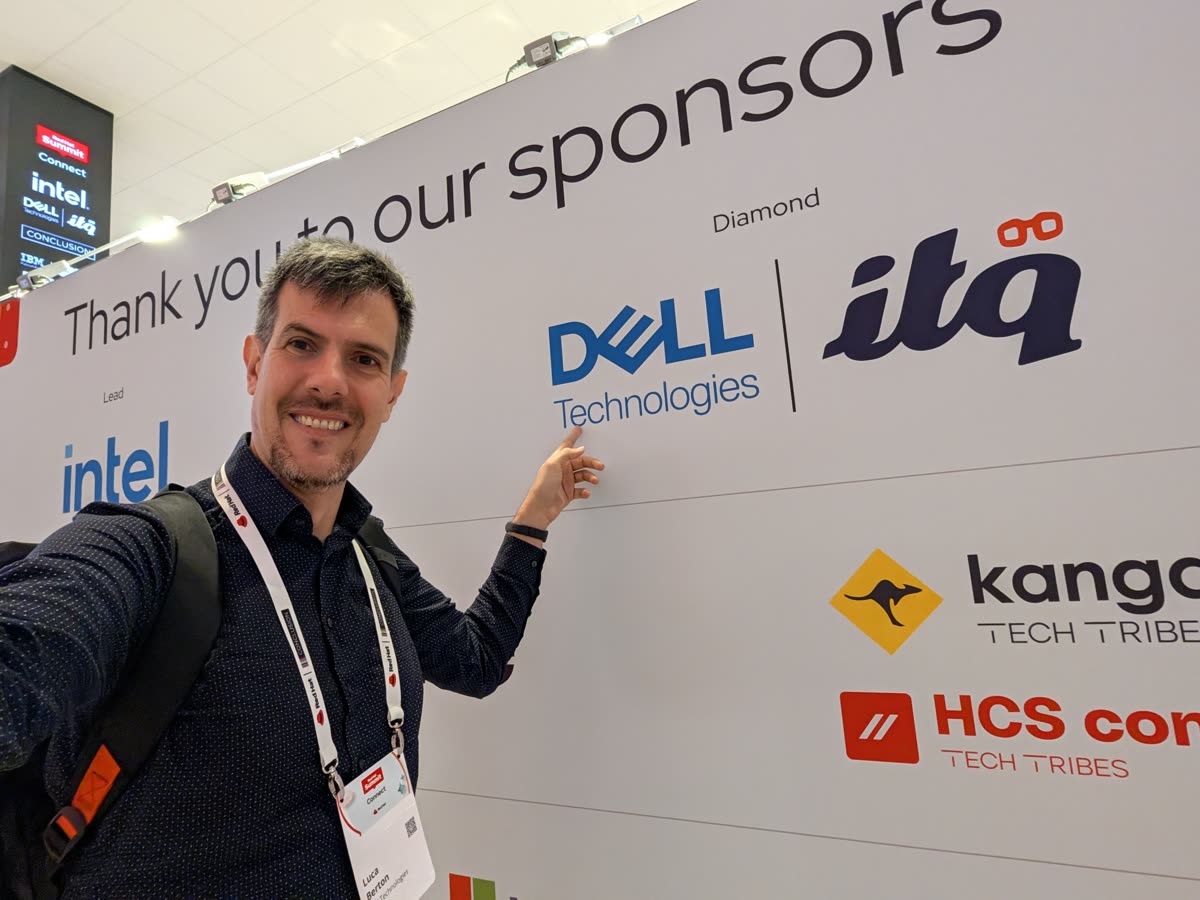
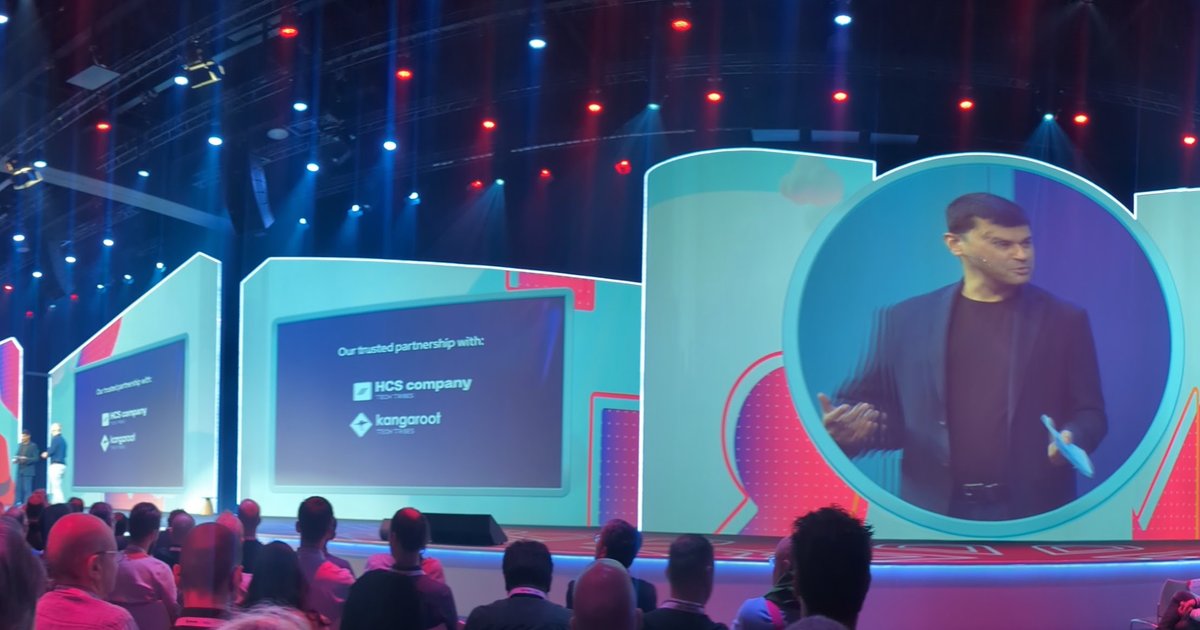
The sponsors wall explains part of what came later. Intel was the lead sponsor, Dell and ITQ the diamond ones, with Conclusion, HCS and Kangaroot at gold level. ITQ and Intel both ended up on the main stage.
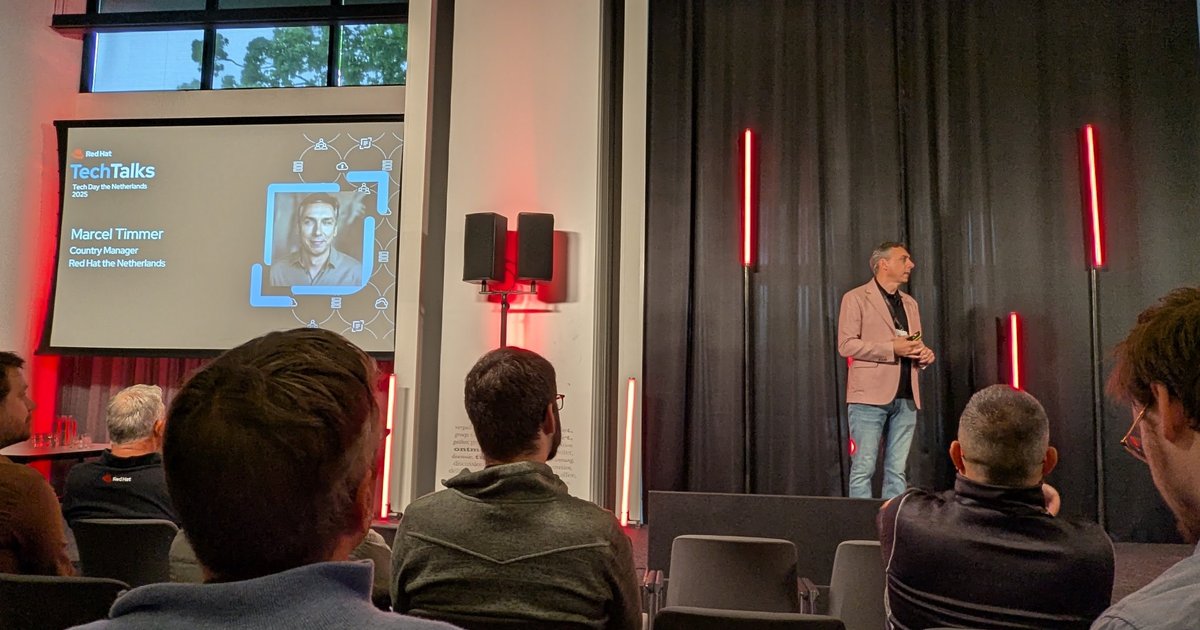
Marcel Timmer: one in four
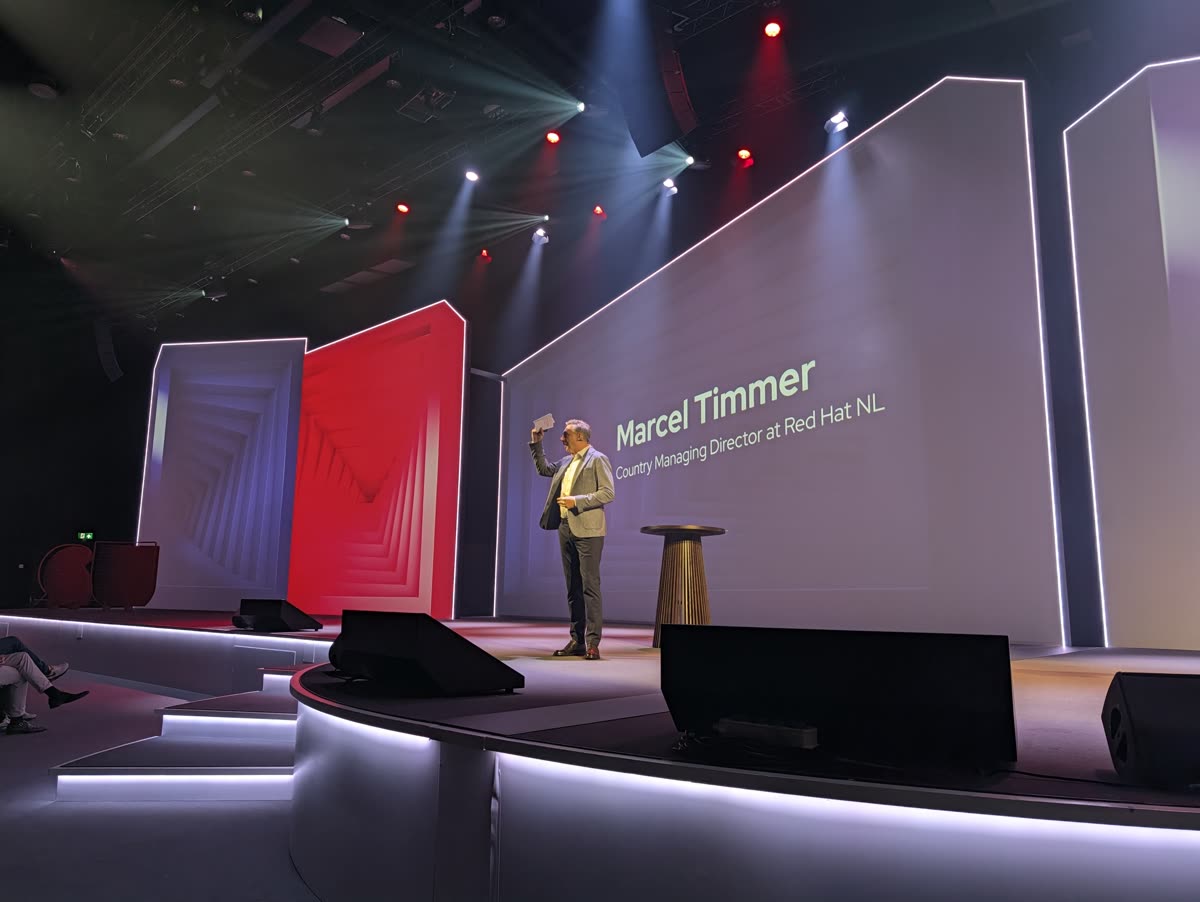
Marcel Timmer, Country Managing Director at Red Hat NL, opened the day, thanked the sponsors, and then put up a slide called “Navigating the shift in our market”. It had three boxes, and I could read two of them: “Accelerating AI adoption” and “Evolving risk management”.
The next slide carried the number I took home from his part:
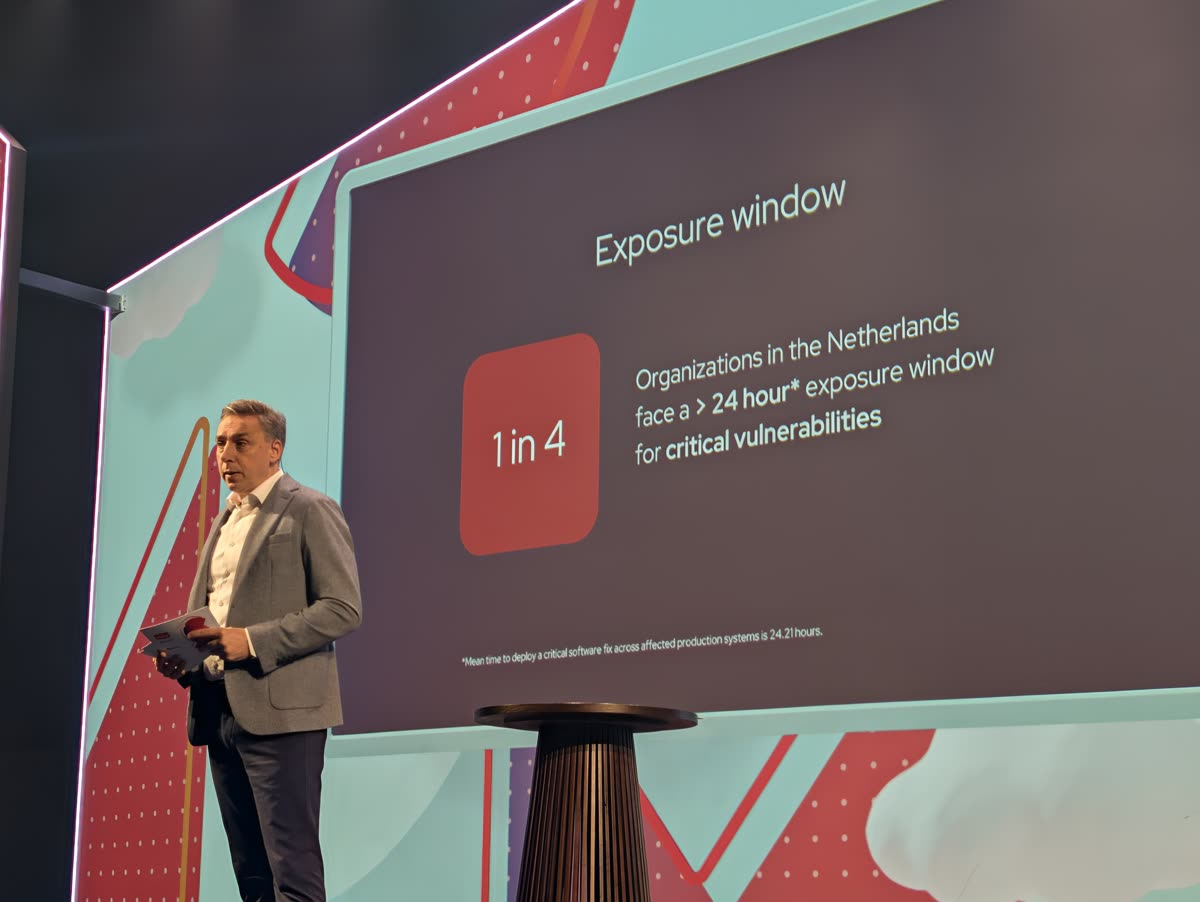
1 in 4 organizations in the Netherlands face an exposure window of more than 24 hours for critical vulnerabilities. The footnote defined it: the mean time to deploy a critical software fix across affected production systems is 24.21 hours. Keep that figure in mind for the end of this post.
Andrew Brown: what do I build on?
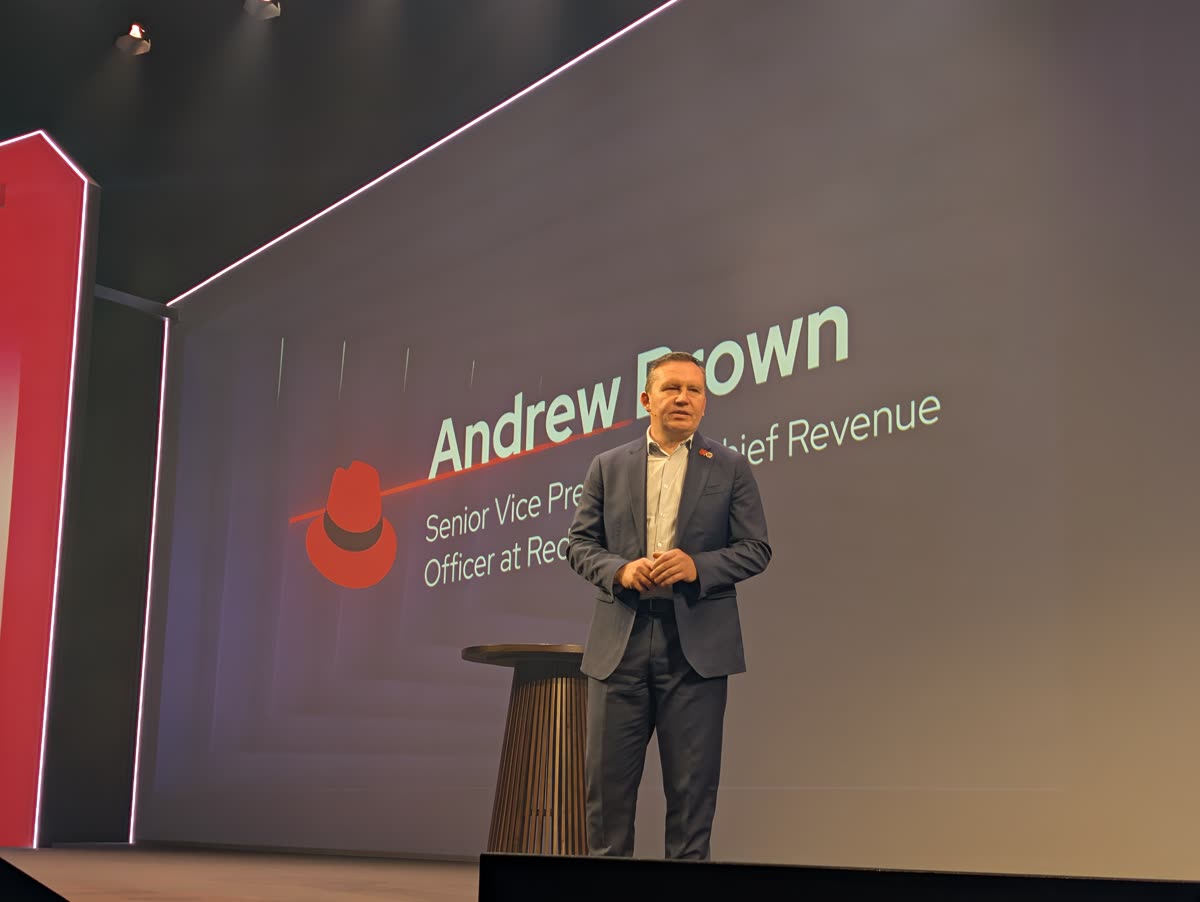
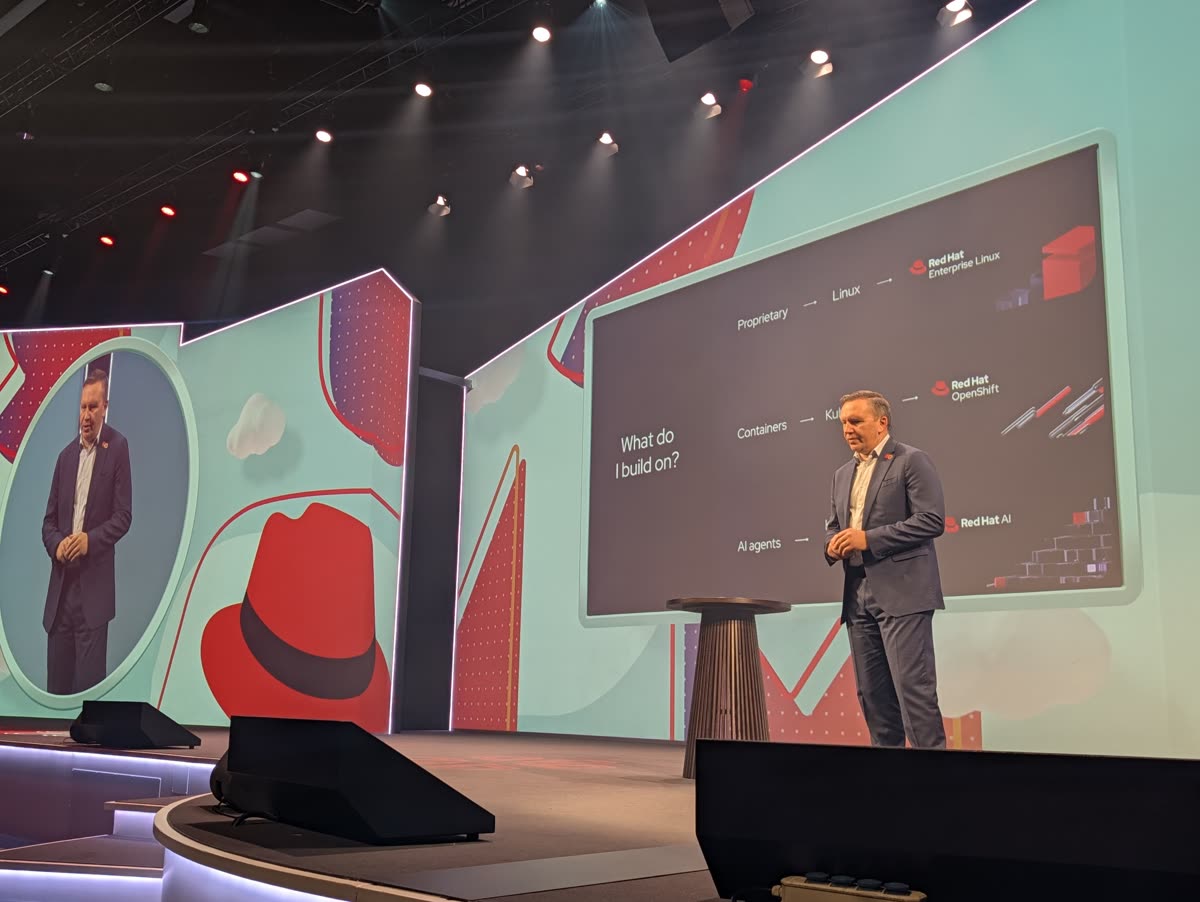
Andrew Brown, Senior Vice President and Chief Revenue Officer at Red Hat, spoke for most of the keynote I photographed. His first slide asked “What do I build on?” and answered in three rows: proprietary systems gave way to Linux and Red Hat Enterprise Linux, containers to Red Hat OpenShift, and AI agents to Red Hat AI.
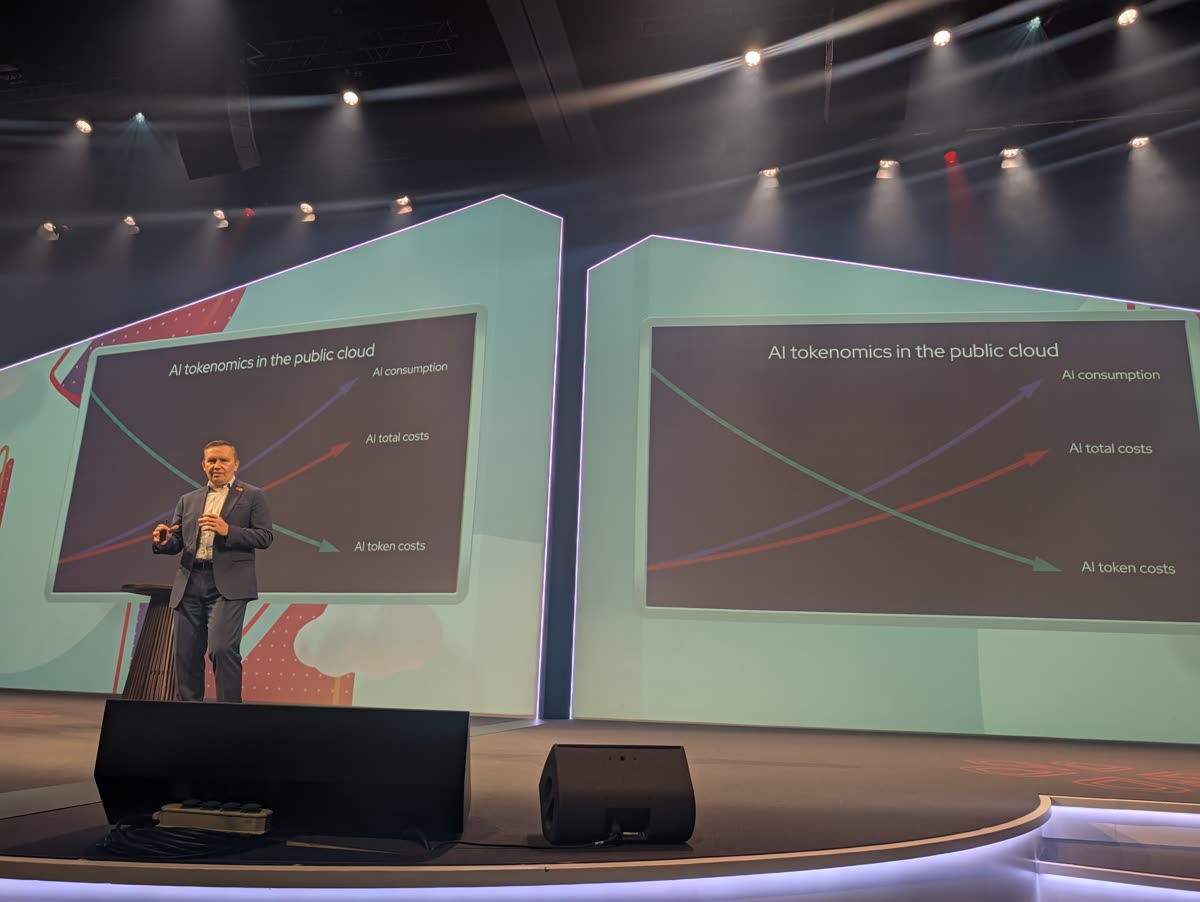
Then came a slide on AI tokenomics in the public cloud, with three curves: AI consumption and AI total costs going up, AI token costs going down. The price of a token falls, and the bill still grows, because consumption grows faster.
Private AI, with three cases from ITQ
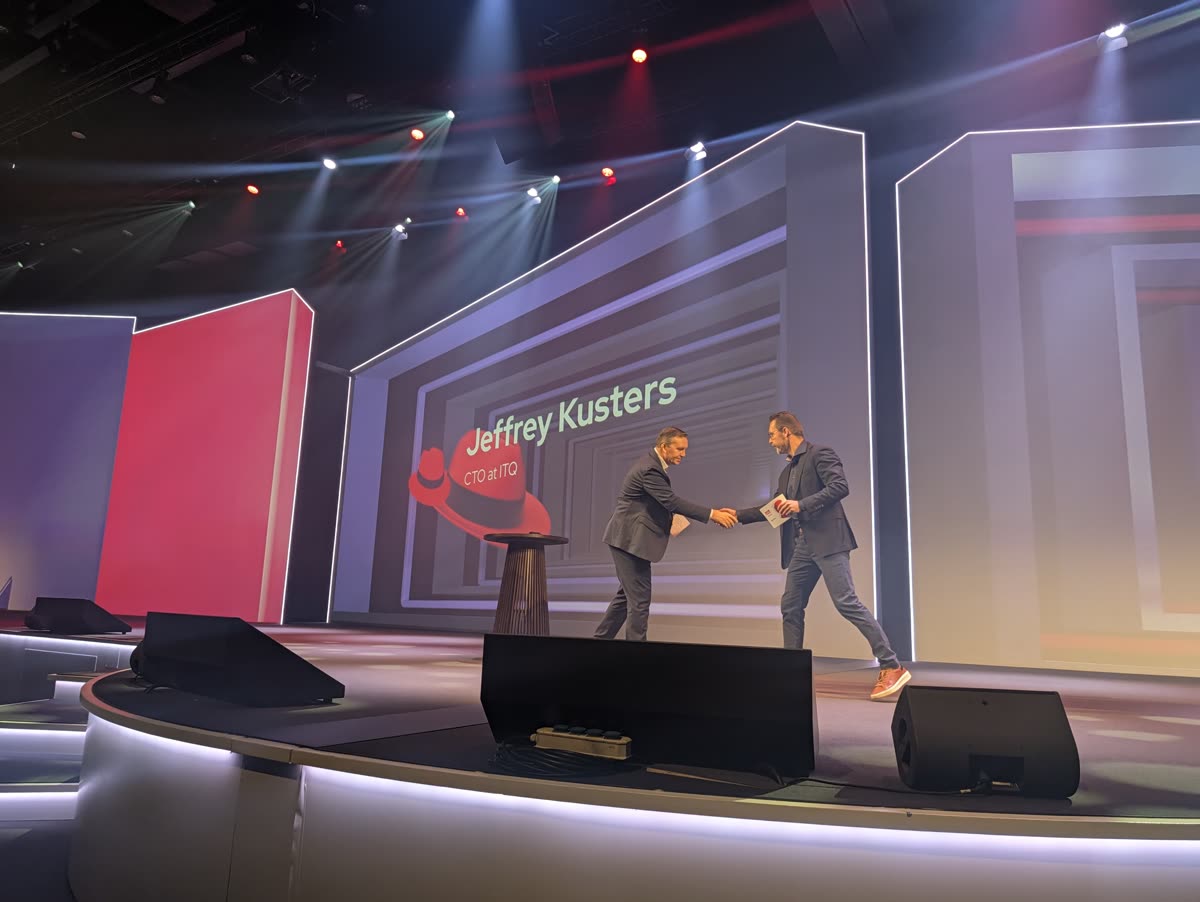
Andrew Brown handed over to Jeffrey Kusters, CTO at ITQ, for “Private AI: From Concept to Production”, subtitled “Bringing enterprise AI to sovereign data with Red Hat OpenShift AI”. Three cards, three kinds of customer:
- Telecom and sovereignty: SETAR (Aruba). An island-native telecom platform built on OpenShift AI, with “in-region governance and token cost control”.
- Healthcare research: Catharina Hospital (Eindhoven). More than 125 clinicians and researchers on on-premise OpenShift AI: “sovereign patient data and local GPU scale”.
- Real-time edge AI: MP Motorsport. A Virtual Race Engineer analyzing multi-lap telemetry, “compact AI coaching without a data center truck”.
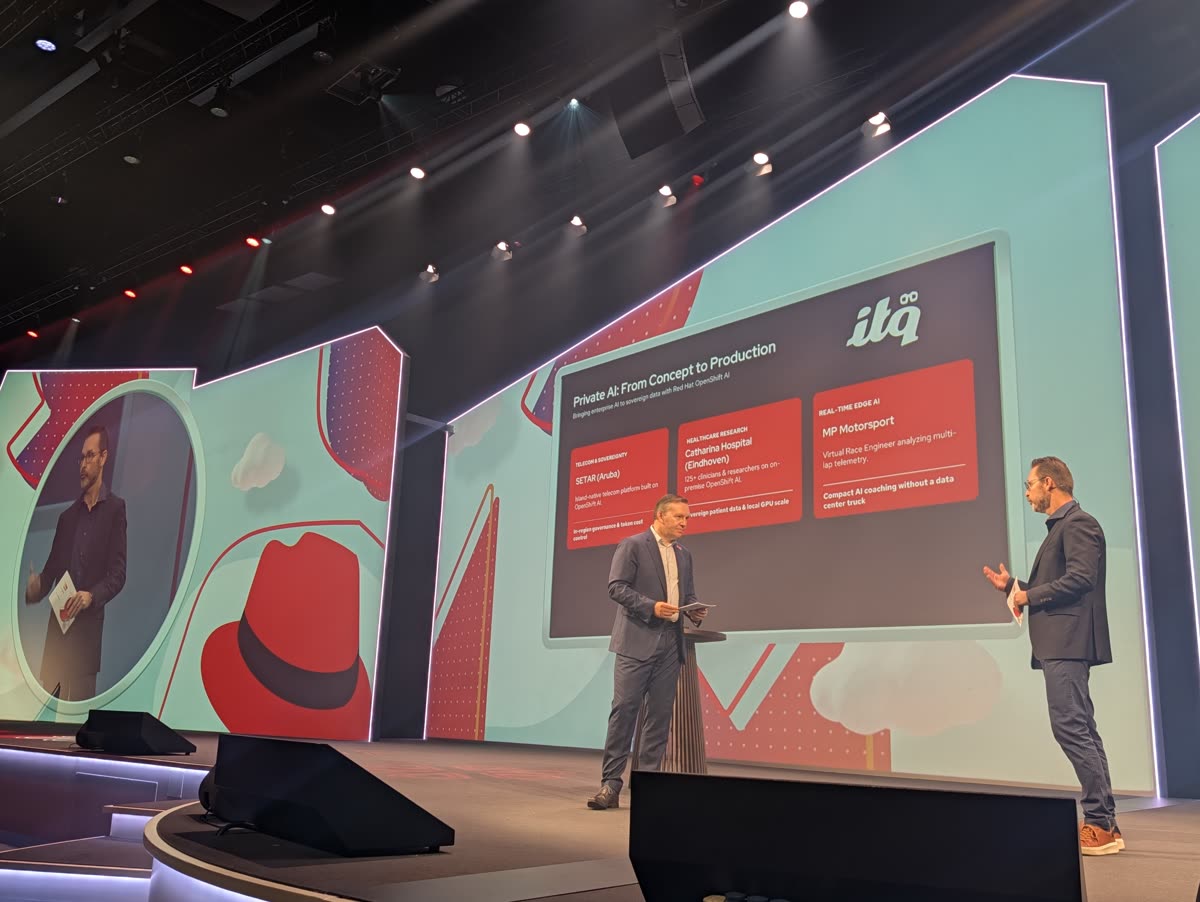
The slide ended with a “dive deeper” strip pointing to the rest of the day: a breakout on the Catharina Hospital case, a race simulator demo at the ITQ and Dell stand, and a workshop called “Prompt to Production”. In the agenda, the hospital session is at 14:00 and in Dutch, with two people from the hospital and ITQ’s Johan van Amersfoort.
Red Hat AI, layer by layer
Andrew Brown then walked up a five-layer slide for Red Hat AI, highlighting one layer at a time:
- Any accelerator: NVIDIA, AMD, Intel, AWS, Google Cloud and Microsoft Azure.
- AI infrastructure: Red Hat Enterprise Linux as an “integrated agentic OS”, the “foundation of AI system”, with “Day 0 hardware support”.
- Model services: Model-as-a-Service and an AI gateway, because “enterprises need many models”, with “Red Hat validated models on Day 0”.
- Agent services: bring your own agents, AgentOps, agent identity, agent lifecycle, MCP services and tools, and agent observability.
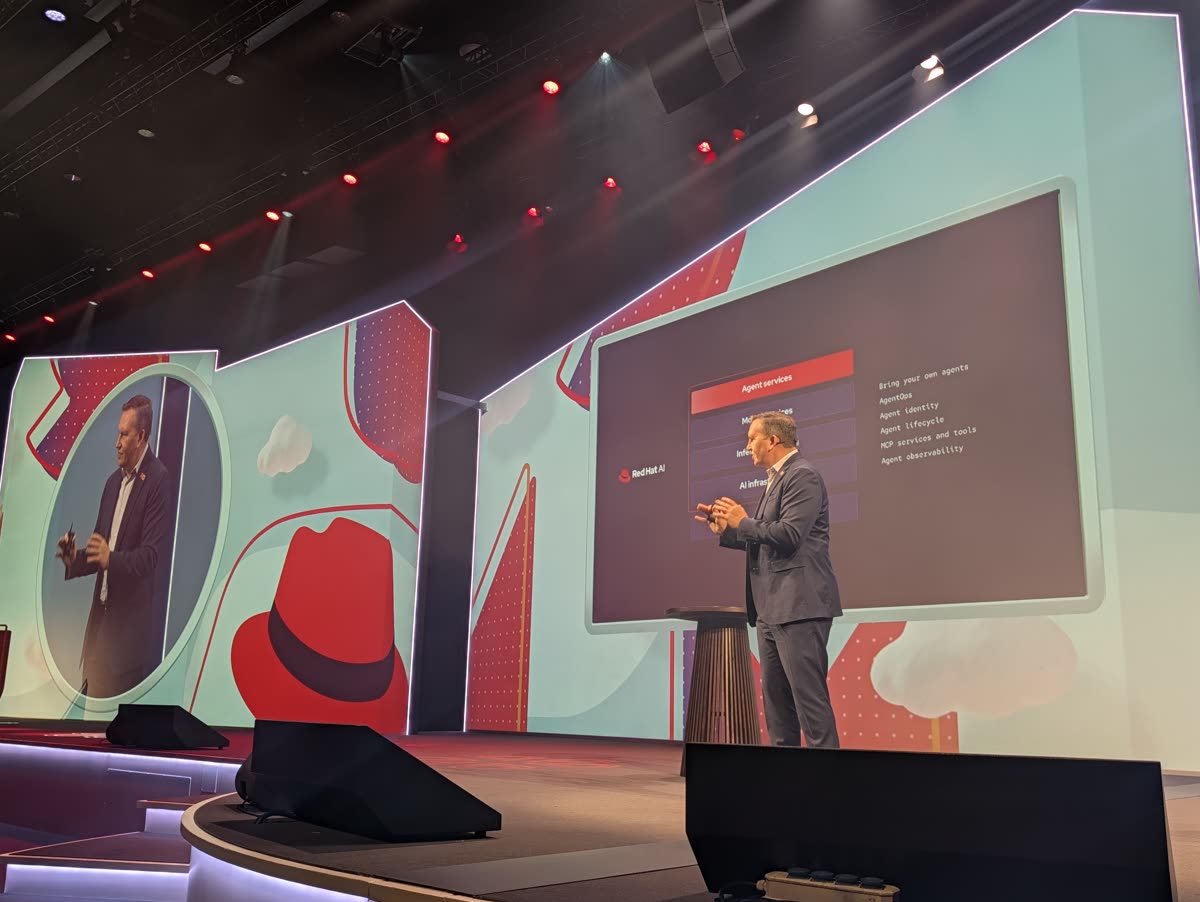
The fifth layer, inference services, sits between the model and the infrastructure layers; I did not catch its highlight.
Automation Orchestrator for Ansible
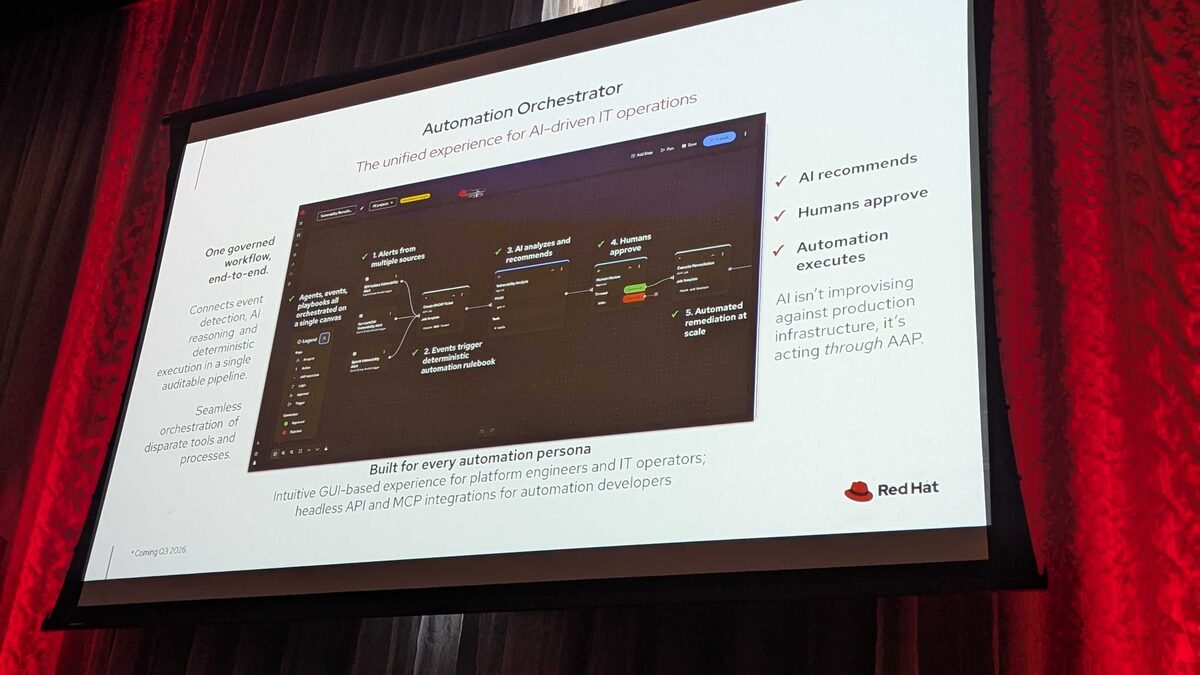
The product news came with a slide titled “Introducing the Automation Orchestrator for Ansible: the trusted execution layer for AI-driven IT operations”, and a workflow it called “one governed workflow, end-to-end”:
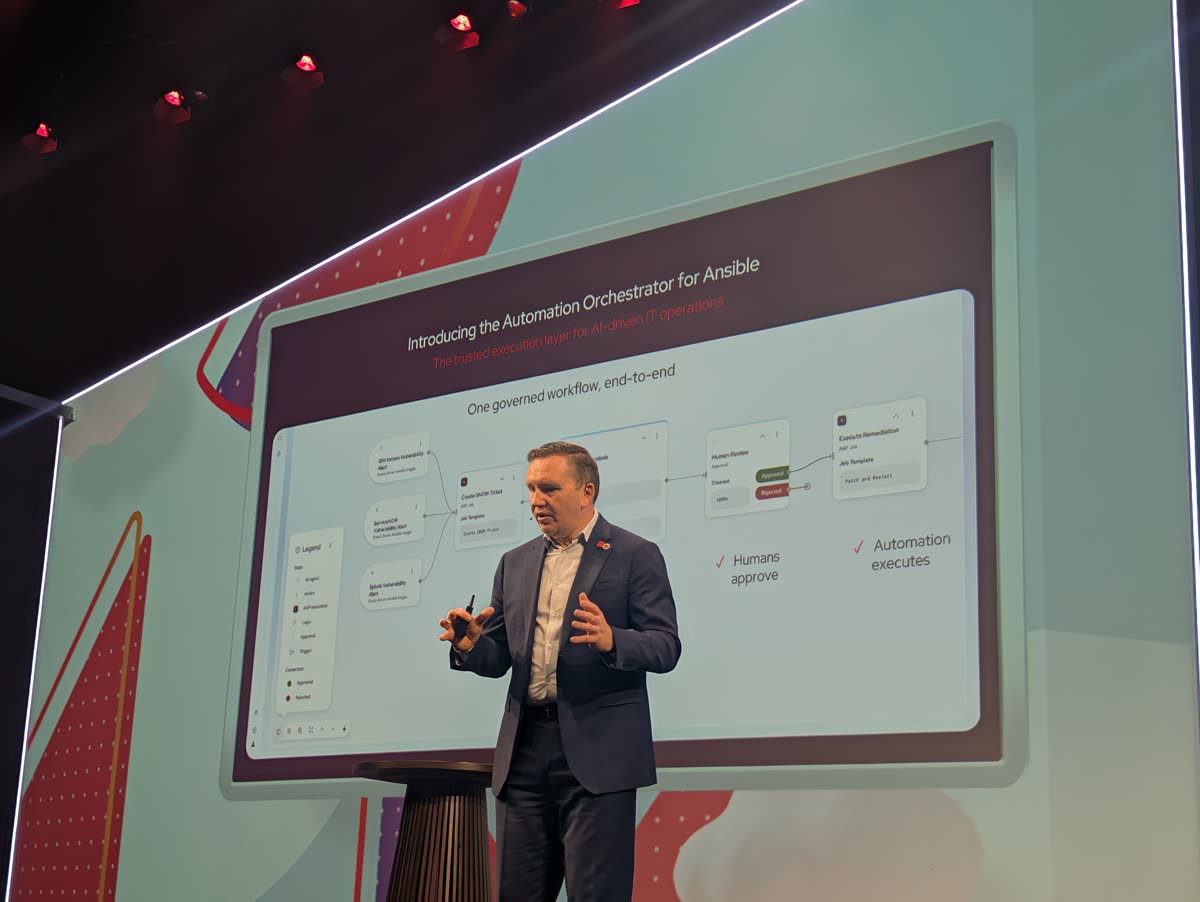
Three vulnerability alerts (from IBM Instana, ServiceNow and Splunk, each an Event-Driven Ansible trigger) open a ServiceNow ticket through an Ansible Automation Platform job. An analysis step follows, then a human review with an approve or reject gate and a timeout of 3600 seconds, and only after approval an “Execute Remediation” job with the “Patch and Restart” template. The slide summed it up under two ticks: humans approve, automation executes.
Red Hat’s own agenda has a session on the same idea at 11:30, “Before the exploit strikes”, by Jürgen Buddy Hoffmann, Ansible Platform Leader: “AI agent swarms can weaponize vulnerabilities in 30 minutes”, and Ansible Automation Platform compresses remediation “from weeks to hours with human-in-the-loop control”.
The ground has shifted
Andrew Brown then moved from the products to the reasons for them. No new name slide came up between his and Intel’s, so the next slides were his.
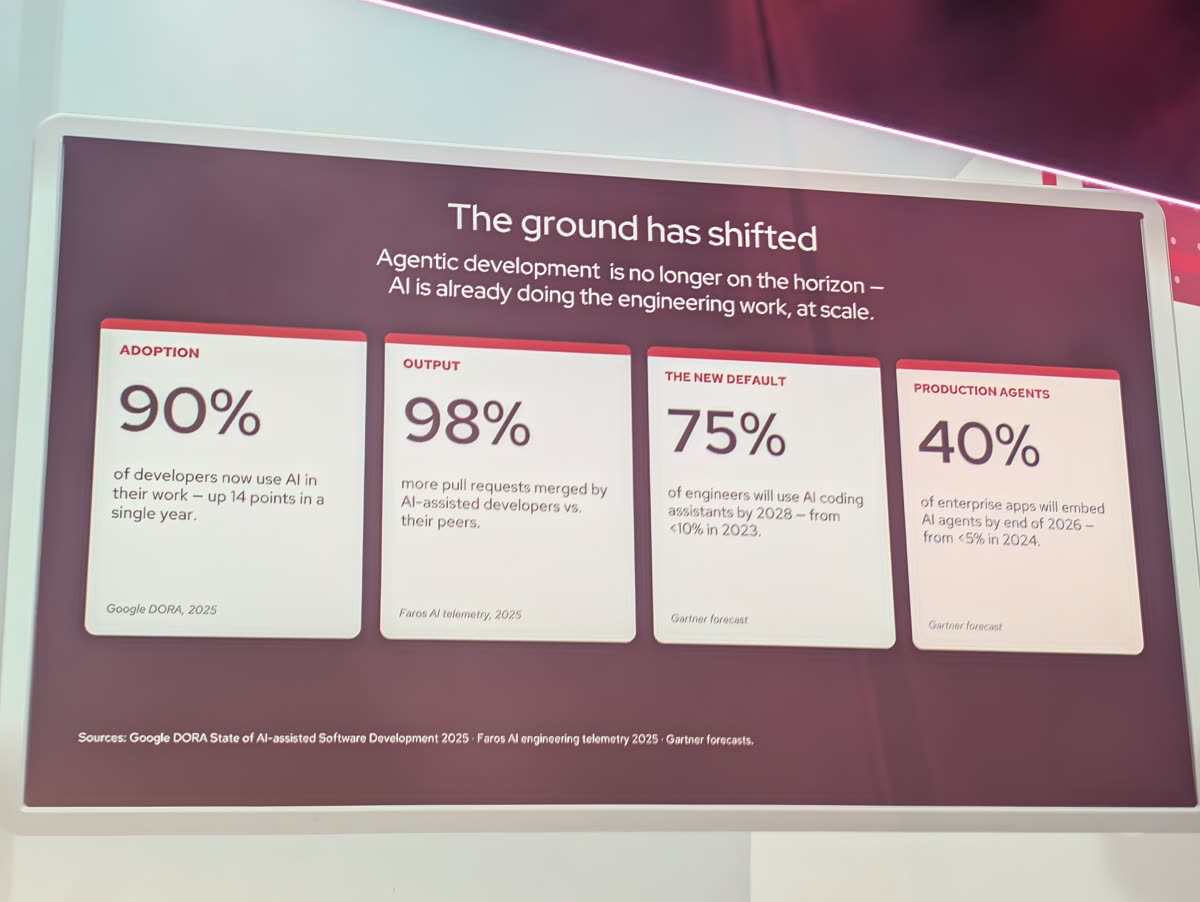
“The ground has shifted” said that agentic development is no longer on the horizon: AI is already doing the engineering work, at scale. Four cards, each with its source on the slide:
- 90% of developers now use AI in their work, up 14 points in a single year (Google DORA, 2025).
- 98% more pull requests merged by AI-assisted developers than by their peers (Faros AI telemetry, 2025).
- 75% of engineers will use AI coding assistants by 2028, from under 10% in 2023 (Gartner forecast).
- 40% of enterprise apps will embed AI agents by the end of 2026, from under 5% in 2024 (Gartner forecast).
Next, “The Mythos Moment: when discovery outpaces defense”:
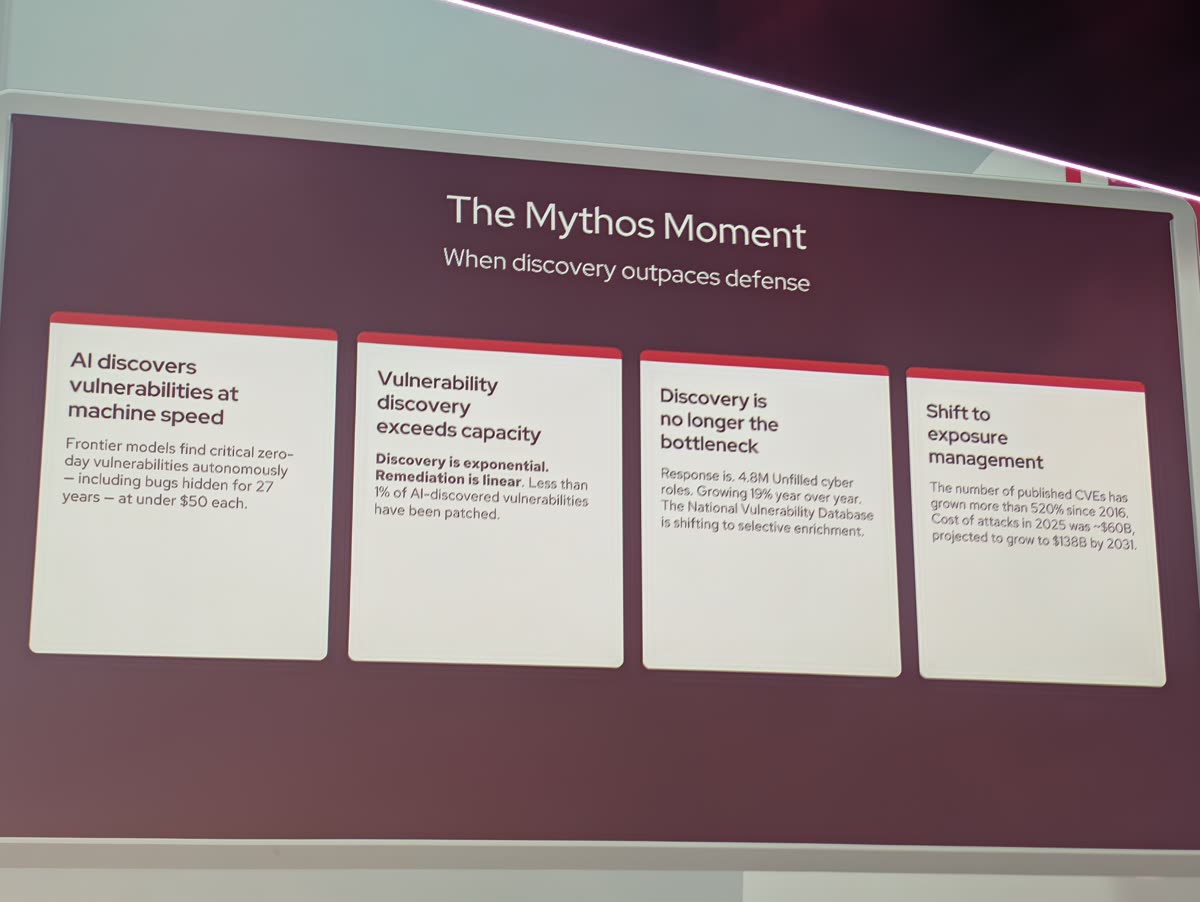
- AI discovers vulnerabilities at machine speed. Frontier models find critical zero-day vulnerabilities autonomously, including bugs hidden for 27 years, at under $50 each.
- Discovery exceeds capacity. “Discovery is exponential. Remediation is linear.” Less than 1% of AI-discovered vulnerabilities have been patched.
- Discovery is no longer the bottleneck; response is. 4.8 million unfilled cyber roles, growing 19% year over year, and the National Vulnerability Database shifting to selective enrichment.
- Shift to exposure management. Published CVEs are up more than 520% since 2016; the cost of attacks in 2025 was about $60 billion, projected to reach $138 billion by 2031.
These are the slide’s numbers, not mine, and I have not checked them against their sources.
Then a chart, “From Vulnerability to Exploitation”, under the title “AI is accelerating the security vulnerability landscape”:
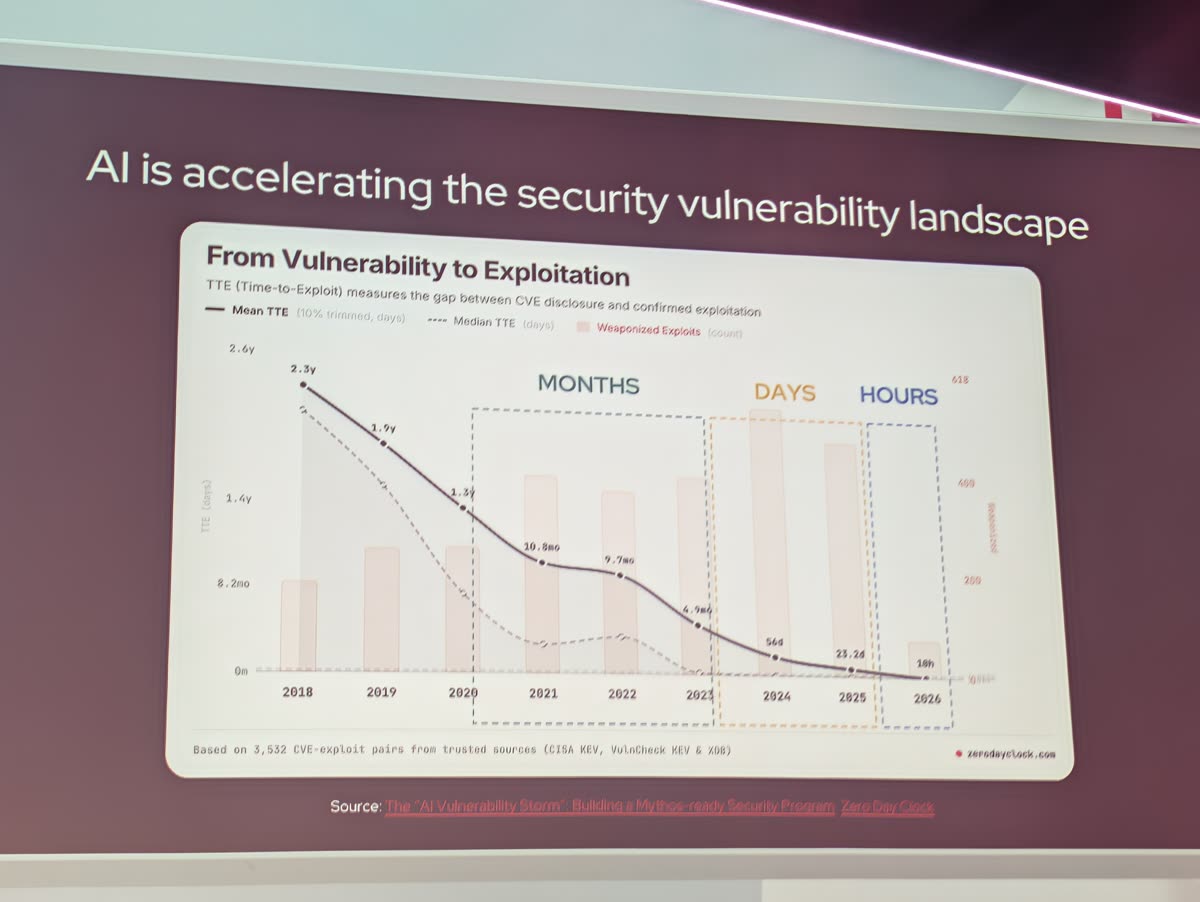
It plots the mean time to exploit, the gap between a CVE’s disclosure and confirmed exploitation, from 2.3 years in 2018, through 10.8 months in 2021, to 56 days in 2024 and 18 hours in 2026, with the zones labelled months, days and hours. The slide says it is based on 3,532 CVE-exploit pairs from CISA KEV and VulnCheck KEV and XDB, and cites zerodayclock.com and a report titled “The AI Vulnerability Storm: Building a Mythos-ready Security Program”.
His answer started with a slide titled “Your trusted source of secure open source software for 30 years”:
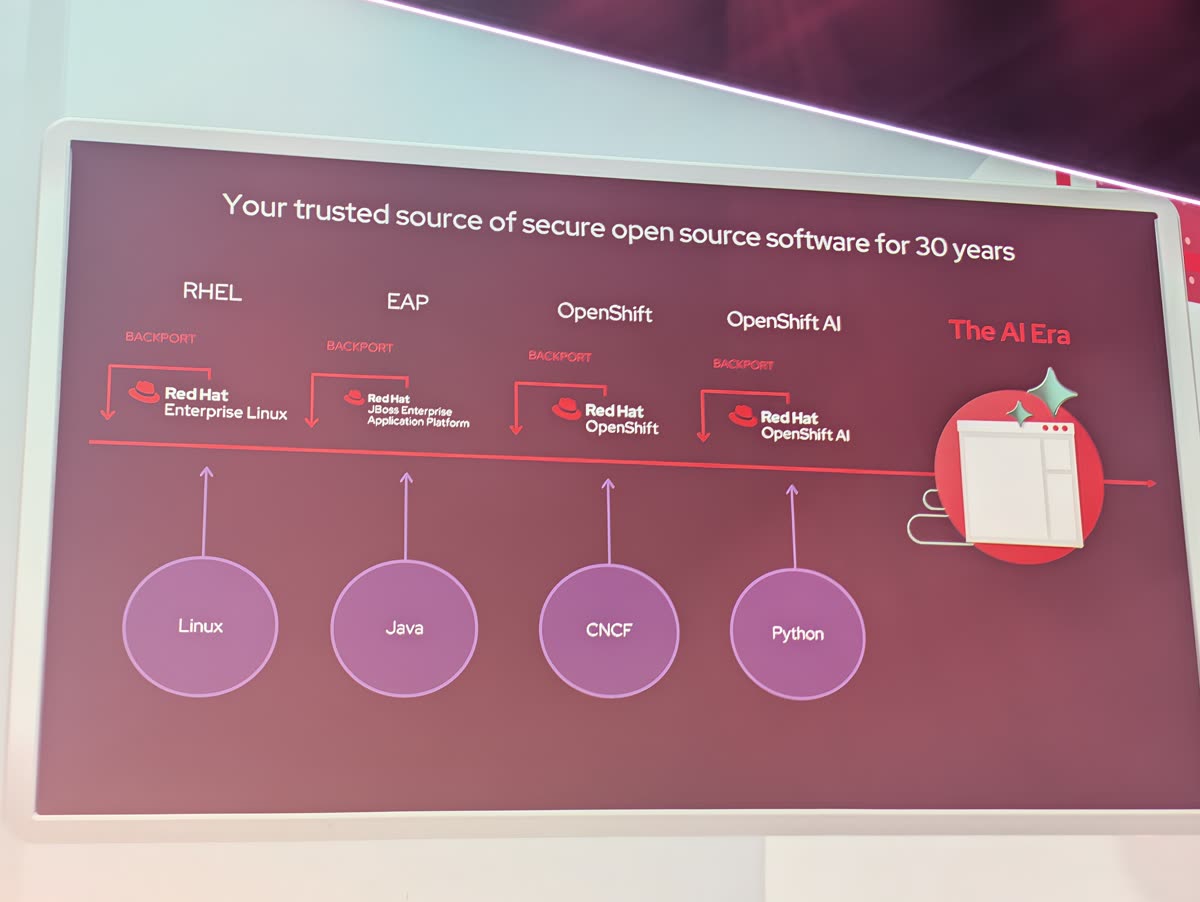
Four Red Hat products, each above the upstream community it builds on, with arrows labelled “backport”: Red Hat Enterprise Linux over Linux, JBoss EAP over Java, OpenShift over the CNCF, OpenShift AI over Python. Then a fifth column, in red: “The AI Era”.
Intel: tokens per watt
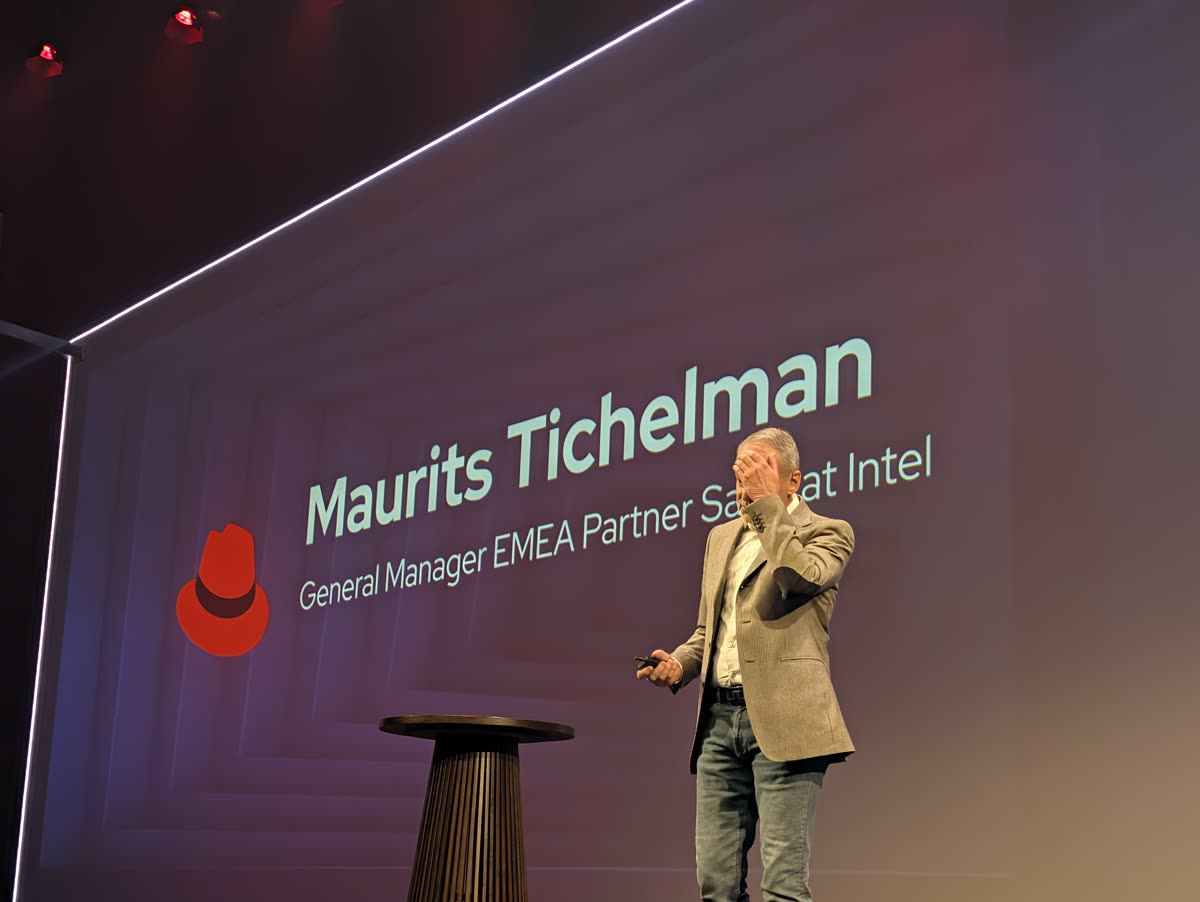
The lead sponsor had the next slot. Maurits Tichelman, General Manager EMEA Partner Sales at Intel Corporation, opened with “Trusted, Open, Sovereign: The New Foundation for Enterprise…” (the last word was behind him), and then showed why Intel wants to talk about tokens.
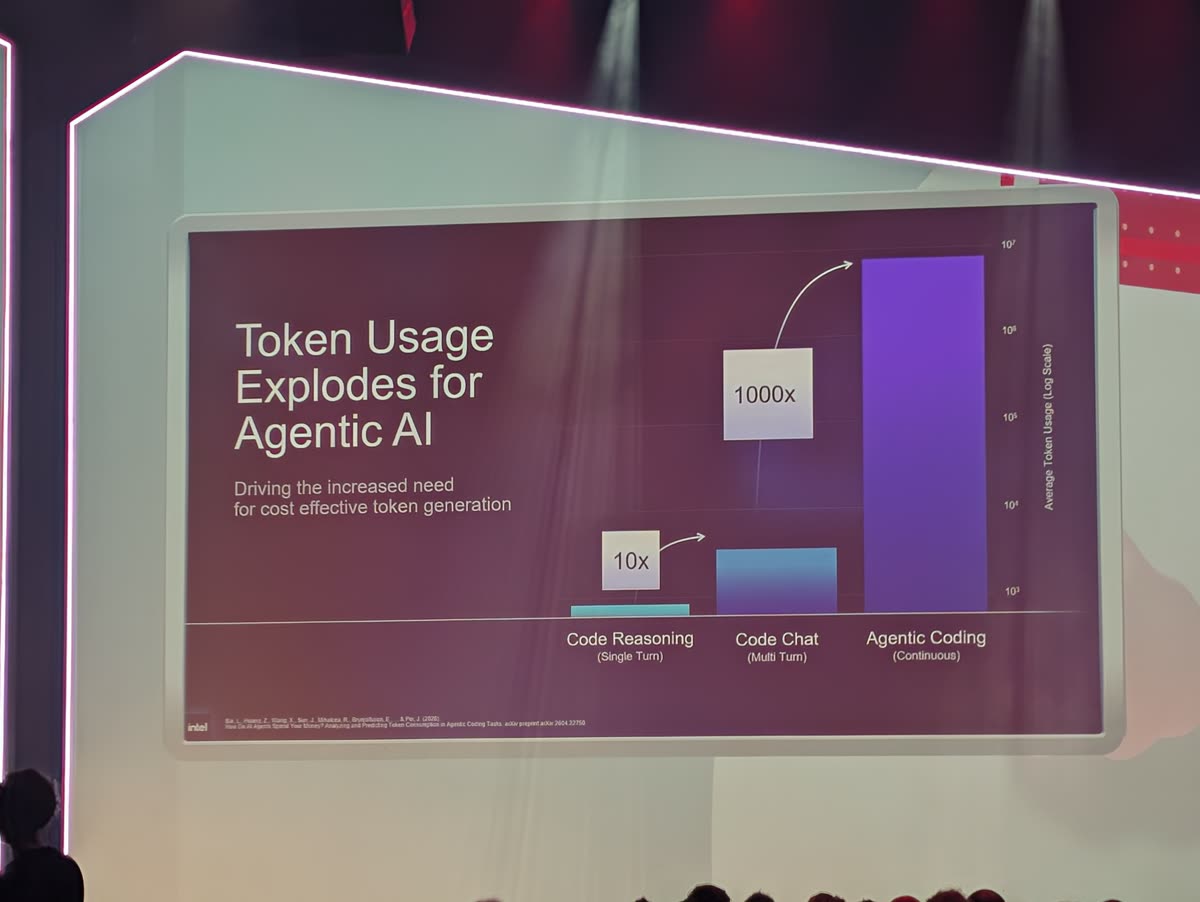
“Token Usage Explodes for Agentic AI”, said the slide, “driving the increased need for cost effective token generation”. Three bars on a log scale of average token usage: code reasoning (single turn), code chat (multi turn), annotated 10x, and agentic coding (continuous), annotated 1000x. The small print cites a 2026 arXiv preprint, as far as I can read it “How Do AI Agents Spend Your Money? Analyzing and Predicting Token Consumption in Agentic Coding Tasks”. It is the other side of Andrew Brown’s tokenomics slide: when each token gets cheaper but agents use thousands of times more of them, the bill grows.
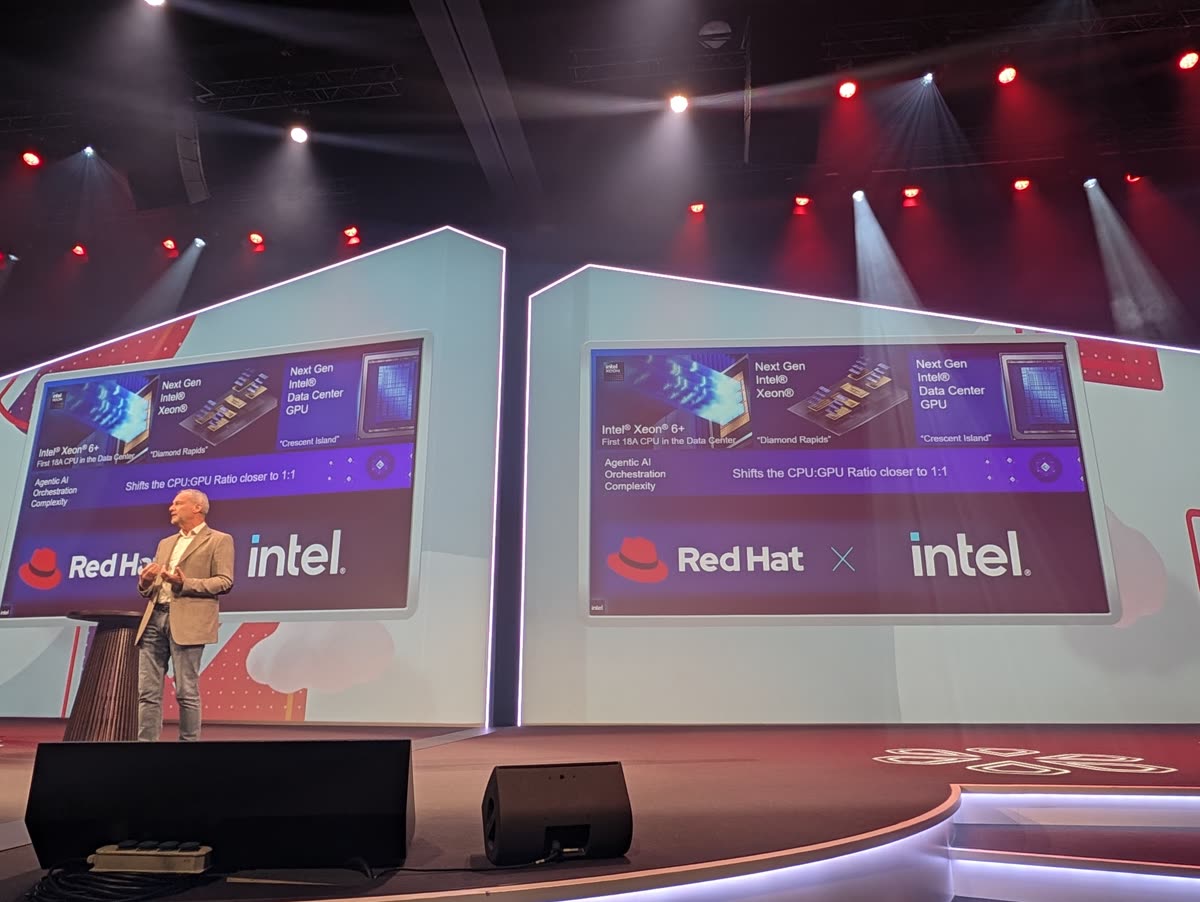
Then the hardware. The next-generation Intel data center GPU, codenamed Crescent Island, “designed for tokens/watt, built on a reliable open software stack”: built for agentic AI, large context capability, power optimized. And on the CPU side, the Intel Xeon 6+, “the first 18A CPU in the data center”, with the next generation, “Diamond Rapids”, to follow. His point on the last slide was that agentic AI orchestration complexity “shifts the CPU:GPU ratio closer to 1:1”, under a Red Hat × Intel logo.
Back to Andrew Brown: an agentic SDLC
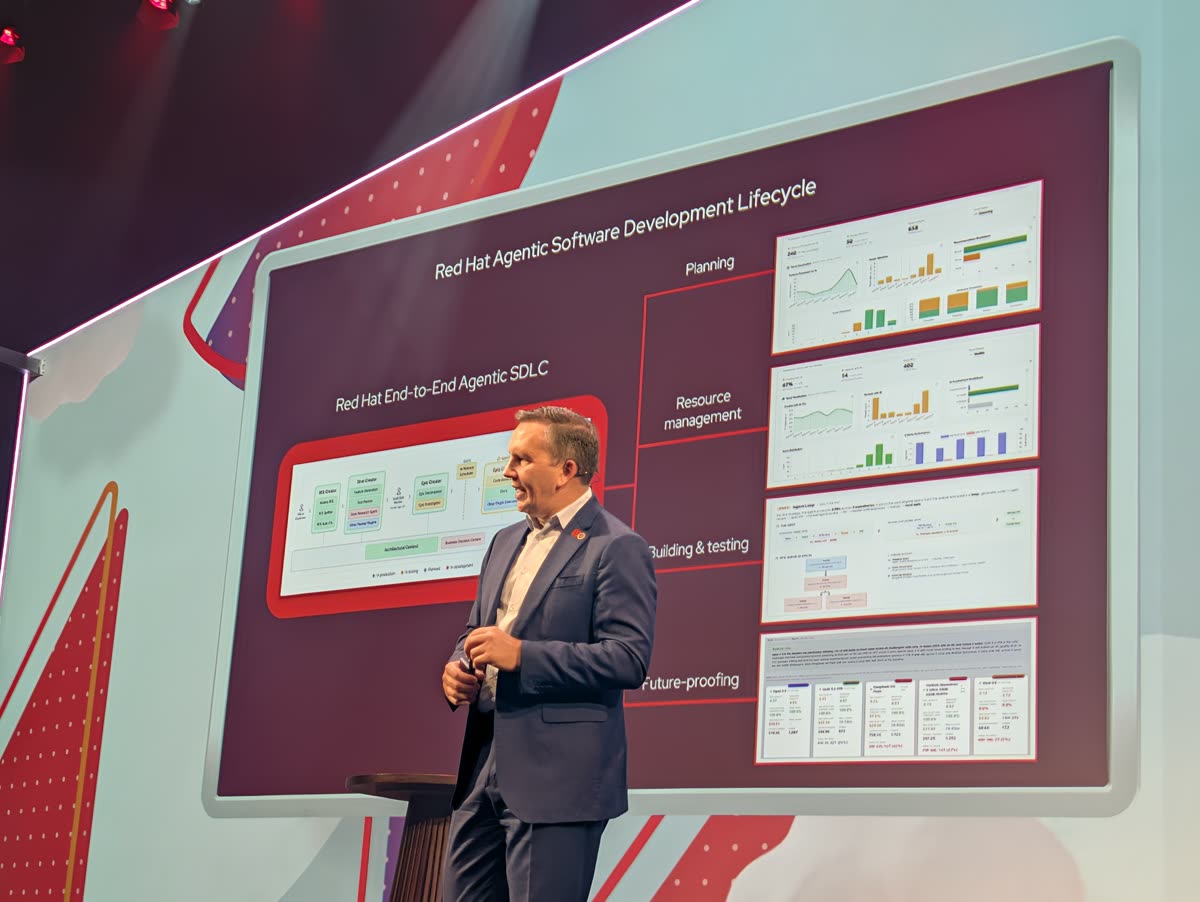
Andrew Brown came back on stage with “Red Hat Agentic Software Development Lifecycle”, a slide titled “Red Hat End-to-End Agentic SDLC”. On the left, a pipeline of agent steps from requirements through epics and code generation to build and release, with architectural and business decision context underneath. On the right, four dashboards labelled planning, resource management, building and testing, and future-proofing. The small print was too small for me to read.
Vincent Danen: the vulnerability gap
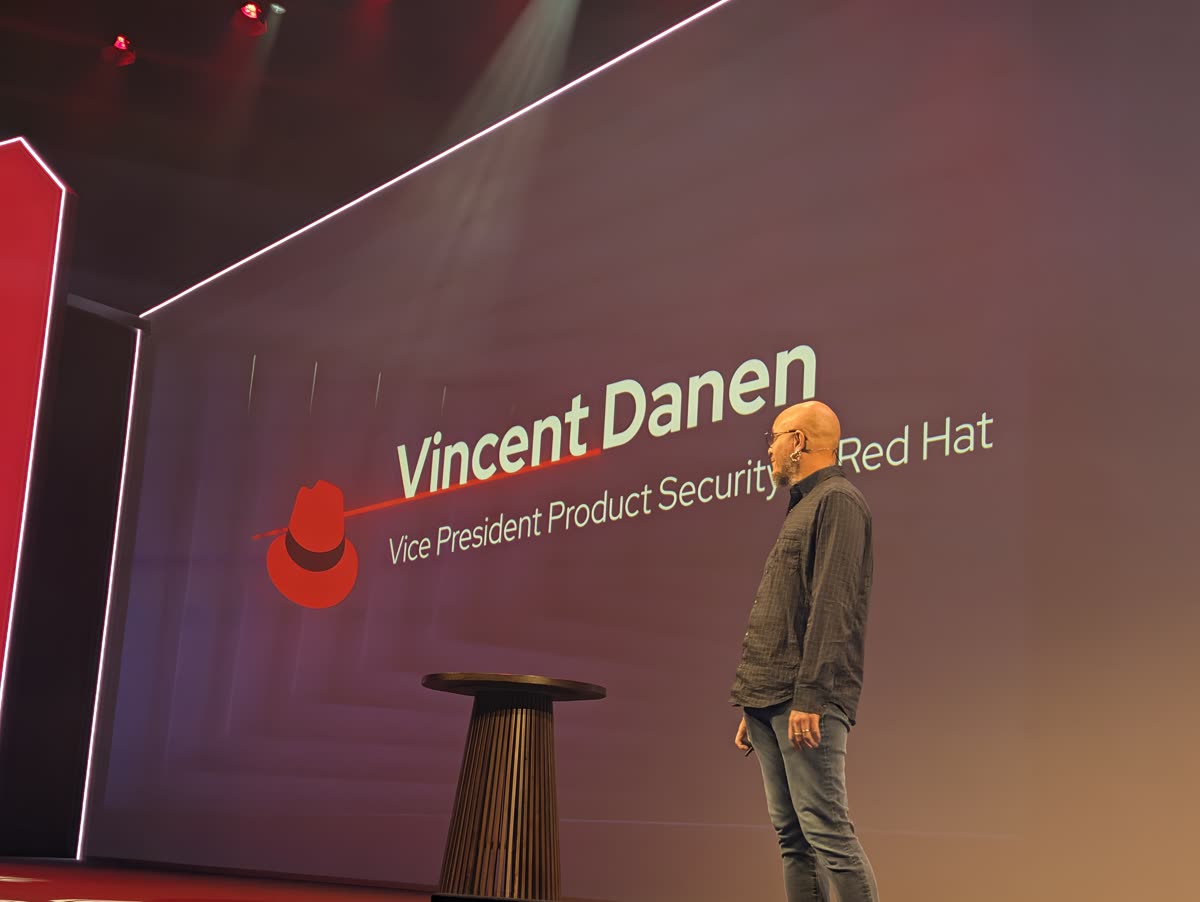
The last speaker I photographed was Vincent Danen, Vice President Product Security at Red Hat. His first slide had two logos: Fedora Hummingbird Linux and Red Hat Hardened Images. Then he came to the problem, on a slide titled “Accelerating two parallel challenges: ‘The vulnerability gap’”:
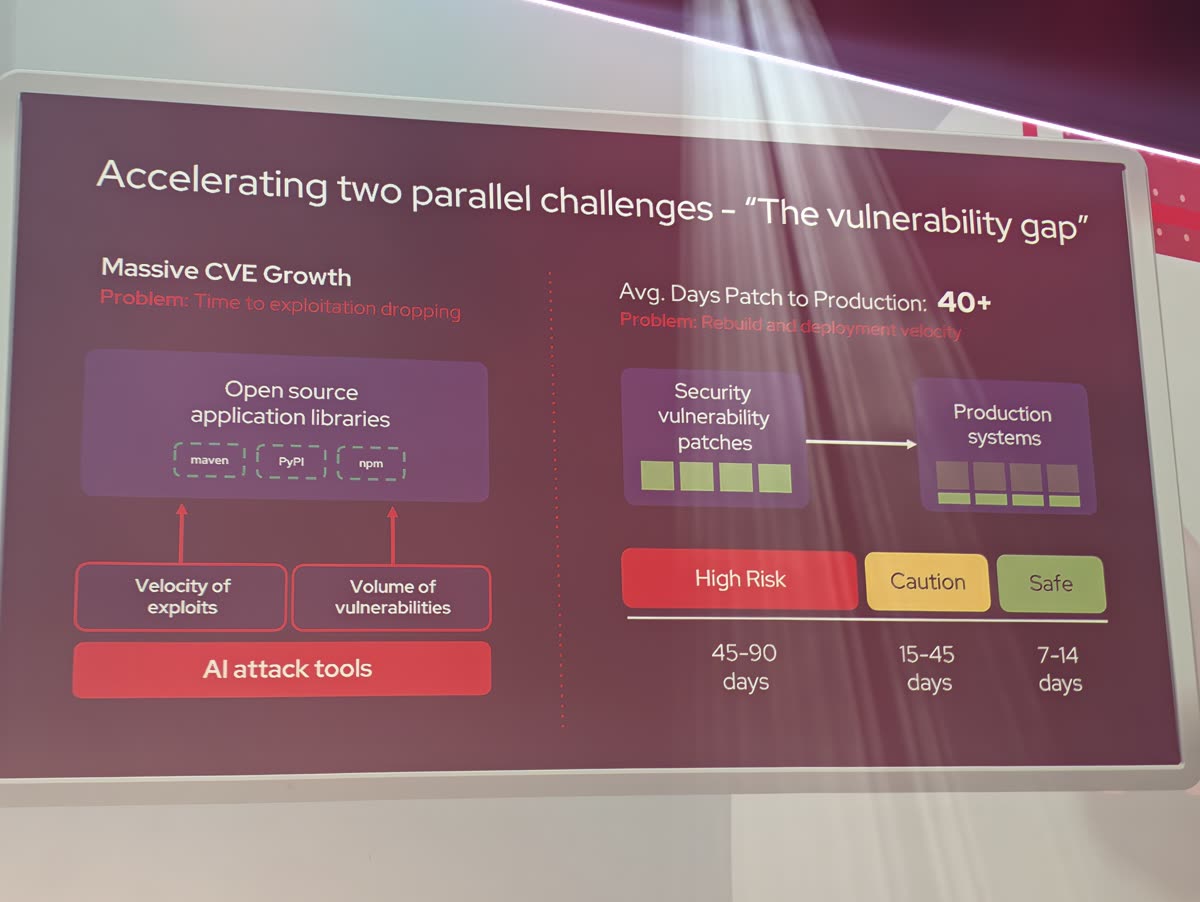
- Massive CVE growth. The problem: time to exploitation dropping. Open source application libraries (the slide names Maven, PyPI and npm) are hit by the velocity of exploits and the volume of vulnerabilities, both pushed by “AI attack tools”.
- Average days from patch to production: 40+. The problem: rebuild and deployment velocity. The slide sorts the time a security patch takes to reach production into three bands: high risk at 45 to 90 days, caution at 15 to 45 days, safe at 7 to 14 days.
His answer was Lightwell, “a clearinghouse for open source vulnerabilities”:
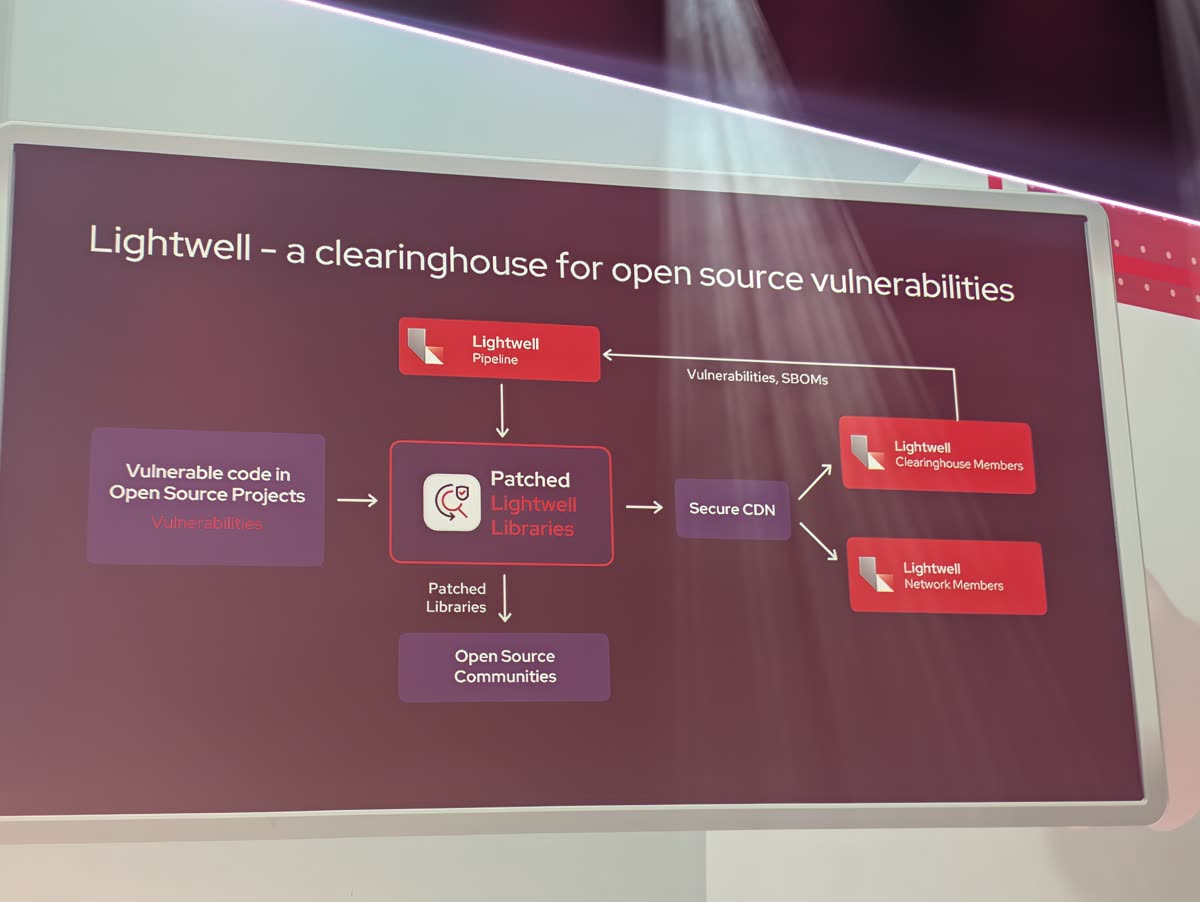
Vulnerable code in open source projects goes through the Lightwell pipeline and comes out as patched Lightwell libraries. Those are served from a secure CDN to the clearinghouse members and the network members, who send vulnerabilities and SBOMs back to the pipeline. The patched libraries also go back to the open source communities. The agenda has a session on it at 14:00, “From CVE to Production Fix: Upgrade-Free Remediation with Red Hat Lightwell Network”, about scoping the blast radius and backporting patches “to the versions you already run”.
Three numbers
Put three numbers from the keynote next to each other. Marcel Timmer’s footnote: 24.21 hours to deploy a critical fix, on average. Andrew Brown’s chart: 18 hours from disclosure to exploitation, in 2026. Vincent Danen’s slide: more than 40 days on average from a patch to production. They measure different things, from different sources, and I would not subtract one from another. They point the same way: the time to exploit has fallen below the time to patch. The keynote showed two answers. One is governed automation, where the slide made a point of showing where the humans approve. The other is patched libraries that arrive already backported, so that fixing does not wait for an upgrade.
What else was on
My photos stop at 10:25, so I leave the breakouts to the official agenda. A few that caught my eye, in the order of the day:
- 11:30, Red Hat: “Before the exploit strikes”, with Ansible Automation Platform and human-in-the-loop remediation.
- 11:30 to 14:00, ITQ and Dell: a hackathon, “From Prompt to Production: build an app with AI, deploy it on OpenShift”.
- 14:00, Red Hat: “From CVE to Production Fix: Upgrade-Free Remediation with Red Hat Lightwell Network”.
- 14:00, ITQ: “Why Catharina Hospital Chose Open Source for Healthcare AI”, in Dutch.
- 15:15, Vincent Danen, Red Hat: “The sky is not falling, but you still need an umbrella: moving from hype to execution”, on AI-driven vulnerability discovery and why mass patching is not the answer.
- 15:15, Red Hat: “What’s new in OpenShift 5?” and “Who’s using your AI? Usage, costs, and control on Red Hat OpenShift AI”.
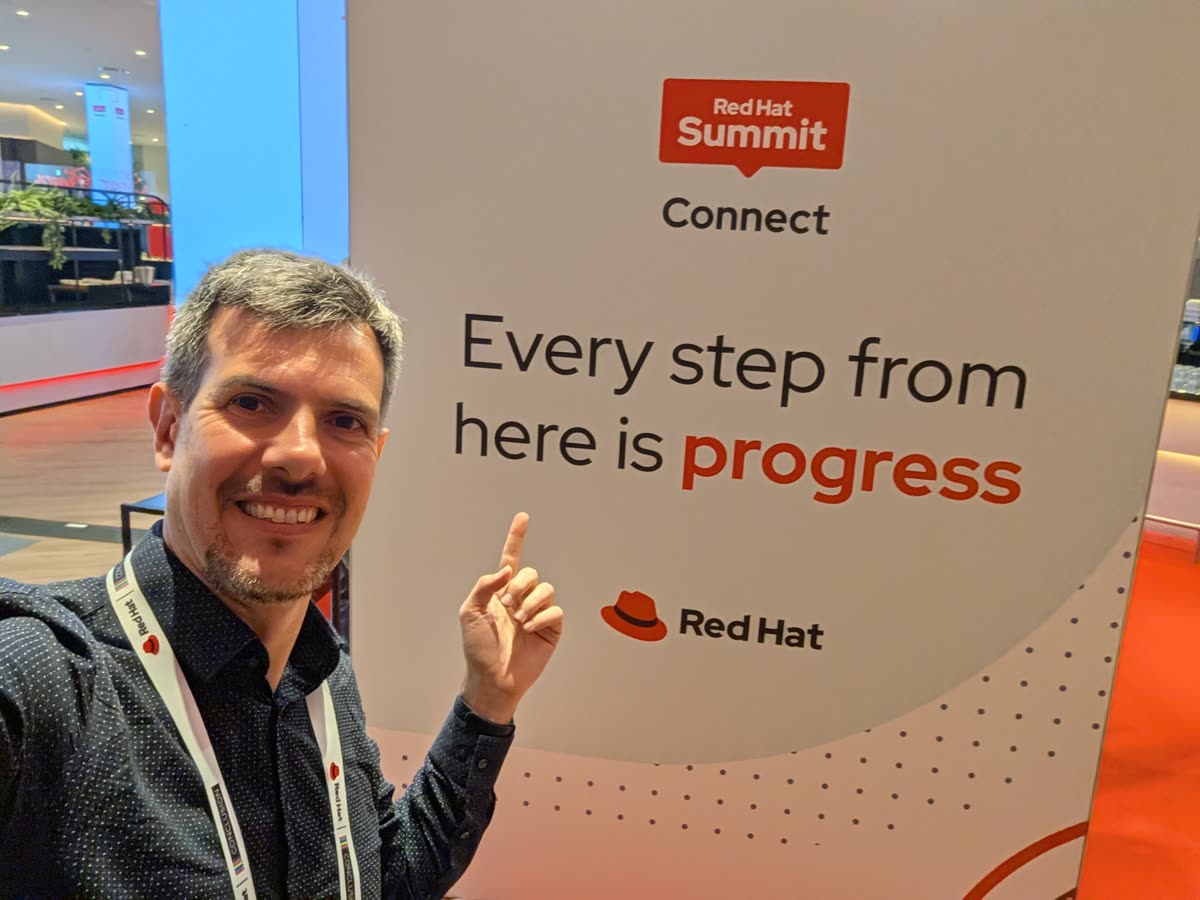
Thanks to the Red Hat Netherlands team and to the sponsors for the day.