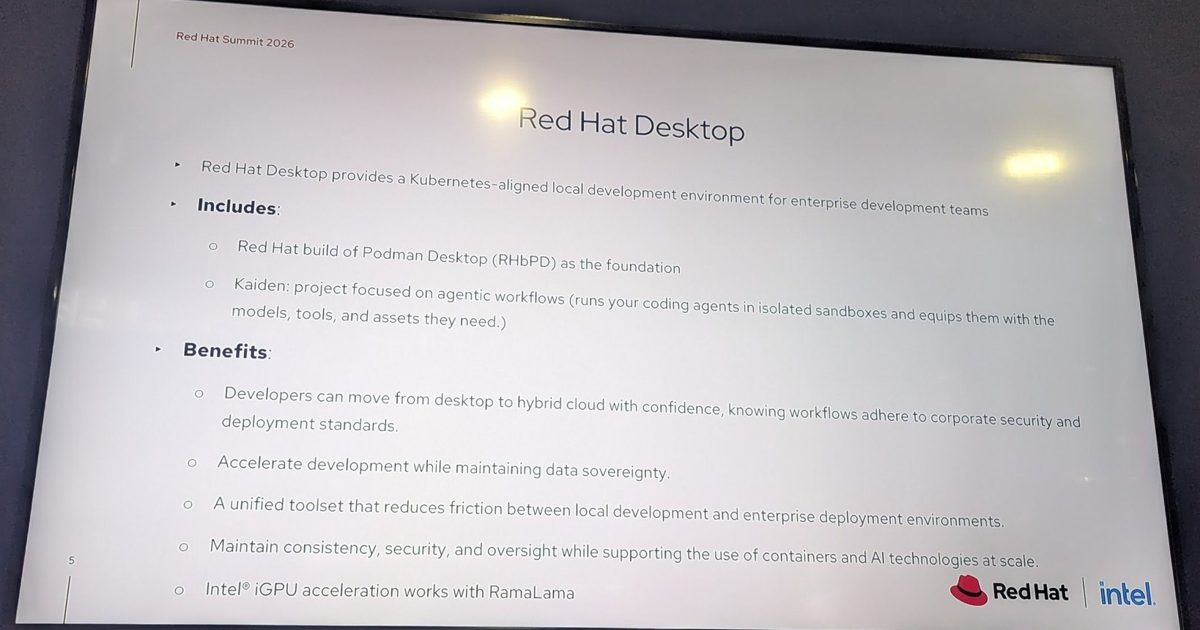
Monday 11 May 2026 was the partner day of Red Hat Summit in Atlanta, and my photos from it fall into two groups. In the afternoon, Omdia analyst slides on how customers buy AI and what digital sovereignty means for partners. A bit later, a Red Hat and Intel session at the expo hall about Red Hat Desktop, Kaiden and local AI on Intel Core Ultra laptops. This post covers only what was on those slides, checked against Red Hat’s public pages. The wider event is in my Atlanta overview and the keynote announcements.
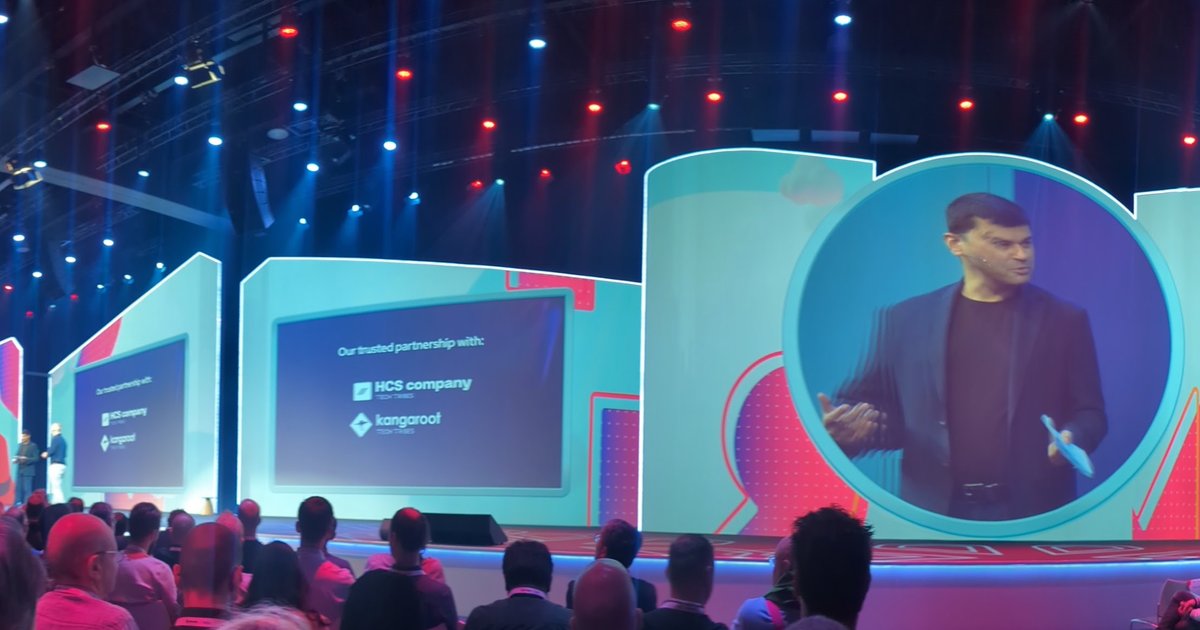
The breakout agenda on the screens listed “Maximize the value of your Red Hat partnership”, “Architecting the future of AI”, “Automating the automators”, “Accelerating RHEL growth” and “Capturing the virtualization land grab”.
Red Hat Desktop and Kaiden
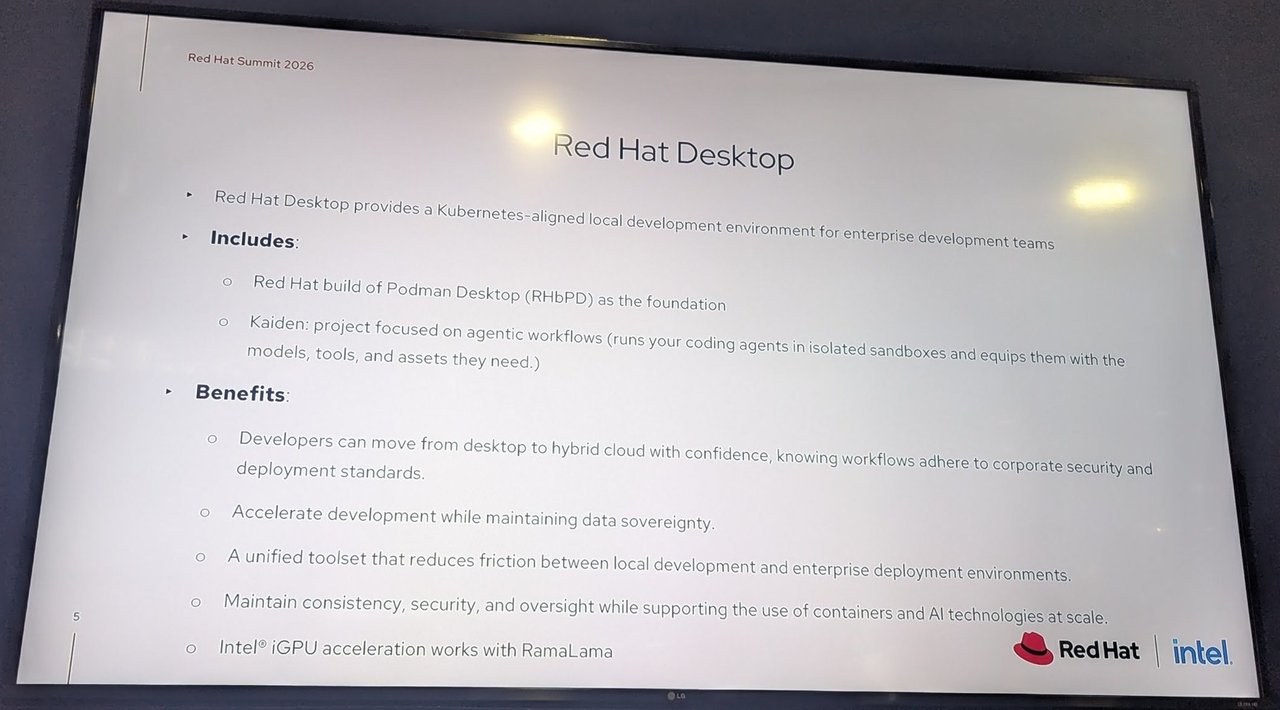
The Red Hat Desktop slide from the Red Hat and Intel session.
The slide describes Red Hat Desktop as a Kubernetes-aligned local development environment for enterprise development teams. It lists two parts:
- the Red Hat build of Podman Desktop (RHbPD) as the foundation;
- Kaiden, described as a project focused on agentic workflows that runs your coding agents in isolated sandboxes and equips them with the models, tools and assets they need.
The benefits listed are moving from desktop to hybrid cloud while following corporate security and deployment standards, accelerating development while maintaining data sovereignty, one toolset between local development and enterprise deployment, and consistency and oversight for containers and AI at scale. The last bullet says Intel iGPU acceleration works with RamaLama.
Is Kaiden public? Yes. Red Hat’s Red Hat Desktop announcement (12 May 2026) calls it an upstream, open source local AI development platform, and the Kaiden site says it is Apache 2.0 licensed and runs each agent session in a Podman container or a libkrun microVM. The product itself is on the Red Hat Desktop page.
One correction to my own earlier coverage: in the keynote post I described Red Hat Desktop as the new name for Podman Desktop. Both the slide and Red Hat’s announcement describe it as built on the Red Hat build of Podman Desktop, with Kaiden alongside it, so treat it as a product that includes Podman Desktop rather than a plain rename.
What Intel Core Ultra adds
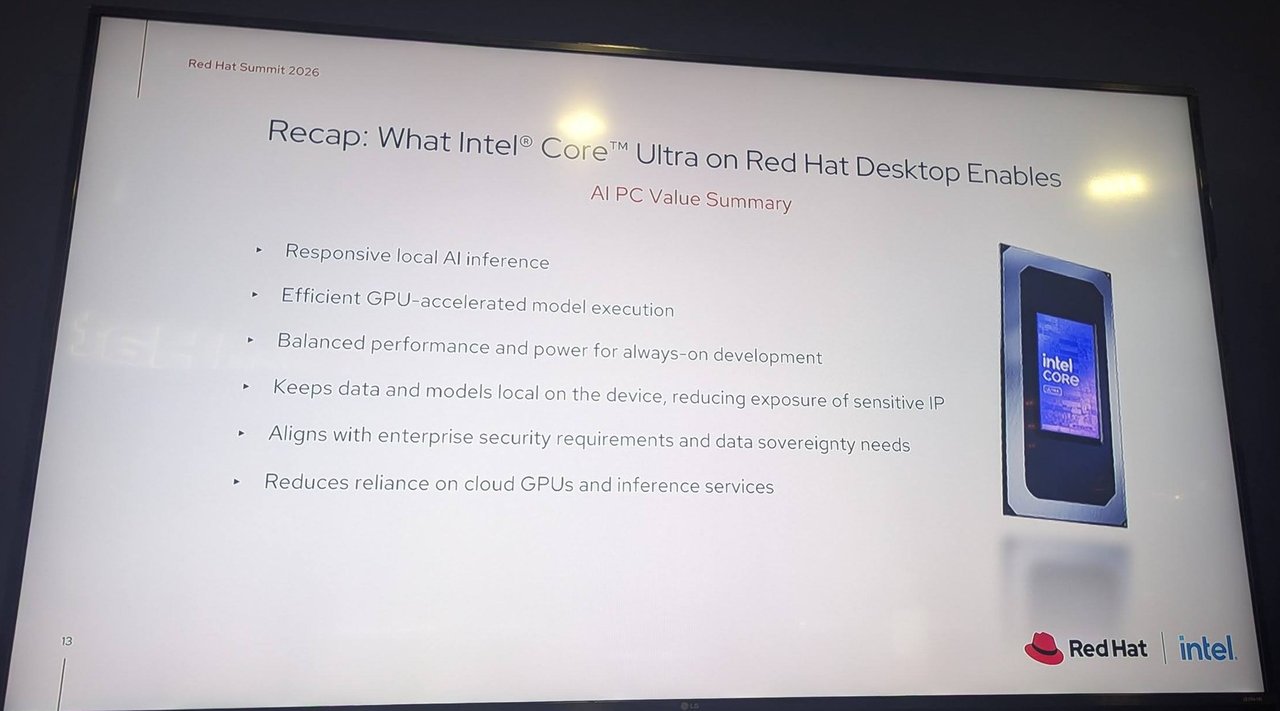
The recap slide: responsive local AI inference, efficient GPU-accelerated model execution, balanced performance and power for always-on development, data and models kept local on the device, alignment with enterprise security and data sovereignty needs, and less reliance on cloud GPUs and inference services.
The session was framed around Intel Core Ultra Series 3 laptops with the built-in Intel Arc GPU. Another slide showed a terminal where ramalama served a small quantised Llama 3.2 1B model from a container image on Windows, as part of an environment-setup walkthrough. A final slide invited people to apply for a free Intel and Red Hat Gen AI proof of concept: fine-tuning a small language model for your data, building agentic AI or model-as-a-service, or optimising inference on Intel Gaudi and Xeon with vLLM. Those are the slide’s words; I have not tried the offer.
My take: the interesting claim is not raw speed but placement. If agents and small models run on the developer laptop inside a sandbox, sensitive code and data stay on the device, which is the same data-control argument I make for sovereign stacks at cluster level.
Omdia: how customers buy agentic AI
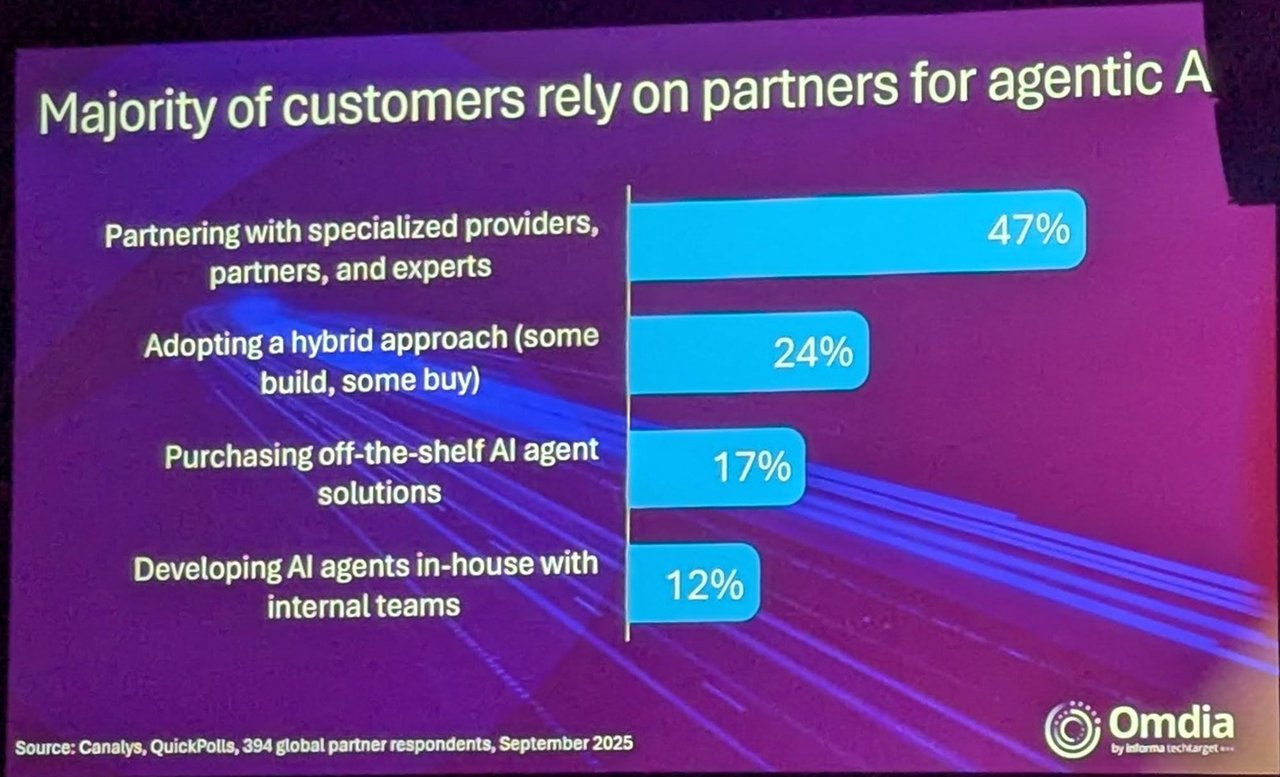
Omdia slide: 47% partner with specialised providers, 24% take a hybrid build and buy approach, 17% buy off-the-shelf agents, 12% build in-house. Source on the slide: Canalys QuickPolls, 394 global partner respondents, September 2025.
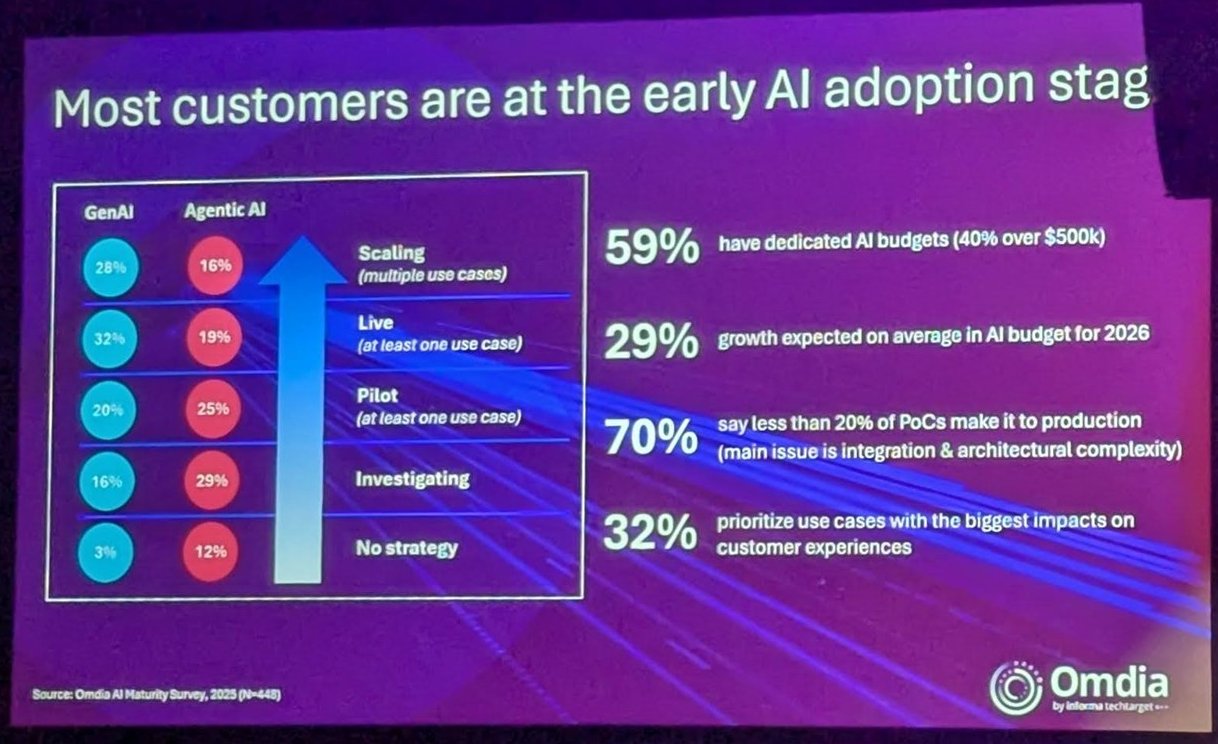
Omdia slide (source: Omdia AI Maturity Survey 2025, N=448): 59% have dedicated AI budgets, 29% average budget growth expected for 2026, and 70% say fewer than 20% of proofs of concept reach production, mainly because of integration and architectural complexity.
For agentic AI, the maturity bubbles on the slide put 16% of respondents at scaling and 12% with no strategy, against 28% and 3% for generative AI. The message for a partner audience was that customers want help with integration, which matches what I see in consulting: the model is rarely the blocker.
Omdia: partner opportunities in digital sovereignty
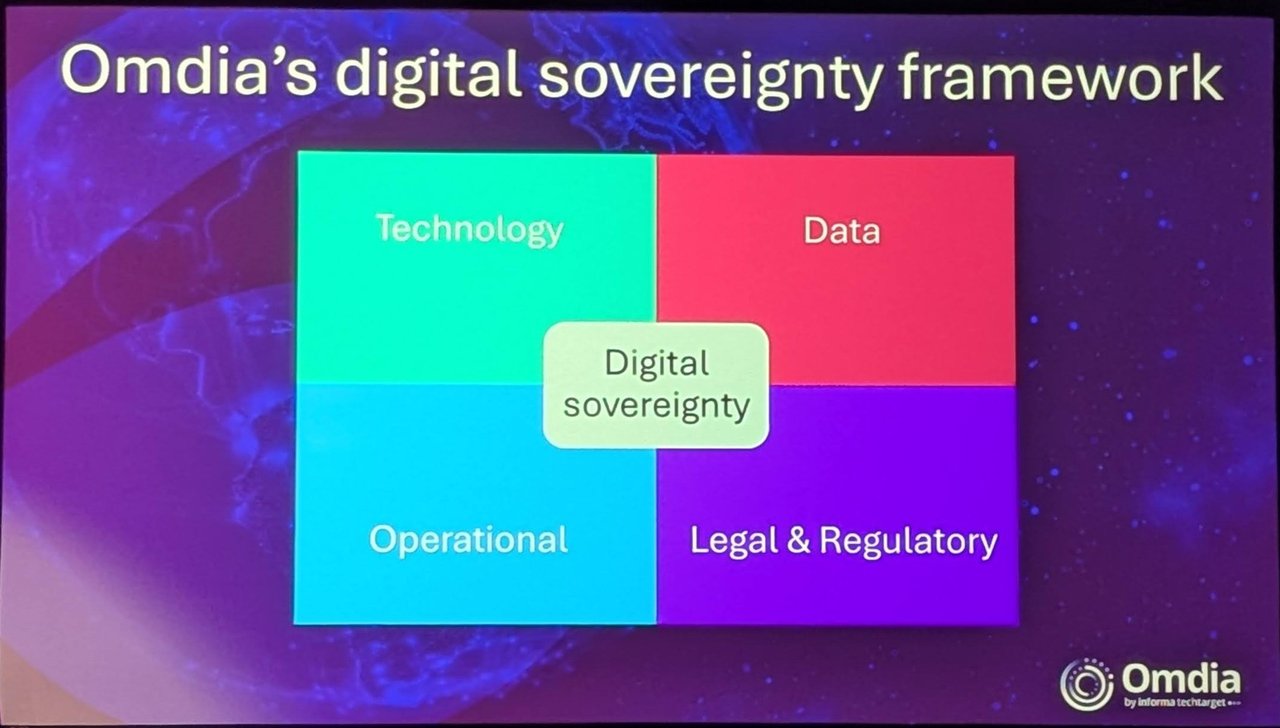
Omdia’s digital sovereignty framework, drawn as four quadrants: Technology, Data, Operational, and Legal and Regulatory.
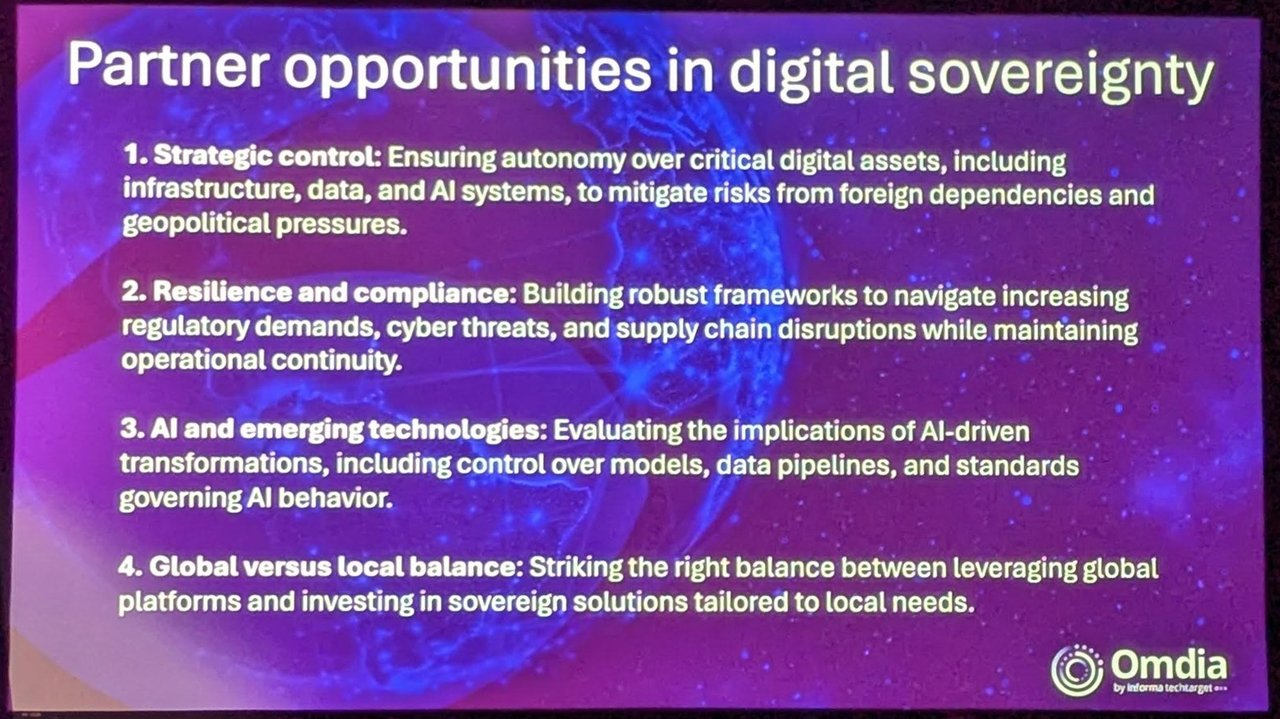
The four partner opportunities on the slide.
The slide lists four opportunities:
- Strategic control: autonomy over critical digital assets, including infrastructure, data and AI systems, to reduce foreign dependencies and geopolitical pressure.
- Resilience and compliance: robust frameworks for regulatory demands, cyber threats and supply chain disruption while keeping operations running.
- AI and emerging technologies: control over models, data pipelines and the standards governing AI behaviour.
- Global versus local balance: using global platforms while investing in sovereign solutions for local needs.
Coming from Europe, I found the fourth point the most practical: nobody serious proposes giving up global platforms, only knowing which layers must stay under local control.
What I left out
Other partner-day content (awards, breakout details, vendor slides) is not covered here. I only used material that matches what Red Hat and Omdia presented publicly or on stage slides, and named no speakers.