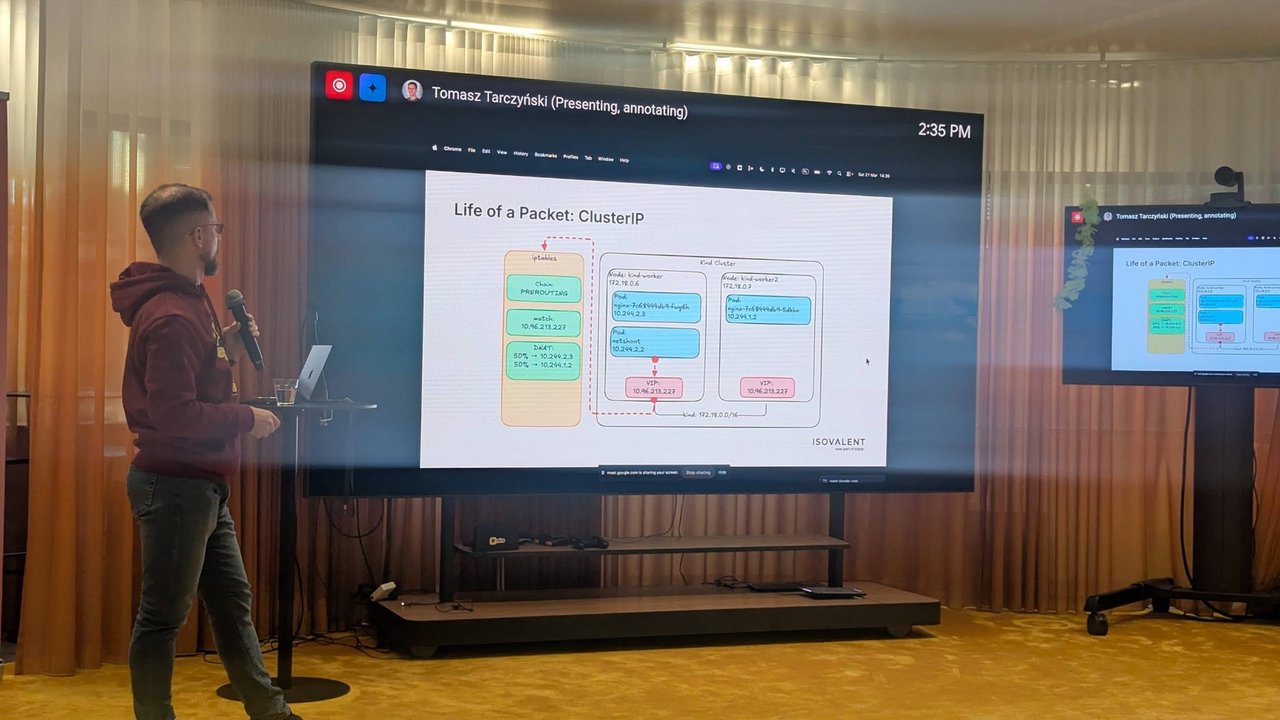
At KubeCon Europe 2026, the CNCF announced that 28% of organizations now have dedicated platform teams. This is not DevOps dying — it is DevOps maturing.
The Key Difference
DevOps = Everyone is responsible for the full lifecycle (build, deploy, run) Platform Engineering = A dedicated team builds the tools so developers do not have to manage infrastructure
| Aspect | DevOps | Platform Engineering |
|---|---|---|
| Who deploys | Each team | Self-service via platform |
| Infrastructure knowledge | Required for all | Abstracted away |
| Cognitive load | High (everyone does everything) | Reduced (golden paths) |
| Tooling | Team choice | Standardized |
| Scaling | Hard past 50 engineers | Built to scale |
Why Platform Engineering Emerged
DevOps works brilliantly for small teams. At 10 engineers, everyone knowing Kubernetes, Terraform, and CI/CD is manageable.
At 200 engineers, it breaks down:
- Every team reinvents deployment pipelines
- 15 different ways to deploy to production
- New hires spend weeks learning internal tooling
- Security and compliance become inconsistent
Platform engineering solves this by building an Internal Developer Platform (IDP) — a self-service layer that gives developers everything they need without touching infrastructure directly.
What a Platform Team Builds
- Self-service deployments — click a button, get a running service
- Golden paths — pre-built templates for common patterns
- Developer portal — service catalog, documentation, APIs (Backstage)
- Automated compliance — security scanning, policy enforcement built in
- Observability — pre-configured dashboards, alerts, logs
# Developer creates this — the platform handles the rest
apiVersion: platform.company.com/v1
kind: Application
metadata:
  name: order-service
spec:
  language: java
  tier: production
  replicas: 3
  database: postgresql
  monitoring: true
The platform team turns this into Kubernetes manifests, CI/CD pipelines, monitoring, DNS, TLS — everything.
They Are Not Competitors
Platform engineering does not replace DevOps principles. It implements them at scale:
- Automation → Platform provides automated everything
- Collaboration → Through self-service, not meetings
- Continuous improvement → Platform team iterates on developer experience
- Shared responsibility → Developers own their apps, platform owns the platform
Think of it as: DevOps is the philosophy, Platform Engineering is the implementation.
Career Implications
DevOps Engineer Role
Still exists, especially in:
- Small-to-medium companies
- Startups (everyone does everything)
- Consulting and advisory
Platform Engineer Role
Growing fast in:
- Enterprises (500+ developers)
- Companies with standardization needs
- Organizations with compliance requirements
Skills Overlap
| Skill | DevOps | Platform Engineering |
|---|---|---|
| Kubernetes | Yes | Yes |
| Terraform/IaC | Yes | Yes |
| CI/CD | Yes | Yes (as platform builder) |
| Developer experience | Sometimes | Core focus |
| API design | Rarely | Often |
| Product thinking | Rarely | Essential |
My Recommendation
If you are a DevOps engineer wondering what to learn next:
- Product thinking — treat developers as your customers
- API design — everything should be self-service
- Backstage — the leading developer portal
- Crossplane — infrastructure as Kubernetes APIs
- Score — platform-agnostic workload spec
The best platform engineers are former DevOps engineers who understand both the infrastructure and the developer experience.