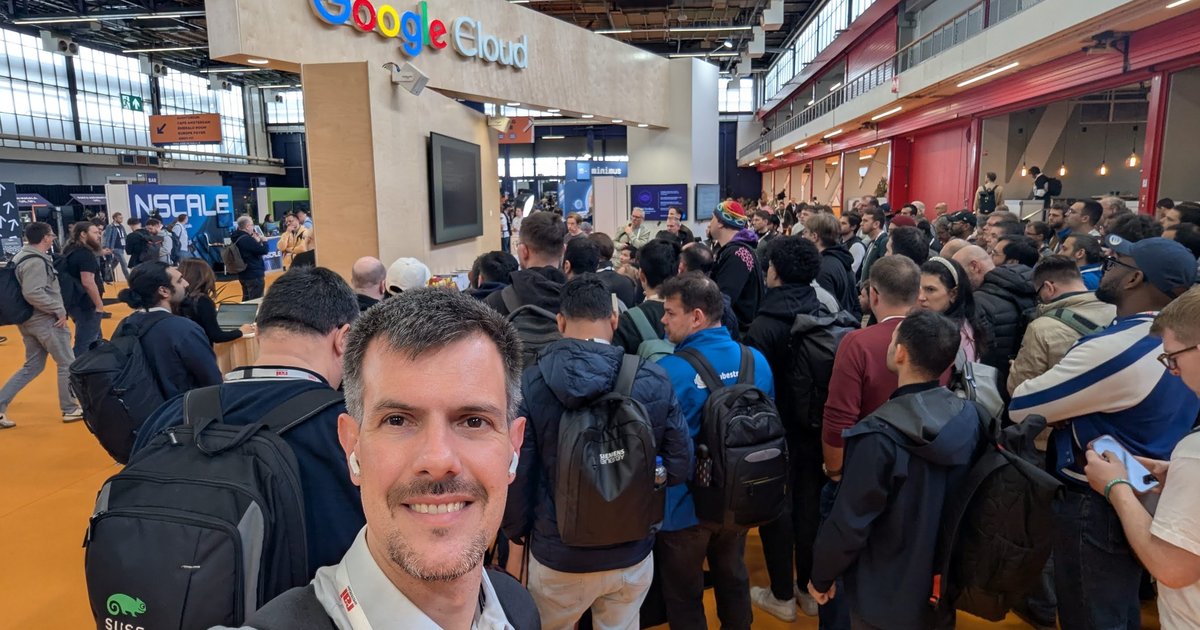
One of the absolute best parts of KubeCon? Bumping into old friends and former colleagues on the expo floor.
Reconnecting with Paulo Menon
It was fantastic to catch up with Paulo Menon. We used to work together, and having the chance to reconnect, network, and talk about where the industry is heading is exactly what makes these events so special.
Our conversation naturally drifted toward the massive shift happening right now: the convergence of AI, MLOps, GitOps, and DevOps. Running AI on Kubernetes is not just a shiny new trend anymore — it is becoming the standard, and figuring out how to do it efficiently is top of mind for everyone.
Two Days Earlier at the Red Hat Stand
That wasn’t our first clip of the week. On Tuesday 24 March, the first day of the main conference, I had already caught Paulo at the Red Hat stand and introduced him on camera as being there with Red Hat. I asked what he expected from the event. His answer was about people first: meeting more people, networking and catching up, then talking about open source, the solutions around AI, and the future of KubeCon and of Kubernetes as a platform. By Thursday the AI part had turned into the MLOps, GitOps and DevOps conversation above. For the other short conversations I recorded that week, see my KubeCon Europe 2026 hallway interviews.
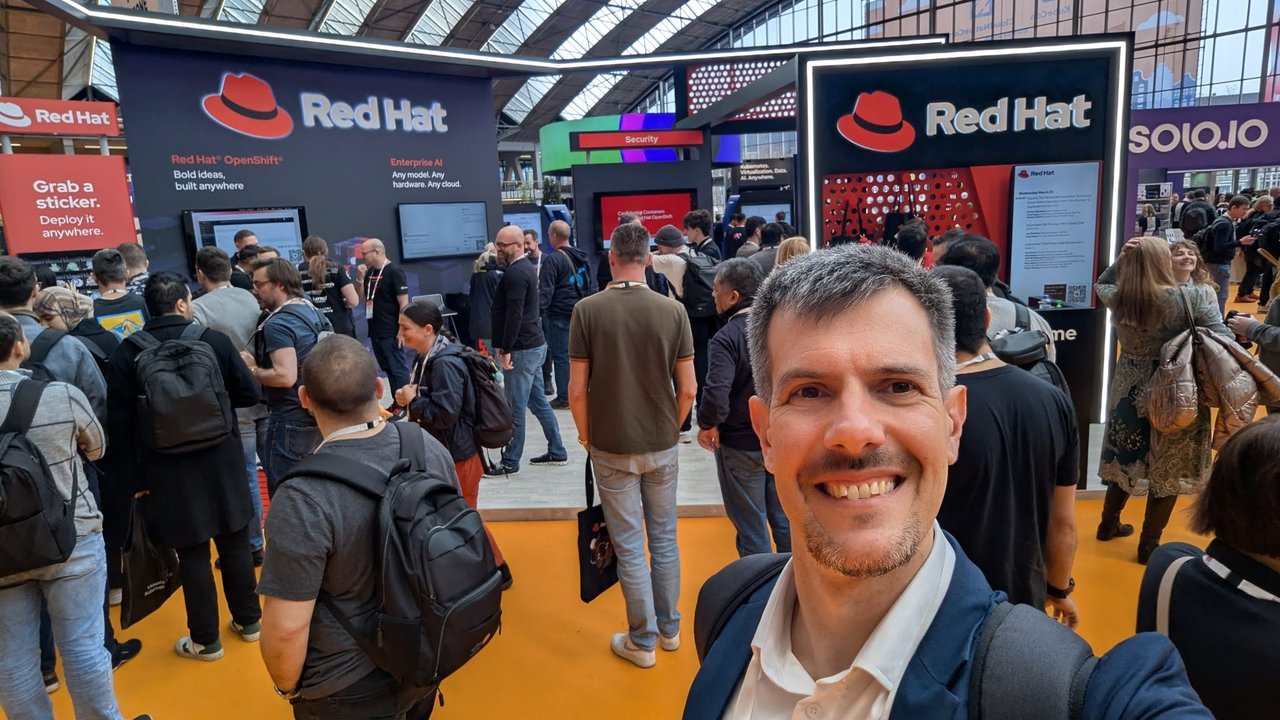 The Red Hat stand on Tuesday morning. Its Enterprise AI wall read “Any model. Any hardware. Any cloud.”
The Convergence Is Real
What makes this moment different from previous hype cycles is that the tooling has caught up with the ambition:
- MLOps gives us reproducible training and evaluation pipelines — frameworks like ZenML are maturing rapidly
- GitOps provides declarative, auditable infrastructure — your model deployments versioned alongside your application code
- DevOps culture ensures cross-functional ownership — platform teams and ML engineers share responsibility for production AI
- Kubernetes is the convergence layer — AI is now the number one workload running on K8s clusters worldwide
The organizations getting this right are the ones that do not treat AI as a separate silo. They integrate it into their existing engineering practices — same CI/CD, same observability, same incident management.
Book Recommendation: Generative AI on Kubernetes
Paulo shared a fantastic resource: the O’Reilly book “Generative AI on Kubernetes”. If you are looking for a practical, hands-on starting point to understand how to operationalize large language models and navigate this new frontier of K8s and AI, he highly recommends picking this one up.
This aligns with the resources I recommend for teams starting their AI on Kubernetes journey:
- Understand the infrastructure — GPU scheduling, model profiles, multi-node inference
- Build the platform — right-sizing, autoscaling, observability
- Operationalize the workflow — GitOps for model deployment, MLOps for training pipelines, DevOps for reliability
The Community Factor
Always grateful for the chance to share ideas, talk tech, and learn from brilliant folks in the community. The future of Kubernetes and AI is incredibly bright — and it is being built by the people you meet at events like KubeCon.
Have you started exploring GenAI on your K8s clusters yet?
Related Posts
- AI on Kubernetes: The First 90 Days
- ZenML and Kitaru: Building Durable AI Agents
- Dynatrace: AI Observability and Right-Sizing
- NVIDIA NIM Multi-Node Deployment on Kubernetes
- KubeCon Europe 2026 Community
- People of KubeCon Europe 2026: Hallway Interviews
About the Author
I am Luca Berton, AI and Cloud Advisor. I help enterprises operationalize generative AI on Kubernetes with production-grade MLOps and GitOps. Book a consultation.