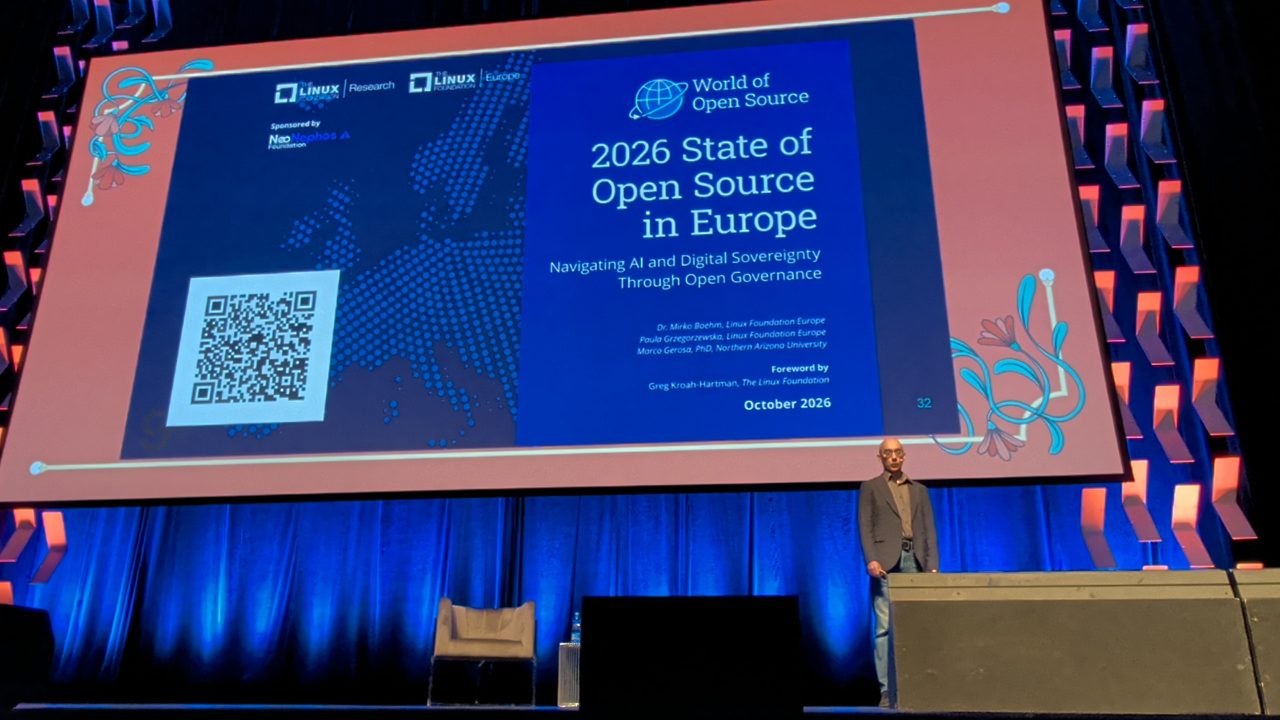
The first keynote block of Open Source Summit Europe 2026 opened with data, not slogans. After the welcome from Thierry Carrez, General Manager of Linux Foundation Europe, the Congress Hall got a tour of the new 2026 State of Open Source in Europe report from Linux Foundation Research. The subtitle is Navigating AI and Digital Sovereignty Through Open Governance.
I was in the hall as a media partner for my interview show Udienza, and I photographed most of the slides. The numbers are worth more than a summary, so here they are, with my reading of what they mean for engineering teams.
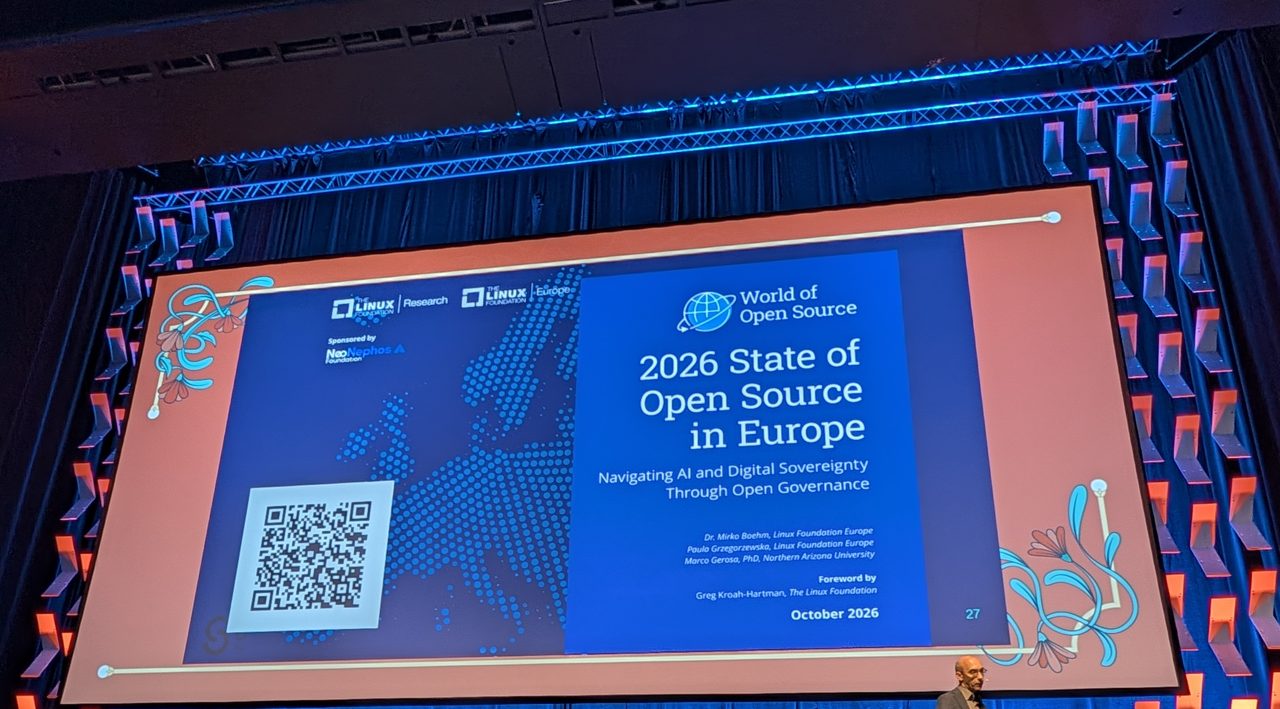 The report is authored by Dr. Mirko Boehm and Paula Grzegorzewska (Linux Foundation Europe) and Marco Gerosa (Northern Arizona University), with a foreword by Greg Kroah-Hartman. It is sponsored by the NeoNephos Foundation.
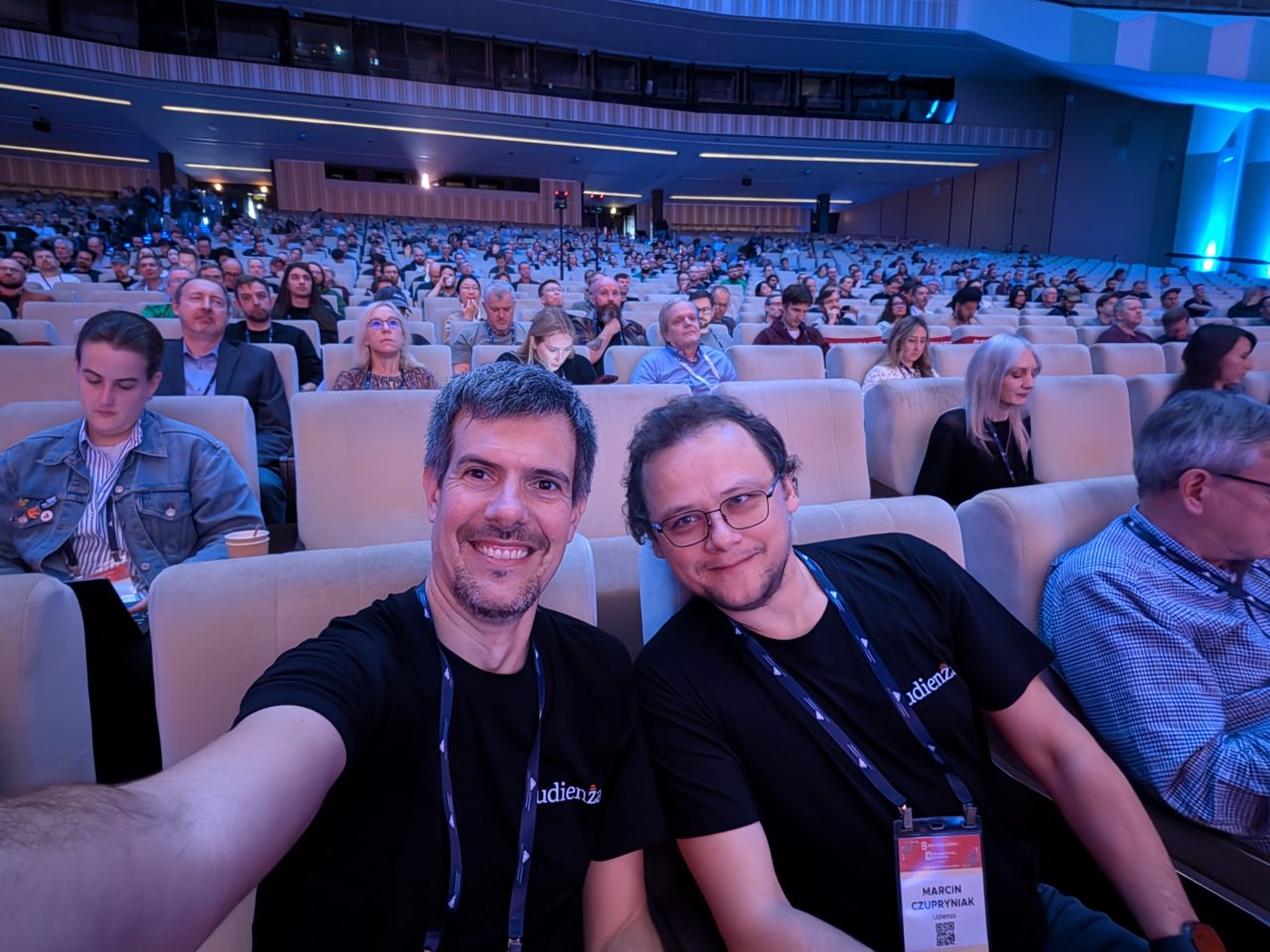 With Marcin Czupryniak, who filmed the Udienza interviews, in the Congress Hall for the opening keynotes.
AI coding tools are increasing open source use, not replacing it
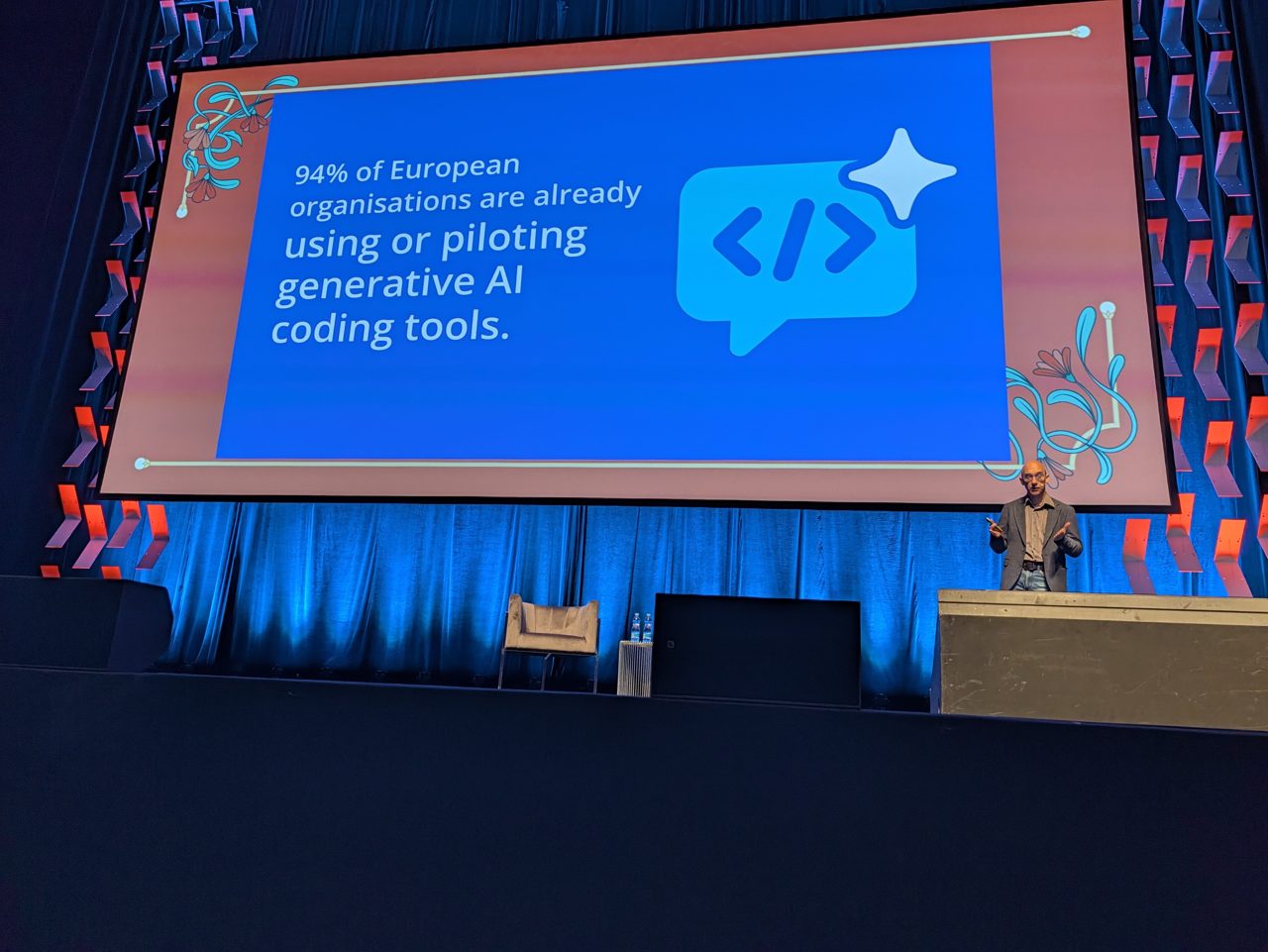
The first slide went straight at the question everybody in the room had: do AI coding assistants make open source less necessary? According to the survey, the opposite is happening.
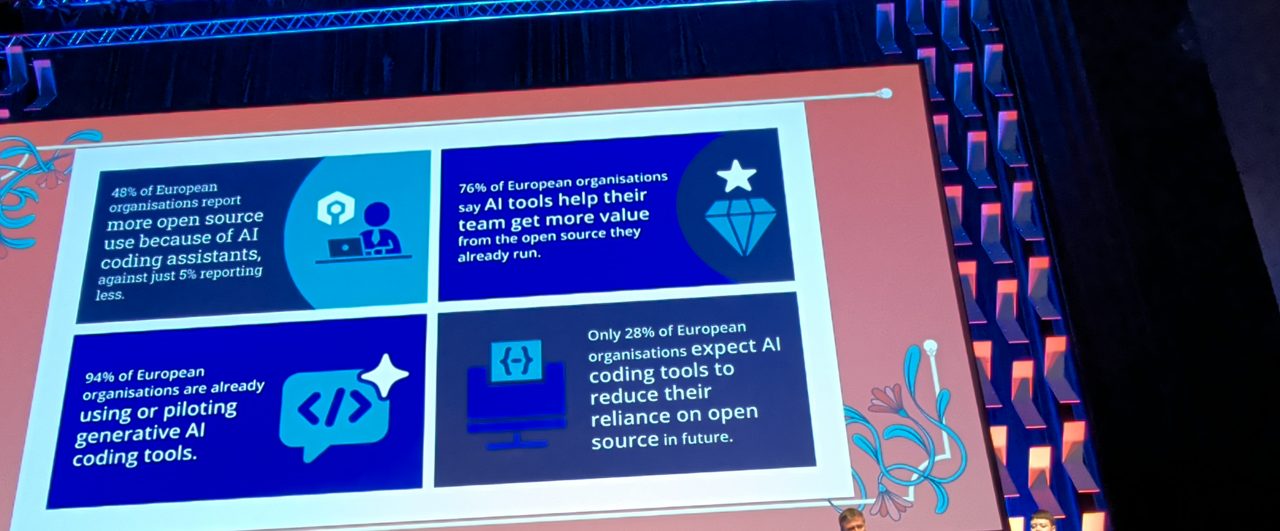
- 94% of European organisations are already using or piloting generative AI coding tools.
- 48% report more open source use because of AI coding assistants, against just 5% reporting less.
- 76% say AI tools help their team get more value from the open source they already run.
- Only 28% expect AI coding tools to reduce their reliance on open source in future.
This matches what I see with clients. An assistant writes glue code. It does not write a database, a kernel, or a container runtime. The more code an assistant produces, the more dependencies get pulled in, and the more your supply chain matters. I covered the production side of that in AI agent guardrails for production. For what the 94% adoption figure means for engineering teams and maintainers, see 94% of European organisations use or pilot AI coding tools.
Europe contributes code, but not governance
The most important slide of the morning, in my opinion, was the one about the gap between writing code and having a say.
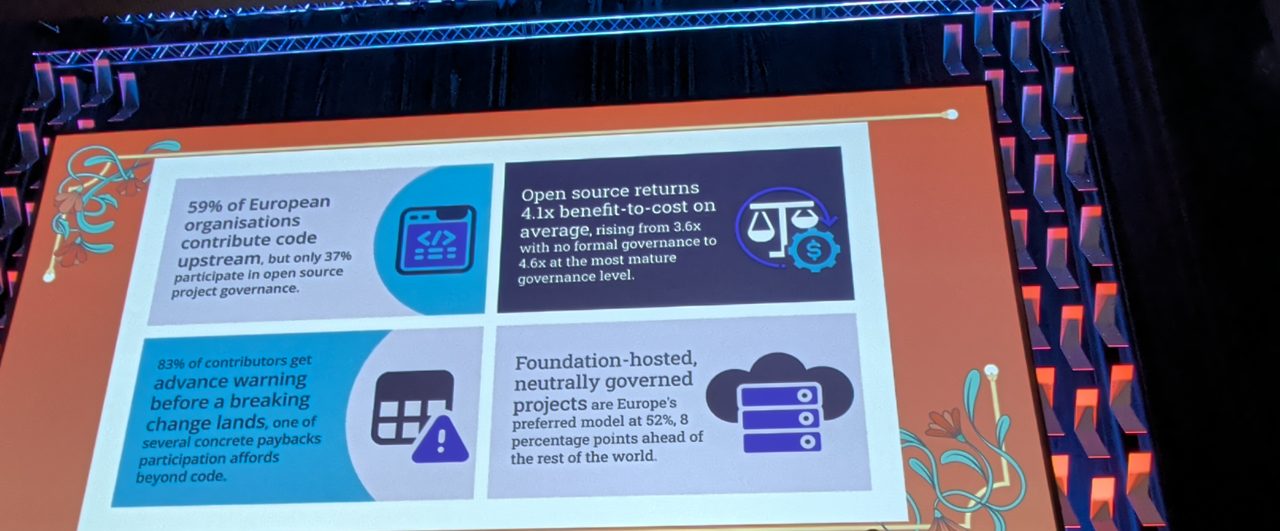
- 59% of European organisations contribute code upstream, but only 37% participate in open source project governance.
- Open source returns 4.1x benefit-to-cost on average, rising from 3.6x with no formal governance to 4.6x at the most mature governance level.
- 83% of contributors get advance warning before a breaking change lands, one of the concrete paybacks of participation beyond code.
- Foundation-hosted, neutrally governed projects are Europe’s preferred model at 52%, eight percentage points ahead of the rest of the world.
The keynote then put the gap on one slide:
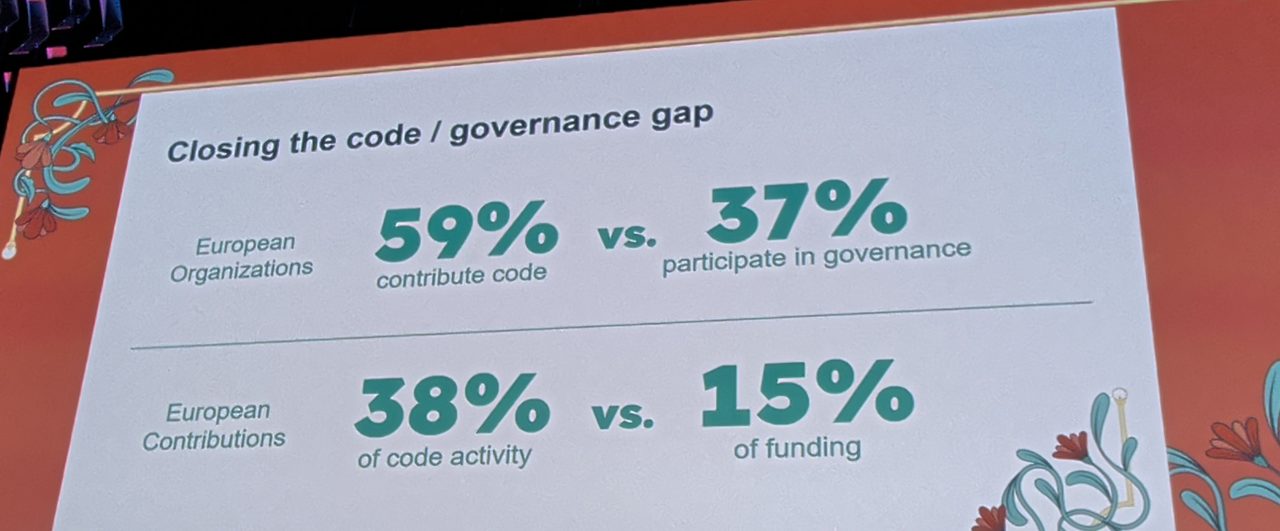
European contributions account for 38% of code activity in the projects studied, but only 15% of funding. Europe does the work and leaves the steering wheel to someone else. I unpack why that makes sovereignty a governance problem in Digital Sovereignty Is an Open Source Governance Problem.
How much of the stack Europe actually writes
The report also measured Europe’s share of code contribution in some of the projects everyone runs:
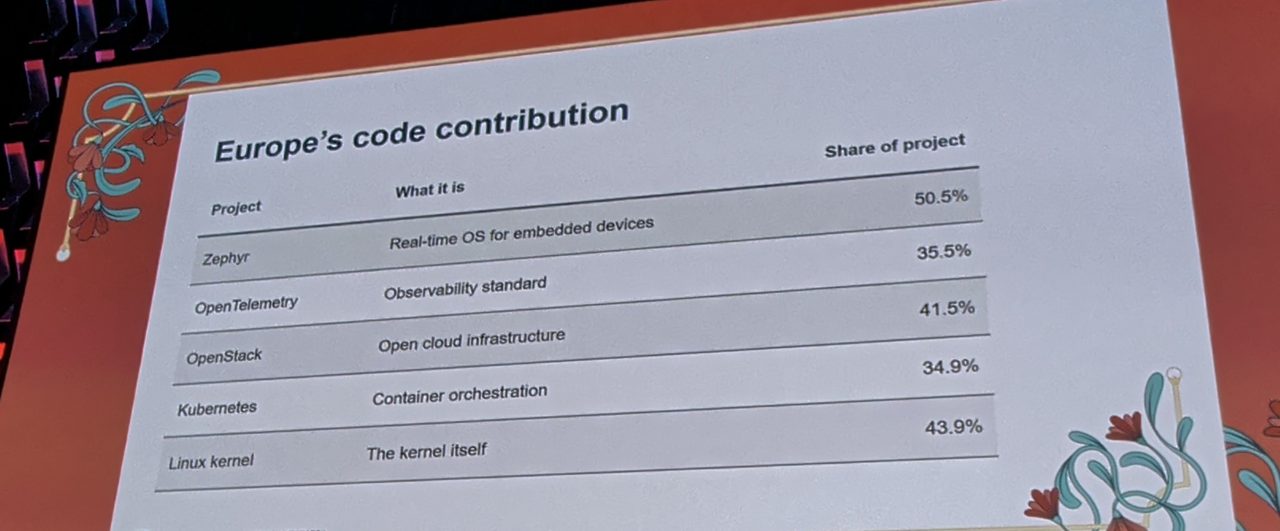
| Project | What it is | European share |
|---|---|---|
| Zephyr | Real-time OS for embedded devices | 50.5% |
| Linux kernel | The kernel itself | 43.9% |
| OpenStack | Open cloud infrastructure | 41.5% |
| OpenTelemetry | Observability standard | 35.5% |
| Kubernetes | Container orchestration | 34.9% |
If you run Kubernetes on Linux with OpenTelemetry, a third or more of that code was written in Europe. That is a strong position to negotiate from, and most organisations do not use it.
Sovereignty is a board-level topic now
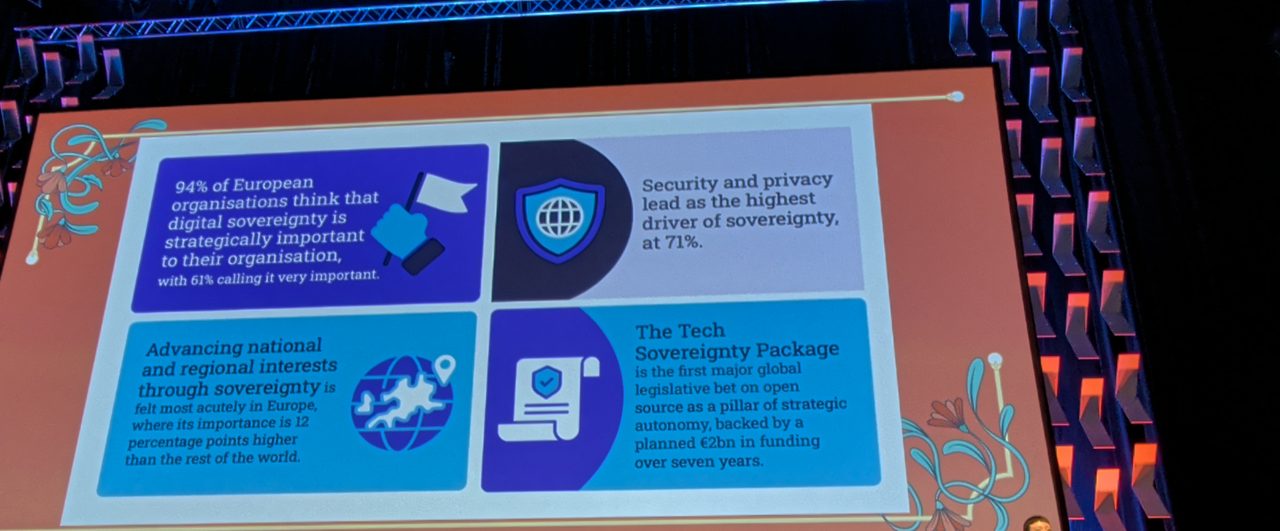
- 94% of European organisations think digital sovereignty is strategically important, with 61% calling it very important.
- Security and privacy lead as the highest driver of sovereignty, at 71%.
- Advancing national and regional interests through sovereignty is felt most acutely in Europe, 12 percentage points higher than the rest of the world.
- The EU Tech Sovereignty Package is described as the first major global legislative bet on open source as a pillar of strategic autonomy, backed by a planned €2bn over seven years.
”Participation in openly-governed open source is the solution”
My favourite slide of the morning was a piece of crossed-out text. It is the most honest summary of the sovereignty debate I have seen.
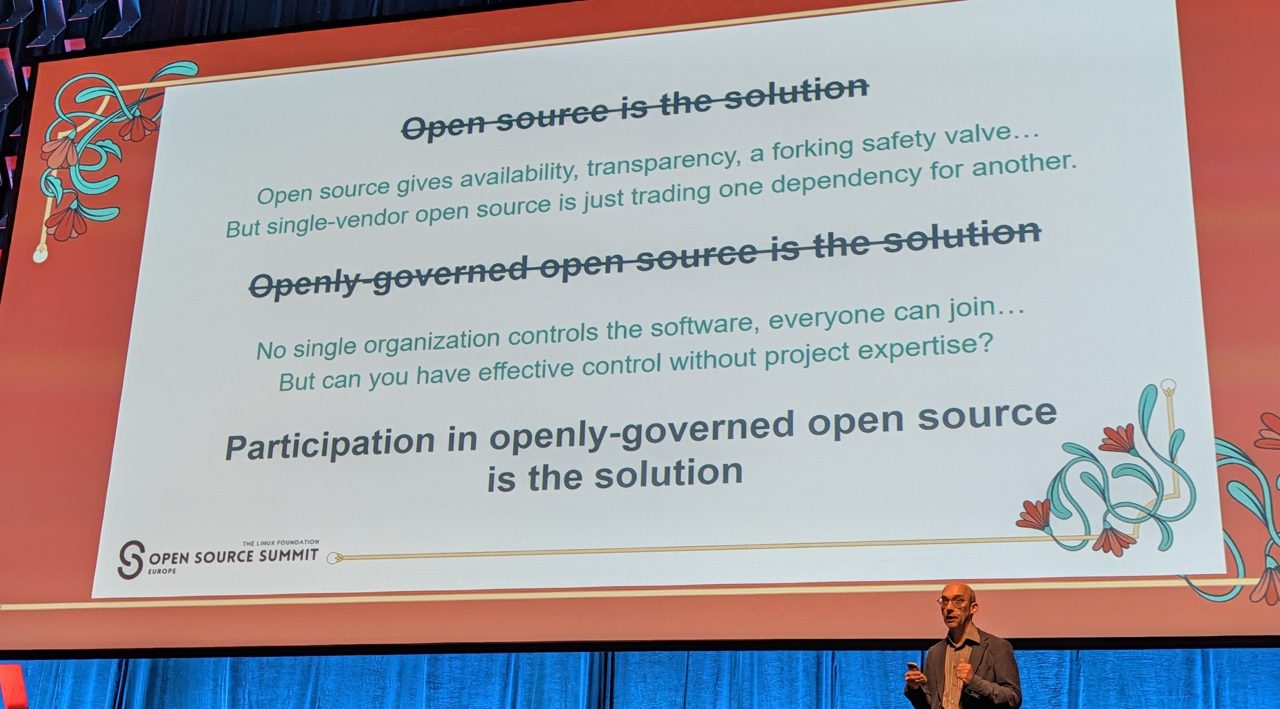
Open source is the solution.It gives availability, transparency and a forking safety valve. But single-vendor open source is just trading one dependency for another.Openly-governed open source is the solution.No single organisation controls the software, and everyone can join. But can you have effective control without project expertise?- Participation in openly-governed open source is the solution.
The report’s conclusion slide called it “deepen participation in the global commons”: engagement, contribution (support upstream maintainers as they adapt to the changes AI brings), and policy that treats regulation as an opportunity.
What I would do with this as an engineering leader
- Count your governance seats, not just your commits. If your team contributes to a project you depend on, find out whether anyone attends its steering, TSC or SIG meetings. The data says the return goes up with governance maturity.
- Prefer foundation-hosted projects for critical dependencies. Single-vendor open source can be relicensed. The forks of the last few years, from OpenTofu to OpenBao to Valkey, all came from that.
- Fund the maintainers you rely on. 38% of the code against 15% of the funding is not sustainable.
- Treat AI coding assistants as a supply chain multiplier. More generated code means more dependencies to track. Your SBOM and patch process matter more in 2026, not less.
For the policy side, see my notes on digital sovereignty and the EU cloud strategy and the European AI sovereignty debate in Paris. The rest of my Prague coverage starts in the Open Source Summit Europe 2026 recap.
Numbers in this article are taken from the slides presented on stage on 7 October 2026. The full report is available from Linux Foundation Research.