People keep saying the operating system does not matter any more. Kubernetes abstracts it, containers carry their own userland, and AI frameworks talk to the GPU directly. Walk the show floor at Open Source Summit Europe 2026, though, and you get a different picture. Three of the eight Diamond and Platinum sponsors (openKylin, openEuler and Red Hat) are operating-system communities or vendors, two of them pitching AI-era workloads. And the Kubernetes host OS has become a security decision.
Here is what I saw and asked about, as a media partner recording Udienza interviews.
openEuler: the OS as an AI inference component
The openEuler booth, a Platinum sponsor, was not showing a desktop or an installer. It was showing inference architecture.
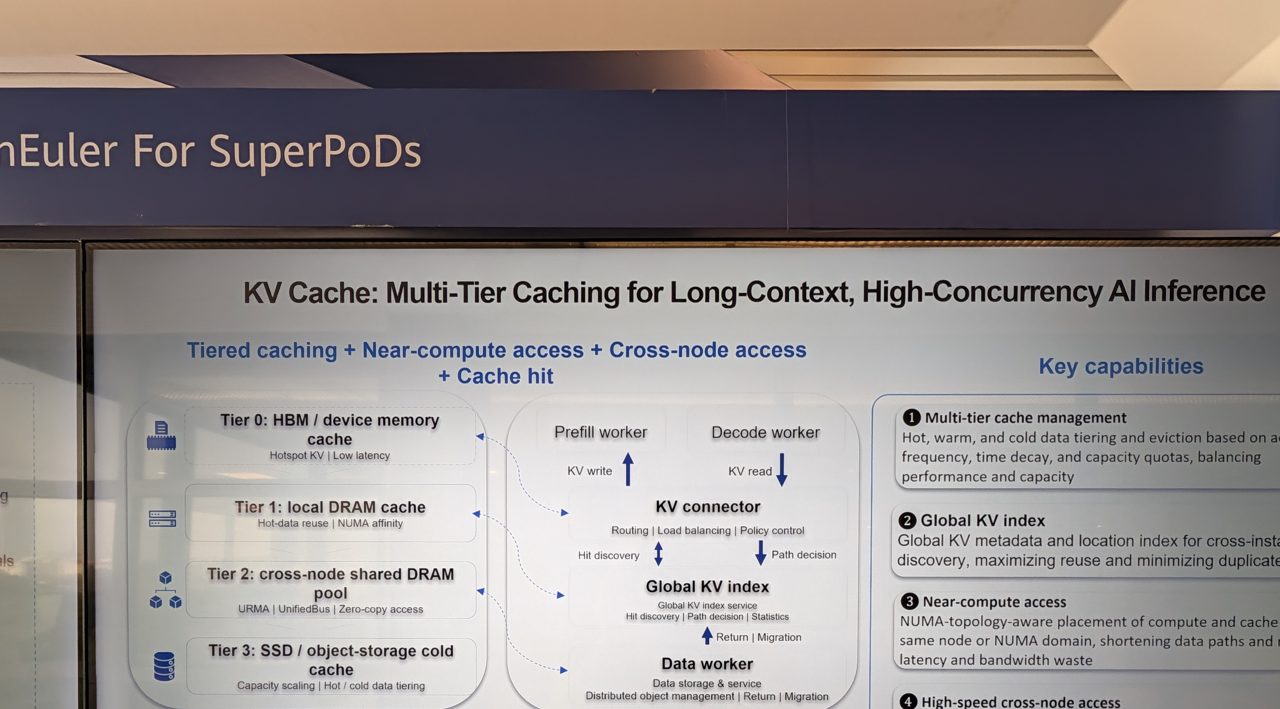
The “openEuler for SuperPoDs” panels described a multi-tier KV cache for long-context, high-concurrency AI inference:
- Tier 0: HBM, device memory cache. Hotspot KV, lowest latency.
- Tier 1: local DRAM cache. Hot-data reuse with NUMA affinity.
- Tier 2: a cross-node shared DRAM pool, with zero-copy access over UnifiedBus (URMA).
- Tier 3: SSD and object-storage cold cache, for capacity and hot/cold tiering.
Between prefill workers (KV write) and decode workers (KV read) sits a KV connector for routing, load balancing and policy, plus a global KV index that tracks where every cached block lives across the cluster. The listed capabilities were multi-tier cache management (hot, warm and cold tiering by frequency, time decay and quotas), the global index to maximise reuse and minimise duplication, NUMA-topology-aware placement, and high-speed cross-node access.
The interesting thing is where this lives. KV-cache offloading is usually discussed as a feature of the inference engine (vLLM, SGLang, llm-d). openEuler is pushing parts of it into the OS and memory fabric layer, because NUMA placement, memory pooling and zero-copy transport are OS problems. Other panels covered “SuperPoD OS for Container Cloud” with memory borrowing across nodes, and openEuler for industrial control with soft and hard real-time.
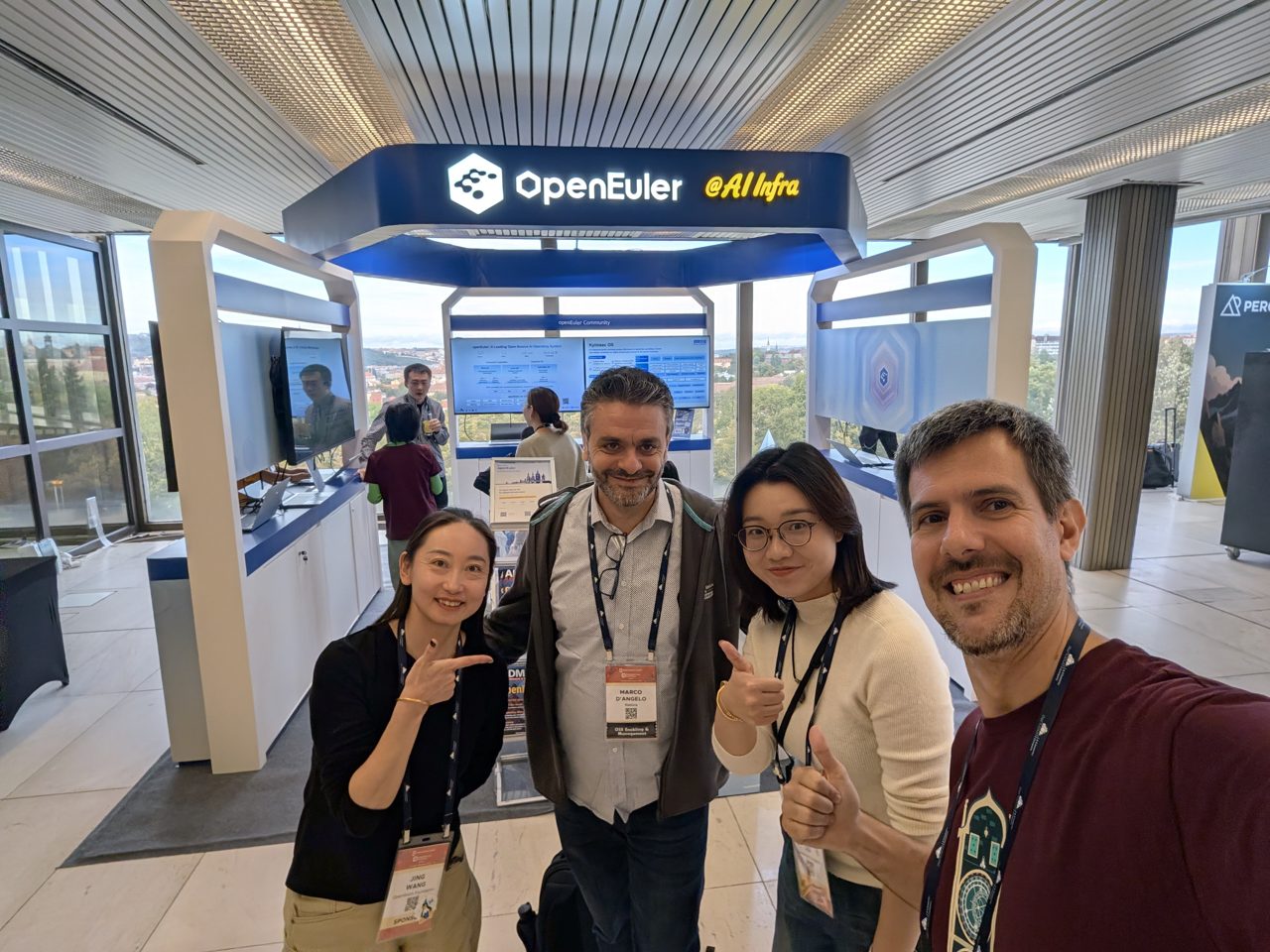 At the openEuler booth on Friday.
I had asked the openEuler team for a Udienza conversation on how an OS community balances performance, trustworthiness, workload intelligence and upstream collaboration. The question I most want answered: which of these optimisations are general enough to go upstream, rather than staying openEuler-specific? For background, see my earlier piece on openEuler as an enterprise Linux.
openKylin: an AI-native OS roadmap
openKylin was a Diamond sponsor, at the top tier next to AWS, Google Cloud, Microsoft Azure and Valkey. Its booth sat at the entrance to the Congress Hall and showed hardware running openKylin, including SpacemiT RISC-V devices.
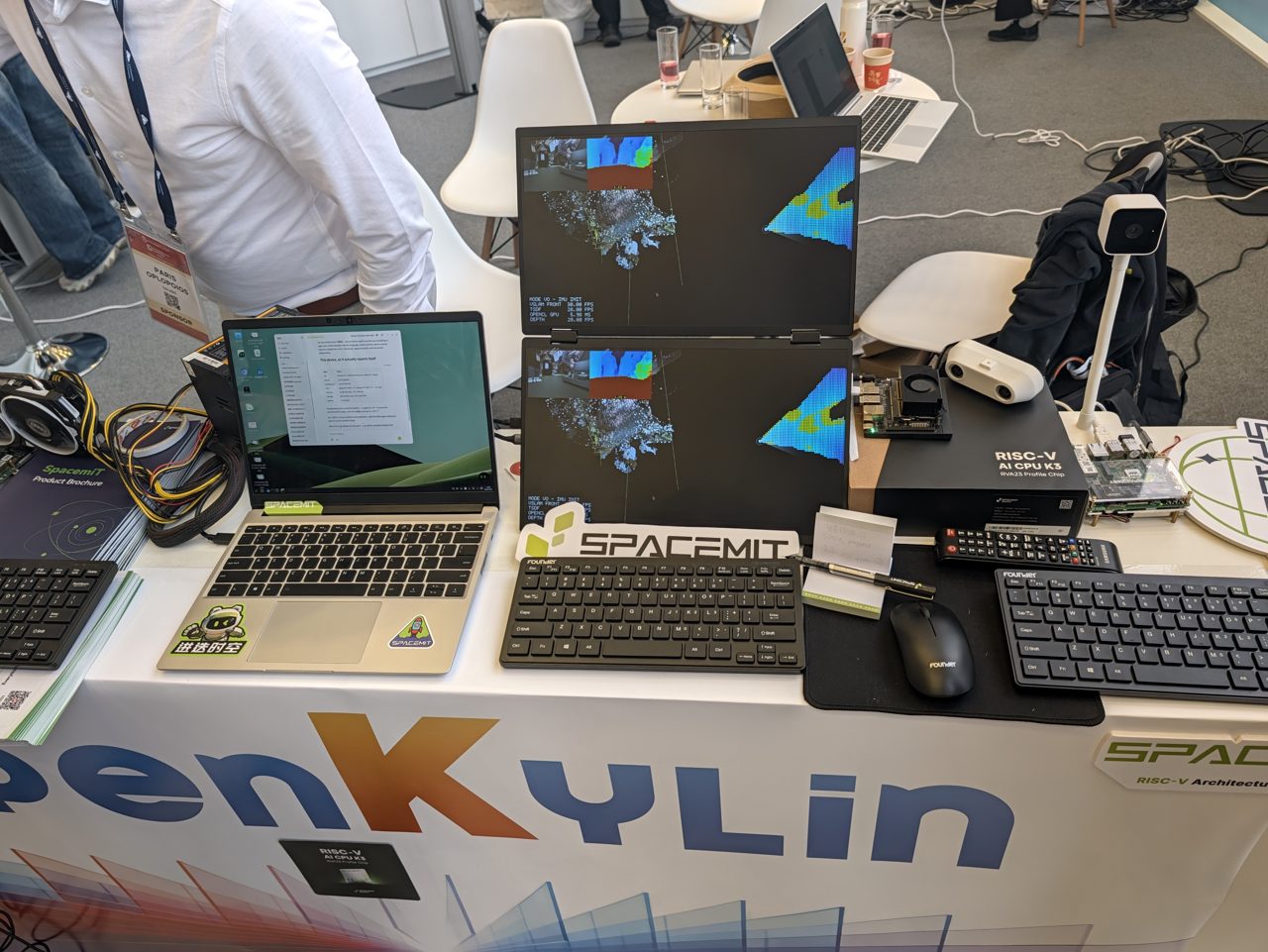
The openKylin team invited me to their booth on Thursday morning for a conversation before they flew home. The angle: openKylin 3.0, the project’s open source OS roadmap, and how AI-native capabilities are changing the operating-system layer. That is a desktop and edge question as much as a server one. When the assistant is part of the OS, it touches permissions, local models, hardware acceleration and update channels.
Flatcar: why the host OS still matters in Kubernetes
On Friday morning, right after the Linus Torvalds keynote, I had a Udienza slot with Thilo Fromm at the Microsoft booth. Thilo is a long-time maintainer of Flatcar Container Linux and previously led the Flatcar OS and security team.
Flatcar is a minimal, immutable, image-based Linux distribution built for container workloads. It is now a CNCF incubating project. Microsoft remains a major contributor, while the project is governed as a community project. The relevant technical areas are automatic updates, systemd-sysext extensions, Kubernetes node operations and supply-chain trust.
My prepared flow for the ten minutes:
- Kubernetes abstracts so much away. Why should platform teams still care about the host operating system?
- What is the biggest operational advantage of an immutable, image-based OS compared with a traditional distribution?
- Flatcar is a CNCF project, but Microsoft is a major contributor. How do you keep it community-driven?
- What does “operational sovereignty” mean at the OS layer?
- Which failure mode do you see most often when teams manage Kubernetes nodes like general-purpose servers?
That last question is the practical one. I still see clusters where someone SSHes into a node to install a package, and six months later nobody can rebuild it. An immutable host makes that impossible by design. I covered the same pattern for RHEL-family systems in bootc: immutable Linux with update and rollback.
Three trends at the OS layer
- The OS is joining the inference stack. Memory tiering, NUMA placement and zero-copy transport decide how many tokens per second you get. Expect more AI-specific work in distributions, and more of it upstream.
- Immutable is the default for nodes. Flatcar, bootc-based systems and similar image-based hosts make nodes cattle at the OS level, not just the pod level.
- Governance follows the OS too. Flatcar in CNCF, AlmaLinux in its own foundation and openEuler in the OpenAtom ecosystem: the host OS is a dependency, and the neutral governance questions apply to it as well.
More from the week: the kernel maintainers I met and the Open Source Summit Europe 2026 recap.