Every AI infrastructure conversation I have ends at the same wall: power. You can order GPUs. You cannot order a grid connection. At Open Source Summit Europe 2026 in Prague, the Linux Foundation launched a project aimed at exactly that wall: OpenGrid.
One market cannot move fast enough, the other cannot get started
The OpenGrid keynote on Wednesday morning summed up the problem on one slide:
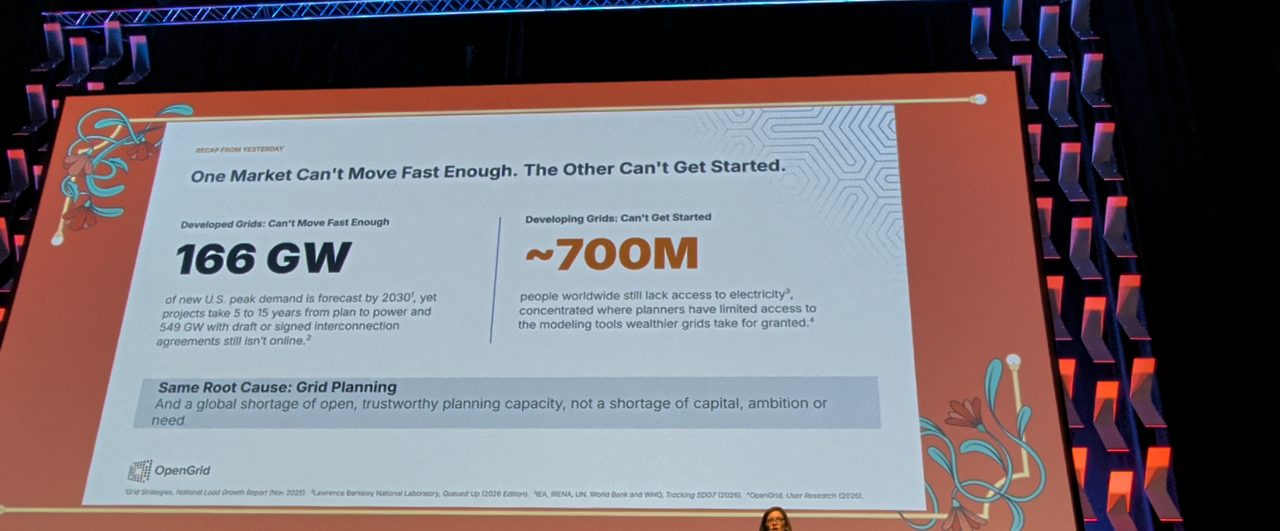
- Developed grids cannot move fast enough. 166 GW of new US peak demand is forecast by 2030, yet projects take 5 to 15 years from plan to power, and 549 GW with draft or signed interconnection agreements is still not online.
- Developing grids cannot get started. Around 700 million people worldwide still lack access to electricity, concentrated where planners have limited access to the modelling tools wealthier grids take for granted.
The common root cause, as the slide put it, is grid planning: a global shortage of open, trustworthy planning capacity, not a shortage of capital, ambition or need.
That is a sentence software people can act on. Planning capacity is mostly software, data formats and models. It is a problem open source has solved in other industries.
What OpenGrid is
According to the Linux Foundation’s launch announcement, OpenGrid is a new initiative to build open source infrastructure for grid planning. Its goal is to give every country access to high-quality grid planning tools by 2030.
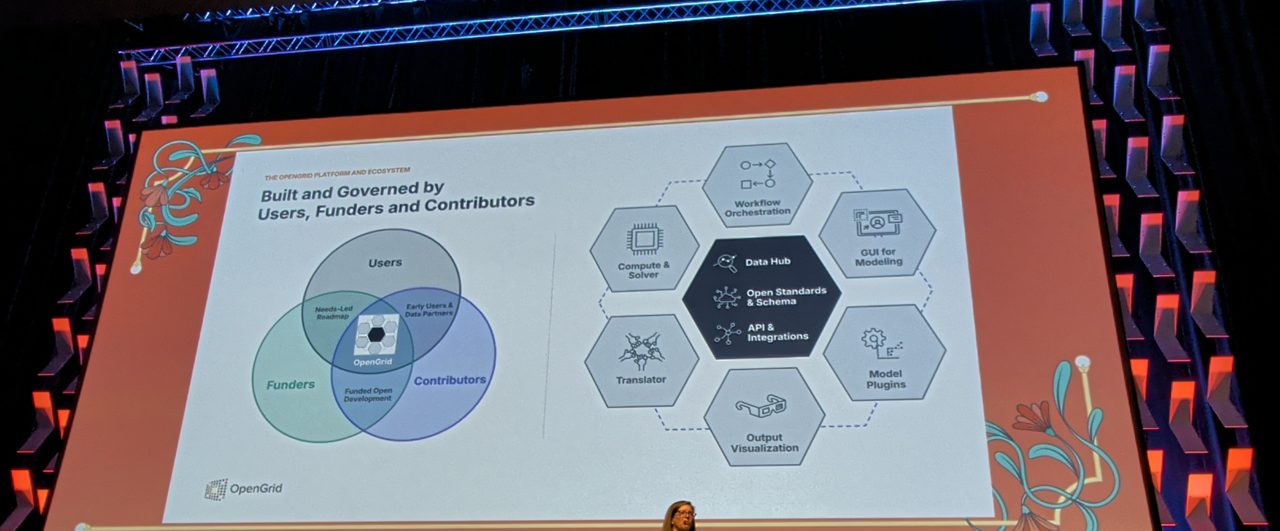
The architecture slide shows a shared core of data hub, open standards and schemas, and APIs and integrations. Around it sit workflow orchestration, a GUI for modelling, model plugins, output visualisation, a translator, and compute and solver components. Governance is a three-way overlap between users (a needs-led roadmap), funders (funded open development) and contributors (early users and data partners).
From the announcement:
- More than 2,500 GW of generation, storage and large-load projects are pending in grid connection queues worldwide.
- Annual grid investment needs to roughly double, to more than $600 billion by 2030.
- Emerging economies are expected to account for nearly 80% of global electricity demand growth through 2030.
- The first application, the OpenGrid Translator, is in development for a 2027 release. It will move data and models between widely used commercial platforms and open source tools.
- Founding supporters include Breakthrough Energy GRIDS, Global Grid Catalyst, Connected Grid Initiative and Google.org, with technical delivery partners Open Energy Transition, Tapestry, TransitionZero and QXT Energy. Alice Yake of BE-GRIDS chairs the OpenGrid Management Committee.
Why a translator first is the right call
I like that the first deliverable is a translator and not a new planning tool. Grid planners already have tools, commercial and open source, and their models are locked into each tool’s format. A translator respects that investment and makes the models portable. It is the same move that made OpenTelemetry succeed: standardise the data first, and let the tools compete on top.
Why this matters to AI infrastructure people
If you build AI platforms, grid planning is now your problem too:
- Data center timelines are grid timelines. A GPU cluster without a grid connection is an expensive warehouse.
- Location decisions depend on planning data. Better, open planning models mean better information on where new capacity can land.
- Efficiency is still the cheapest megawatt. While grids catch up, the GPU utilisation work covered in my FinOps and GPU cost notes is the fastest win.
OpenGrid is a reminder that open source summits are not only about developer tools. The same collaboration model that built Linux is now being pointed at physical infrastructure.
More from Prague: State of Open Source in Europe 2026, Open Source at a Crossroads, and the event recap.