Not every good conversation at Open Source Summit Europe 2026 in Prague was a scheduled interview. Between the booked Udienza slots, I recorded a few short chats at booths where something caught my eye. Three of them had a common thread: open source reaching into things you can hold, from laptops and phones to money.
Quotes are from my recordings, lightly edited for clarity.
Framework: a laptop you can keep upgrading
Framework had a booth on the Solutions Showcase floor with its slogan “Fix consumer electronics”. I spoke with Daniel, who works on firmware and on everything software-related for their products. Because Framework sells online, the booth was a rare chance to touch the hardware.
The idea is simple: every component is sold individually, and you can treat the machine as a normal laptop or upgrade it part by part.
“If you want to, you can upgrade most parts of it, especially the mainboard. When there’s a new CPU generation, you don’t have to buy a whole new laptop and throw everything away.”
The line-up now has four categories: Laptop 12, Laptop 13, Laptop 16 (which supports a dedicated GPU for gaming or AI work) and a Desktop, with a new mainboard for each every year. At the booth he also showed an early prototype of a wireless keyboard with a touchpad, aimed at couch or media-PC setups and devices like a Raspberry Pi, that pairs with up to four devices.
I asked about the memory shortage that is pushing hardware prices up this year:
“We work very closely with the suppliers, to make sure we can get the memory at all, and at the best possible prices, so people can buy hardware at the moment.”
Why this belongs at an open source summit: repairable, upgradeable hardware is the hardware equivalent of open source. You own it, you can fix it, and it does not become waste because one part is old. Daniel mentioned he has used his for years.
The Ethereum Foundation: open source finance
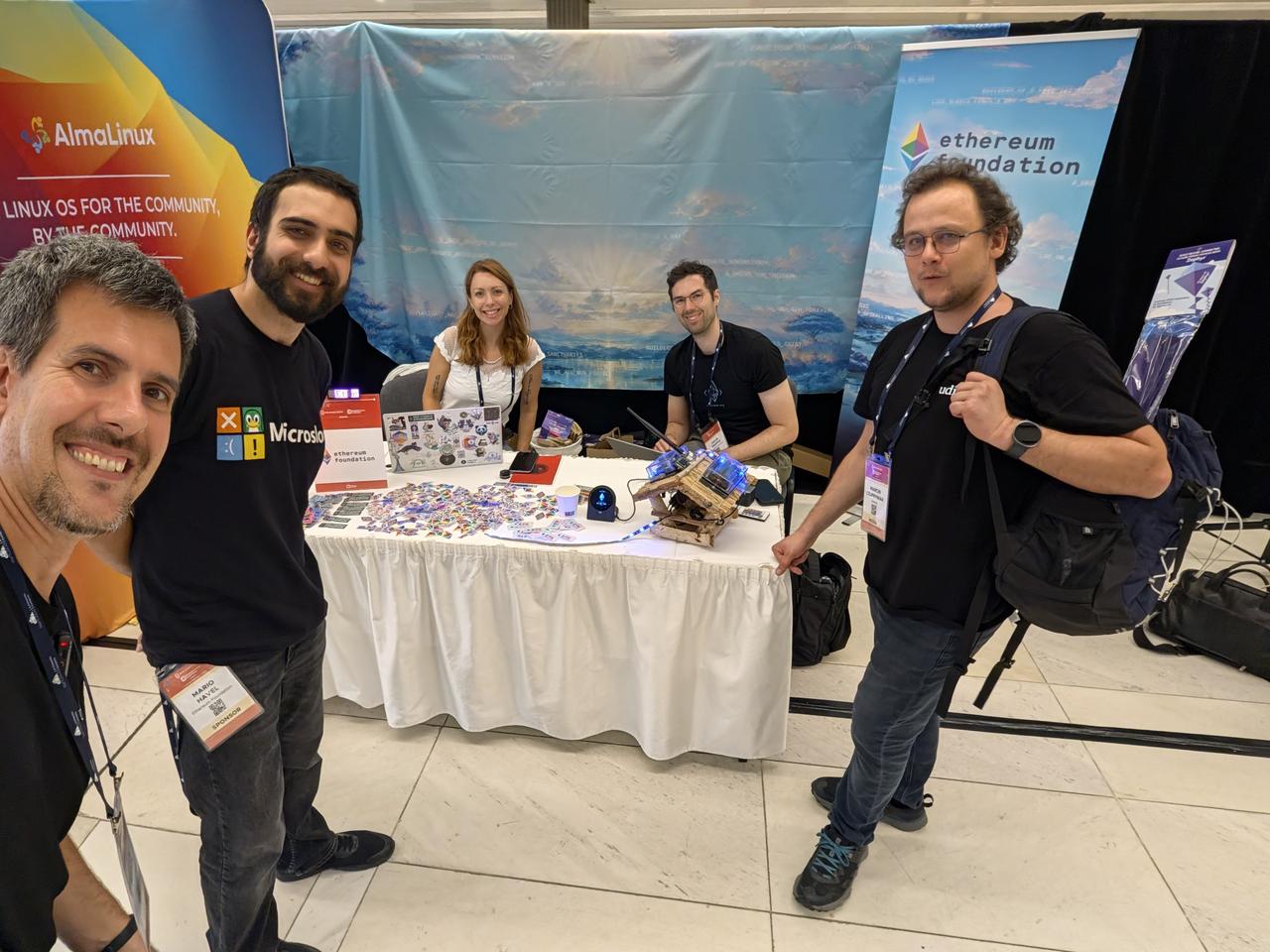 At the Ethereum Foundation booth, on the Solutions Showcase floor.
At the Ethereum Foundation booth I talked with Mario Havel, who works on the foundation’s research and development side and maintains epf.wiki, a wiki about the core protocol.
He described Ethereum as a “world computer”: a platform where anyone can run decentralised applications, which grew out of the Bitcoin community because Bitcoin was not extensible enough to run arbitrary programs. His framing for an open source audience:
“We are basically re-implementing finance in the open source, free software way. Everything is open and transparent. Everybody can see the logic being executed. You’re not trusting a bank or a proprietary system with your data and your money.”
What I found most useful was his comparison of the foundation’s role with the Linux Foundation’s:
“The Linux Foundation doesn’t maintain the kernel or own the kernel. In the same way, the Ethereum Foundation does not own Ethereum. We help facilitate development around the protocol, as one of maybe a dozen organisations that contribute to it.”
He said the foundation’s strongest contribution is technical research, working with cryptographers in-house and in academia on censorship resistance, zero-knowledge proofs, privacy and scaling. The booth had some fun hardware too: a “block clock” showing Ethereum’s block height ticking every 12 seconds, and a proof-of-concept bird feeder that pays whoever feeds the birds through a smart contract.
To get involved, he pointed to ethereum.org, which is itself open source and welcomes contributions, and to the many local ETH events, including ETH Prague.
A phone running mainline Linux
The last chat was on Thursday afternoon. David Heidelberg of Phosh and Petr Hodina showed me a phone with no Android at all:
“It’s a mobile phone running the mainline Linux kernel, GNOME applications, and the UI is Phosh, the phone shell. It’s completely open source. It runs mainline Linux, so you get what classical Linux on desktops and laptops is.”
On some phones you can plug in a dock with DisplayPort and a keyboard and use it like a laptop. And if you use Debian, you get all the Debian software you are used to, as the same binaries as on the desktop, adapted for touch.
How to get one: buy a supported phone and flash it. They mentioned phones from SHIFT, a German manufacturer, and older devices such as the OnePlus 6. Supported devices are listed by the community distributions, with more options coming.
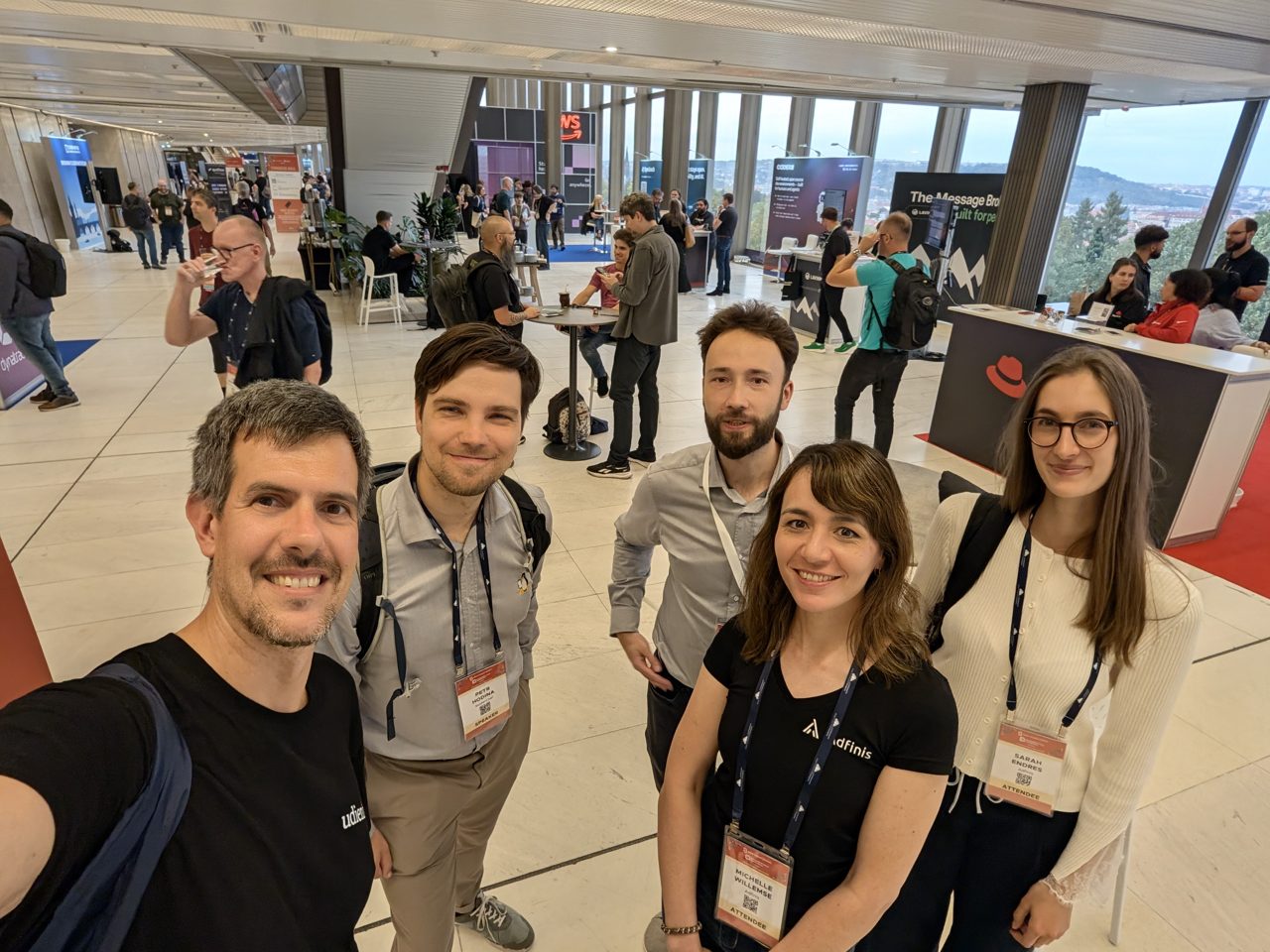 Petr Hodina (second from left) on the show floor, a few minutes before the Linux phone demo.
This connects directly to what Greg Kroah-Hartman told me the day before: phones are “the most complex beasts out there” for the kernel. Getting a phone to run mainline Linux, with no vendor kernel fork, is a big engineering achievement.
The common thread
All three conversations are about ownership:
- A laptop you can repair and upgrade instead of replace.
- Money systems whose rules are public code.
- A phone that runs the same open Linux as your server.
It is the same question the sovereignty keynotes asked at the level of countries, asked here at the level of the device in your pocket.