Open Source Summit Europe is two conferences in one building. Next to the cloud and AI tracks, the Embedded Linux Conference Europe ran 78 sessions in Prague, alongside a 46-talk Zephyr Developer Summit and a PX4 drone track. Embedded is also where Europe is strongest: the State of Open Source in Europe report presented that week puts Europe’s share of Zephyr code at 50.5%, the highest of any project measured.
As a media partner I booked several Udienza conversations with embedded engineers. These stories are concrete in a way AI keynotes rarely are: a real constraint, a design decision, and something other teams can reproduce.
Texas Instruments: turning bench wiring into test infrastructure
Franklin Cooper Jr. is an embedded software engineer at Texas Instruments with more than 15 years in embedded software. He has contributed and upstreamed work in U-Boot, Linux and Yocto. TI was a Gold sponsor, and its booth sat on Floor 2, right across from the large AWS booth.
His session tackled a problem every hardware team knows: scaling embedded hardware testing without constantly rewiring the lab. The solution is a low-cost FPGA used as a programmable routing fabric between boards and test equipment, designed to work across Zephyr, Linux, bare metal and vendor SDKs. Instead of an engineer moving jumper wires between test runs, the routing is reconfigured in software.
We had a Thursday morning slot in front of the TI booth. The questions:
- What breaks first when embedded hardware testing scales beyond one engineer’s bench?
- Why use an FPGA as a programmable routing fabric instead of traditional lab switching hardware?
- How do you keep the test layer software-agnostic across Linux, Zephyr and vendor SDKs?
- What was the hardest real-world peripheral or timing edge case?
- What could another team reproduce cheaply next week from your approach?
This is CI/CD for hardware. The cloud world solved “works on my machine” with containers and pipelines. Embedded teams still too often have “works on my bench”. Making the physical wiring programmable is the step that lets hardware tests run unattended in a pipeline.
Igalia: replacing a foundational API in WPE WebKit
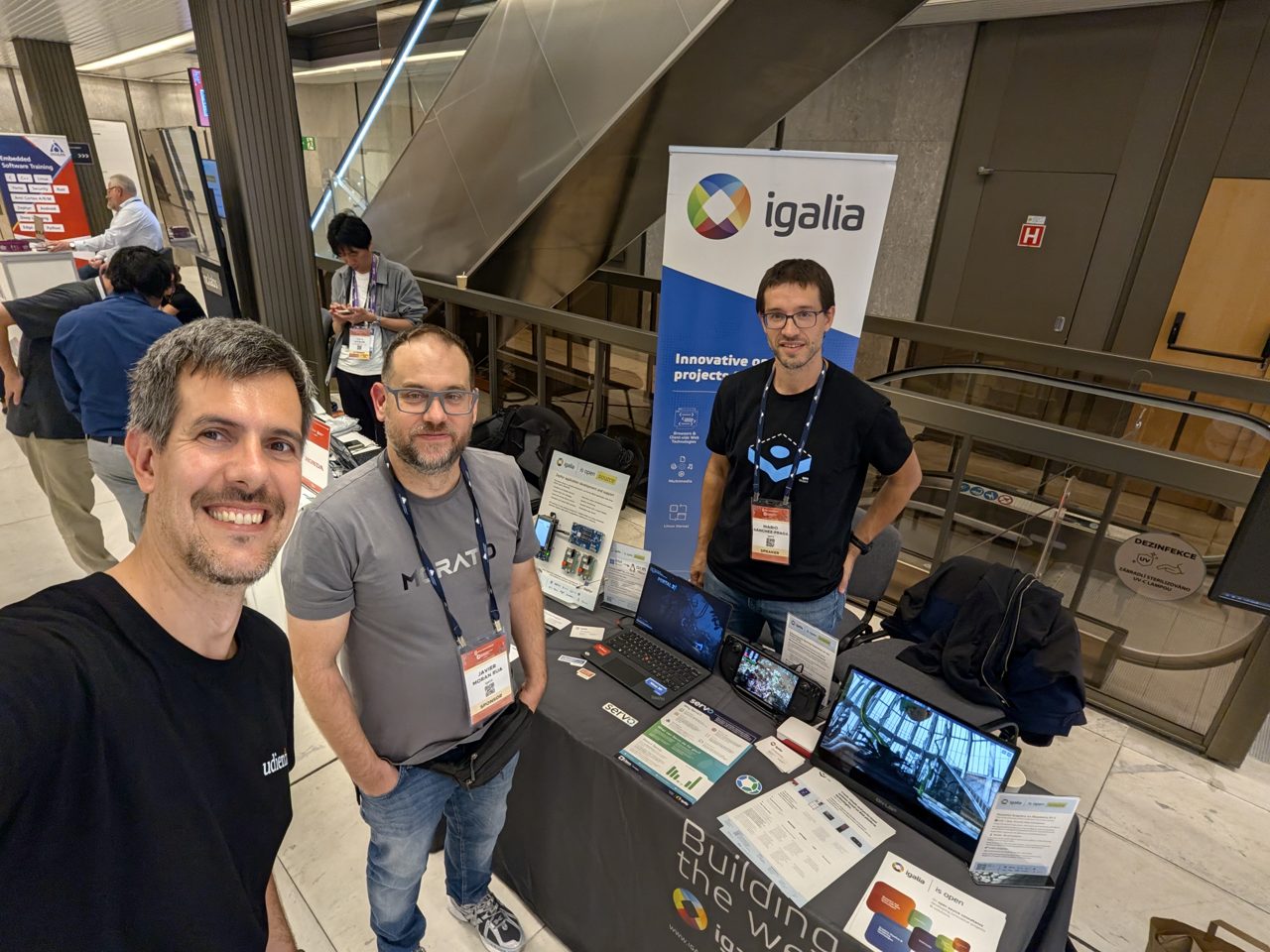 At the Igalia booth on Floor 2, on Thursday afternoon.
Mario Sánchez Prada works at Igalia on WPE WebKit, the WebKit port for embedded devices. You find it in set-top boxes, infotainment systems and kiosks. In WPE 2.54, WPEPlatform became the default platform-integration API and the old libwpe-based API was deprecated. Mario’s session was a hands-on example: writing a launcher for embedded devices with the new WPEPlatform API.
Mario asked to meet after his talk, because people often come with questions after a session. We met at Igalia’s booth on Floor 2 at the end of Thursday afternoon. My angle: why a mature embedded browser project replaces a foundational integration API, and what that migration teaches about long-lived open source architecture.
- What limitation in the old libwpe and backend model made a new API necessary?
- Which design decision in WPEPlatform are you happiest with now that the API is stable?
- Where does zero-copy and DMA-BUF integration make the biggest practical difference?
- What is the hardest part of supporting Wayland, DRM/KMS, headless and other embedded environments without fragmenting the project?
- What should downstream integrators do now, before the deprecated API becomes technical debt?
The last question is the one for product teams. If you ship a device with WPE, the deprecation clock has started. Plan the migration while the old API still works.
RISC-V on the show floor
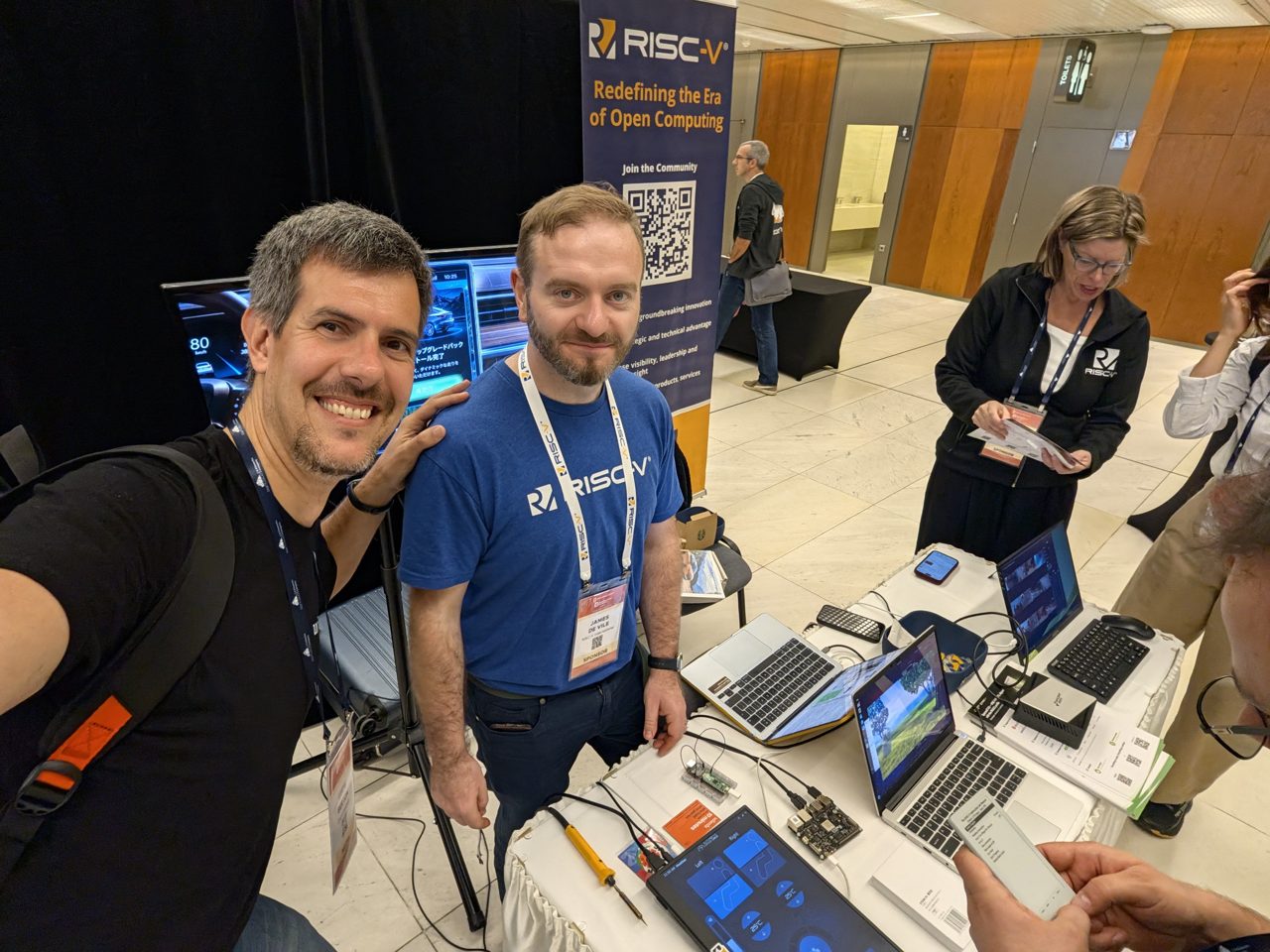 At the RISC-V International booth on Wednesday morning.
RISC-V International had a booth, and RISC-V hardware also turned up at other stands, including SpacemiT devices at the openKylin booth. The RISC-V team was showing an ISA explorer that maps the extensions in the specification, which is more useful than it sounds when you need to know which profile a given board actually implements.
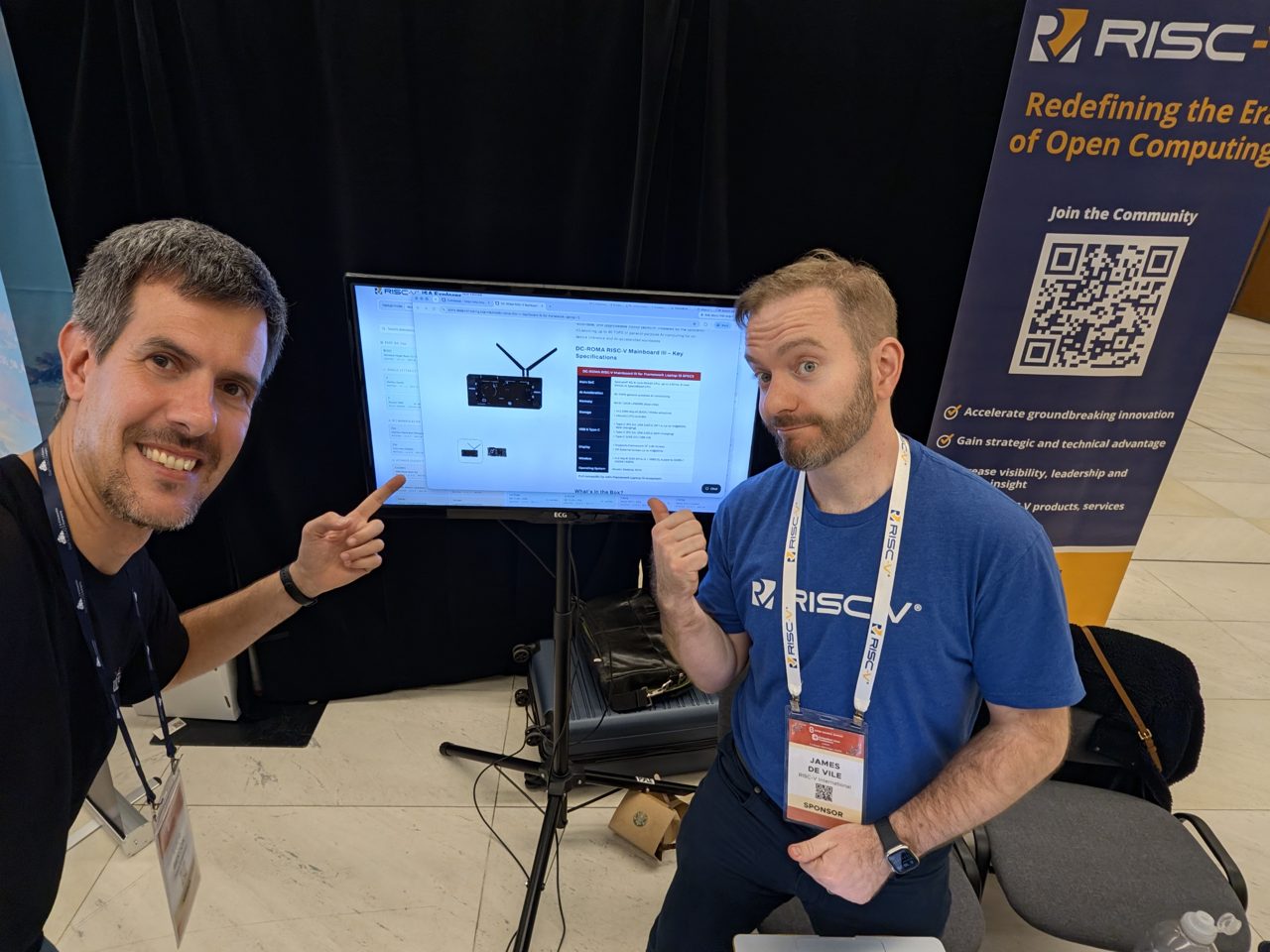
If you want to start with RISC-V without buying hardware, my guide to RISC-V emulation with QEMU is the quickest path.
Embedd: chip data that AI can read
Embedd describes itself as software infrastructure for chips. It makes chip data more accessible and reduces the friction of datasheets and development tooling. Co-founder Maxim Gorinov was at their booth all three days. Our angle was turning fragmented hardware knowledge into software infrastructure that engineers and AI can use:
- What is the most expensive information gap between a chip vendor and an embedded engineer?
- Why are datasheets still such a poor interface for software development?
- How do you make hardware knowledge machine-readable without introducing dangerous hallucinations or ambiguity?
- What changes when AI agents become consumers of chip documentation and tooling?
This is the embedded version of the Docsy keynote on documentation for AI agents. A hallucinated register address is not a funny chatbot mistake. It is a bricked board.
ELISA and safety-critical Linux
The ELISA Project (Enabling Linux in Safety Applications) had a booth too, and the Linux Foundation’s communications team helped me arrange time with Philipp Ahmann there. Safety-critical Linux, in cars, medical devices and industrial systems, is where “move fast” stops working. The Safety-Critical Software track, with ELISA and the Zephyr safety work, is one of the reasons the embedded half of this conference has become so important.
Why embedded people should be at Open Source Summit
The embedded track is small next to KubeCon-sized events, but it is where the hardest open source engineering happens: real-time constraints, safety certification, long product lifetimes and hardware you cannot redeploy. If you work in cloud, spend a session there. The way embedded teams think about testing, long-term support and supply chains would improve most platform teams.
More from Prague: the OS layer in the AI era, the kernel maintainers I met, and the Open Source Summit Europe 2026 recap.