OpenTelemetry baggage lets you set a value such as a tenant ID once, at the edge, and read it in every service the request touches. It’s also one of the easiest ways to send your users’ data to a company you never meant to share it with. This post explains what baggage is, how it differs from span attributes, how to read and write it in Python, and how to copy it onto spans. Then it reproduces the leak with three small local services and tests three ways to stop it.
I tested everything with Python 3.13, opentelemetry-api and opentelemetry-sdk 1.45.0, and the 0.66b0 releases of opentelemetry-instrumentation-flask, opentelemetry-instrumentation-requests and opentelemetry-processor-baggage, plus Flask 3.1.3, requests 2.34.2 and nginx 1.31.6.
Where this came from
At the SRE NL meetup at Elastic Amsterdam in February 2026, Evelien Schellekens’s “Guide to Observability with OpenTelemetry” ended with a “To infinity and beyond” slide: Baggage, OTTL and OpAMP. On baggage, she said you can use it to share session IDs and user IDs with all the services in the back end. She also warned that auto-instrumentation adds this metadata to any outgoing request, so it can reach third-party APIs, and that you shouldn’t send baggage, or at least nothing sensitive, to a third party. That warning is what this post tests. I already wrote up OpAMP, the third item on the slide, in OpAMP: Manage OpenTelemetry Collector Fleets Safely.

A slide from “Guide to Observability with OpenTelemetry” at SRE NL: Baggage, “metadata that travels with the request”, listed next to OTTL and OpAMP.
What OpenTelemetry baggage is (and isn’t)
The OpenTelemetry baggage docs describe baggage as contextual information that is passed between signals: a key-value store that travels with the context. Three things follow from that:
- It’s not a span attribute. The docs say baggage is “a separate key-value store and is unassociated with attributes on spans, metrics, or logs without explicitly adding them”. If you want
tenant.idon your spans, something has to copy it there. - It crosses process boundaries. A span attribute stays in your telemetry pipeline. A baggage entry goes into the HTTP headers of the next request, and the one after that.
- Nobody signs it. The same page warns that “there are no built-in integrity checks to ensure that Baggage items are yours”. Any caller can send a
baggageheader.
Good baggage is small, non-secret, and useful to many services: a tenant ID, an opaque user or session ID, a synthetic-traffic flag. Bad baggage is anything you wouldn’t put in a URL: emails, names, tokens, account numbers.
The W3C baggage header
On the wire, baggage is the baggage HTTP header from the W3C Baggage specification (the current version is a Candidate Recommendation Snapshot dated 30 May 2024). It’s a comma-separated list of key=value members, each with optional ;-separated properties:
baggage: tenant.id=acme,user.id=u-1234,user.email=jane%40example.comValues are percent-encoded, which is why @ shows up as %40. That’s encoding, not protection: anyone who sees the header can decode it.
The spec says a platform must propagate all entries when there are 64 list-members or fewer and the header is 8192 bytes or less. Its grammar allows at most 180 members. The Python propagator (W3CBaggagePropagator in 1.45.0) enforces 8192 bytes per header, 4096 bytes per member and 180 members. When I set 200 entries, it injected 180 and logged “Baggage exceeded the maximum number of list-members”. A single 5,000-character value was dropped with a warning, and the header wasn’t sent at all.
You don’t have to configure the propagator. OTEL_PROPAGATORS defaults to tracecontext,baggage in the SDK environment variable spec, so traceparent and baggage go out together on every instrumented call.
Reading and writing baggage in Python
The API lives in opentelemetry.baggage: set_baggage, get_baggage, get_all, remove_baggage and clear (API reference). Contexts are immutable, so set_baggage doesn’t change anything in place. It returns a new Context, and you attach that context to make it current:
from opentelemetry import baggage, context

ctx = baggage.set_baggage("tenant.id", "acme")
ctx = baggage.set_baggage("user.id", "u-1234", context=ctx)
token = context.attach(ctx)
try:
    ...  # every instrumented outgoing call in here carries both entries
finally:
    context.detach(token)
Downstream, the Flask instrumentation extracts the incoming header for you, so reading it is one call:
tenant = baggage.get_baggage("tenant.id")   # "acme", or None
everything = dict(baggage.get_all())
set_baggage takes a name and a value, with no metadata argument. When I extracted user.id=u-1;ttl=60, the property stayed inside the value: get_baggage("user.id") returned "u-1;ttl=60". If another service adds properties, don’t compare values with == without checking.
The lab: two services and a nosy “third party”
The setup runs on a laptop, with no Docker until the last fix:
frontend(port 9100) is the edge service. It sets baggage and callscheckout.checkout(port 9200) reads the baggage and calls a scoring API.external_api(port 9300) plays the third party. It has no OpenTelemetry and logs the trace headers it receives.
python3 -m venv .venv
.venv/bin/pip install opentelemetry-distro opentelemetry-instrumentation-flask \
  opentelemetry-instrumentation-requests opentelemetry-processor-baggage flask requests
The fake third party:
# external_api.py
from flask import Flask, request, jsonify

app = Flask(__name__)

@app.get("/v1/score")
def score():
    seen = {k.lower(): v for k, v in request.headers.items()
            if k.lower() in ("baggage", "traceparent", "tracestate")}
    print(f"[external-api] received trace headers: {seen}", flush=True)
    return jsonify(score=42, headers_seen=seen)

if __name__ == "__main__":
    app.run(port=9300)
The edge service sets three entries. The third one is the mistake:
# frontend.py
import requests
from flask import Flask, jsonify
from opentelemetry import baggage, context

app = Flask(__name__)

@app.get("/buy")
def buy():
    ctx = baggage.set_baggage("tenant.id", "acme")
    ctx = baggage.set_baggage("user.id", "u-1234", context=ctx)
    ctx = baggage.set_baggage("user.email", "jane@example.com", context=ctx)
    token = context.attach(ctx)
    try:
        r = requests.get("http://127.0.0.1:9200/checkout", timeout=5)
    finally:
        context.detach(token)
    return jsonify(r.json())

if __name__ == "__main__":
    app.run(port=9100)
checkout reads the baggage, copies two keys onto its spans (more on that below) and calls the third party:
# checkout.py
import os
import requests
from flask import Flask, jsonify
from opentelemetry import baggage, trace
from opentelemetry.processor.baggage import BaggageSpanProcessor

ALLOWED = ("tenant.id", "user.id")
trace.get_tracer_provider().add_span_processor(
    BaggageSpanProcessor(lambda key: key in ALLOWED)
)

EXTERNAL_URL = os.environ.get("EXTERNAL_URL", "http://127.0.0.1:9300/v1/score")
app = Flask(__name__)

@app.get("/checkout")
def checkout():
    tenant = baggage.get_baggage("tenant.id")
    r = requests.get(EXTERNAL_URL, timeout=5)
    return jsonify(tenant=tenant, baggage=dict(baggage.get_all()), external=r.json())

if __name__ == "__main__":
    app.run(port=9200)
Both instrumented services run under zero-code auto-instrumentation, with spans printed to the console:
export OTEL_TRACES_EXPORTER=console OTEL_METRICS_EXPORTER=none OTEL_LOGS_EXPORTER=none
.venv/bin/python external_api.py &
OTEL_SERVICE_NAME=checkout .venv/bin/opentelemetry-instrument .venv/bin/python checkout.py &
OTEL_SERVICE_NAME=frontend .venv/bin/opentelemetry-instrument .venv/bin/python frontend.py &
curl -s localhost:9100/buy
Copying baggage onto spans with BaggageSpanProcessor
The contrib package opentelemetry-processor-baggage provides BaggageSpanProcessor. On span start, it reads the baggage from the parent context and sets each entry whose key passes your predicate as a span attribute. ALLOW_ALL_BAGGAGE_KEYS copies everything. A list of predicates works too. The package also has a BaggageLogProcessor for log records (README).
There’s no environment variable for it, so with opentelemetry-instrument I added it in code with trace.get_tracer_provider().add_span_processor(...). That works because the agent has already installed the SDK TracerProvider by the time the app imports. Run the same file with plain python and you get the API’s proxy provider, which has no add_span_processor.
In my run, both checkout spans, the GET /checkout server span and the outgoing client span, had tenant.id=acme and user.id=u-1234. Neither had user.email, because the predicate filtered it out. frontend’s server span had neither: it started before the baggage was set, and frontend has no processor.
This is why the copy matters. A backend can only filter or group by tenant if the tenant is on the span.

Earlier in the same talk: the live Elastic demo, showing failed transaction latency and correlations for a service.
The leak: auto-instrumentation sends baggage to the third party
Here’s what the fake third party logged:
[external-api] received trace headers: {'traceparent': '00-87cb9ad2894dda8af9254c98c97a2f54-e5de38093de699af-03', 'baggage': 'tenant.id=acme,user.id=u-1234,user.email=jane%40example.com'}All three entries left the building, including the email. That’s the important detail: the BaggageSpanProcessor predicate controls what gets onto your spans, not what gets propagated. checkout never touched baggage in its code. The requests instrumentation injected the current context into the outgoing call, as it does for every call. The OpenTelemetry docs say the same: “automatic instrumentation includes Baggage in most of your service’s network requests.”
There’s a second problem. I called the edge with a forged header:
curl -s -H 'baggage: is.admin=true,tenant.id=globex' localhost:9100/buyfrontend overwrote tenant.id with its own value, but is.admin=true reached checkout and then the third party. If any service makes a decision based on baggage, a caller can set it.
Fix 1: decide what goes in, and reset at the edge
The cheapest fix happens before anything is propagated. Only put in values you’d be fine seeing in a third party’s access log, and start from empty baggage at your trust boundary:
ctx = baggage.clear()                                        # drop whatever the caller sent
ctx = baggage.set_baggage("tenant.id", "acme", context=ctx)
ctx = baggage.set_baggage("user.id", "u-1234", context=ctx)  # opaque ID, no email
baggage.clear() returns a copy of the current context with no baggage. The active span is kept, so the trace still links up. With this change, the forged is.admin entry no longer reached checkout. You can also strip the inbound baggage header at your ingress proxy, which protects services you don’t control the code of.
Fix 2: send nothing to external hosts
I found no setting in the Python SDK or the requests instrumentation (as of 1.45.0 and 0.66b0) that limits propagation to a list of internal hosts. A propagator’s inject only receives the header carrier, not the URL, so it can’t decide by destination. These three options did work in the lab, each with a trade-off.
Clear baggage around the call. This follows the Baggage API spec, which requires a way to remove all entries “to avoid sending any name/value pairs to an untrusted process”:
from contextlib import contextmanager
from opentelemetry import baggage, context

@contextmanager
def without_baggage():
    token = context.attach(baggage.clear())
    try:
        yield
    finally:
        context.detach(token)

with without_baggage():
    r = requests.get(EXTERNAL_URL, timeout=5)
The third party received only traceparent. The trade-off: the client span for that call also lost its tenant.id and user.id attributes, because the processor copies from the context, and that context is now empty.
Strip the header in a dedicated session. The instrumentation wraps Session.send, injects the headers, then calls the transport adapter. An adapter that pops the header runs after the injection:
from requests.adapters import HTTPAdapter

class StripBaggageAdapter(HTTPAdapter):
    def send(self, request, **kwargs):
        request.headers.pop("baggage", None)
        return super().send(request, **kwargs)

third_party = requests.Session()
third_party.mount("http://", StripBaggageAdapter())
third_party.mount("https://", StripBaggageAdapter())
Calls through third_party arrived with traceparent only, and the client span kept its tenant attributes. Pop traceparent and tracestate too if you don’t want to share trace IDs with the vendor.
Exclude the URL from instrumentation. OTEL_PYTHON_REQUESTS_EXCLUDED_URLS takes comma-separated regexes (requests instrumentation docs). For a matching URL, the instrumentation calls the original send straight away, so nothing is injected. With OTEL_PYTHON_REQUESTS_EXCLUDED_URLS="127.0.0.1:9300", the third party saw no trace headers at all. You also lose the client span, so the slow vendor call disappears from your traces. I’d only use this for calls you don’t care to see.
Each HTTP client library has its own instrumentation package, so check its options for any other client you use.
Fix 3: strip it at the egress proxy
If outbound traffic already goes through a proxy, remove the header there. It works for every language and every service behind it. In nginx, a proxy_set_header with an empty value means the header “will not be passed to a proxied server”:
server {
    listen 8080;
    location / {
        proxy_pass http://host.docker.internal:9300;
        proxy_set_header baggage "";
    }
}
I saved that as egress.conf, ran it with nginx:alpine, and pointed the original leaky checkout.py at the proxy:
docker run -d --rm --name baggage-egress -p 127.0.0.1:9380:8080 \
  -v "$PWD/egress.conf:/etc/nginx/conf.d/default.conf:ro" nginx:alpine
EXTERNAL_URL=http://127.0.0.1:9380/v1/score OTEL_SERVICE_NAME=checkout \
  .venv/bin/opentelemetry-instrument .venv/bin/python checkout.py &
The third party received traceparent and no baggage. host.docker.internal resolves to the host on Docker Desktop. On Linux, add --add-host=host.docker.internal:host-gateway to the docker run command.
The OpenTelemetry Collector can’t do this job. It sits in the telemetry path, not between your services and the vendor. What it can do is clean up the copy: if a sensitive baggage key ended up as a span attribute, delete it in the Collector before it reaches a backend. My OpAMP post pushes exactly that kind of redaction to a fleet.
Checklist
- Baggage is for small, non-secret, cross-cutting IDs. If it would hurt in a vendor’s logs, it doesn’t belong there.
- Call
baggage.clear()(or strip the header at ingress) at the edge, and never authorise anything based on baggage. - Copy keys onto spans with an explicit allowlist, not
ALLOW_ALL_BAGGAGE_KEYS. - Wrap third-party clients: clear the context, strip the header in the transport, or strip it at the egress proxy.
- Keep it under the limits: 64 entries and 8 KB is what every implementation must carry.
- Check propagation the way I did here: point a call at a header-logging endpoint and look.
My take: baggage is worth using, but treat it like a cookie you set on every request your platform makes. Put the egress strip in the platform (proxy or shared HTTP client), so that each team doesn’t have to remember it.
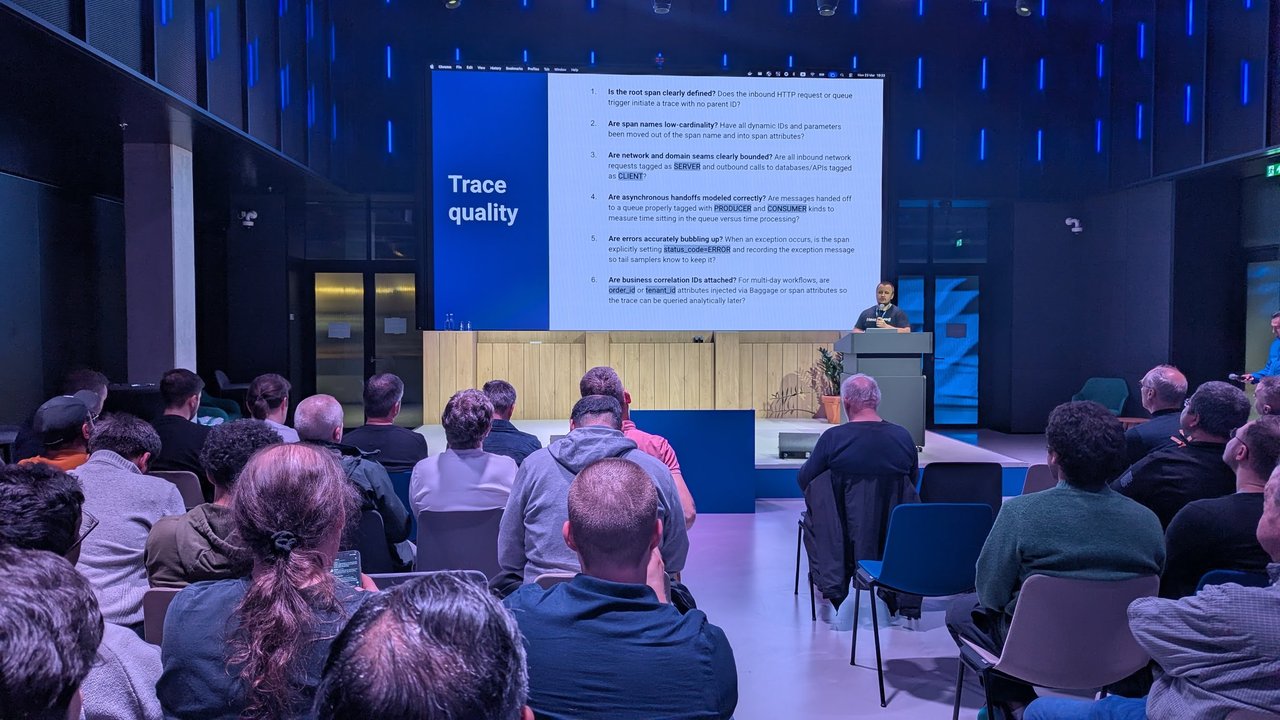
For the rest of the context-propagation picture, see my OpenTelemetry trace quality checklist.