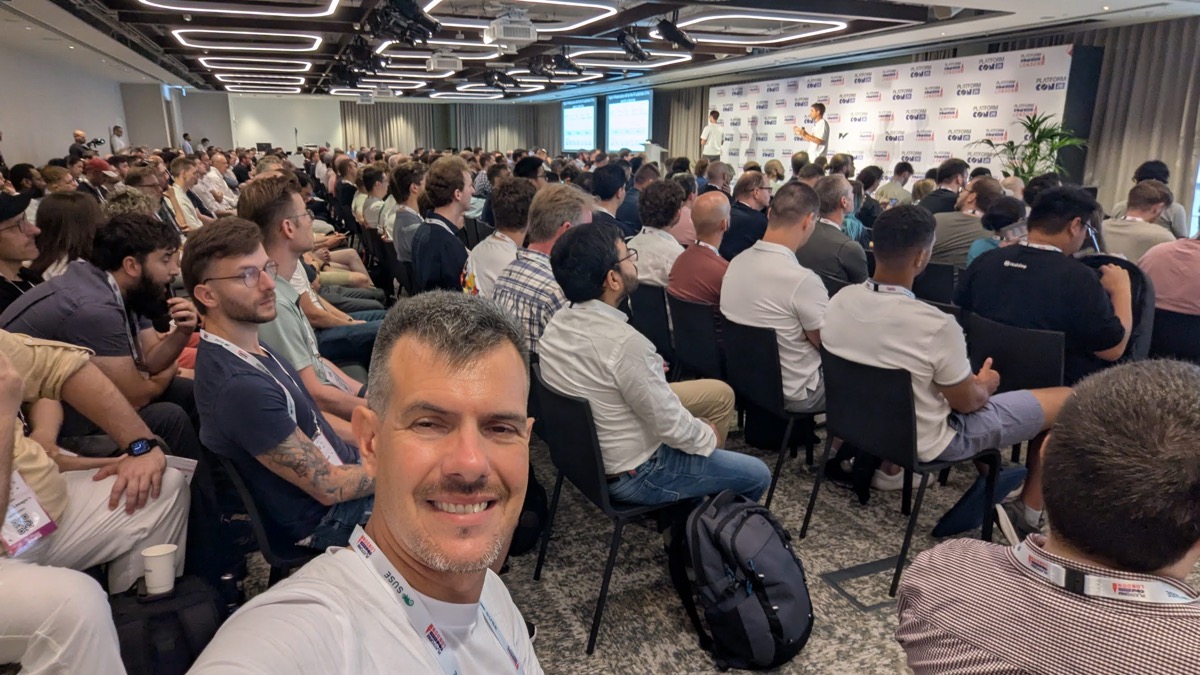
Running a secrets manager on open hardware is one of those demos that reframes what you thought was possible. At Open Source Summit Europe, we got OpenBao — the open-source community fork of HashiCorp Vault — running natively on a RISC-V machine. Not emulated, not cross-compiled for show. The actual OpenBao binaries, on open silicon.
I sat down with Antonio Taro, a contributor to OpenBao, to talk through what that milestone actually means — for secrets management, for open hardware, and for the broader question of who controls the stack underneath your security tooling.
Why OpenBao Exists
If you have followed the secrets-management space, the origin story is familiar by now: when HashiCorp relicensed Vault from MPL to BUSL, a chunk of the community — backed by IBM — forked it into what became OpenBao, now governed under the Linux Foundation. The point of the fork was never “Vault but different.” It was governance: a secrets manager whose license and direction cannot be changed out from under you by a single vendor’s business decision.
That governance argument has always been a software-story argument. What changes when you put it on open hardware?
OpenBao on RISC-V: Software Meets Silicon
The RISC-V run is the interesting part. RISC-V is an open instruction set architecture — no proprietary license, no closed firmware blob, no vendor dependency baked into the silicon. Pairing it with OpenBao closes a loop: you now have open software running on open hardware, with the option to verify the stack from the application layer all the way down to the instruction set.
For secrets management specifically, that combination matters more than it might sound. A secrets backend is one of the most sensitive components in any infrastructure. If the software that holds your credentials depends on a closed, single-vendor toolchain — and the hardware it runs on does too — then “open” only describes the top layer. Running OpenBao on RISC-V removes that last dependency: the architecture itself is open and auditable.
This is the same sovereignty lens I keep coming back to. OpenBao on RISC-V is a concrete data point for the argument that you can build secure, verifiable, open solutions from the silicon up to the application layer — not just trust a vendor’s word at one tier of the stack.
Secrets Management in the Cloud and Kubernetes
The practical conversation with Antonio stayed close to where OpenBao actually gets used: Kubernetes, cloud, and multi-cloud secrets management. The day-to-day problem platform teams face is not “is my ISA open” — it is “how do I hand credentials to workloads across clusters and clouds without sprawling long-lived secrets everywhere.”
OpenBao’s answer is the same one the Vault world has been building for years, applied consistently to non-human identities: short-lived, scoped tokens; tight per-workload permissions; rotation and auditability as defaults rather than afterthoughts. The RISC-V demonstration does not change that API surface — but it does change where you can run it, and what you have to trust underneath it.
Why Open Software on Open Hardware Matters Now
The timing is not accidental. With geopolitics, privacy regulation, and data-sovereignty requirements all pulling in the same direction, the appeal of a stack you can actually inspect end to end is growing fast. OpenBao on RISC-V is a small, real proof that the open path is no longer theoretical at any layer — silicon included.
That is the throughline of the whole demo: not “RISC-V is fast” or “OpenBao is a Vault replacement,” but open software plus open hardware equals a verifiable foundation for the next decade of infrastructure security.
How to Get Involved
OpenBao is a community project — contributors, maintainers, and users all welcome. If you run secrets management in production, or you care about the governance and hardware story underneath it, the best places to start are the project’s own channels:
- Project site: openbao.org
- Source and issues: github.com/openbao
For platform teams evaluating a Vault alternative whose license and governance cannot change out from under them again, it is worth a serious look — and now, worth a serious look on open hardware too.
Related Reading
- Open Source Summit Europe 2025 Amsterdam: Recap, the full week around this demo
- OpenBao Founder on Secrets Management for AI Agents
- Christian Gafner, Adfinis: Digital Sovereignty Meets OpenBao
- RISC-V Summit Europe 2026: Open Hardware Meets AI in Bologna
- DeepComputing DC-ROMA: Running DeepSeek on a RISC-V Laptop, No GPU
- Digital Sovereignty in Europe
About the Author
I am Luca Berton, AI and Cloud Advisor. I work at the intersection of platform engineering, cloud security, and enterprise AI deployments. Book a consultation.