From a CVE to a patch an enterprise can actually trust
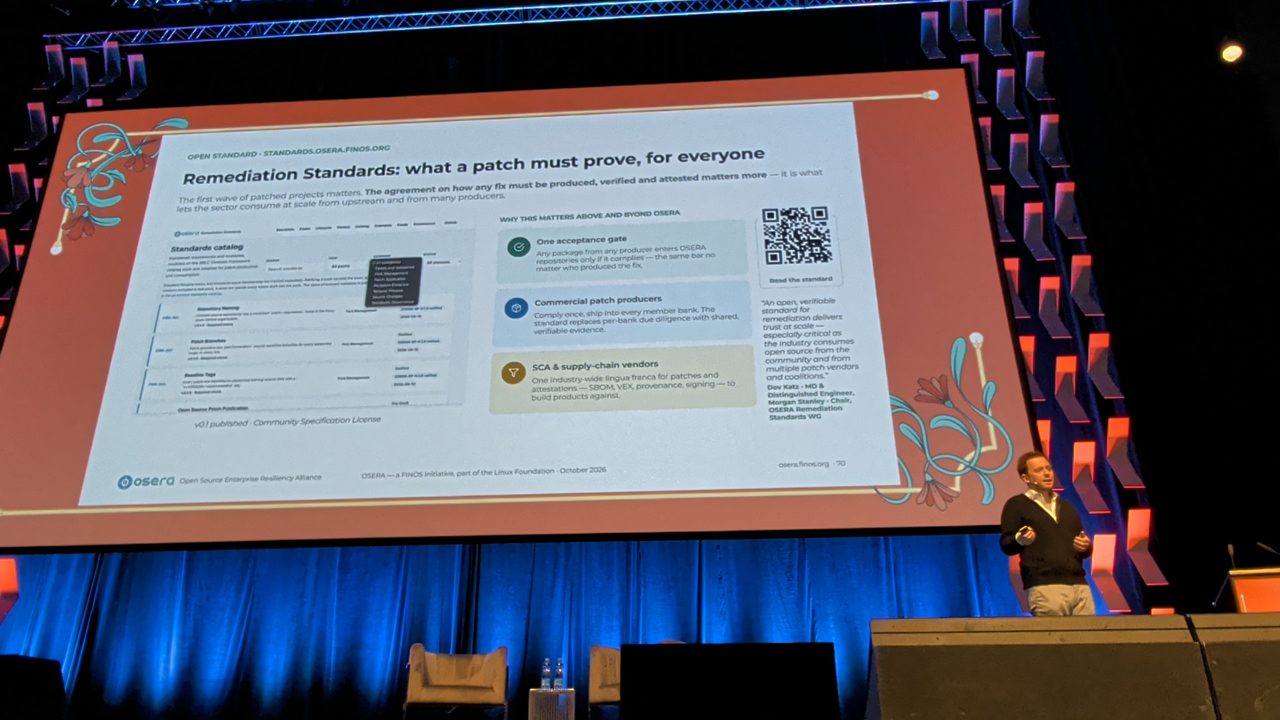
One of the most practical security ideas I photographed at Open Source Summit Europe 2026 in Prague was a FINOS OSERA slide on remediation standards. Its central point was that a patch must be accompanied by proof that recipients can evaluate and reuse.
That gets to a problem every platform and security engineer recognizes: knowing a vulnerability exists is not the same as having a compatible, tested, trustworthy fix.
On October 7, 2026, the Fintech Open Source Foundation (FINOS) announced at the summit that the Open Source Enterprise Resiliency Alliance (OSERA) was operational. FINOS said that, within its first 100 days, the initiative had attracted six Premier members and delivered patches for more than 50 commonly used Java-ecosystem projects.
The motivation is straightforward: financial institutions often rely on the same upstream packages, including old versions that remain embedded in regulated systems. It makes little sense for every bank to independently rebuild and audit the same security fix.
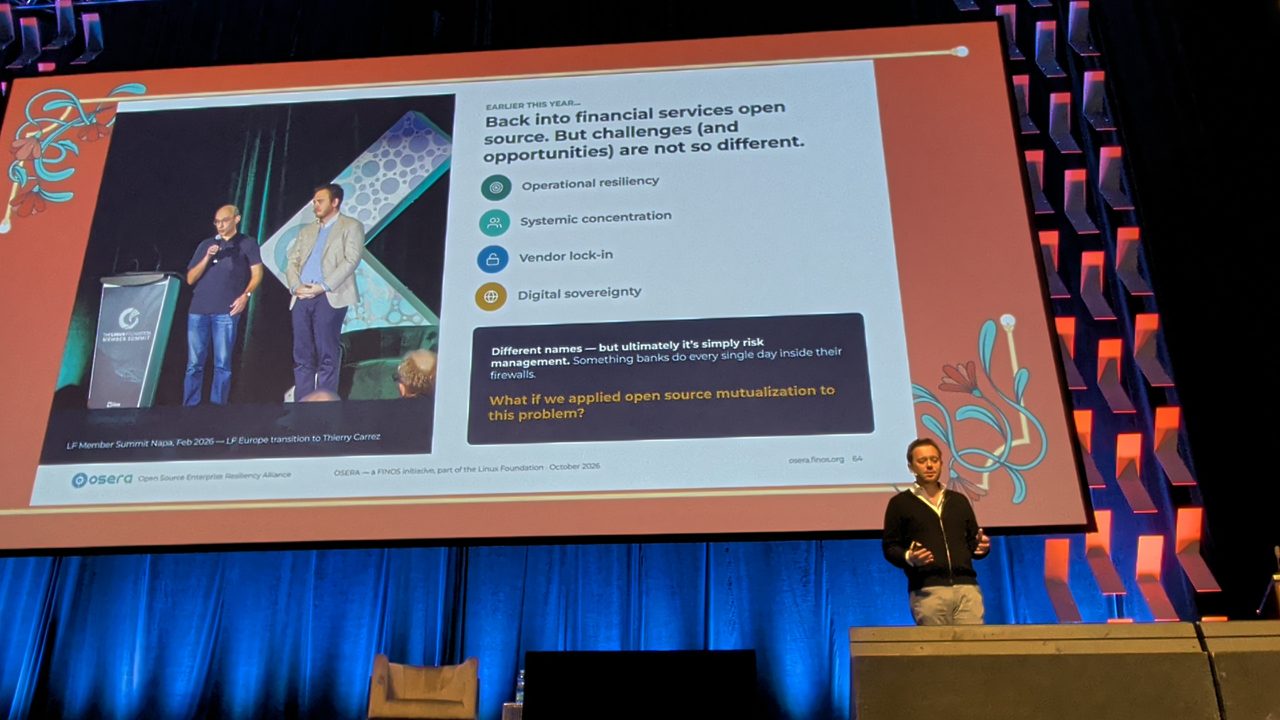
The conference discussion on open source collaboration in financial services. Photo: Luca Berton.
What OSERA is trying to standardize
The OSERA Remediation Standards initiative focuses on what must be true of a patch, not simply who happens to distribute it.
Imagine two vendors each ship a fix for an aging Java dependency. Both say “CVE patched.” But the enterprise recipient still needs to know:
- Origin: Which upstream source, advisory, or commit formed the basis of the fix?
- Scope: What changed, and was it limited to the relevant vulnerability?
- Compatibility: Does the artifact run on the same Java bytecode level and dependency line?
- Evidence: What tests ran against the exact commit that was released?
- Identity: Who built and published the patched artifact?
- Distribution: How can scanners and dependency systems discover the new status?
Those are questions a repeatable standard can answer much better than a one-off PDF assurance letter.
A ratified standard pack, with important boundaries
OSERA’s first pack, OSERA-SP-0.1.0, was ratified on September 10, 2026. The standards site says the pack establishes checks for source provenance, fork conventions, compatibility, release naming, and published evidence.
The distinction between ratified and observe-only matters. OSERA also tracks additional proposed standards for a future 0.2.0 pack. A proposal on a roadmap is not yet a mandatory requirement of the currently ratified pack.
Equally important, the governance documentation explicitly says that pack alignment does not establish provider certification. Do not describe a build as “OSERA-certified” merely because its repository advertises conformity with OSERA-SP-0.1.0.
The patch-consumption workflow
For an enterprise remediation team, the goal is to make patch acceptance a predictable pipeline rather than an exceptional meeting.
CVE / security advisory
          |
          v
Find affected dependency and supported version
          |
          v
Locate OSERA-style patched source and release
          |
          v
Verify upstream patch basis + test evidence
          |
          v
Verify bytecode / API / dependency compatibility
          |
          v
Ingest SBOM + OpenVEX / CycloneDX vulnerability data
          |
          v
Test in your own application environment
          |
          v
Approve, deploy, monitor, and retain evidence
A standardized patch can shorten investigation, but it does not remove the recipient’s duty to test the real application. An upstream fix that passes a library’s test suite can still expose a runtime mismatch in an enterprise stack.
A concrete example: Java bytecode compatibility
Suppose a legacy workload still runs on Java 8. A maintainer backports a security fix from a newer upstream release into the older branch.
If the patched artifact is accidentally compiled at a higher bytecode level, it may be perfectly valid Java and still crash in the enterprise runtime.
OSERA’s ratified REL-002 Bytecode Compatibility requirement addresses exactly that: patched artifacts must preserve the previous released artifact’s bytecode level unless an exception is approved. The acceptance evidence should establish the comparison, not just claim that compilation succeeded.
A recipient can independently inspect class-file compatibility:
# Inspect a class file extracted from the candidate JAR.
# The major version is displayed in javap's verbose output.
javap -verbose -classpath my-library-patched.jar com.example.MyClass | grep 'major version'

# Example expected for a Java 8-compatible class:
# major version: 52
The example class name is illustrative; replace it with one actually present in the candidate JAR. A single class inspection is only a spot check: a full compatibility gate should examine all relevant artifacts, dependencies, and runtime behavior.
Release provenance and test evidence
The OSERA fitness checks include requirements for baseline tags, upstream source links, and release evidence. They are intended to make it possible to answer a surprisingly difficult question:
Which exact commit was tested, and is it the commit that produced the binary I am about to deploy?
For teams maintaining their own remediation pipelines, I would retain a small evidence bundle beside each release:
# Illustrative internal evidence record, not a normative OSERA schema
patch:
  package: "example:legacy-library"
  vulnerability: "CVE-YYYY-NNNN"
  baseline_commit: "<verified upstream tag or commit>"
  patch_basis: "<upstream commit or advisory link>"
  tested_commit: "<exact Git SHA>"
  artifact_sha256: "<actual artifact digest>"
  runtime: "Java 8"
  tests:
    command: "./gradlew test"
    report: "<CI artifact URL>"
  reviewed_by: "<change approver>"
This is a team-level implementation example, not a claim that OSERA requires this exact YAML structure. The definitive requirements are published in the versioned standards catalog.
Why OpenVEX and CycloneDX matter
A patched artifact is easier to use if scanners can understand its status without bespoke adapters.
The OSERA feeds documentation describes requirements for both OpenVEX and CycloneDX data in the ratified pack:
- OpenVEX communicates vulnerability applicability and remediation assertions in a machine-readable way.
- CycloneDX connects component inventory and vulnerability-management data to artifacts and releases.
That lets enterprise consumers ingest not only a replacement JAR but also evidence about which vulnerability is addressed and which artifact the statement applies to.
The important rule: never treat a VEX statement by itself as proof that a deployed binary is safe. Validate the producer, artifact identity, digest, evidence, and actual deployment state.
Security teams can start before adopting OSERA
You do not have to be a financial institution to benefit from this model. A platform team can start with a short policy for critical upstream security fixes:
- Prefer an official supported upstream release where one is available.
- For a backport, preserve a precise link to the vulnerability and upstream change.
- Record the exact source commit, build inputs, test outputs, and artifact digest.
- Verify runtime and dependency compatibility, not just unit tests.
- Publish machine-readable component and vulnerability information.
- Feed the verified artifact into existing CI/CD and change-approval controls.
- Keep a plan to converge on a supported upstream version instead of maintaining an indefinite fork.
For mature environments, this can be expressed as policy-as-code and made available through the internal developer platform.
What I took away from Prague
The most valuable idea in the OSERA presentation is not merely “patch once, use everywhere.” It is “patch once, prove enough that everyone can make an informed acceptance decision.”
As the number of security reports and AI-assisted patches increases, teams need better shared evidence, not another flood of unreviewed binaries.
OSERA is an interesting example of financial institutions using open governance and common technical standards to solve a problem they all share. The precise future of the initiative remains open, but its current specifications are already a useful reference for enterprise remediation design.
For more context, see my Open Source Summit Europe 2026 Prague recap, Digital Sovereignty at Prague, and AI Coding Adoption in Europe.
Sources: FINOS OSERA announcement, October 7, 2026 · OSERA standards · Ratified standards pack · OSERA governance · OSERA GitHub repository