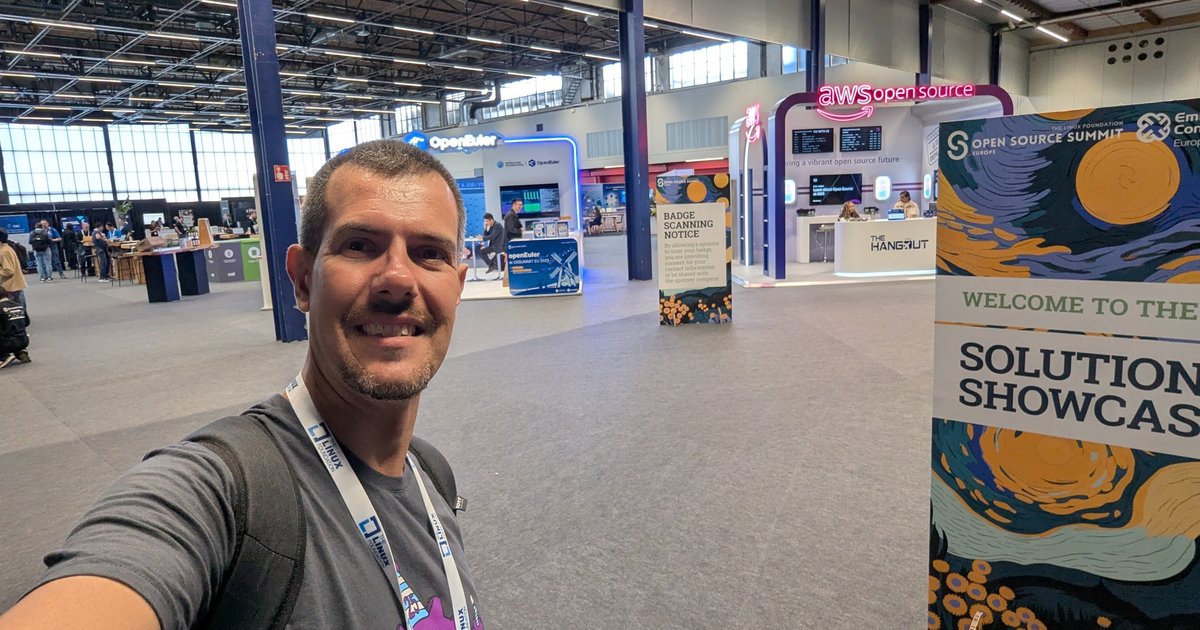
The Linux Foundation’s Open Source Summit Europe 2025 ran at RAI Amsterdam from Monday 25 to Wednesday 27 August, co-located with the Embedded Linux Conference Europe (ELC). I was there all three days. I sat in the keynote hall in the mornings, recorded short interviews in the Solutions Showcase, and spent the afternoons in ELC rooms. I was also there supporting DeepComputing at the RISC-V booth, which is why I’m wearing their T-shirt in several of these photos.
I’m writing this in October 2026, a few days before the 2026 edition opens in Prague, so it’s a look back. Everything below comes from the slides I photographed, the talks and interviews I recorded, and the official announcements I checked afterwards. All times are local (CEST).
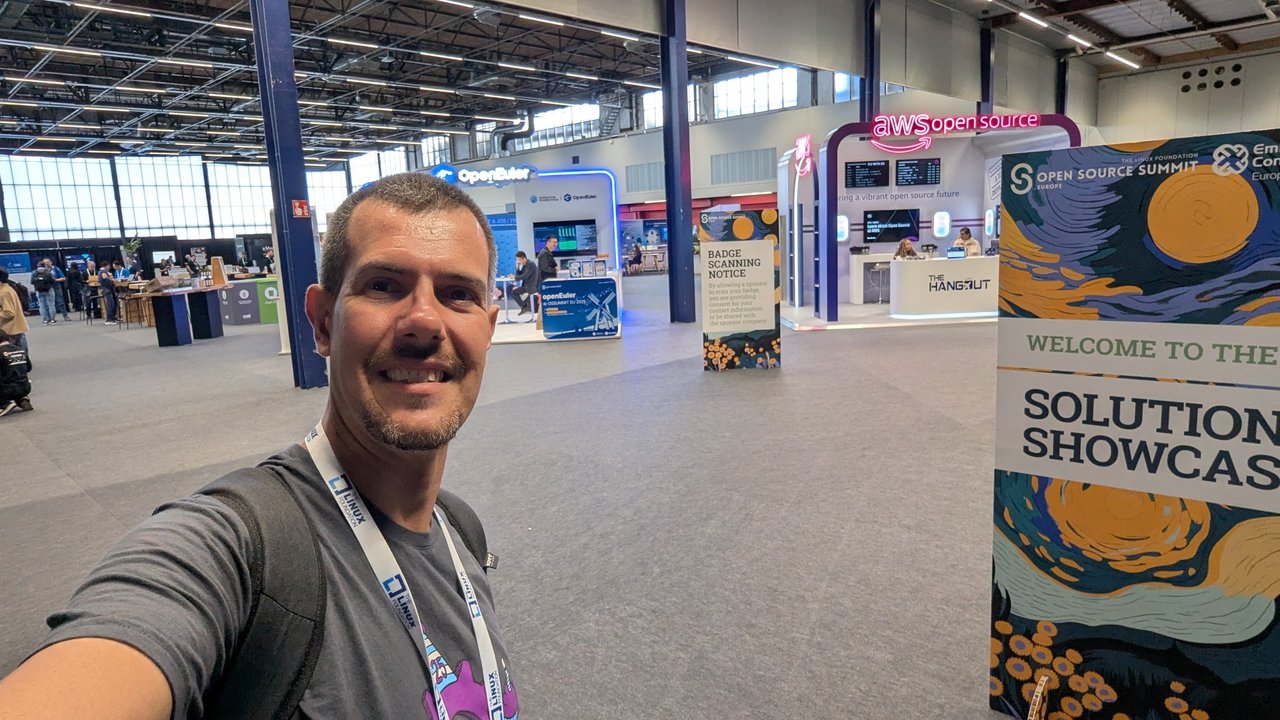
Monday morning, before the expo hall filled up: openEuler on the left, the AWS open source “Hangout” on the right.
Sunday: picking up the badge a day early
My summit actually started on Sunday afternoon, 24 August, when I went to RAI to collect my badge a day before the opening keynote. A “Welcome attendees! Entrance G” sign pointed the way, and the “Welkom!” banner over the entrance carried all three co-located events: the Embedded Linux Conference Europe, Open Source Summit Europe and AI_dev. By the time I had my lanyard, the “Thank you sponsors” wall was already up inside.
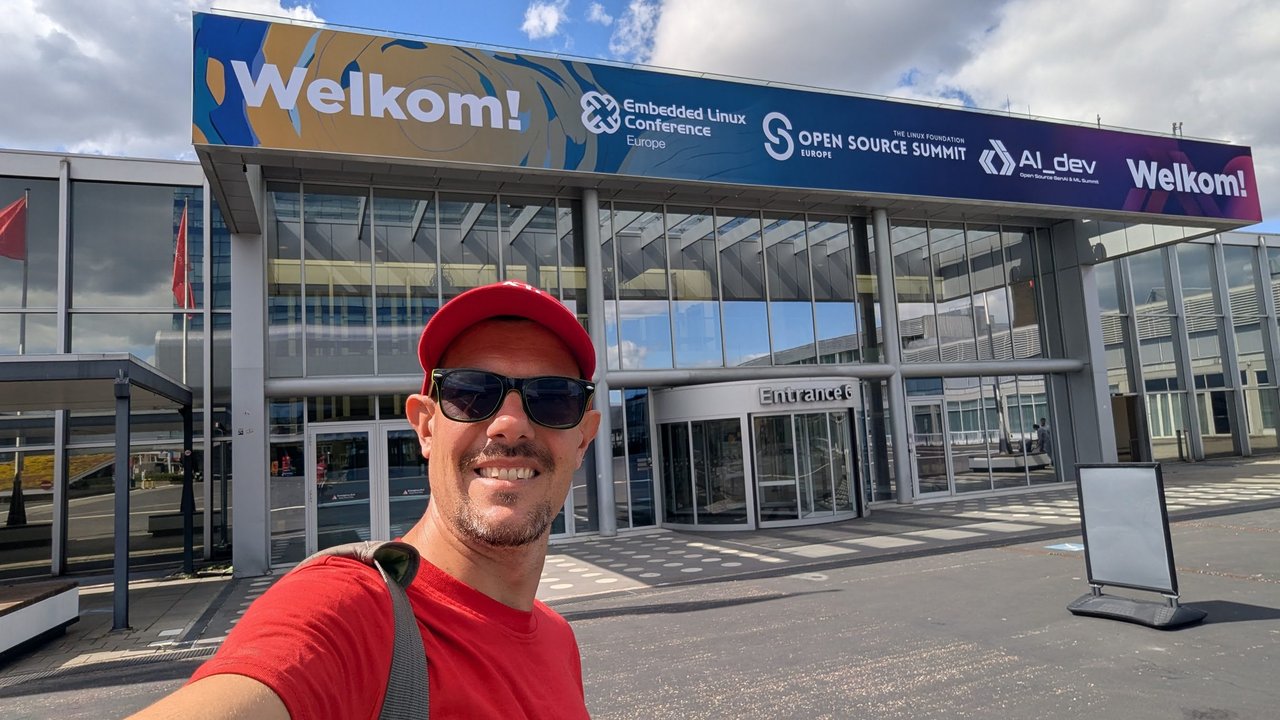
Sunday afternoon at RAI: badge pickup a day ahead, under the “Welkom!” banner.
Day 1 keynotes: agents, databases and money
The opening keynote set the theme with a slide that read “2025 is the Era of AI Agents (Agentic AI)” and, underneath, “Frontier Models are so 2024”. The next slide covered DeepSeek’s V3.1 release as a pivot towards agentic, tool-using tasks.
The most useful slide for me was “The Agent ‘stack’”. From top to bottom:
- Agent Experience/UX: conversational and action interfaces
- Agent Orchestrators: Azure AI Foundry, Google Vertex, Amazon Bedrock Agents, LangChain, CrewAI
- Protocols & Standards (MCP, A2A) next to Registries (secure discovery and orchestration)
- Skills/Tools Plugins: from API management to enterprise resources
On the left an arrow pointed down: “OSS Quickly Pushes Cost Down”. On the right an arrow pointed up: “Value and Innovation Go Up”.
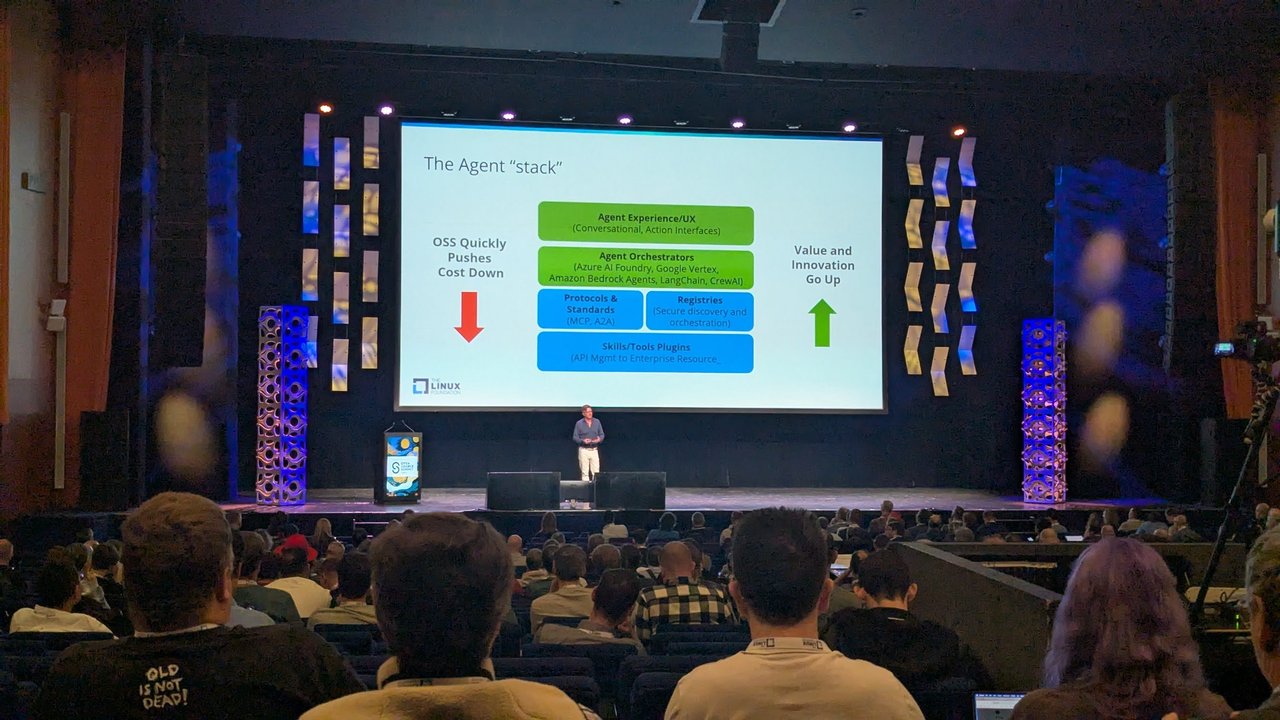
“The Agent ‘stack’”: open source at the bottom pushing cost down, value moving up the layers.
The keynote also brought a reality check. A slide citing a University of Texas at Austin study said early studies show “higher personal productivity but no major project-level breakthroughs yet”. According to the slide, Copilot raised OSS project-level contributions by 5.9% (+2.1% individual contributions, +3.4% developer participation), while coordination and integration time went up by 8%. In other words, more and broader contributions, but slower coordination.
My take: that tradeoff matches what I see with platform teams. AI assistants make it cheap to open a pull request. Reviewing, integrating and owning the change still costs the same human time, and that’s where the backlog moves.
Three announcements in a row
Then came the Linux Foundation news, back to back:
- DocumentDB joins the Linux Foundation. The slide listed four points: open source (MIT-licensed, LF-governed), MongoDB compatible (works with all open source MongoDB drivers), based on Postgres (PostgreSQL extensions and ecosystem), and broad industry support (“AWS, Azure, GCP and 7 others”). The logos on the slide were Microsoft, AWS, Google Cloud, Snowflake, Supabase, CockroachDB, YugabyteDB, SingleStore, Rippling and Ubicloud. The LF press release adds that the project began as a pair of PostgreSQL extensions launched by Microsoft.
- “Released Today: The State of Commercial Open Source 2025 Report”, from LF Research, COSSA and Serena. Right after it: “Also Launching Today: The Commercial Open Source Startup Alliance”. According to the slide, COSSA delivers “shared data, mentorship, and best practices” to entrepreneurs, investors and communities building open source companies. The report’s press release puts 2024 funding for commercial open source startups at $26.4 billion.
- “Welcome to the Linux Foundation: agentgateway”: “the first and only data plane purpose-built for AI agents”, for agent-to-agent, agent-to-tool and agent-to-LLM traffic “without vendor lock in”.
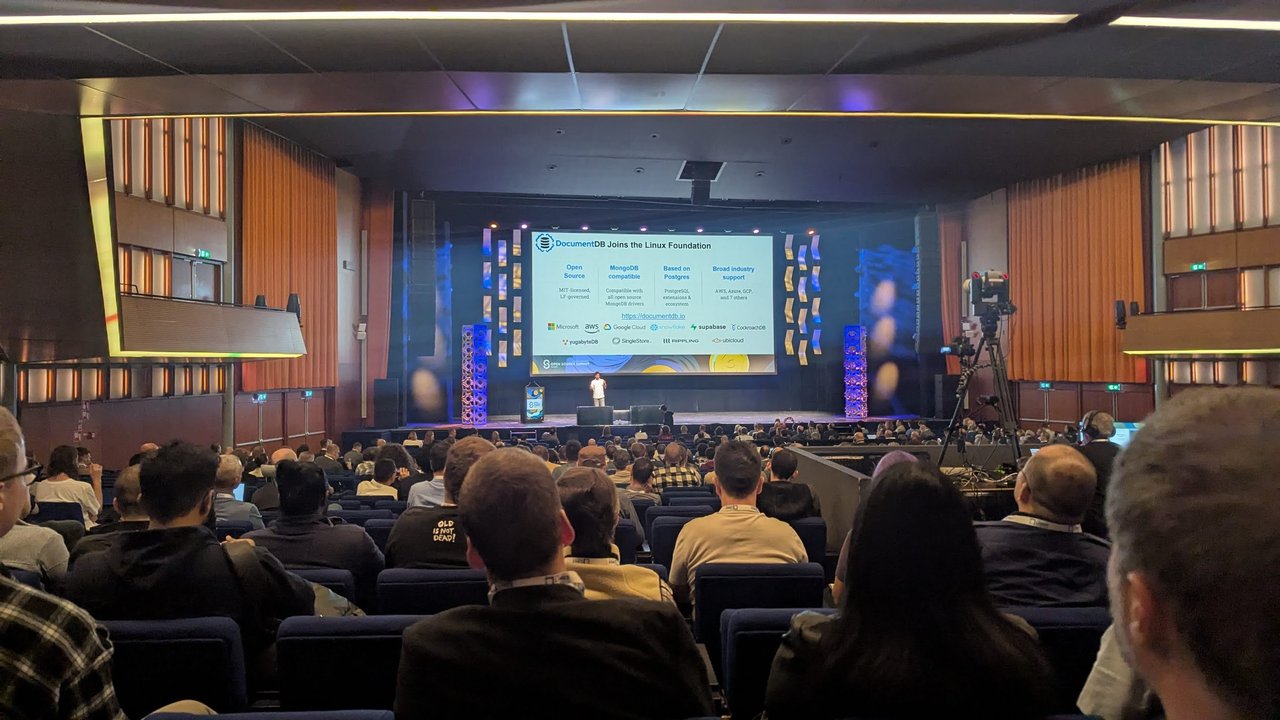
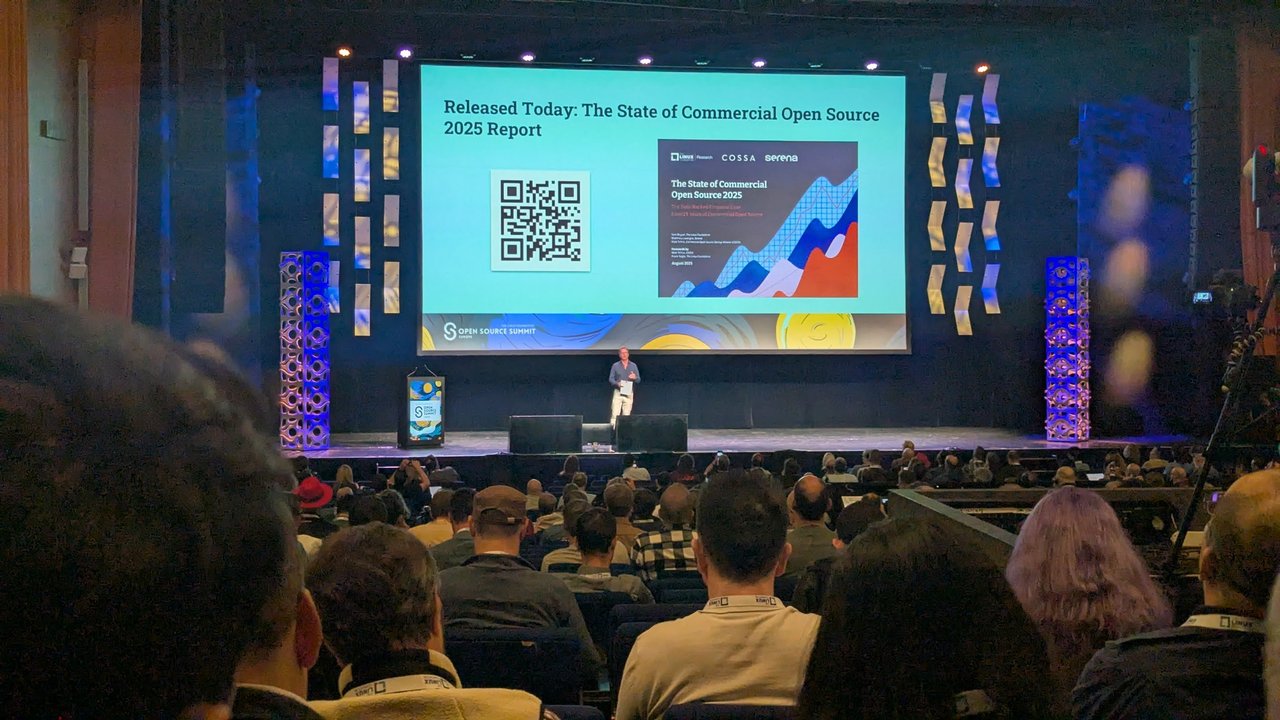
Two of the day-1 announcements: DocumentDB moving to the LF, and the State of Commercial Open Source 2025 report.
agentgateway: why not just Envoy?
agentgateway got its own short keynote from the team at Solo.io, which contributed the project. I recorded it. The argument went like this:
- Agents work best when they’re small and focused, with a small set of tools. Bigger workflows come from agents passing state and tasks to each other.
- MCP (for tools) and A2A (between agents) are both JSON-RPC, but with long-lived, stateful, multi-turn sessions. They help with interoperability, but they don’t solve governance, security, policy, observability, rate limiting or cost control.
- Envoy was built for classic HTTP: read the headers, stream the body, close the connection. AI traffic needs to look deep inside the body. So they built a new proxy from scratch, in Rust.
The speaker described three use cases:
- Consuming LLMs as an egress gateway, with model failover, guardrails injected into prompts, and credential management.
- Self-hosted inference routing, using signals like GPU and cache utilisation, LoRA adapters and queue depth.
- An MCP gateway, with tool-server aggregation, authorisation, protocol-aware routing and deep tracing, so that not every agent can reach every tool.
It runs standalone, with a UI, declarative config and a playground. On Kubernetes, a control plane such as kgateway or Istio can program it live over xDS.
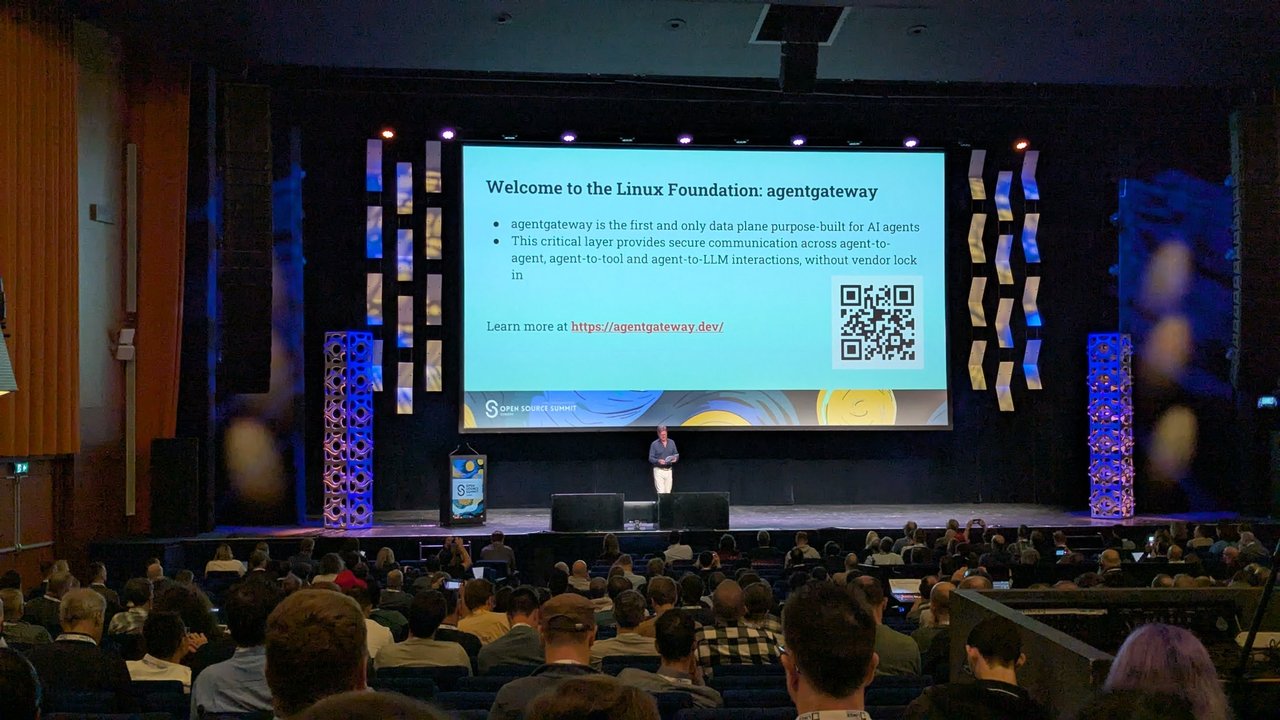
agentgateway joining the Linux Foundation, Monday morning.
My take: the “support agent accidentally calls the payroll system” example from this talk is the real reason to put a gateway in front of MCP servers. Scoping which agent sees which tools is an authorisation problem, and it belongs in the platform, not in each agent’s prompt.
The morning closed with a DevRel Foundation spotlight from Stacey Kruczek (introduced on the slide as Community Growth Strategist and Developer Relations Leader). Under “Scaling the Challenges of DevRel: is the profession at risk?”, the slide quoted the 11th annual State of DevRel survey (2024): 50% find awareness of their impact challenging, and 61% find it hard to meet business impact.
The expo floor and the booth interviews
Among the booths I photographed in the Solutions Showcase:
- the AWS open source “Hangout”, built around an airport departures theme
- openEuler, a Diamond sponsor
- Red Hat
- Sony’s AITRIOS edge AI platform
- Sidero (“The Best OS for Kubernetes”)
- Framework (“Consumer electronics is broken. We are here to fix it.”)
- the RISC-V International booth, shared with DeepComputing
- a “Post a job / Find a job” board
Framework: “Consumer electronics is broken”
On Monday afternoon I stopped at the Framework booth. Its two roll-up banners read “Consumer electronics is broken” and “We are here to fix it.”, and the table had Framework laptops and a small desktop on display. Earlier that morning, another table with Framework laptops and flyers for DeepComputing’s “World’s First 50 TOPS RISC-V AI PC” had set a small challenge on a card: “Think you can swap a mainboard like a pro?”
The two companies are linked: Framework’s marketplace sells the DeepComputing RISC-V Mainboard for the Framework Laptop 13, and Yuning Liang came back to that partnership in his talk on Wednesday (below).
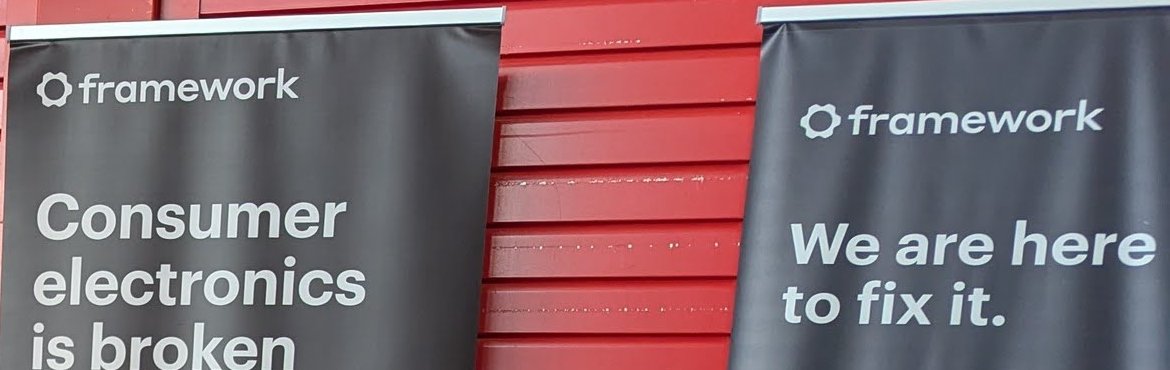
Framework’s two banners, against the red wall of the expo hall.
Gold and silver sponsors
Later on Monday afternoon, the keynote hall was nearly empty and the main screen cycled through the sponsor slides. The gold slide listed Automattic, the Cloud Native Computing Foundation, Coder, Dynatrace, LavinMQ, Red Hat, Sony, SUSE and Texas Instruments. The silver slide listed Arm, CAMARA, Chainguard, GitLab, minimus, New Relic, Sentry, Sidero and Valkey, plus two logos too small to read in my photo. The diamond and platinum tiers are on the sponsor wall further down.
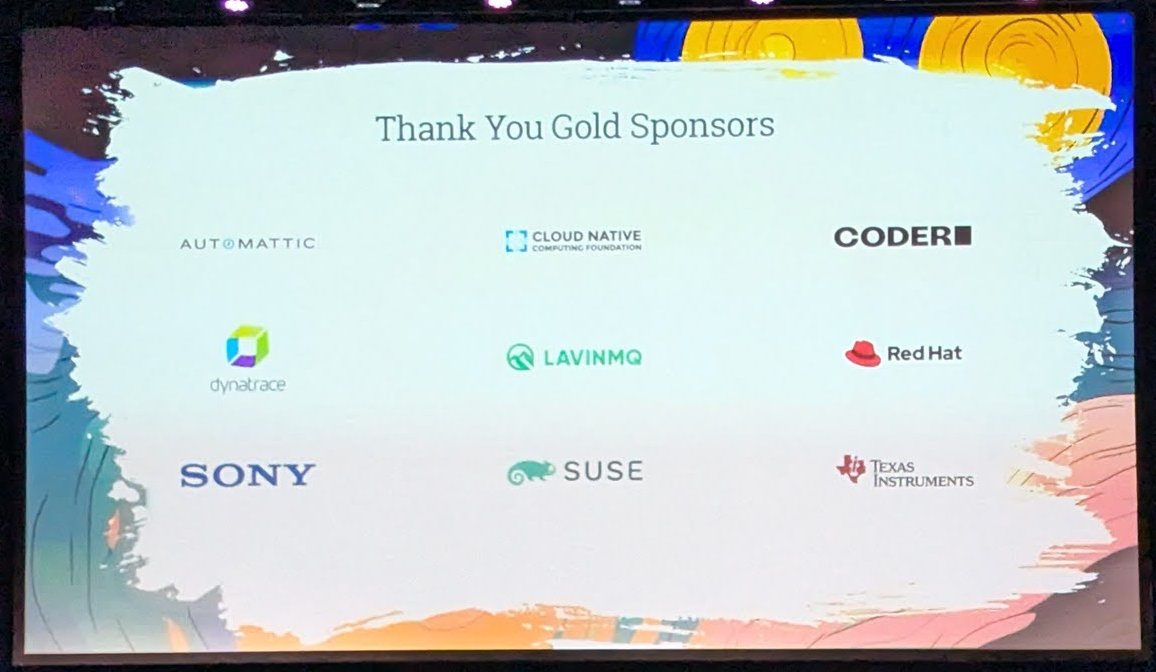
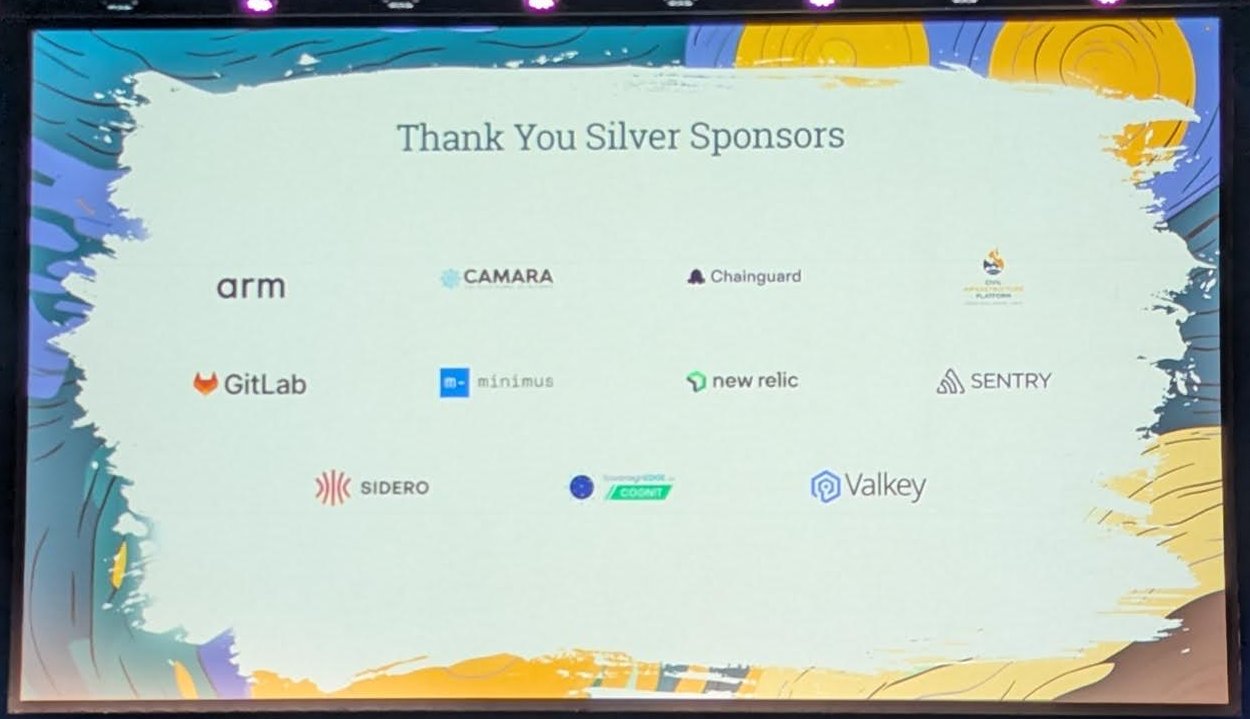
The gold and silver sponsor slides on the main keynote screen.
At the openEuler booth, a video ran on loop with Andrea Gallo, CEO of RISC-V International. Next to him, the screen said openEuler works with RISC-V to build the best RISC-V-based OS:
- openEuler 24.03 LTS is “the first OS to support the RISC-V Trusted Execution Environment”
- openEuler is an associate member of RISC-V International
- it’s the first open source OS from China on the RISC-V landscape
- “99% of RISC-V commercial software packages supported”
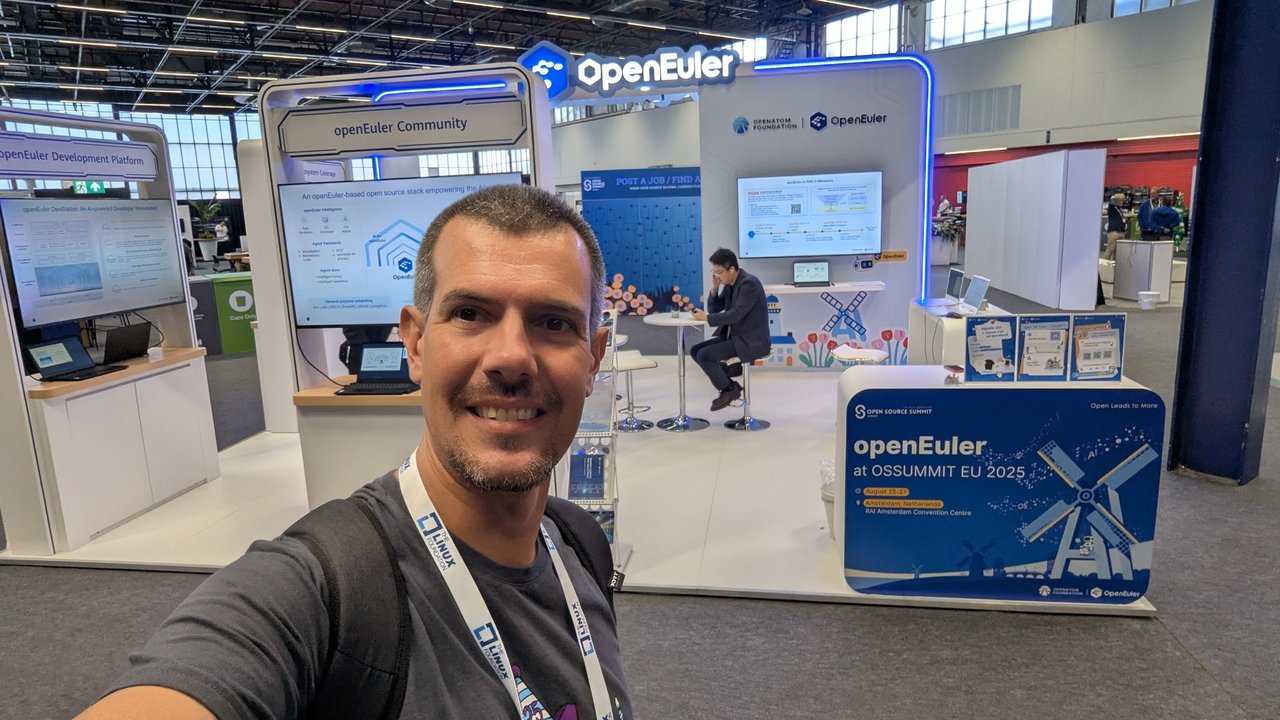
At the openEuler booth on Monday morning.
Helen, openEuler community
On Wednesday I came back to openEuler and recorded a short interview with Helen from the openEuler community. She described openEuler as a fully open source, Linux-based operating system run by the OpenAtom Foundation, with a growing set of AI features for developers. The one she highlighted was DevStation, a desktop edition you can download from the official site. It comes with an AI agent out of the box, so you can ask the OS in natural language to handle development tasks. The openEuler DevStation docs describe it as the project’s first workstation built for developers.
James, RISC-V International
At the RISC-V booth on Tuesday I interviewed James, who said his job at RISC-V International is to develop content: telling the stories of what people build with RISC-V. He compared the development boards on the table to an Arduino or Raspberry Pi kit. They ship with documentation, SDKs, compilers and pre-built binaries, because the goal is to “reduce the time to value” between a board arriving and someone building something with it.
His main point was RVA23. In the past, he said, many RISC-V boards targeted different versions of the ISA, so you never knew whether a Linux distribution would boot out of the box. RVA23 gives everyone one stable hardware target. He said Canonical and Red Hat were already building RVA23-compatible Ubuntu and RHEL, so that when RVA23 hardware rolled off production lines (he expected the end of 2025 or early 2026), it would just work. Individuals can join the community for free through riscv.org, and companies join as paid members. I wrote a separate explainer on what RVA23 means.
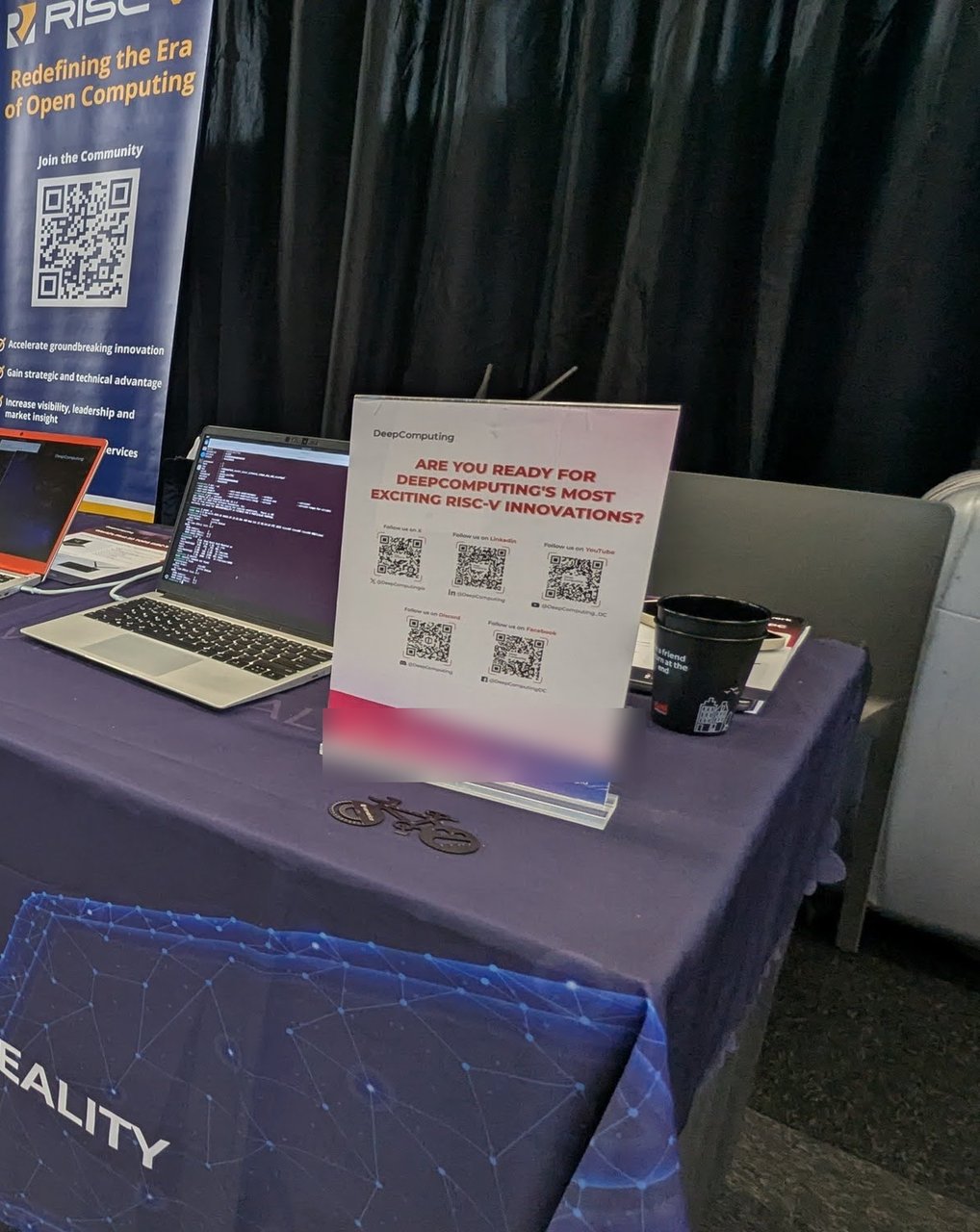
Tuesday morning at the RISC-V booth: the “Redefining the Era of Open Computing” banner and DeepComputing’s laptops at a Linux terminal.
Yuning, DeepComputing
A few minutes earlier I had recorded Yuning from DeepComputing at the same booth. He introduced the company as making “the world’s first AI PC with RISC-V SoC”, able to run 7B and 14B language models. It isn’t a prototype: it’s a board you can buy and put into a laptop. He showed a 13-inch machine and a 14-inch mock-up, and invited open source software developers to come to his talk and contribute to the RISC-V ecosystem.
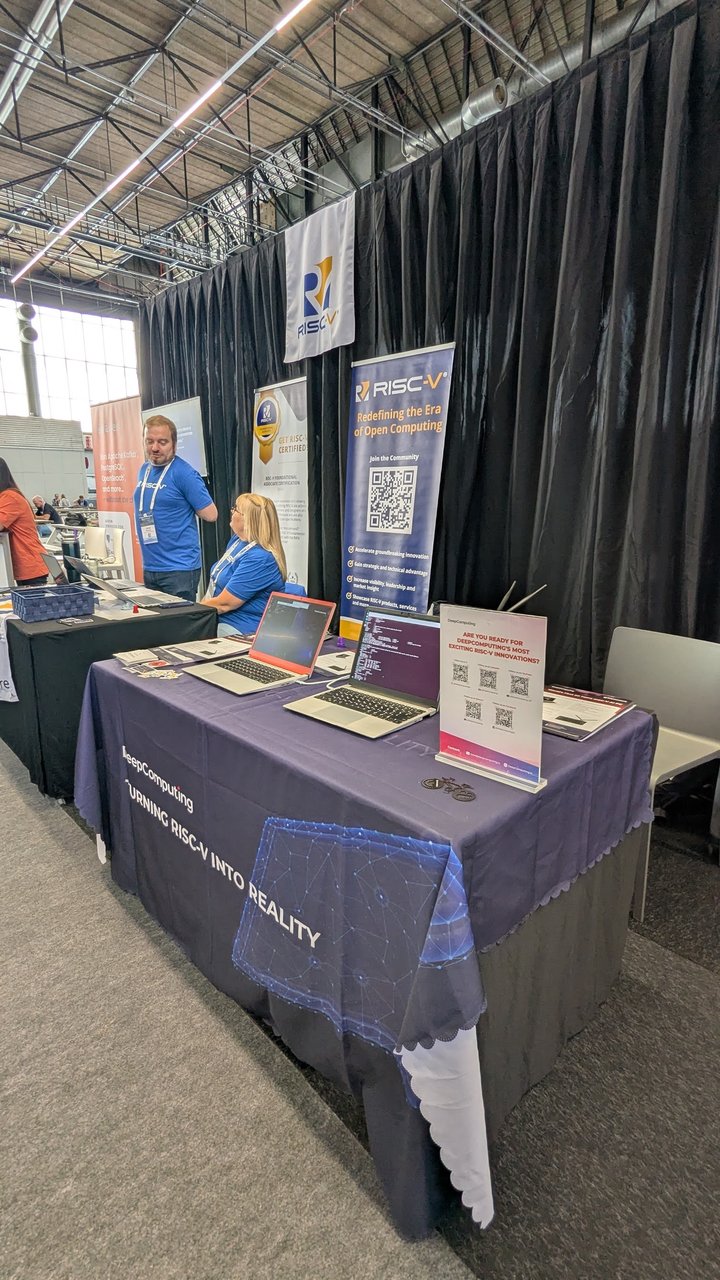
DeepComputing’s table at the RISC-V booth: RISC-V laptops running Linux, ready for people to try.
The booth is also where the OpenBao demo happened. On Wednesday, Antonio downloaded the official RISC-V build of OpenBao from GitHub and ran it on one of these machines, and it worked out of the box. That interview has its own post: OpenBao on RISC-V.
Maemalynn Meanor, ELISA and Zephyr
On Wednesday afternoon I bumped into Maemalynn Meanor, director of marketing communications at the Linux Foundation, who was representing the ELISA and Zephyr projects. ELISA stands for Enabling Linux in Safety Applications. One of its biggest efforts, she said, is Space Grade Linux: making Linux safe to run in space. ELISA had just opened a Discord where you can talk to ambassadors and join meetings. Zephyr has a Discord too, plus a website and YouTube channel full of use cases. She mentioned Google Chromebooks among the products that run Zephyr. If you’re new to it, I have a Zephyr RTOS on RISC-V guide.
Day 2 keynotes: Microsoft, OpenSearch and drones
Tuesday opened with an openEuler keynote from the chair of the project, about its AI stack. I caught the end. He described two newer acceleration projects. One splits prefill and decode across different nodes, including CPUs, and he quoted 10–30% higher throughput depending on the model. The other sorts MoE experts into hot, warm and cold, keeps the cold ones on CPU and the hot ones on GPU, and he quoted a 10–15% throughput gain. He was candid that nobody yet knew what happens when you combine the two. He also shared a naming tradition: openEuler releases are named after a food. He picked the first one, hui mian, a noodle dish from his home province of Henan, and invited the audience to suggest the next.
Next was Ryan Waite (Open Source Strategy and Incubations, Microsoft) with “Open Source & AI at the Core: How Microsoft Builds and Runs on OSS”. He opened by admitting that 15 to 20 years ago Microsoft was, “if you were polite”, a sceptic. He traced the change from a contribution of about 20,000 lines of code in 2009, through VS Code, to the GitHub acquisition in 2018. Some claims from his talk:
- Microsoft is the leading cloud contributor to the CNCF and the number two contributor overall for the last three years.
- More than two thirds of the virtual machines in Azure run Linux.
- The company works “upstream first”, then brings those changes downstream into its products.
- Security comes first, with new open source projects such as Copacetic and Dalec, and partnerships with the Rust Foundation, Alpha-Omega and the OpenSSF.
Then Pallavi Priyadarshini gave “OpenSearch at the Linux Foundation: one year of innovation and community growth”. According to her talk:
- OpenSearch 3.0 shipped in May 2025, and 3.2 came out the week before the summit, on an eight-week release cadence.
- The project has passed 3,000 contributors.
- 3.2 is “11x more performant” than OpenSearch 1.0.
- Contributors include Uber, ByteDance (conversational search), SAP (security features), NVIDIA (GPU acceleration for vector search) and engineers from Apple.
- New in the 3.x line: agentic search, agentic memory and native MCP support.
- The 3.2 release was orchestrated end to end by an AI release bot.
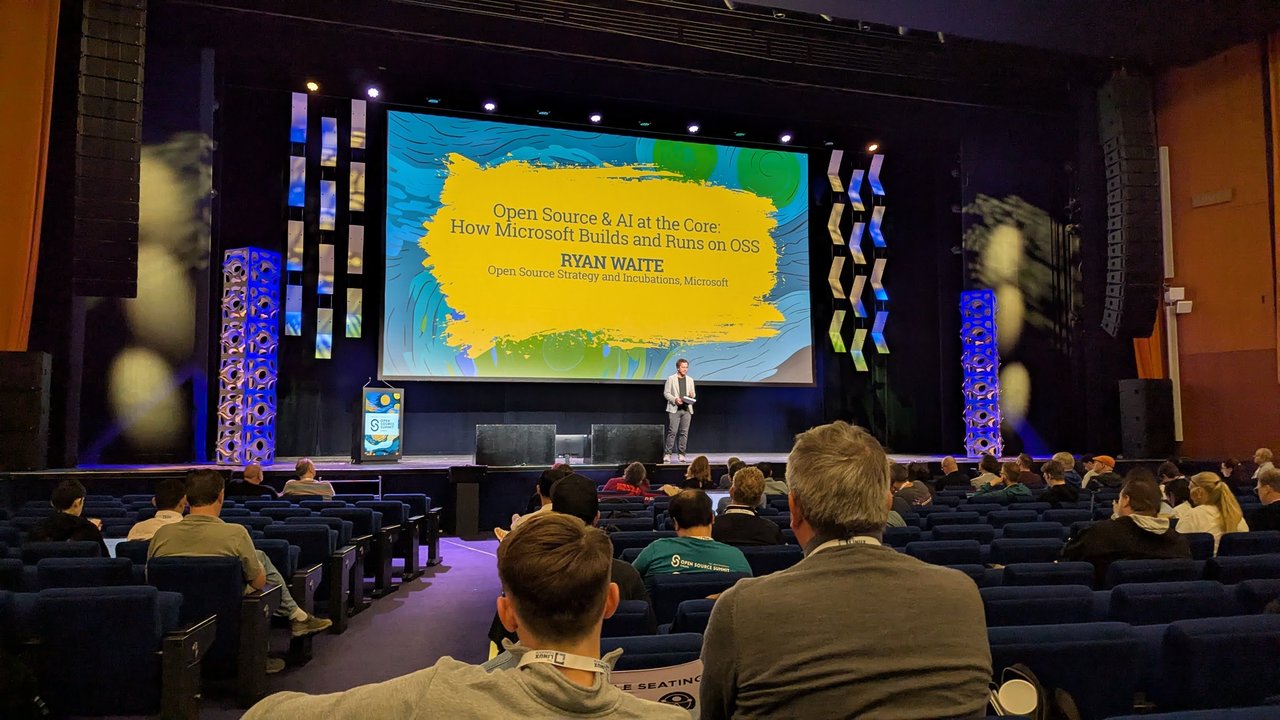
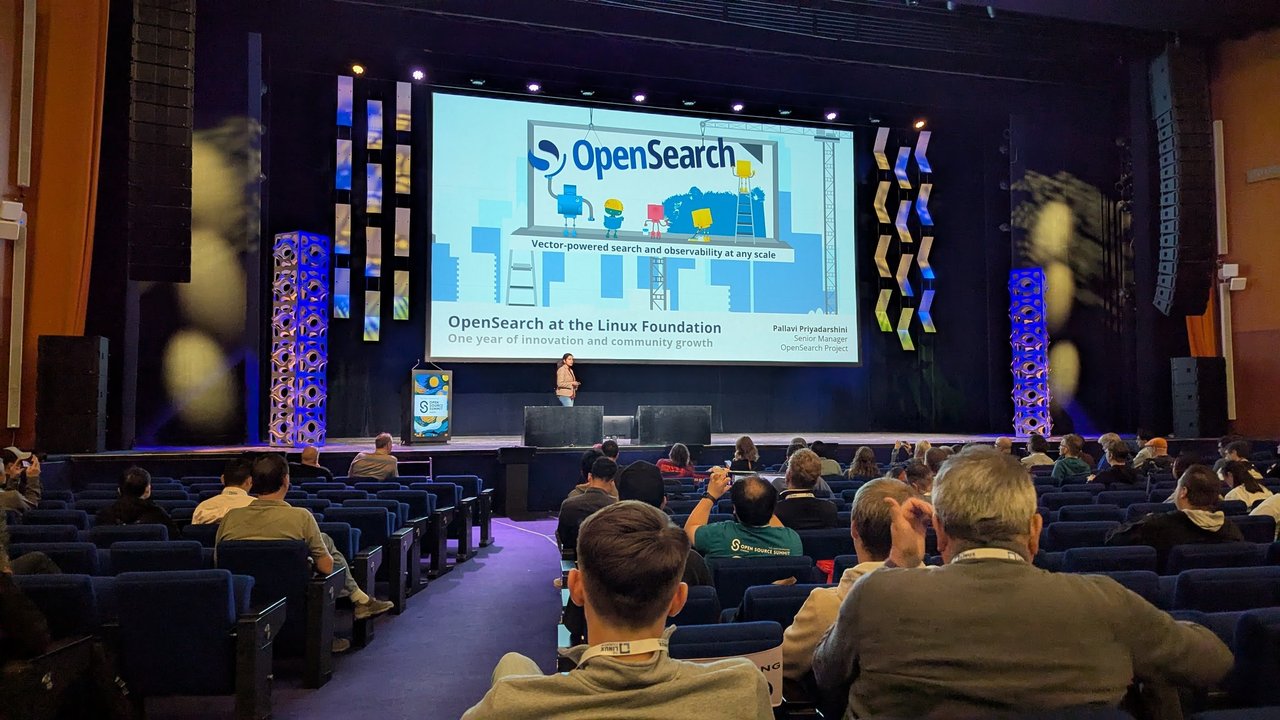
Tuesday keynotes: Microsoft on running on open source, and OpenSearch one year after joining the Linux Foundation.
The last Tuesday keynote I recorded came from Ramon Roche (general manager of the Dronecode Foundation, which hosts PX4) and Kimberly McGuire (an independent roboticist and co-lead of the ROS Aerial Robotics interest group). They told the made-up story of “Mary”, an intern who wants drones to scan warehouse inventory. She picks PX4 for real-time flight control, ROS for high-level autonomy and OpenCV for vision, and writes unit tests and CI. Her drone then flies left instead of right into a wall, because a sensor was mounted rotated. The fix in the story was simulation first, with O3DE, the Open 3D Engine from the Linux Foundation’s Open 3D Foundation. They ended with a real warehouse case: Corvus Robotics, which according to the speakers takes inventory accuracy up to 99% with open source drones.
Embedded Linux Conference: boot time, Bluetooth at scale and cameras
On Tuesday afternoon at 15:05 I looked into The Cost of Security: Measuring and Reducing Boot-Time Impact. The room was packed. The slide on screen explained how to measure boot time:
- timestamps from the serial console output
- kernel timestamps (clock monotonic)
- the offset between the bootloader starting the kernel and timestamp zero of clock monotonic, which was 220 ms in that example
I spent the rest of the slot next door at Testing Zephyr Bluetooth Devices at Scale by Donatien Garnier of Blecon. From the slides:
- Early insights: timing benchmarks (medians) comparing Android GATT and iOS L2CAP, and charts of advertising packets lost between test devices and gateways.
- Early hardware-in-the-loop testing with balena managing nRF development kits.
- A testbed of 7 × 16 nRF52840 dongles running dedicated firmware, updated nightly from main. One callout warned about USB resource exhaustion.
- Metrics and telemetry: connection and receive times per device, exported through OpenTelemetry.
- Zephyr’s
native_sim:west build -b native_simuses the host’s Bluetooth adapter as the controller. - Fast reference scenario testing with RootCanal, a virtual controller connected over HCI + TCP to native_sim, Cuttlefish and a hotspot.
- Conclusion: “Divide and conquer”, “First things first”, “Focus on what’s important”.
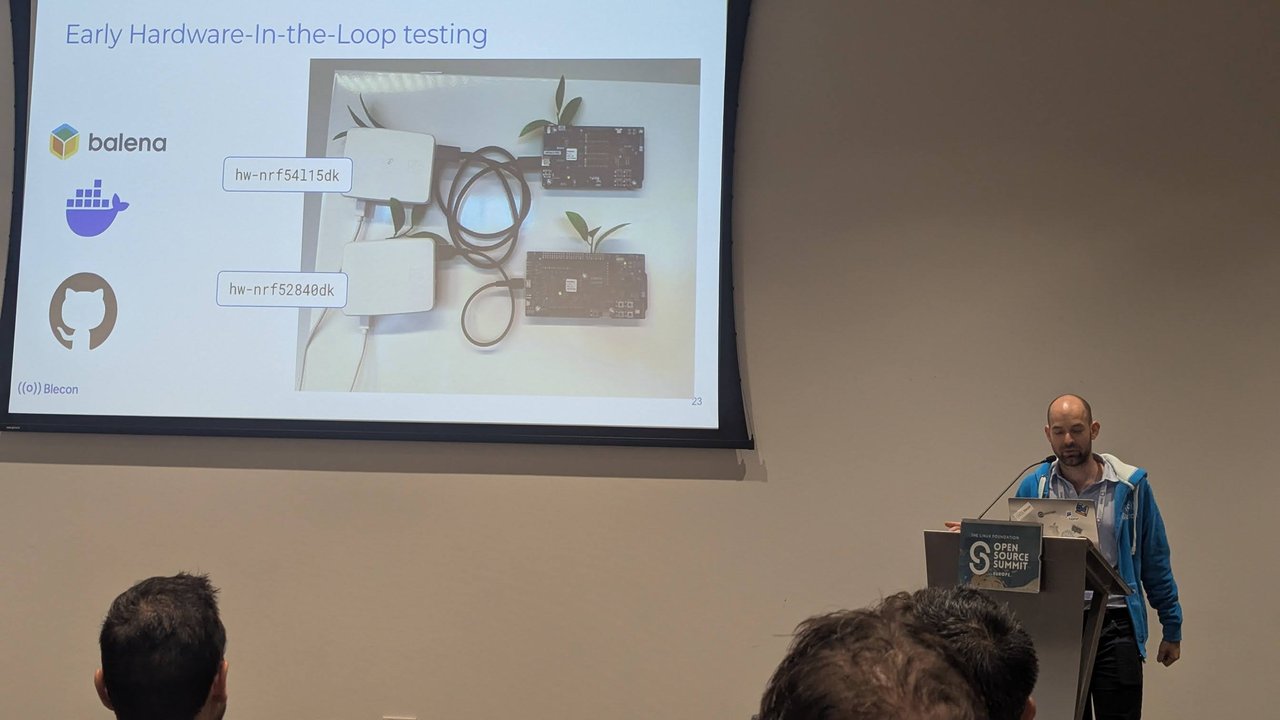
Blecon’s hardware-in-the-loop setup: balena-managed nRF boards in the test loop.
My take: this is the same layered approach good platform teams use for Kubernetes. Simulate first (native_sim and RootCanal, like kind clusters), run a cheap hardware farm nightly (like ephemeral test clusters), and keep real-world characterisation for the few questions only real hardware can answer. Exporting device metrics through OpenTelemetry means embedded test results end up in the same observability stack as everything else.
Later on Tuesday I caught part of the libcamera update. One slide introduced Camshark, “a GUI tool for libcamera” with full access to all camera features, working remotely over SSH and with heterogeneous cameras. The libcamera ELCE 2025 post has the full list of demos.
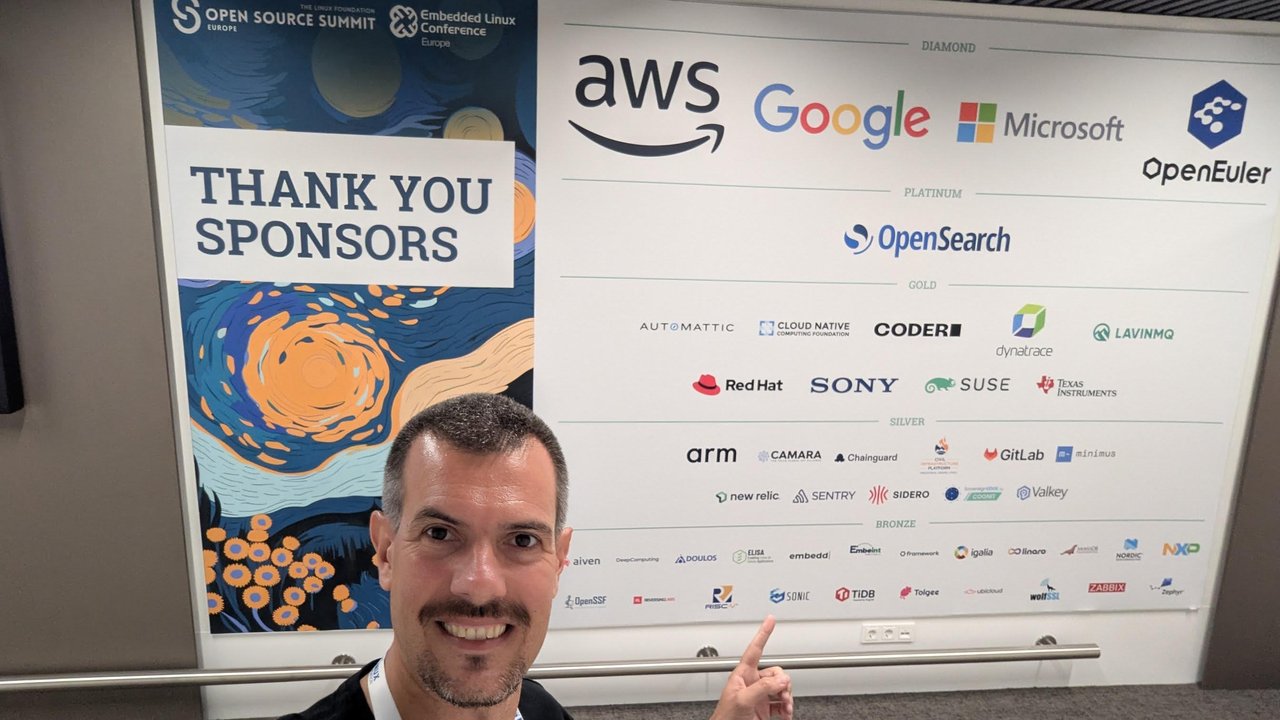
The sponsor wall: AWS, Google, Microsoft and openEuler as Diamond sponsors, OpenSearch as Platinum.
Day 3 keynotes: vertical foundations and uncertainty
Wednesday morning was about industries. A FINOS (Fintech Open Source Foundation) keynote by its chair emeritus described the AI governance framework, a crowdsourced framework he said banks would traditionally have paid consultants to build. He also covered Common Cloud Controls, a Citi-led project on oversight of multiple cloud providers, which he tied to Europe’s digital sovereignty debate. FINOS announced eight new members and a new chair from RBC. The call-to-action slide said “remember, contribution is not just code!”
A Linux Foundation slide then mapped horizontal and vertical foundations: CNCF and the Open Infra Foundation as horizontal layers, with FINOS, LF Energy and AgStack as verticals. That led into a panel with Arpit Joshipura (Linux Foundation), Lingli Deng (China Mobile) and Madeline Dassule (FINOS). The telecom side of the discussion described a real tension: telecom infrastructure is specified on five- to ten-year cycles, while open source iterates every six months. Because of that complexity, the expectation that open source would change the supply chain hadn’t materialised: operators still depended on their main suppliers.
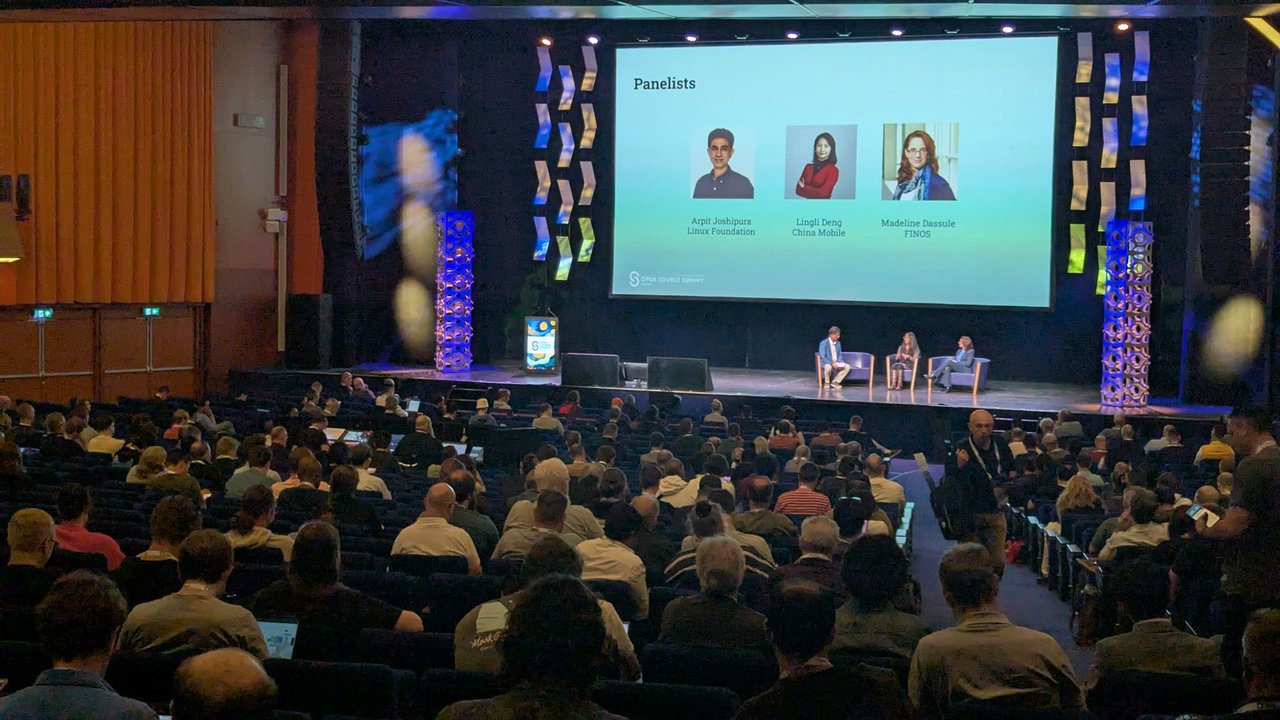
The industries panel: Linux Foundation, China Mobile and FINOS.
The guest keynote was Margaret Heffernan, introduced on the slide as an entrepreneur, CEO and author of Embracing Uncertainty and Willful Blindness, speaking on “Embracing Uncertainty”. Right after, the closing slide announced next year: Open Source Summit Europe + Embedded Linux Conference Europe, Prague, Czechia, 7–9 October 2026.
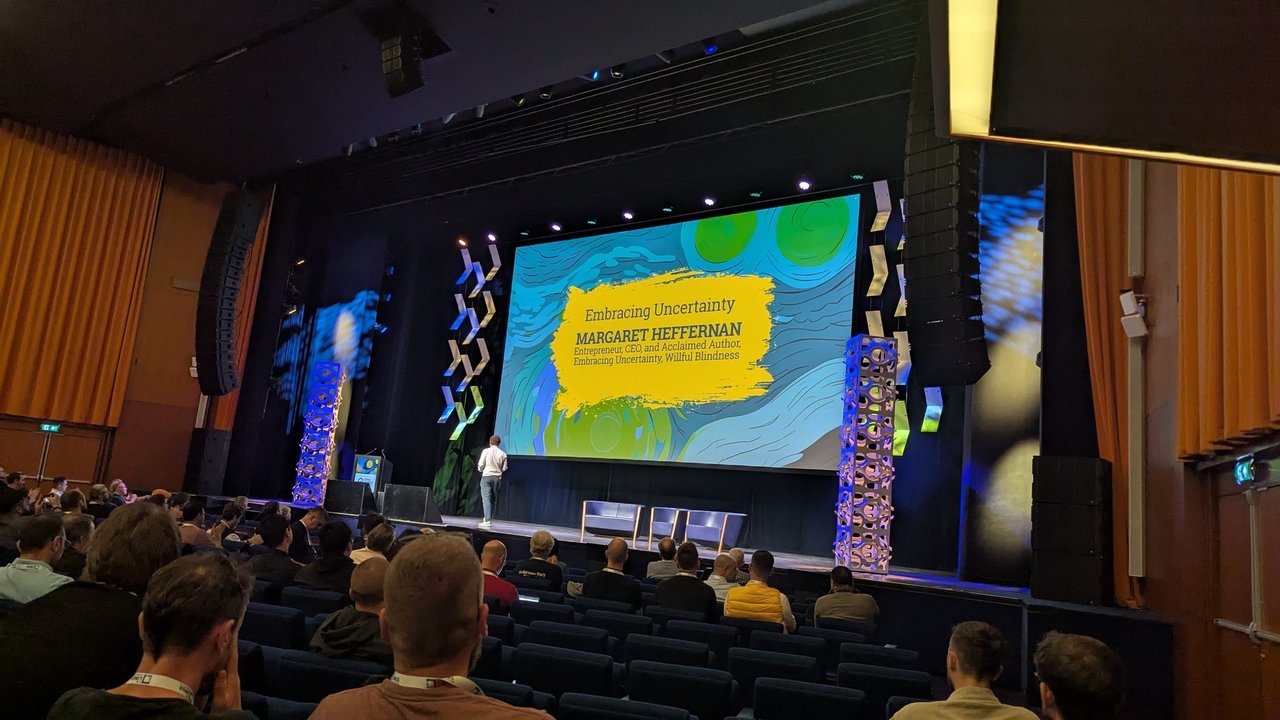
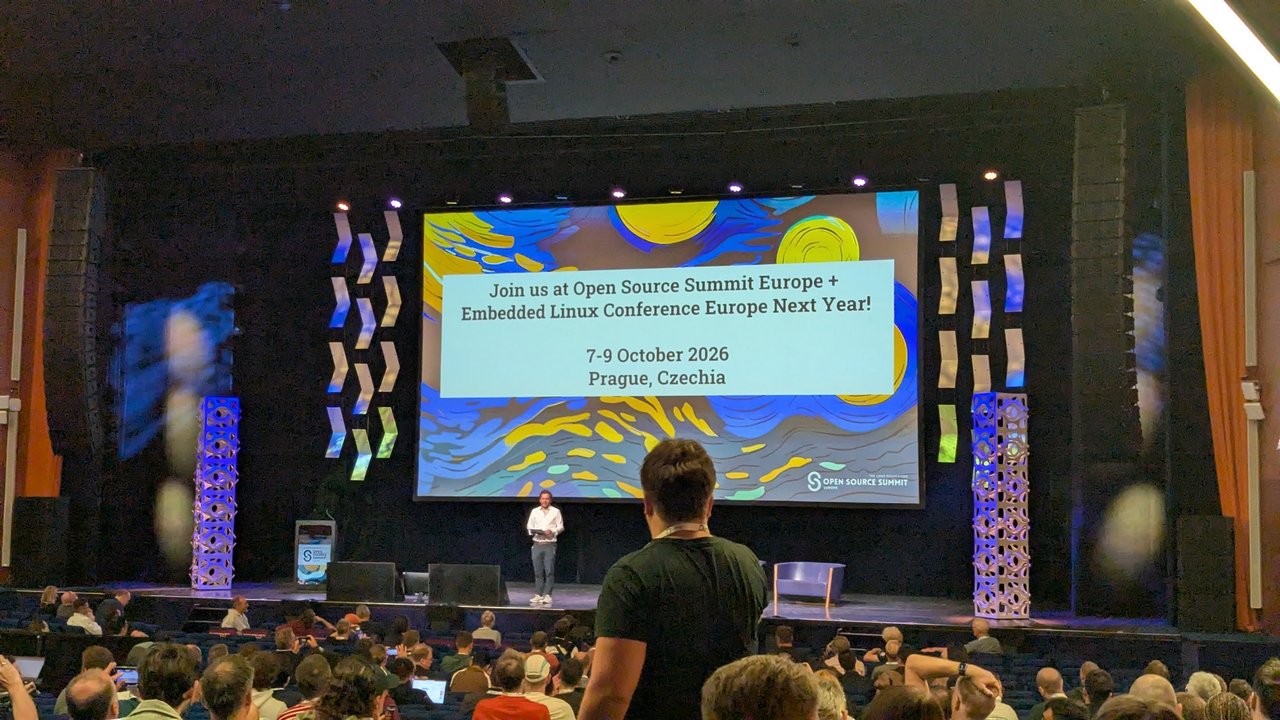
Margaret Heffernan’s keynote, and the save-the-date for Prague 2026.
Yuning Liang: RISC-V AI PCs, from the hardware side
At 14:07 on Wednesday, in an ELC room, DeepComputing founder Yuning Liang gave “Hardware Innovation in the World’s First RISC-V 50 TOPS AI Compute for Mass Production Development”. Most of his deck was marked company-confidential, so I’m not publishing those slides. I’m only summarising the public points he made out loud:
- He introduced himself as “a core software guy” who used to port Java virtual machines to PowerPC and MIPS, and joked that he was “stupid enough” to spend his money making hardware.
- DeepComputing makes consumer electronics only on RISC-V: tablets, smart speakers, routers and laptops.
- He partnered with Framework so that a RISC-V mainboard can go into an upgradeable, repairable laptop. One board design can then serve several products, which helps a small company reach volume.
- For AI on RISC-V, his message was that the hard part is software: porting and optimising frameworks, models and runtimes. The day before, in our interview, he had made the same ask: more open source software developers contributing to the RISC-V ecosystem.
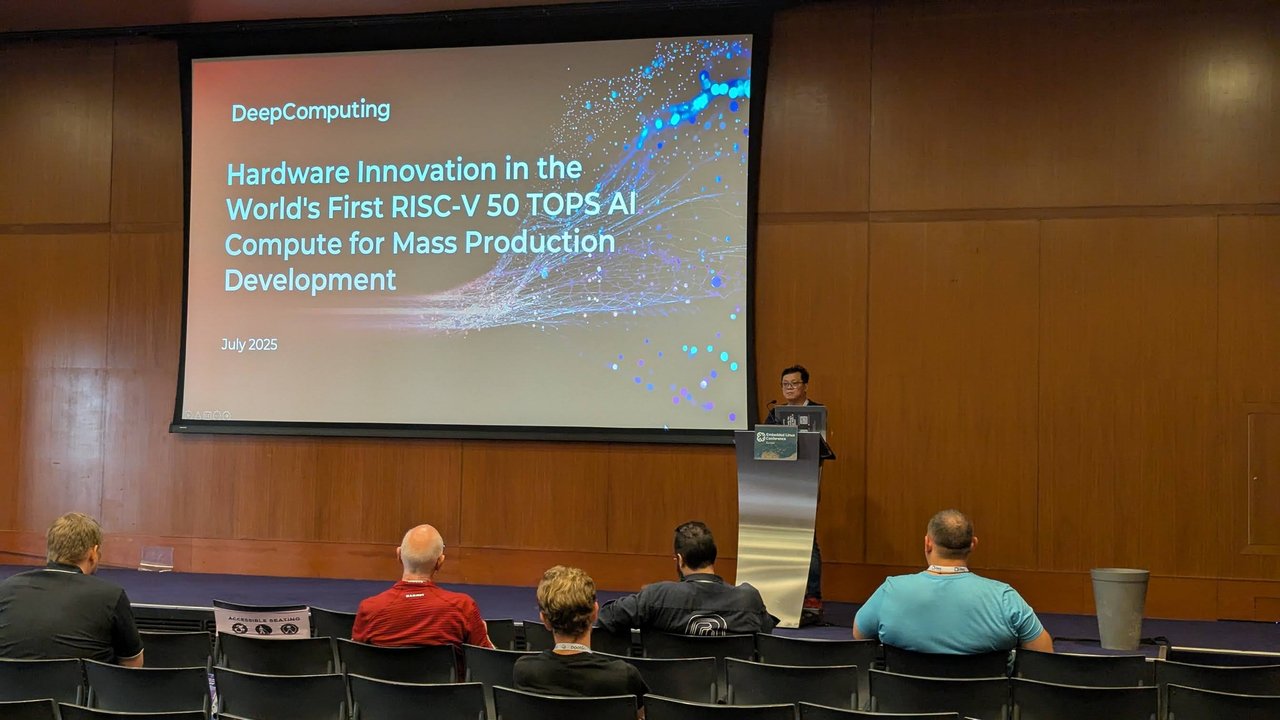
The public title slide of Yuning Liang’s talk. The rest of the deck was marked confidential.
Emiel Brok (SUSE): the perfect storm of NIS2, CRA and sovereignty
At 16:06, Emiel Brok gave “Perfect Storm: What Digital Sovereignty, NIS2 and CRA mean for your IT Strategy”. His slide introduced him as Open Source Ambassador at SUSE, co-founder and board member of DOSBA, and board member of APELL. On stage he explained that DOSBA is the Dutch Open Source Business Alliance, and that APELL is the European umbrella for about nine national business alliances. The talk covered:
- The most pressing regulations: NIS-2, the CRA (Cyber Resilience Act), DORA and PCI-DSS.
- Who is in scope for NIS2: lists of critical and highly critical sectors, from manufacturing and electricity to banking and digital infrastructure, with a size threshold of at least 50 employees and €10 million annual turnover.
- Common Criteria EAL 4+ vs ISO 27001: EAL stands for Evaluation Assurance Level, which he summed up as how deep the evaluator looks into your supply chain. He named the BSI as the independent body that checks compliance with these criteria, and the slides showed mutual recognition through SOGIS-MRA and CCRA.
- “Unpacking Digital Sovereignty” into seven parts: secure and independent supply chains, data governance and access control, technological sovereignty, resilience and business continuity, software autonomy and open source, regulatory compliance and privacy, and infrastructure and hardware control.
- “Why SUSE?”: SUSE’s position on open sovereign IT, with local delivery backed by global capability.
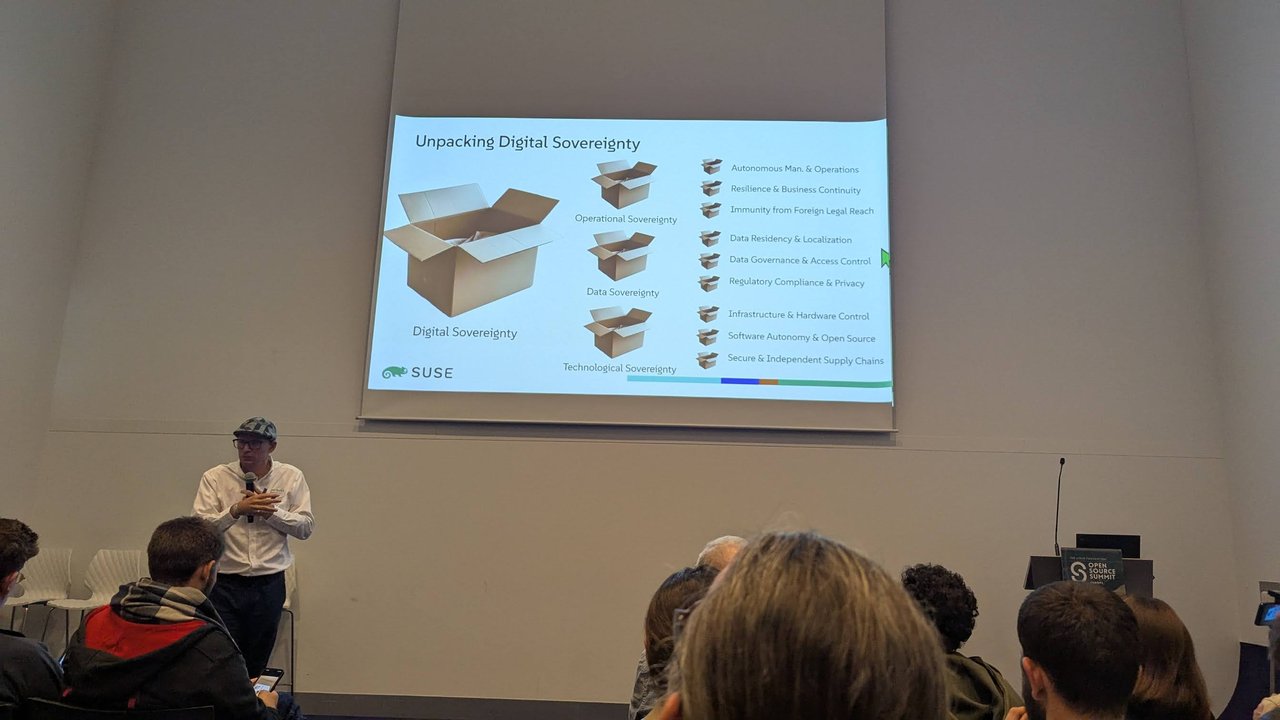
“Unpacking Digital Sovereignty”: seven parts, only one of which is “use open source”.
My take: the useful part of that slide is that open source is one of seven boxes, not the whole answer. For the regulatory side, my CRA vs NIS2 comparison and what the CRA means for open source go deeper.
ELC turns 20: closing games with Tim Bird
The last session was the ELC closing: “Closing Games and Prizes” with Tim Bird of the Linux Foundation, celebrating two decades of the Embedded Linux Conference. Before the games, a few history slides:
- the program committee over the years, including Walt Miner since 2024
- a list of “Some Keynote Speakers”, from Linus Torvalds, Thomas Gleixner, Jon Corbet and Andrew Morton to Tim Canham of NASA
One prize was a discount on the 4th edition of Mastering Embedded Linux Development.
At the end, the outgoing program committee chair announced from the stage that Walt Miner would take over as chair. Tim Bird was recognised for 20 years of service to the Embedded Linux Conference with a small penguin award.
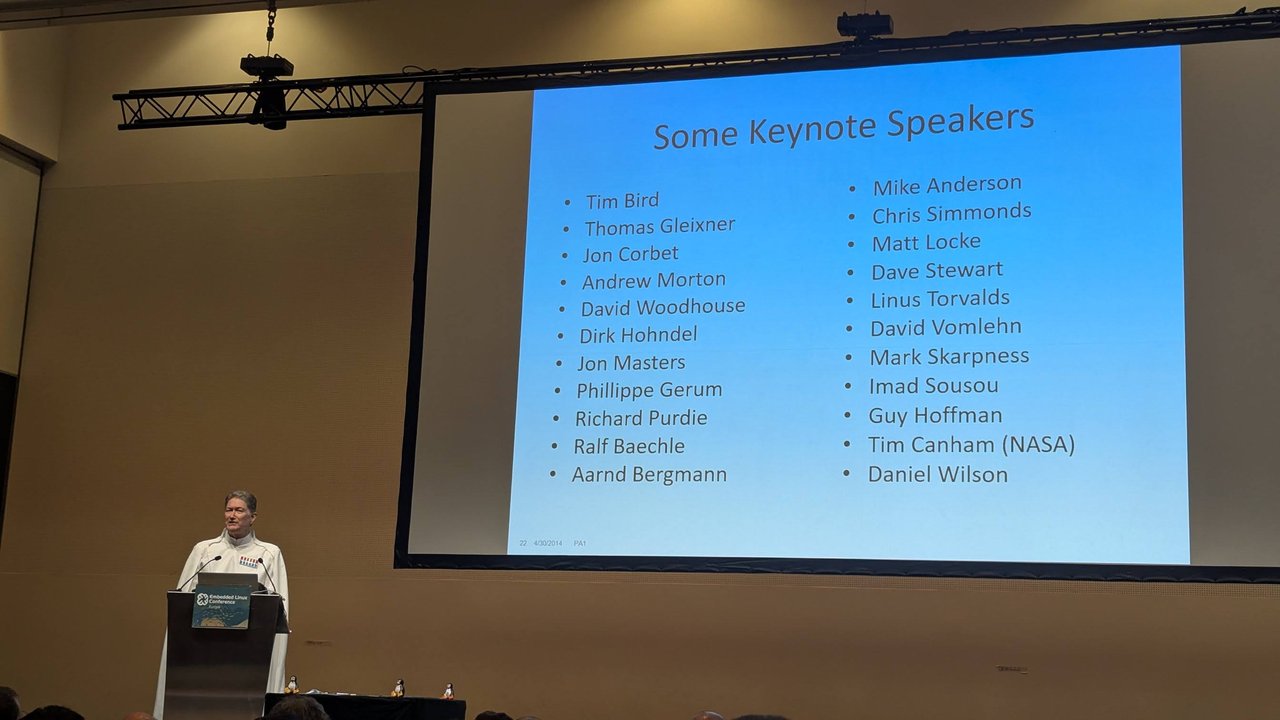
Twenty years of ELC keynote speakers, shown at the closing session.
What I took away
- Agents arrived at the Linux Foundation as infrastructure, not demos. The day-1 stack slide and agentgateway were both about the boring layers: protocols, registries, gateways and policy. That’s where platform teams will spend their time.
- RISC-V’s bottleneck is software, and RVA23 is the fix everyone pointed to. James at RISC-V International and Yuning Liang said the same thing from two sides: a stable hardware target plus distributions that work out of the box.
- Embedded testing looks more and more like cloud testing. Simulation, nightly hardware farms and OpenTelemetry all showed up in one Zephyr talk.
- Sovereignty is now a compliance topic. NIS2, the CRA and DORA turned “digital sovereignty” from a keynote word into an audit checklist.
The 2026 edition runs in Prague from 7 to 9 October, and I’ll be filming there for Udienza. The day after this summit, the co-located AI_dev Europe 2025 took over the same venue. That one gets its own post: AI_dev Europe 2025: CERN, Cerebras and LanceDB.