The Pattern
A clear trend is emerging in 2026: the most interesting AI tools are free, open-source, and self-hostable. They are not vaporware startups with waitlists and subscription tiers — they are repositories you can clone, modify, and run today. Six projects that landed in my radar this month all follow the same playbook:
- Target a category dominated by expensive, closed SaaS
- Replace it with code that runs on your own machine or server
- Strip out subscriptions, API bills, and content filters
Here is what caught my attention.
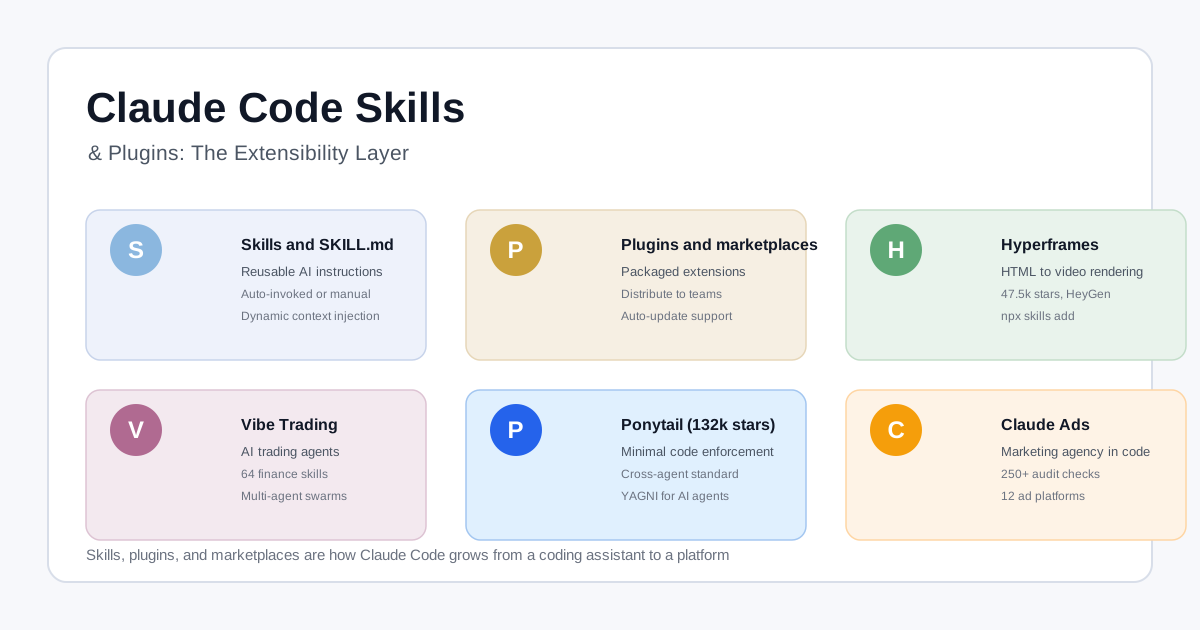
1. Hyperframes — Video from HTML
Replace: Rendered video production, motion graphics tools
Repo: heygen-com/hyperframes (Apache 2.0, 47.5k stars)
Instead of prompting a diffusion model and hoping it matches your vision, Hyperframes asks an AI agent to write HTML. It then renders that HTML — CSS animations, JavaScript motion, media — into a deterministic MP4, frame by frame through a headless browser pipeline.
The key difference from AI video generators: deterministic and editable. The same HTML always produces the same video. You can version-control your videos, tweak the code, and regenerate instantly.
What it’s good for
- Product demos — describe the flow in HTML, render to video
- Social media videos — animated text, icons, stats (the kind designers build in After Effects)
- Landing page hero videos — animate a product mockup, render to MP4
- Ads — generate hundreds of variants by looping over data
Quick start
npx skills add heygen-com/hyperframesOr manually:
npx hyperframes renderHyperframes is used in production at HeyGen, with community adoption from teams like tldraw and TanStack.
2. Fincept Terminal — Free Bloomberg Alternative
Replace: Bloomberg Terminal ($27,000+/year), Refinitiv, FactSet
Repo: Fincept-Corporation/FinceptTerminal (open-source edition, 30k+ stars)
Fincept Terminal is a free, open-source financial intelligence platform with 41 modules covering:
- Agentic research — ask questions in plain language, get sourced notes
- Quant lab & backtesting — research signals, test strategies, inspect volatility surfaces
- Deep fundamental research — statements, valuation, peer analysis across equities and derivatives
- Markets & execution — live coverage across equities, crypto, and prediction markets
- Macro & global intelligence — official statistics, central bank series, shipping lanes, geopolitics
The open-source edition is free. The Enterprise edition ($10–$40/month per user) adds real-time data feeds, live broker execution, and priority inference. Either way, it costs a fraction of a Bloomberg seat.
Why it matters
A Bloomberg Terminal costs ~$27,000 per user per year. Fincept starts at $10/month. The enterprise comparison table on their site shows Fincept winning on every feature except legacy brand recognition — and adds multi-agent AI research, a quant lab, and the ability to connect your own data sources that Bloomberg can’t match.
3. Open-Gen-Al — 200+ Local AI Models, One Studio
Replace: Midjourney, Runway, ElevenLabs, Suno AI (subscription fatigue)
Repo: anil-matcha/Open-Generative-AI (MIT, 28.1k stars)
Open Generative AI is an open-source AI image and video generation studio with 400+ models across 8 categories — no content filters, no closed ecosystem, no subscription fees. It bundles:
- Image generation — Flux, Kling, Midjourney-style, Sora alternatives
- Video generation — text-to-video, image-to-video, lip sync (9 models)
- Audio — text-to-speech, voice cloning, music generation
- Code — AI-assisted generation with multiple backends
Self-hosted, fully hackable, MIT licensed. The hosted version at muapi.ai is free to try if you don’t want to set up local inference.
4. Vibe Trading — AI Trading Agents Without Writing Quant Code
Replace: Manual strategy research, separate backtesting tools, trading notebooks
Repo: HKUDS/Vibe-Trading (MIT, 32.9k stars)
Vibe-Trading turns plain-English finance questions into runnable analysis. Describe a strategy in natural language and it:
- Loads market data from 100+ connectors
- Generates the strategy code
- Runs backtests with cross-market support
- Generates reports and exports results
- Uses persistent research memory across sessions
It ships with 64 finance skills and 29 specialist swarm team presets — pre-configured multi-agent teams for different market scenarios. Trading ideas become backtests becomes reports, all from a single prompt.
Example
vibe-trading run -p "Backtest a BTC-USDT 20/50 moving-average strategy for 2024, summarize return and drawdown, then export the report"When you’re ready to act, it can route live orders through your own broker — but it holds no funds and never trades outside limits you set.
5. Claude Ads — Marketing Agency in a Skill
Replace: $10K+/month ad agency retainers, enterprise audit tools
Repo: AgriciDaniel/claude-ads (open-source Claude Code skill)
Claude Ads turns Claude into a complete paid-media operations team. It runs 250+ automated checks across 12 platforms (Google, Meta, YouTube, LinkedIn, TikTok, Microsoft, Apple, Amazon, Reddit, Pinterest, Snapchat, X) in parallel.
One command generates:
- A score out of 100 for your ad accounts
- Sourced findings with specific campaign names, costs, and issues
- Versioned JSON reports ready to export to clients
- Actionable recommendations — not generic advice, but platform-specific optimizations
The audit completes in 3–5 minutes vs. 2–4 weeks for a human agency, at $0 vs. $5–10K. It’s a Claude Code skill, so it slots into the same agentic workflow as the rest of Claude’s tools.
Quick start
/plugin marketplace add AgriciDaniel/claude-ads
/plugin install claude-ads@ai-marketing-hub-claude-ads
6. Camofox Browser — Anti-Detection Browser for AI Agents
Replace: Standard Puppeteer/Playwright (easily blocked), commercial anti-detect browsers
Repos: daijro/camoufox (Firefox fork, 11.7k stars) | redf0x1/camofox-browser (REST API server, 383 stars)
Camoufox is a Firefox fork engineered for web scraping and AI agents. While standard browser automation (Puppeteer, Playwright, Selenium) relies on JavaScript patches that are fragile and easily detected, Camoufox does anti-detection at the browser engine level — C++ code that intercepts every JavaScript property (navigator, WebGL, screen, fonts, WebRTC) before it reaches the page.
The Camofox Browser Server wraps the Camoufox engine behind a REST API, making it accessible to any AI agent regardless of language:
| Feature | Puppeteer/Playwright | Camofox Browser Server |
|---|---|---|
| Anti-detection | JavaScript patches (fragile) | C++ engine-level (robust) |
| Integration | Direct SDK only | REST API for any language/agent |
| AI agent support | Varies | MCP + OpenClaw compatible |
| Memory footprint | ~800MB+ (Chrome) | ~200MB (debloated Firefox) |
It’s compatible with existing Playwright code out of the box, and 300+ projects already depend on it.
The Bigger Picture
These six tools don’t just compete on price — they compete on ownership. When you replace a SaaS tool with open-source code on your own machine, you gain:
- No API bills — inference runs locally, costs zero per call
- No rate limits — your hardware is the only constraint
- No content filters — full creative freedom
- No data leakage — nothing leaves your infrastructure
- Customizable — you can modify the code
The tradeoff is real: you trade convenience for control. These tools require setup, maintenance, and some technical skill. But for teams and individuals who need to operate at scale — or who simply don’t want a vendor deciding what they can and can’t build — the tradeoff is increasingly worth it.
Getting Started
You don’t need to adopt all six at once. Pick the category that costs you the most today:
- Spending on video production? Try Hyperframes
- Paying for Bloomberg/FactSet? Try Fincept Terminal
- Juggling 10 AI tool subscriptions? Try Open-Gen-Al
- Running manual trading research? Try Vibe Trading
- Hiring agencies for ad audits? Try Claude Ads
- Getting blocked by bot detection? Try Camofox Browser
Disclosure: I have no financial relationship with any of these projects. This is a personal roundup of tools I’ve been testing. If you found this useful, subscribe to my newsletter for weekly AI tool roundups.