Some of the best technical talks use analogies from the physical world to explain digital concepts. Austin Parker’s “Observability IRL” talk at the Grafana Labs OpenTelemetry event in Amsterdam was a masterclass in this approach — using the Osborne Fire-Finder from 1930s fire lookout towers to explain why modern observability stacks work the way they do.
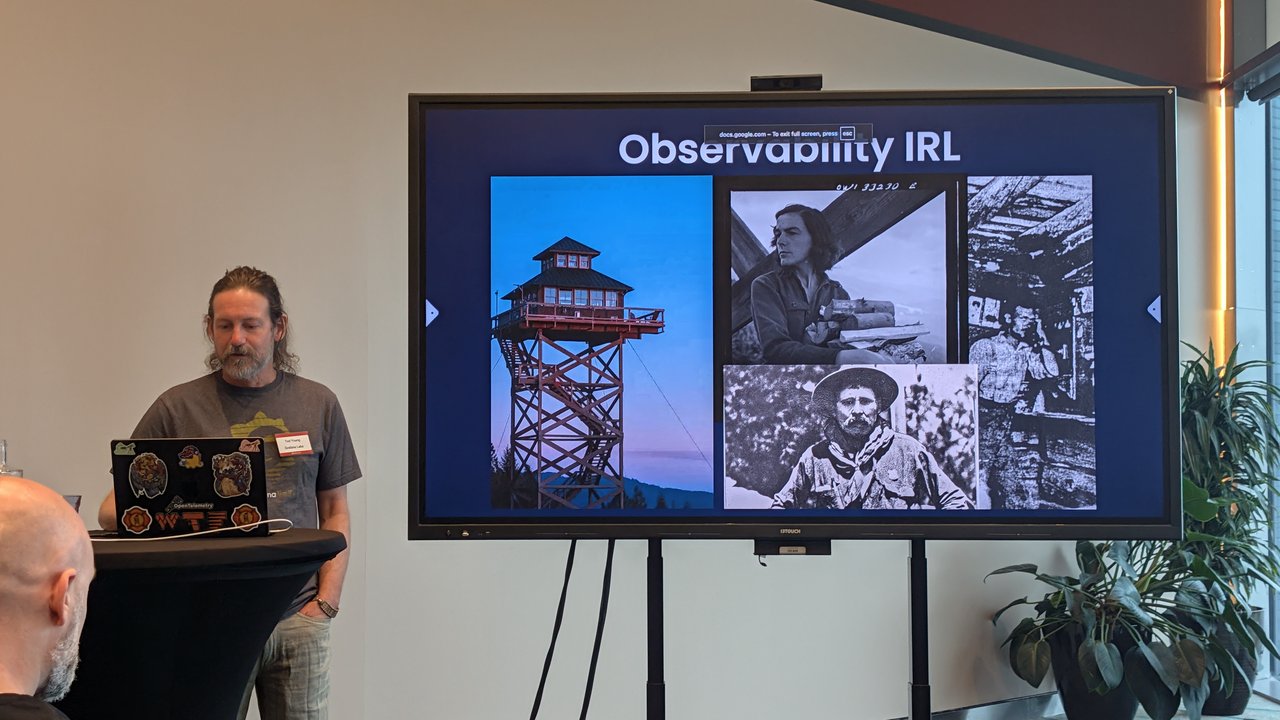
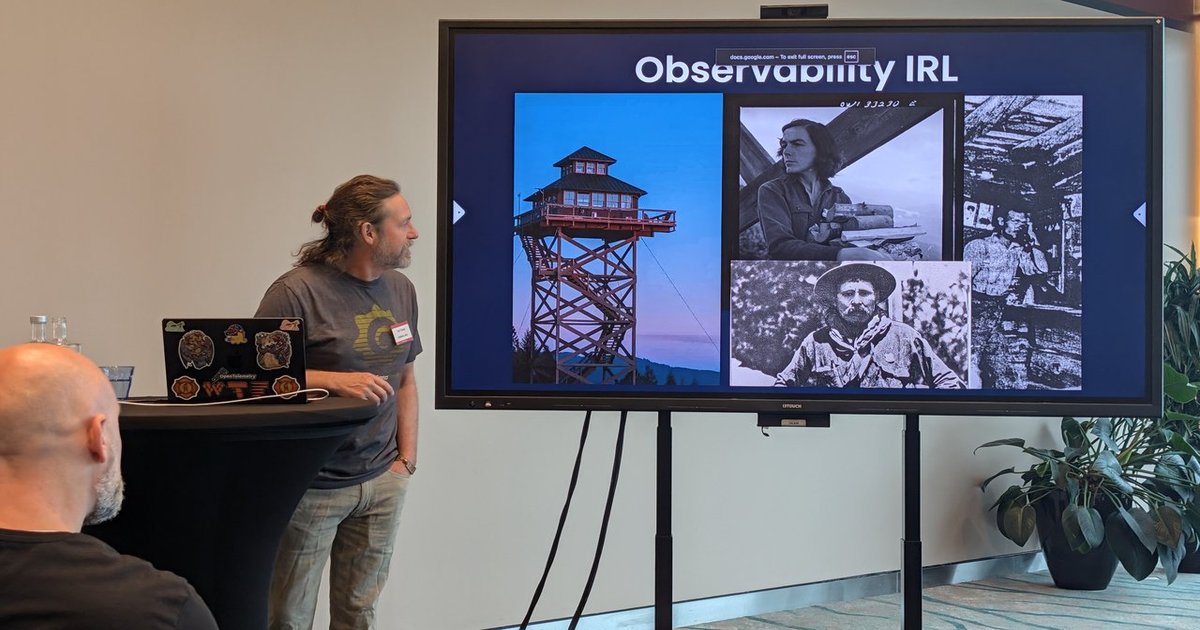
Austin Parker at the Grafana Labs OTel event, using the Osborne Fire-Finder as a metaphor for distributed tracing.
The Fire Lookout System
Before satellites and radar, the primary defense against wildfires in remote areas was the fire lookout tower. Staffed by dedicated lookouts, these towers — positioned on mountain peaks and hilltops — provided panoramic views across thousands of acres of forest.
The lookout’s workflow was deceptively simple:
- Spot smoke — scan the horizon for the telltale wisp of smoke
- Determine bearing — use the Osborne Fire-Finder to pinpoint the direction
- Plot on map — rotate a map table to match the bearing and mark the location
- Dispatch response — radio the coordinates to firefighting teams
This is observability in its purest form: detect, triage, locate, respond.
The Osborne Fire-Finder
The Fire-Finder was a precision instrument — a rotating metal disc mounted on a map table, with sights on opposite edges. The lookout would align the sights on the smoke plume, read the bearing from the compass rose, then rotate the map table to match. Where the bearing lines intersected on the map was the fire’s location.
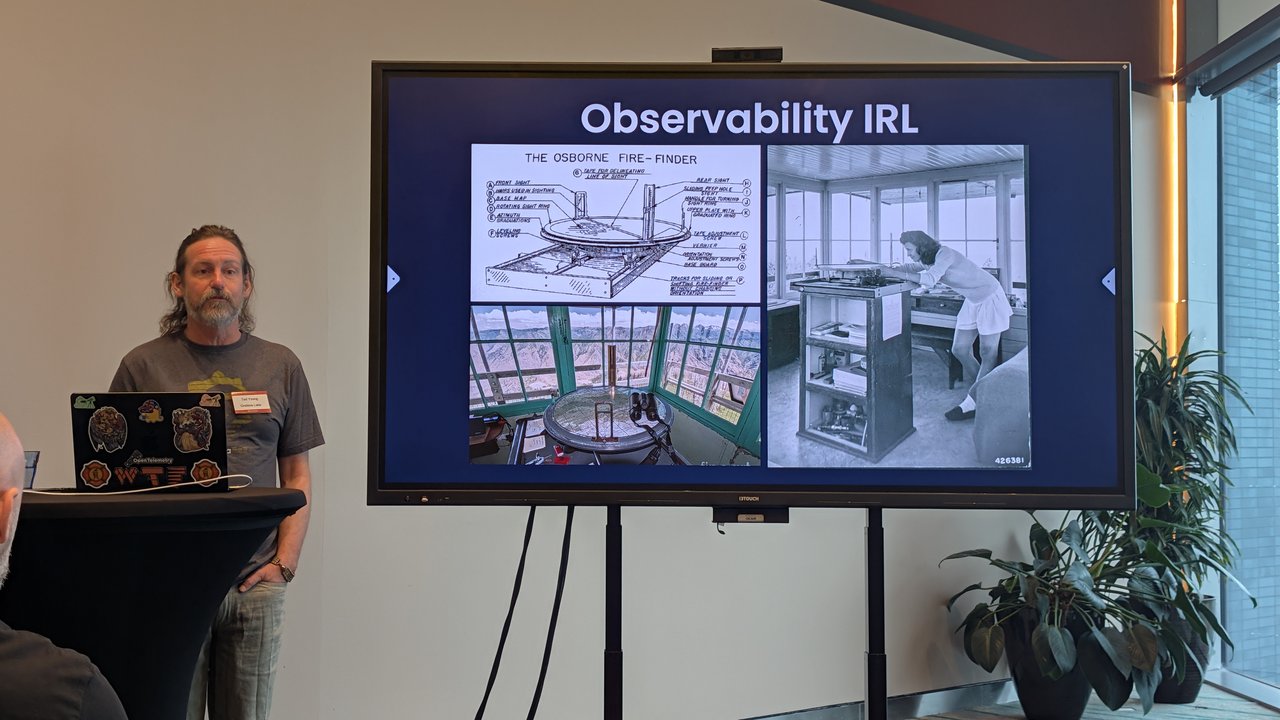
The Osborne Fire-Finder — the 1930s equivalent of a distributed tracing system. (Photo: Ted Young’s slide at the Grafana Labs event.)
The Parallel to Software Observability
The mapping from fire lookout to modern observability is remarkably direct:
| Fire Lookout System | Modern Observability |
|---|---|
| Spotting smoke | Detecting anomalies in telemetry data |
| Bearing (direction) | Correlating traces to identify the source service |
| Map plotting | Combining metrics, logs, and traces to pinpoint root cause |
| Dispatching response | Triggering alerts and automated remediation |
The key insight: the lookout didn’t need to see the fire to find it. All they needed was the bearing — the direction from which smoke was coming. Similarly, in modern software, you don’t need to see the bug to find it — you need the trace that shows where the request went wrong.
Why This Matters Now
The analogy becomes more than poetic when you consider the scale challenge. A single fire lookout could monitor about 20 square miles. Modern observability platforms monitor millions of services, processing billions of telemetry points per second.
The Osborne Fire-Finder solved the scale problem of its era by providing a standardized way to take a bearing and plot a location. Today’s OpenTelemetry solves the same problem for software — providing a standardized way to take a trace and locate an issue across a distributed system.
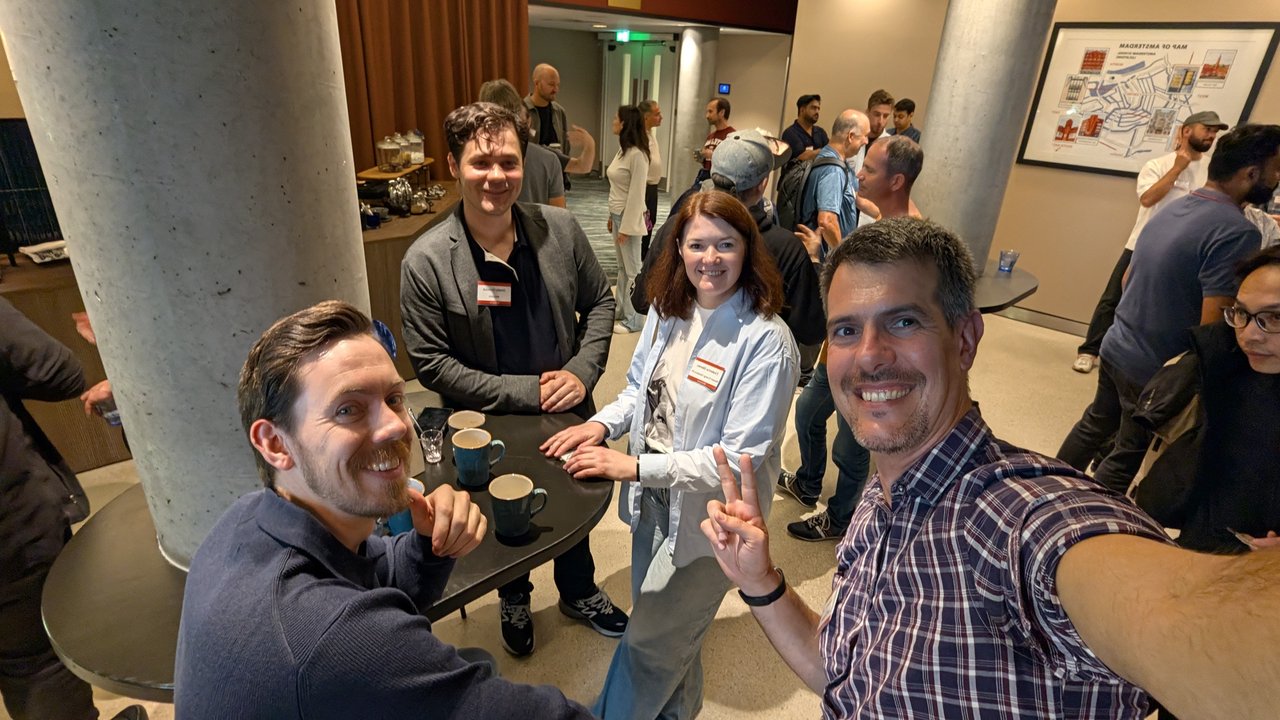
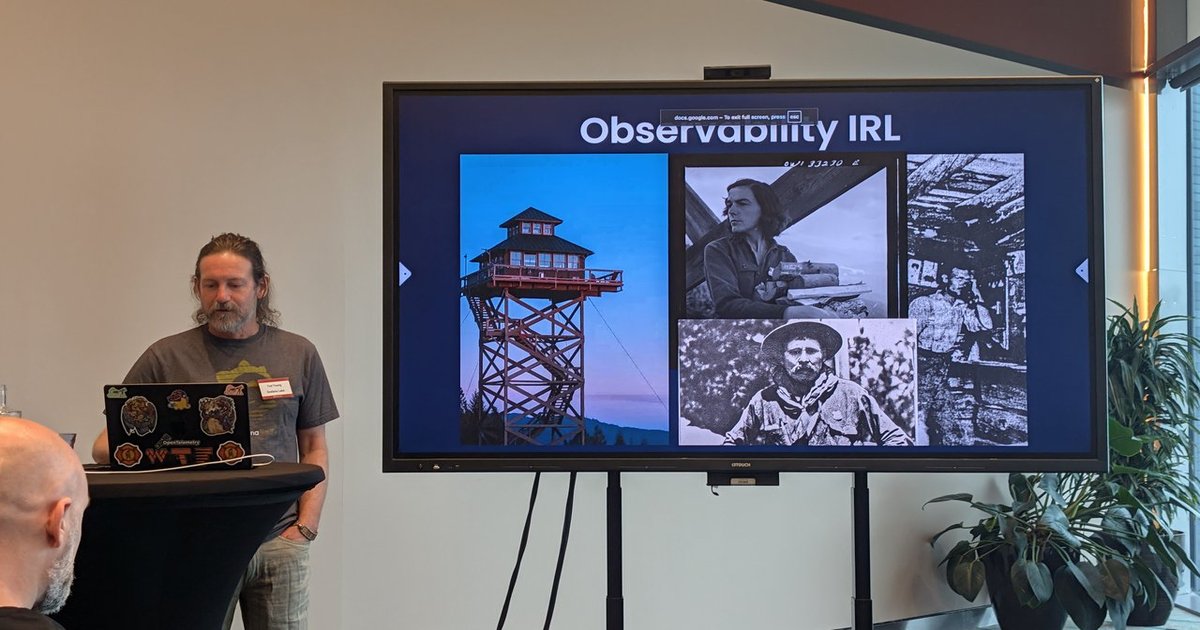
Austin Parker’s full “Observability IRL” presentation setup — the Fire-Finder analogy was the centerpiece of the talk.
The Human Element
One aspect of the fire lookout system that modern observability often overlooks: the human element. Fire lookouts didn’t just mechanically plot bearings — they built mental models of their territory, learning which valleys smoke appeared in first, which ridgelines carried scent, and how weather patterns affected fire behavior.
Today’s SREs do the same thing. They build intuition about their systems — knowing that latency spikes on Tuesday mornings correlate with the cron job that runs billing, or that error rates in the EU-West region always rise when the marketing campaign emails go out.
The Fire-Finder didn’t replace the lookout’s intuition — it augmented it. OpenTelemetry doesn’t replace the SRE’s expertise — it gives them better data to act on.
Takeaways for Practitioners
- Start with the basics. Just as fire lookouts needed clear panoramic views, you need infrastructure visibility before anything else.
- Standardize the tools. The Fire-Finder was a standard instrument used across the entire forest service. OpenTelemetry provides the same standardization for observability.
- Trust but verify. The lookout’s bearing was always cross-checked with visual confirmation. Similarly, alerts should trigger investigation, not blind action.
Related Reading
- Ted and Ed’s Hierarchy of Observability Needs
- How to Roll Out OpenTelemetry at Scale: Grafana Labs Amsterdam Recap
- What is OpenTelemetry? Kubernetes Observability Guide 2026
About the Author
I am Luca Berton, AI and Cloud Advisor. I work at the intersection of cloud security, platform engineering, and enterprise AI deployments. Book a consultation.