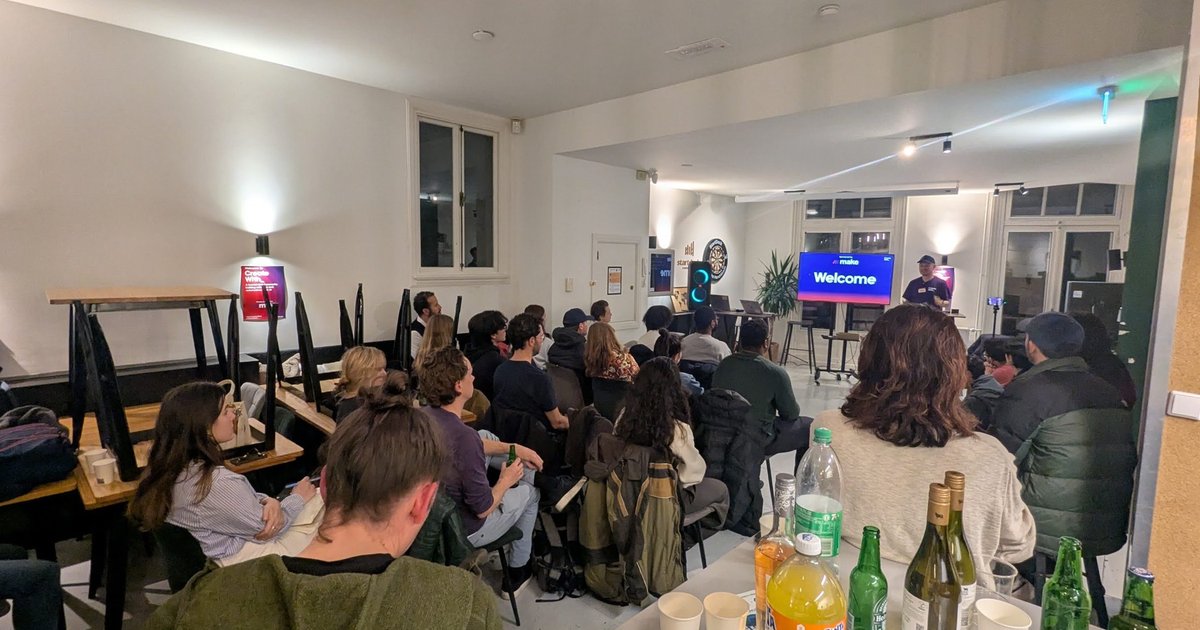
On 3 November 2025 I spent an evening at StartDock coworking in Amsterdam (Prins Hendrikkade) with a no-code and AI builders community. The banners in the room read “Create With”, described as a human-first AI community building software and automations with AI, with Make as a sponsor on the welcome screen. It ran in a small room with talks, a break between them, beer in the fridge and pizza at the end. I recorded three stretches of it. This post is my summary of two talks and an informal Q&A.
I do not name speakers except where a slide did. The recordings are from my phone, so for the middle talk the audio did not transcribe usable text, and I say so below. Numbers are the speakers’ claims.
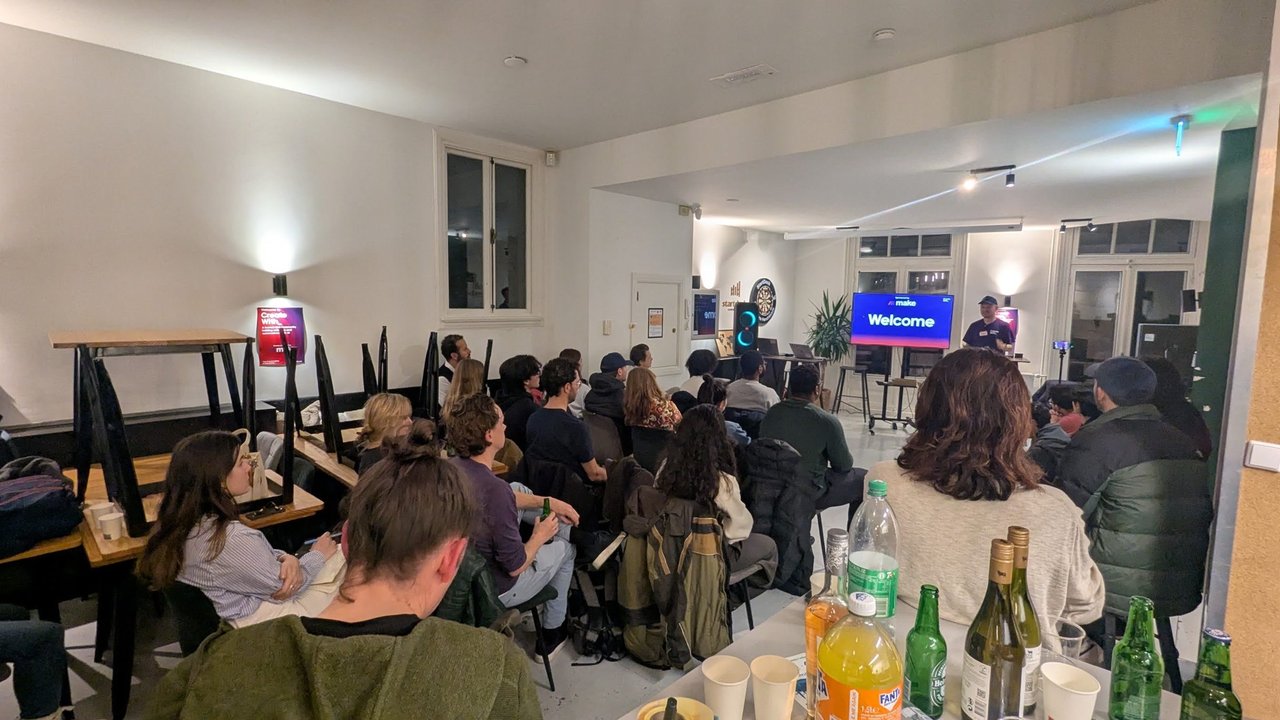
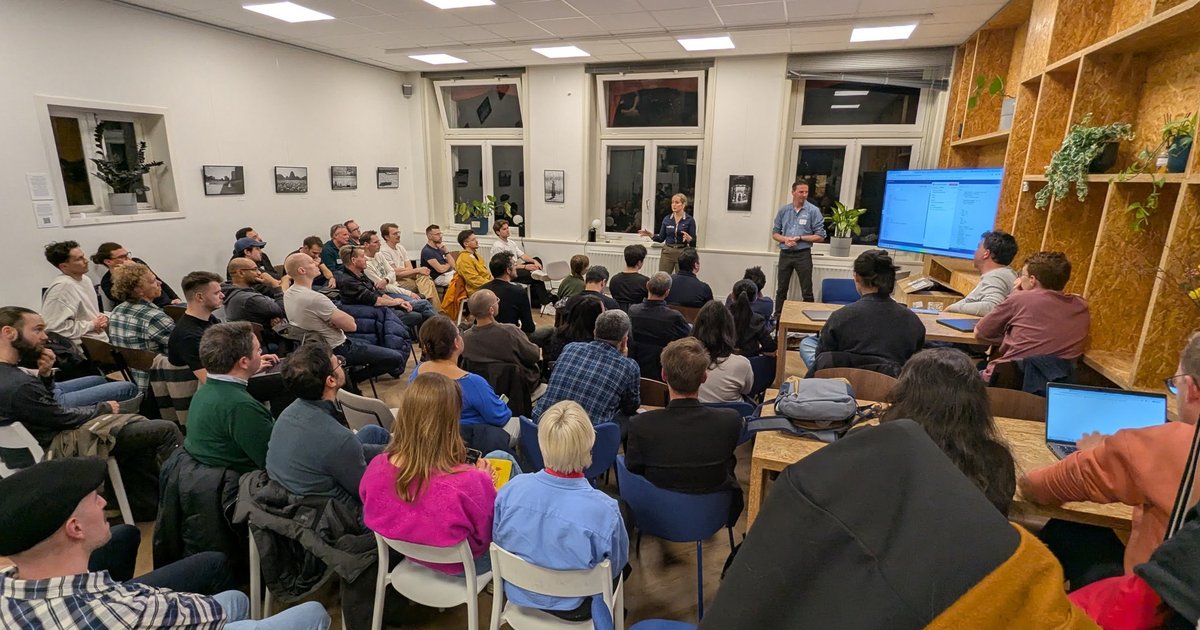
The room before the talks began.
Talk 1: Excel users are the next developers
The first speaker, one of the people running the community, opened with a number argument. There are 8.2 billion people in the world and, as he put it, only about 27 million of them code. He thinks about 1.5 billion people are “technically curious” and would like to build apps, and that this is also roughly the number of Excel users. If you like Excel, you can probably build apps and automations with AI and visual development tools, although he said you still need to be somewhat technical.
His history of why now: in the 1990s a website meant writing HTML; in the 2000s platforms like Wix and WordPress let you drag and drop websites; in the 2010s tools such as Bubble, Adalo and WeWeb let you build apps the same way; and in the last few years AI made software and automations more accessible. He drew a ladder of four levels:
- AI for content creation: ChatGPT or Perplexity for blog posts, email text and images. Useful, but you copy and paste a lot.
- Automation: Zapier, Make or n8n run the process once and keep running it. The limit is that you cannot easily share or monetise an automation without a front-end.
- Vibe coding: tools such as Lovable, Bolt and Cursor generate a full app from a prompt. Great for simple ideas, but if you are not a coder you are left with code you cannot safely change, and asking for a button colour can break the app.
- Visual development: tools like Bubble and WeWeb have the steepest learning curve, because you must understand how apps work, but you do not write code, and they scale to marketplaces with millions of users if built properly.
He gave three examples from his own life. First, an AI agent in Zapier that reads a weekly school newsletter and decides which dates go into his calendar. Second, a staff rota calculator for a friend who manages a team of mental health nurses in the English health service: he asked her a few questions, pasted the conversation into Lovable, refined it and sent it within about half an hour. She has used it week after week, and he said the local trust now wants to roll it out across the region, at which point he gets nervous. His point: a traditional quote would have killed the idea, but a half-hour prototype showed what was possible. Third, a LinkedIn ghostwriting app built in Bubble with a friend, which people pay monthly to use, so two non-technical people built a small software business. He also described the community: in-person events, workshops for companies and a paid membership with bi-weekly office hours; details are on createwith.com.
My take: this is the same split I see in platform work. Vibe-coded prototypes are cheap evidence for a product conversation, but “the local trust wants to roll it out” is the moment when you need an owner, data protection, hosting and support, which is exactly where fusion teams need a platform behind them.
Talk 2: an app for a niche problem
A second speaker followed, whose title slide showed the name Maarten Munster. As far as I can tell from the poor transcript of his introduction, the app solves a dull but important problem and was built with Bubble. The audio of his talk came out of my transcription as unusable text, so I will not describe the content. The slide had a link to his professional profile, which I leave out.
Talk 3: do not automate chaos
The longest recording is a talk from a founder with a sales and marketing background of 10 to 15 years who had written a book about marketing automation five years earlier, before ChatGPT. I do not have his name from a slide, so I leave it out. His theme was productivity.
Hyper-productivity versus a bolt-on. Many large companies treat AI as a business objective, he said, when it is a technology. Bolting it on is like a jet engine on a bicycle: fast until you have to steer. If ChatGPT turns ten hours of work into five, 40 hours becomes 35, which is nice but not hyper-productivity. Scale comes when AI is wired into the processes of real people and their tools: CRM, email, project management. He quoted a rule about not automating what should not exist at all: “if you automate chaos, you get faster chaos”. Simple, predictable processes can be drag-and-drop automations; where there is no fixed path, an agent can help.
Examples from a seller’s day (his own, and live):
- Lead research. A sales rep used to spend about 30 minutes googling a lead’s company, role and news before calling. An automation using search results produces a tailored report in advance and saves roughly 25 minutes.
- Meeting notes. Tools that transcribe meetings are “silent” unless connected. Connect them to the CRM and the notes are logged with qualification criteria (budget, authority, need, timeline), CRM fields filled from what was said, and a draft follow-up email appears in Outlook.
- Renewals. A workflow scans the project management system for projects with a budget ending and no new budget prepared, checks the CRM for an opportunity (asking whether an existing one is the renewal), and builds the proposal and the signable document. A human-in-the-loop step sends the raw text to Teams for review and approval before anything continues. He said it saves 80 to 95 hours a year and was built in under a business day.
- Content repurposing. When a white paper is published, a model extracts “challenge, solution, value” combinations, picks the best five and drafts five blog posts for approval. Approved posts get an image, an animated version for LinkedIn, a WordPress publication, newsletter items and nurture emails. He also generated one podcast episode: a multi-stage script (quality drops when you ask for a long one in one go), a cloned voice trained on hours of his own talks, and publishing to podcast platforms. He has made only one episode because he has not yet worked out how to turn listeners into leads.
- Account lists. A twice-yearly workflow checks whether people at 500 target companies still work there, finds replacements, and flags new fitting companies in the CRM. He first built it as an agent, found it did not work as hoped, and rebuilt it as a plain workflow.
Choosing what to automate. Ask how often something happens, how long it takes each time, and what that time costs. Spending eight hours to save 80 can still be a waste if the same effort could save 800. And even if AI can do it, humans should keep creativity, strategy and accountability: when a machine makes a mistake, a person is accountable. His closing line: automate to make things better, not just faster.
My take: the renewals example is the one I would copy, because it shows a human-in-the-loop approval as an ordinary workflow step, and “agent first, workflow if it does not behave” matches what I see: use an agent only where the path is not known. For the governance side, see Company-Wide Guardrails for AI Automation.
Informal Q&A
After the talks there was a relaxed Q&A with the second speaker. One answer I noted: he prefers to stay solo for now because he likes the flexibility after managing teams, and he said he is not sure what role he would hire for. The rest was personal rather than technical, so I leave it out.
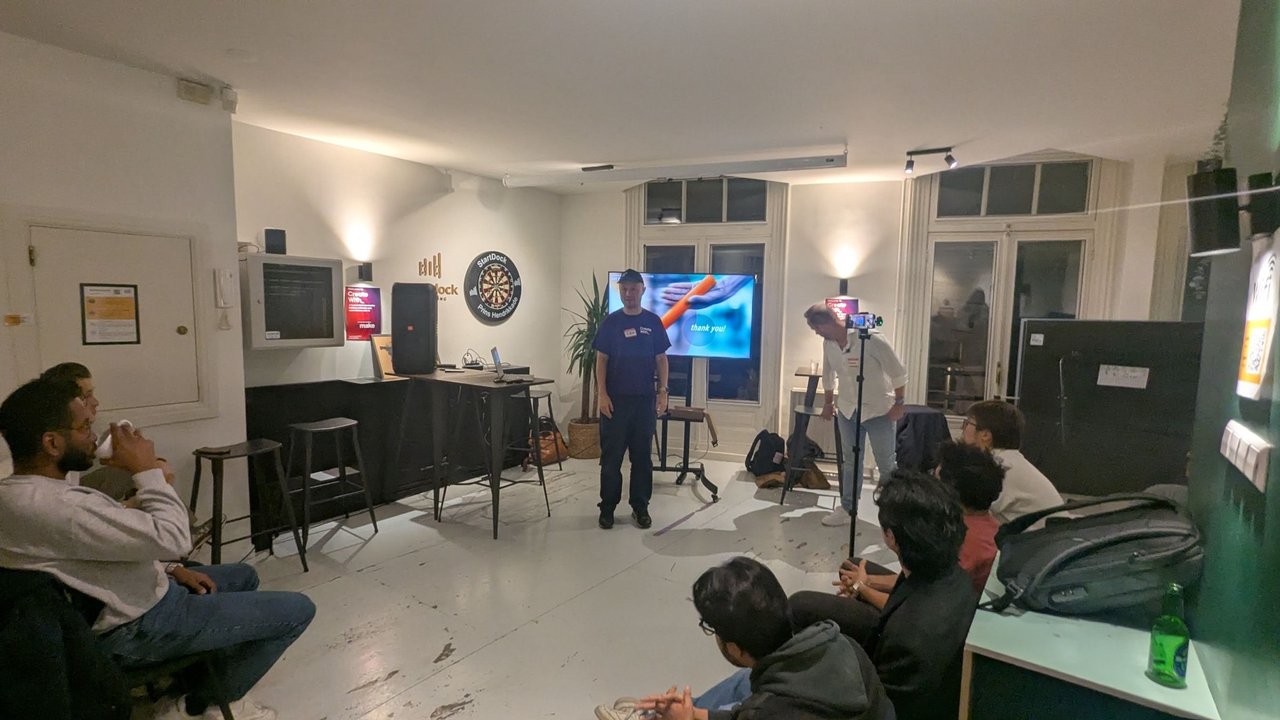
The closing “thank you” slide, just before the pizza.