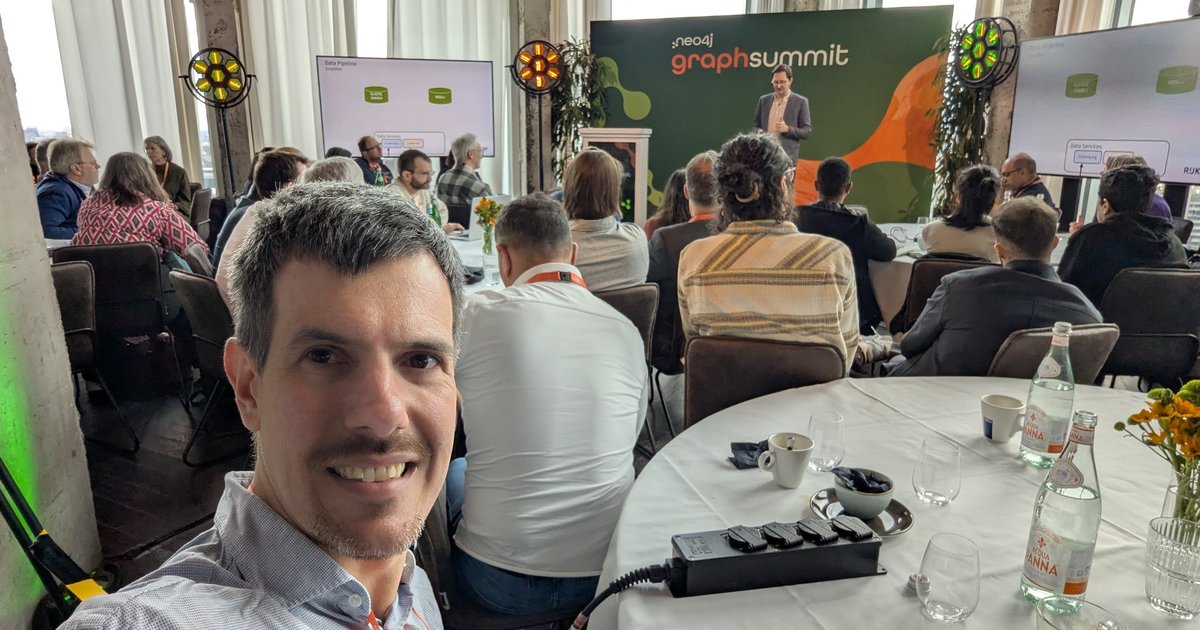
On 13 March 2025 I spent the day at Neo4j GraphSummit Amsterdam, high up in A’DAM Tower overlooking the IJ. A month earlier, at CfgMgmtCamp, I’d opened Configuration Management Day with a talk on automating Neo4j-based GenAI environments with Ansible. GraphSummit was a chance to hear where Neo4j itself is taking the platform.
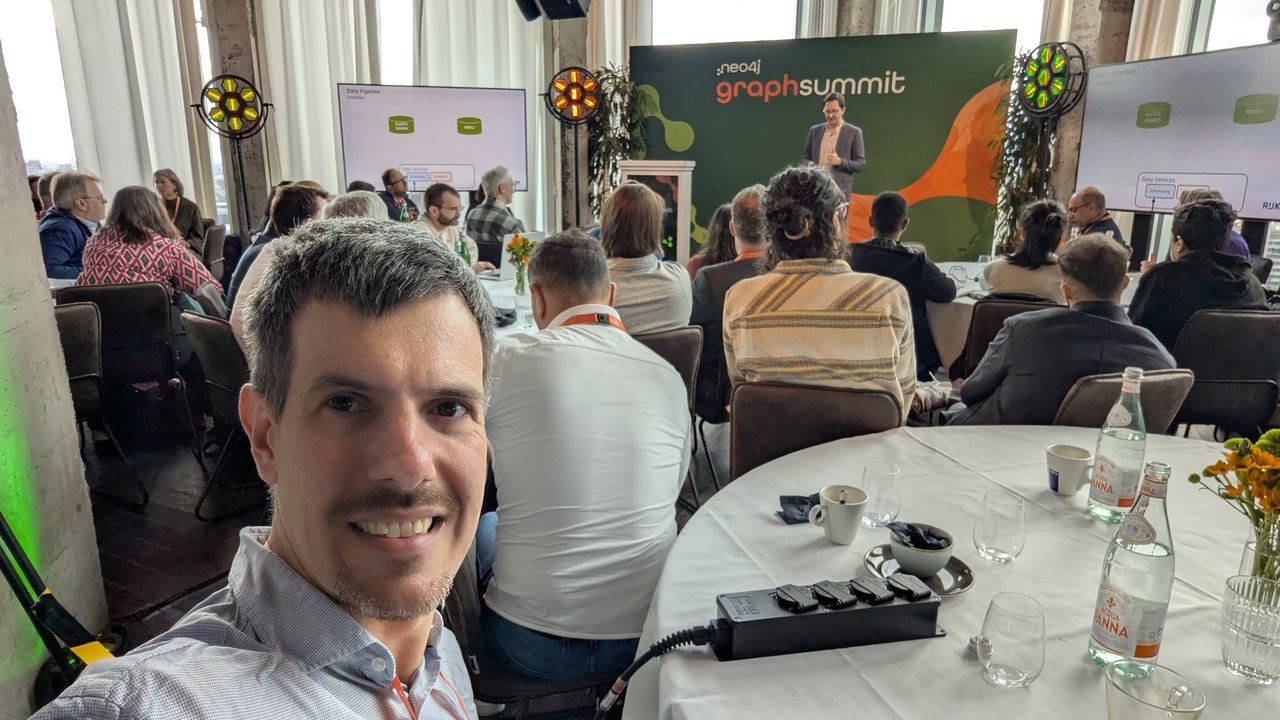
Round tables, a full room and the GraphSummit stage on the top floor of A’DAM Tower.
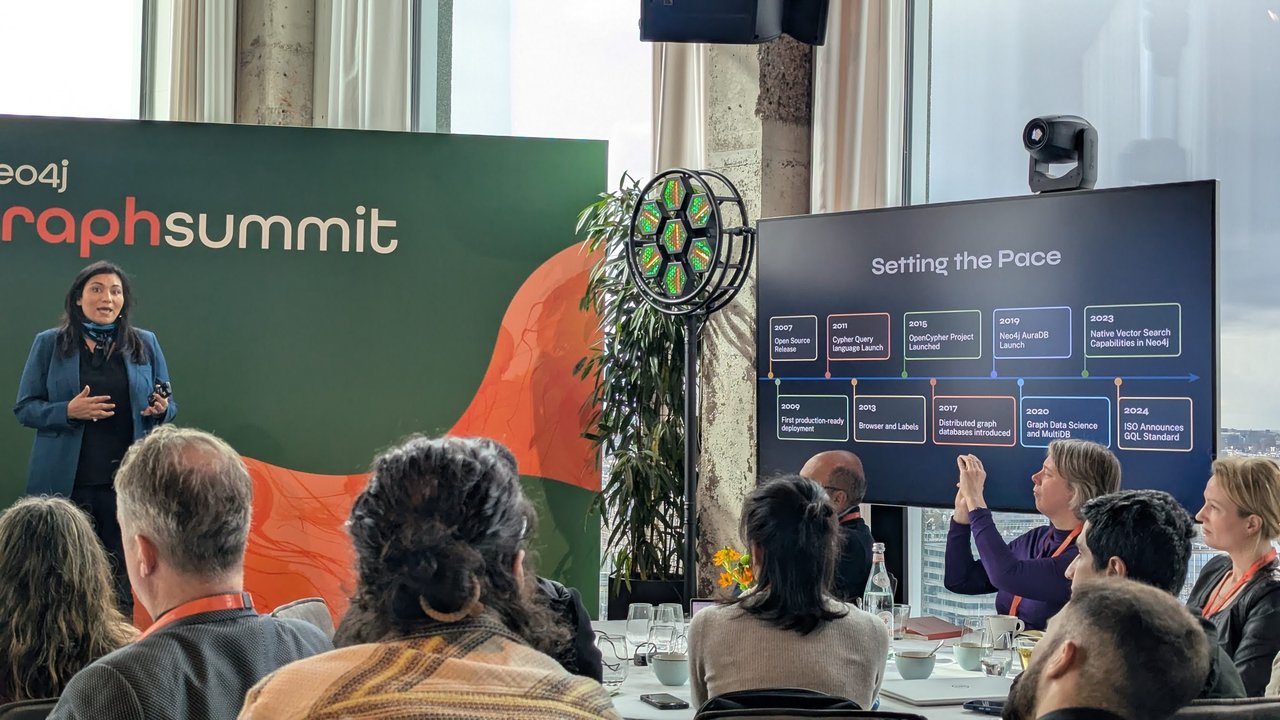
Eighteen years in one slide
The opening keynote put Neo4j’s history on one timeline, called “Setting the Pace”. It ran from the open source release in 2007, through the Cypher query language (2011), openCypher (2015) and the AuraDB cloud service (2019), to native vector search in 2023 and ISO’s 2024 announcement of the GQL standard, which grew out of Cypher.
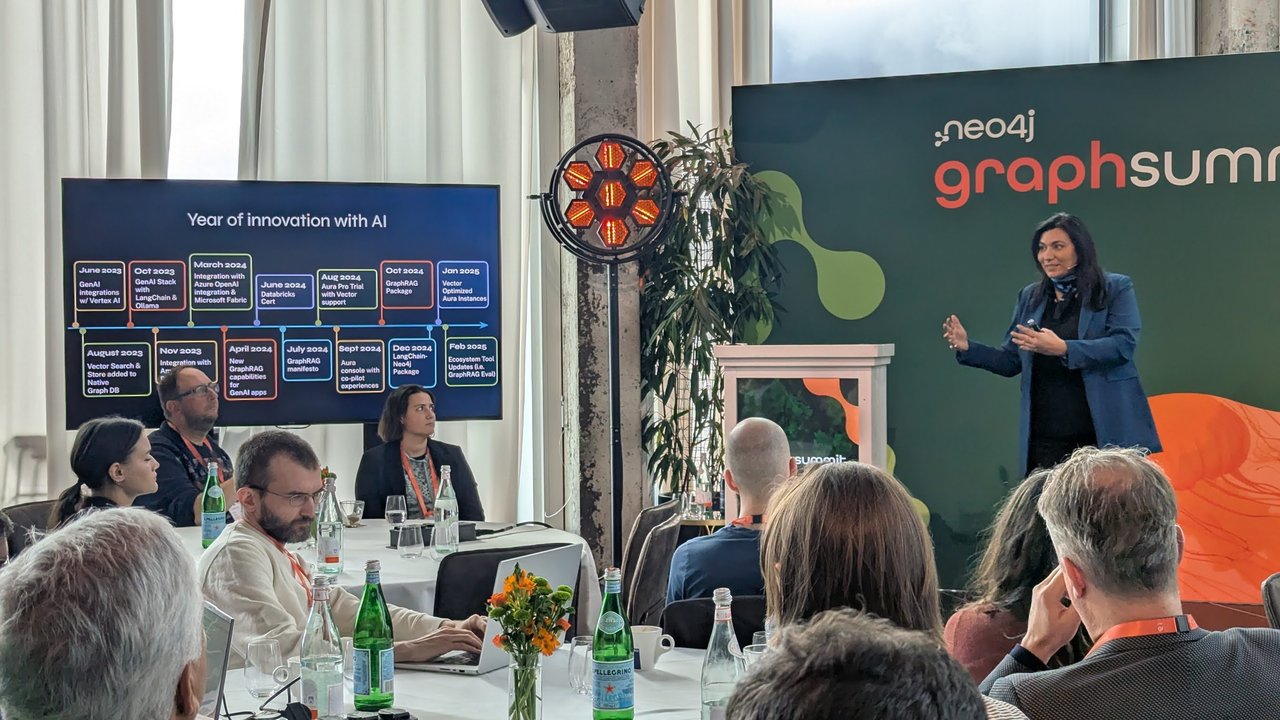
The slide I photographed most was the next one, “Year of innovation with AI”. It covered about eighteen months of GenAI work:
- Oct 2023: the GenAI Stack with LangChain and Ollama
- Mar 2024: integration with Azure OpenAI and Microsoft Fabric
- Apr 2024: new GraphRAG capabilities for GenAI applications
- Jun 2024: Databricks certification
- Jul 2024: the GraphRAG manifesto
- Aug–Sep 2024: an Aura Pro trial with vector support, and an Aura console with copilot experiences
- Oct–Dec 2024: a GraphRAG package and the LangChain-Neo4j package
- Jan–Feb 2025: vector-optimised Aura instances and ecosystem tooling such as GraphRAG evaluation
The message was clear. Neo4j wants to be the knowledge layer behind retrieval-augmented generation, not just another database you query. I agree with the bet. Vector search finds text that looks similar. A graph tells you how things are actually connected, and for enterprise data that’s usually the part you need.
Graphs, vectors and algorithms in practice
The technical sessions went from the knowledge-graph data model up to production search. Two slides summed up the toolbox well.
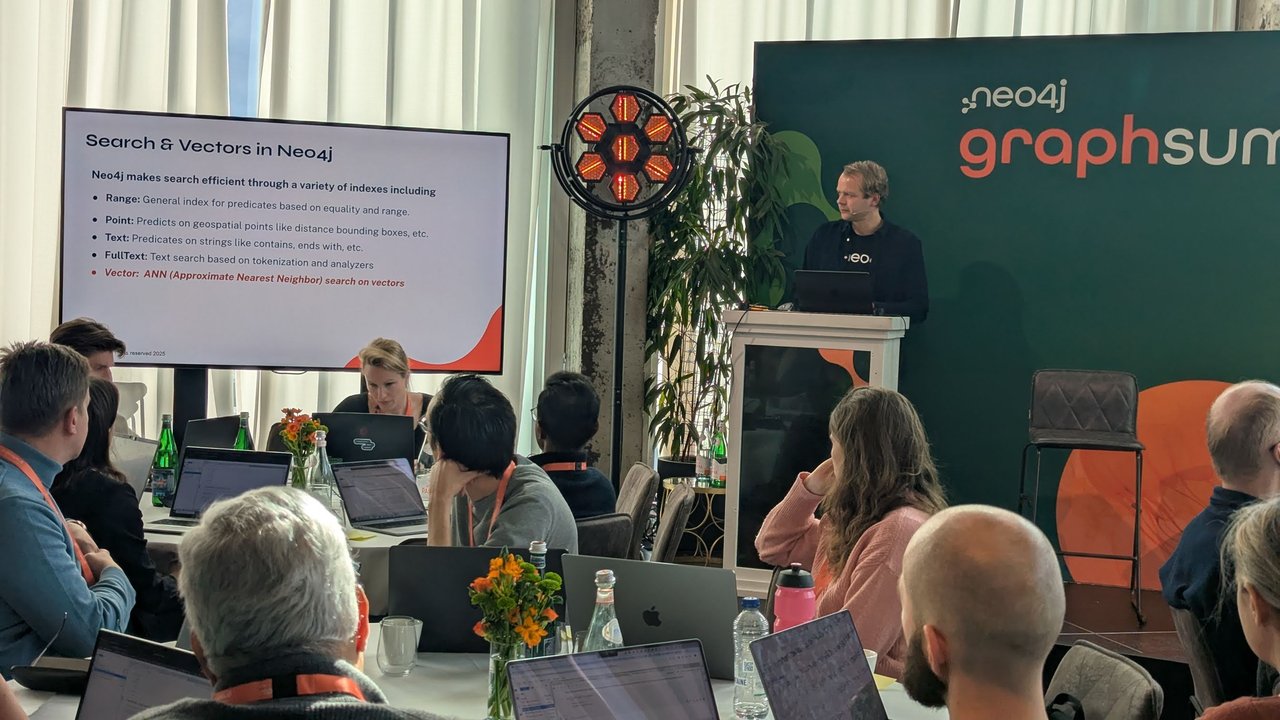
The first was search and vectors in Neo4j. A single database offers several index types: range indexes for equality and range predicates, point indexes for geospatial queries, text indexes for string predicates, full-text search with analysers, and vector indexes for approximate nearest neighbour search on embeddings.
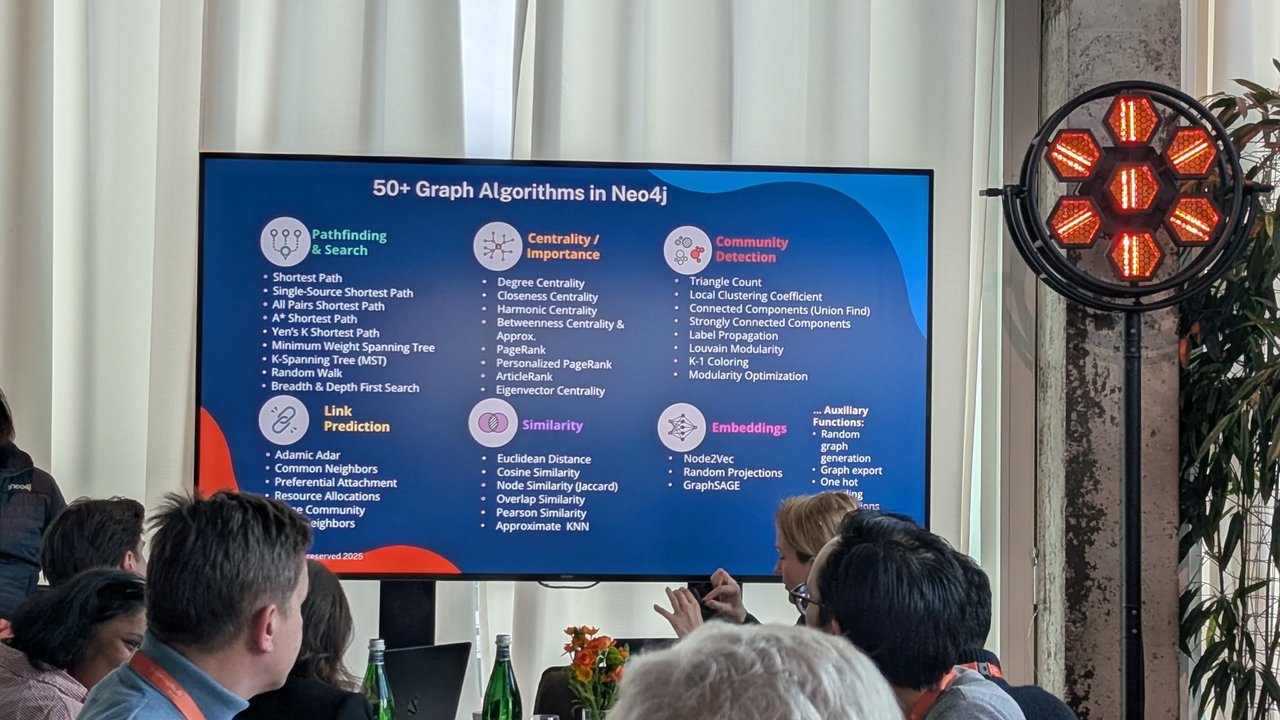
The second was the 50+ graph algorithms in Neo4j Graph Data Science. They’re grouped into pathfinding and search, centrality, community detection, link prediction, similarity and embeddings. PageRank, Louvain and shortest path are the familiar ones. Node embeddings are the bridge back to machine learning.
What I liked most was that part of the programme was hands-on. Attendees were given links to notebook environments so they could run the examples themselves, instead of only watching someone else type Cypher.
What the sessions covered
I also recorded a few short clips during the morning sessions. Three topics in them are worth writing down.
Scaling a graph out. The Neo4j Product Vision & Roadmap keynote was presented by Neha Bajwa, VP of Product Marketing at Neo4j, according to her title slide. The roadmap part started from a problem every graph user hits. Traversals are fast because nodes and relationships are stored together, and that same layout makes horizontal scaling hard: a table can be split down the middle, a graph can’t be split without slowing traversals down. The slide promised “Large Graph Support” for 100TB+ graphs, with intelligent sharding and separate storage for topology and properties.
The plan, as presented, came in two phases:
- Short term: property sharding. Nodes and relationships stay on the primary cluster, and the properties, where most of the data sits, are sharded across several clusters. It was in early access at the time, with availability for interested customers planned over the summer. It builds on the new block format, plus a middle layer that keeps properties used by common queries in memory.
- Long term: active-active. Neo4j’s research team is looking at splitting the graph across multiple primary clusters. The speaker framed this as research, and something that hasn’t been achieved for graphs before.
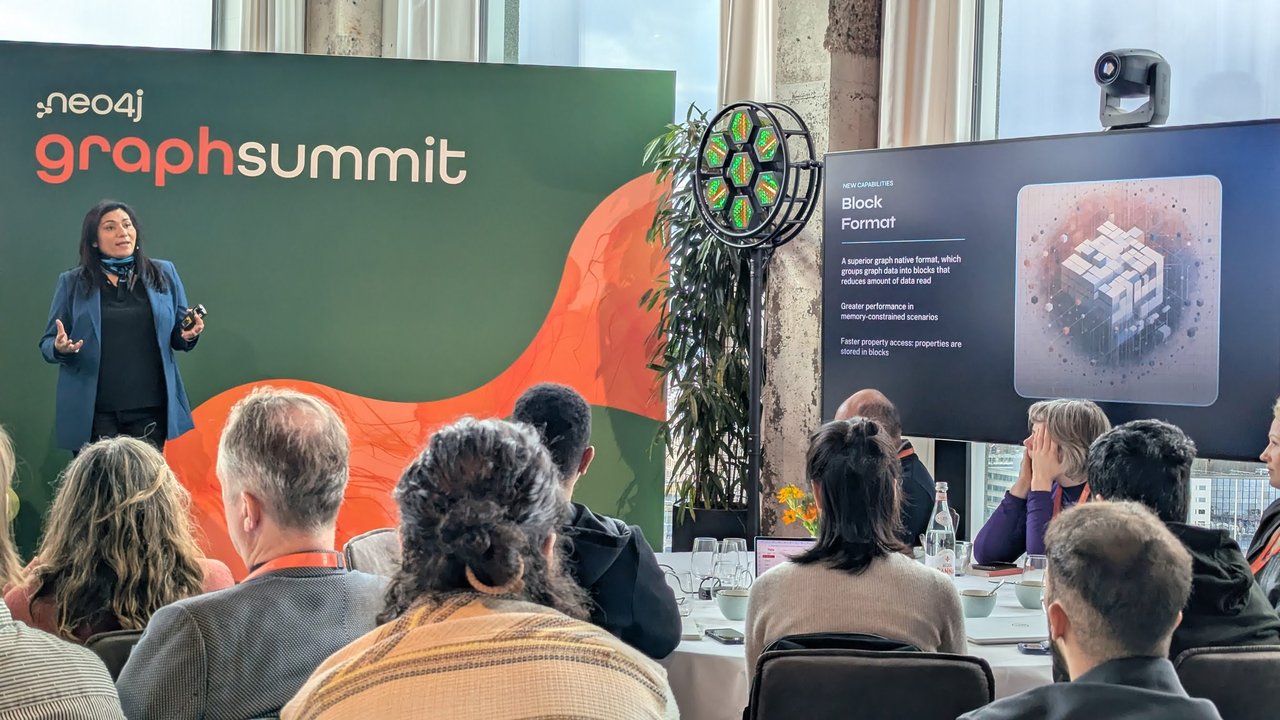
The block format slide: graph data grouped into blocks, faster property access, and better performance when memory is tight.
Aura Business Critical vs Virtual Dedicated Cloud. Under “Comprehensive Cloud Offerings for Your Workloads”, the speaker explained the difference between two Aura tiers. Business Critical, launched in 2024, is multi-tenant: one instance is shared by several organisations, which lowers the price. According to Neo4j it has full feature parity with Virtual Dedicated Cloud, the tier previously called Enterprise. Virtual Dedicated Cloud adds an isolated environment, at a higher price, for organisations that need complete isolation, such as government, defence or highly regulated financial companies. The keynote also mentioned the vector-optimised Aura instances introduced in January, which can scale storage because vectors need much more of it.
Knowledge graphs vs traditional databases. One question in the panel Q&A was what makes clients adopt graph technology alongside their existing databases. A Neo4j panellist said that, driven by GenAI, the most popular use case over the past two years has been a knowledge graph as an abstraction layer on top of traditional databases. Their rule of thumb: if your use case is more about relationships and interdependencies between data, graphs are a good fit. The examples given were supply chain, which is all about connections and is recursive and hierarchical, and fraud detection. The panellist added that knowledge graphs are good at storing contextual metadata and traversing it quickly, and that GenAI makes this more pressing because it forces you to bring data from many underlying systems together.
My take: separating topology from properties is the right first step, because traversals mostly touch topology. Active-active writes on a graph are a much harder problem, and it was good to hear it described honestly as research.
Stephen Chin, Neo4j’s VP of Developer Relations, moderated that panel. I recorded a separate interview with him later in the day: Stephen Chin (Neo4j) at GraphSummit Amsterdam: GraphRAG.
The view from A’DAM Tower

The break view: the IJ, the ferries and Amsterdam Centraal.
The day ended with drinks overlooking the city, which is a good setting for the question every GraphRAG project eventually hits: how do you keep the knowledge graph up to date once it’s feeding an LLM?

My takeaways
- GraphRAG is a real engineering pattern now. It has packages, evaluation tooling and certified integrations, not just blog posts.
- Vectors and graphs work together. The best designs use vector search to find a starting point, then the graph to expand context along real relationships.
- Operations decide the outcome. Provisioning, upgrades, backups and access control for a graph database are the same automation problems I work on every day. That’s why I keep automating Neo4j with Ansible.
Thank you to the Neo4j team for a well-run, genuinely technical day.