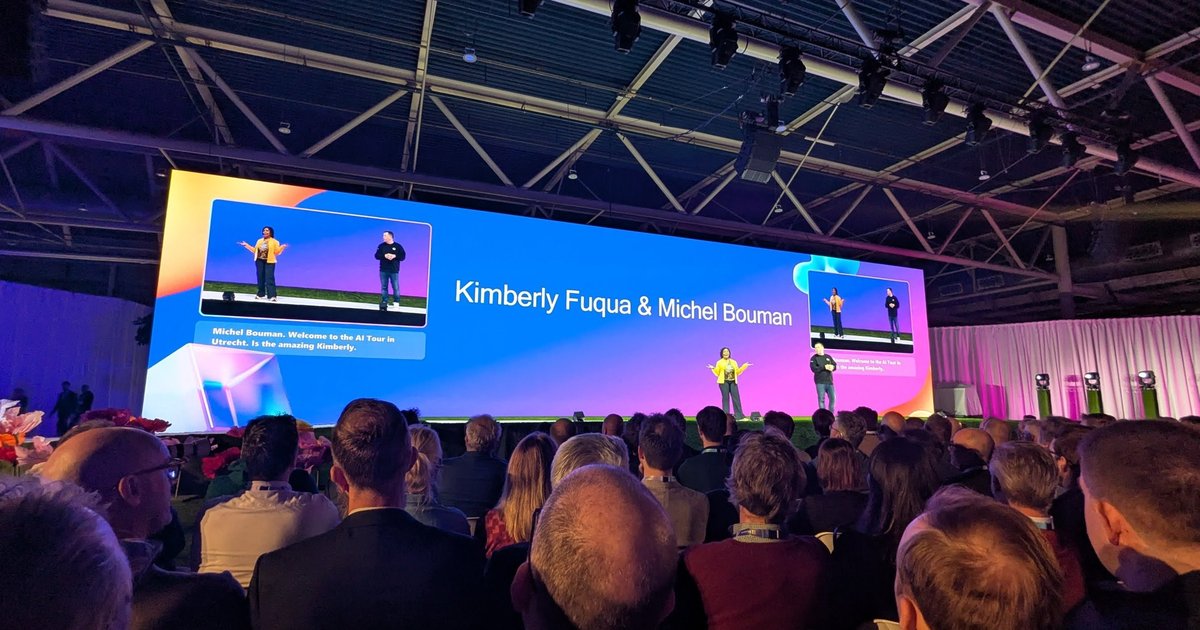
On Thursday 20 March 2025 I went to the Microsoft AI Tour in Utrecht, a free one-day event at the Jaarbeurs. The official Utrecht page lists an opening keynote by Jared Spataro, a Connection Hub, and workshops on Copilot Studio agents, GPT-4o, Microsoft Fabric, Purview and AI-ready Azure landing zones. This post covers what I captured: the keynote, and one afternoon session in the hall where everyone listened on headphones.
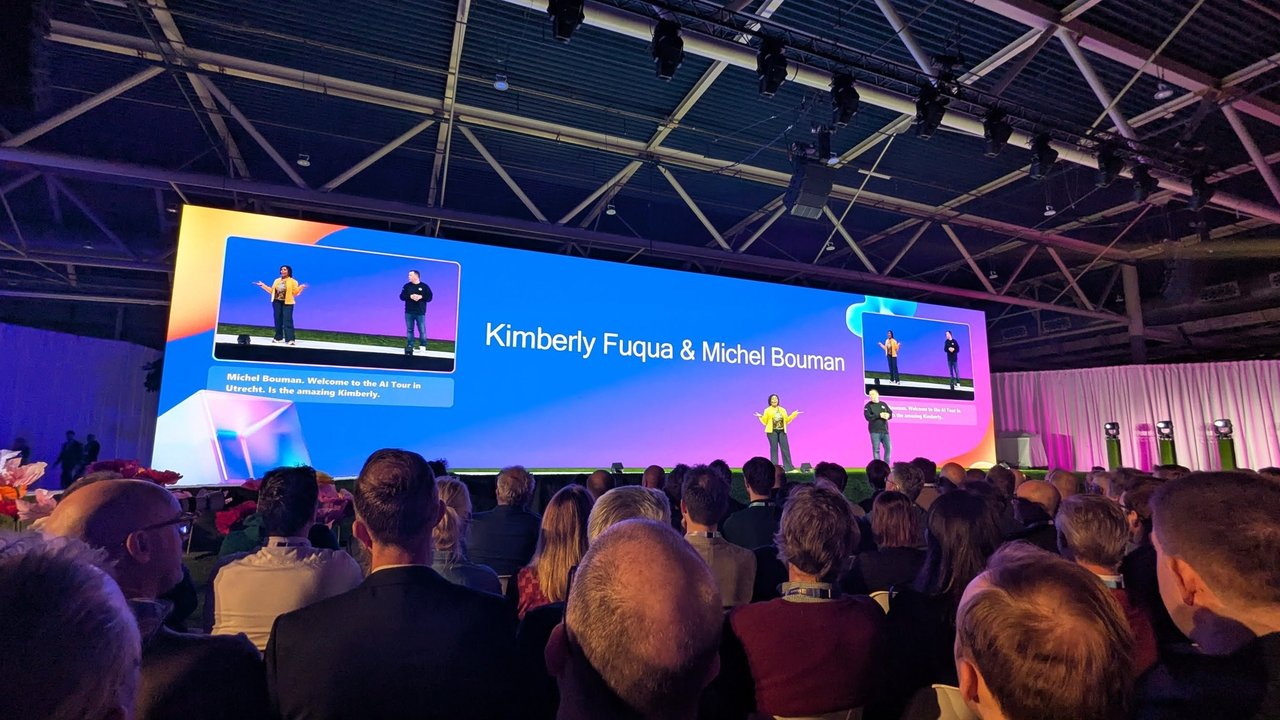
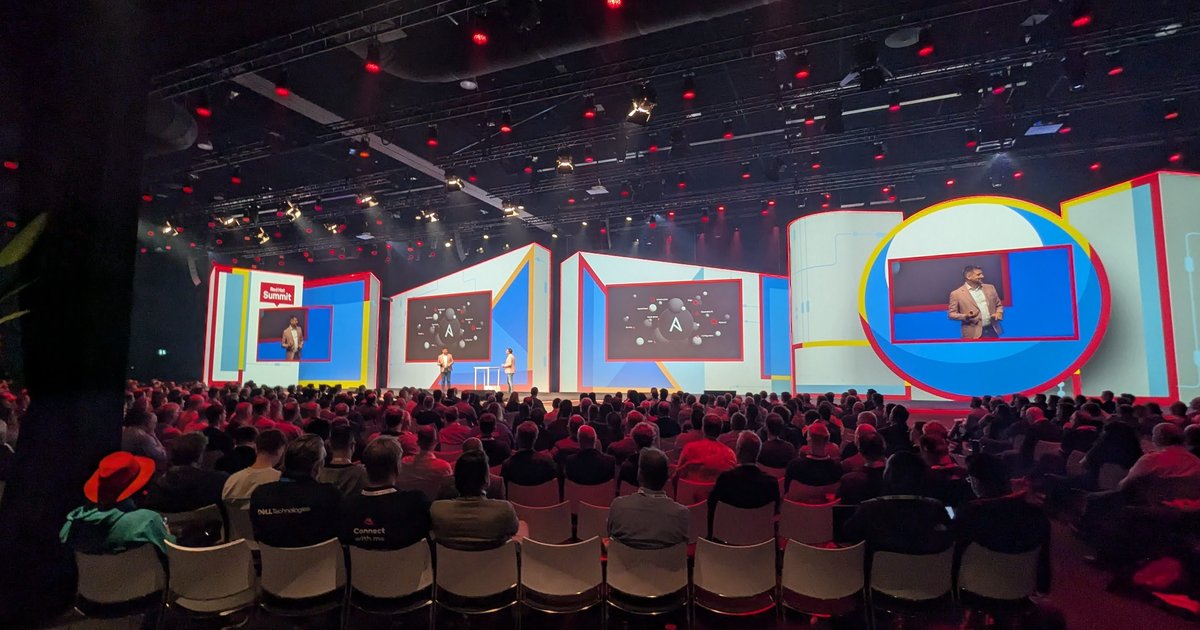
The welcome on the main stage: the screen named Kimberly Fuqua and Michel Bouman as the hosts.
Keynote: three kinds of agent
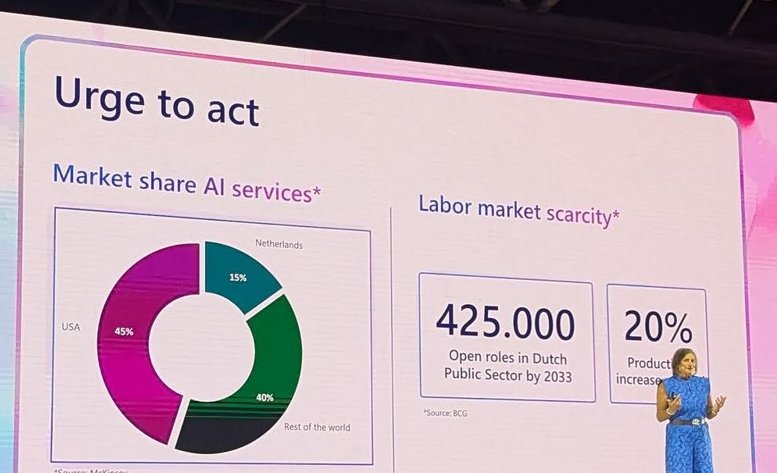
Early in the keynote, an “Urge to act” slide paired a market-share chart for AI services (USA 45%, rest of the world 40%, the Netherlands 15%) with a labour-market scarcity panel: 425.000 open roles in the Dutch public sector by 2033. The source on the slide is BCG.
The keynote opened with a short film about intelligence in nature, then Michel Bouman welcomed the audience to Utrecht. The main message of the Microsoft keynote content was agents. As presented, an agent is “a packaging up of AI” that can reason, remember, be given skills (send an email, create a support ticket, update a CRM) and react to triggers such as an incoming customer email, checking in with a person when it needs guidance.
Microsoft then split agents into three levels, using an IT help desk as the example:
- Retrieval agent: answers how-to questions from an internal knowledge base.
- Task agent: when triggered, orders a new laptop for an employee from concrete instructions on model and delivery address.
- Autonomous agent: takes the employee’s laptop request itself, decides which policies to check, decides whether the employee is eligible, then buys and ships it.
The Copilot Studio demo
The demo used a fictional retail company, Contoso Outdoors. An autonomous agent built in Copilot Studio watched incoming orders around the clock. Using inventory and sales data from SAP, it decided a new shipment of jackets was underperforming, paused future orders, and suggested approved discounts held in Dataverse. The store manager could assign the repricing task to a colleague from the same place, so nobody had to open a system of record.
The build part showed how little there is to it: instructions written in natural language covering the trigger, the inventory lookup, notifying the manager and discount handling; SharePoint sites as knowledge sources, a Dataverse connection for approved pricing, and actions via SAP connectors, plus messaging and task assignment. Microsoft said there are more than 1,500 out-of-the-box connectors. See the Copilot Studio documentation for what is available today.
My take: the useful part of this demo is the shape, not the product. Triggers, scoped knowledge, a short list of permitted actions and a human who approves the exceptions is the same pattern I want from any agent in production, whichever vendor builds it.
Developers, Foundry and security
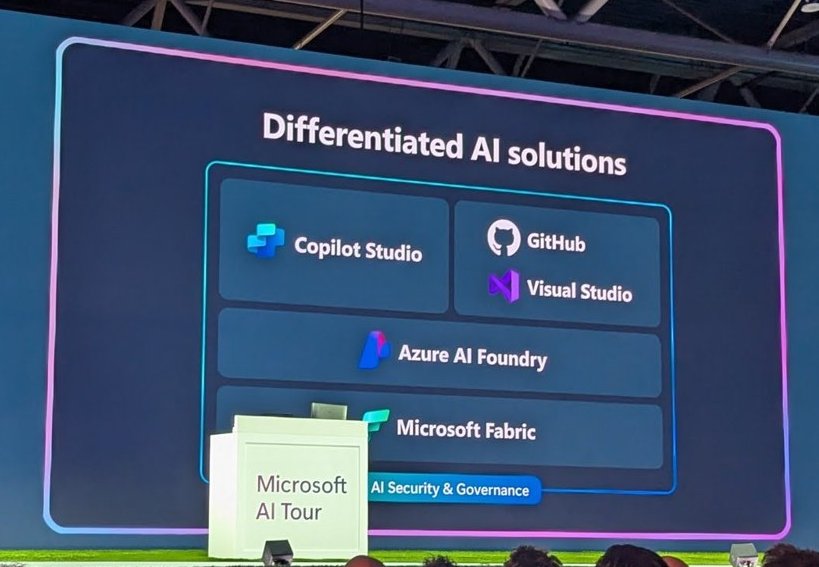
The “Differentiated AI solutions” slide grouped Copilot Studio, GitHub, Visual Studio, Azure AI Foundry, Microsoft Fabric and AI security and governance as one landscape.
The developer segment showed GitHub Copilot finding a cross-site scripting problem in a pull request, suggesting changes, running the app to check for errors and adding a star rating to a product page. Microsoft then described Azure AI Foundry as the place to design and scale AI apps and agents, with models, tooling, safety and monitoring in one place. According to the keynote, it offered Azure OpenAI Service in more than 28 regions with data residency in each, and a catalogue of more than 1,800 models from OpenAI, Meta, Mistral, Cohere, NVIDIA and others. Those are Microsoft’s numbers from March 2025. The platform has since been renamed Microsoft Foundry, and its current overview describes agents, models and tools under one management plane.
The security segment framed AI risks as data oversharing, leakage, jailbreaks and regulation, and pitched Defender, Entra, Intune and Purview together as one way to secure and govern AI. The keynote ended on customer stories, including a Dutch bank said to support more than 3.5 million customer conversations a year with Copilot Studio.
A customer session: ABN AMRO and a customer-service assistant
Between the keynote and the afternoon I watched a customer session in the big hall. The slides carried the ABN AMRO logo next to Capgemini’s, and the speaker slides were titled “Technical setup: Anna Chat”, “Architecture and guardrails” and “Enhancing Anna with LLM”.
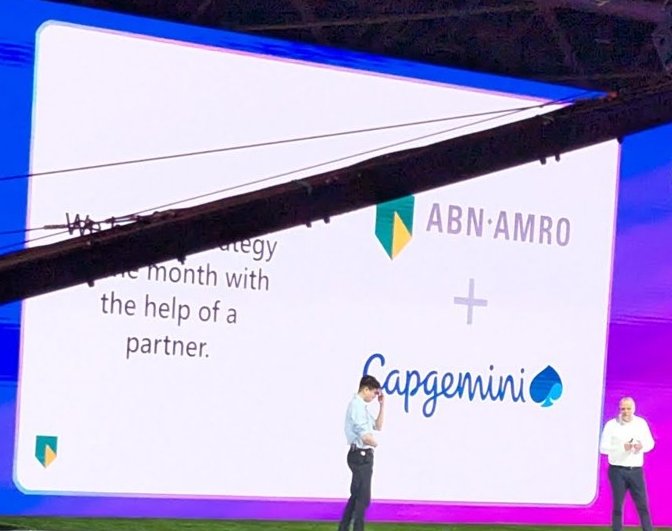
The ABN AMRO and Capgemini slide. The text on the left, partly hidden by a camera cable, was about a strategy done in a month with the help of a partner.
The part I found most useful was the guardrail design. The session described a first-generation assistant built as retrieval-augmented generation on Azure OpenAI and search, grounded in a public FAQ and reachable through WhatsApp. The customer gets one question to the bot, and anything the bot cannot answer is handed to a human agent. Because language models are non-deterministic, they added an input guardrail that cuts off a customer message before it reaches the model if it is not valid or safe, and an output guardrail that checks the answer again. The example guardrail categories were profanity and safety, which covers prompt injection and jailbreaking. That detail comes from the audio of the session, so treat it as my notes, not a transcript.
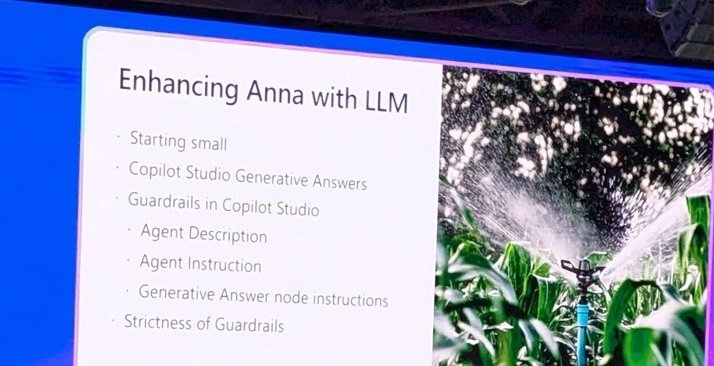
The follow-up slide: start small, move onto Copilot Studio Generative Answers, and set guardrails through the agent description, agent instruction and generative answer node instructions, with a note on the strictness of the guardrails.
My take: “start small, add guardrails on both sides of the model” is the most transferable lesson of the day, and it applies to any chat assistant, not only Microsoft’s.
Afternoon session: AI-driven business transformation
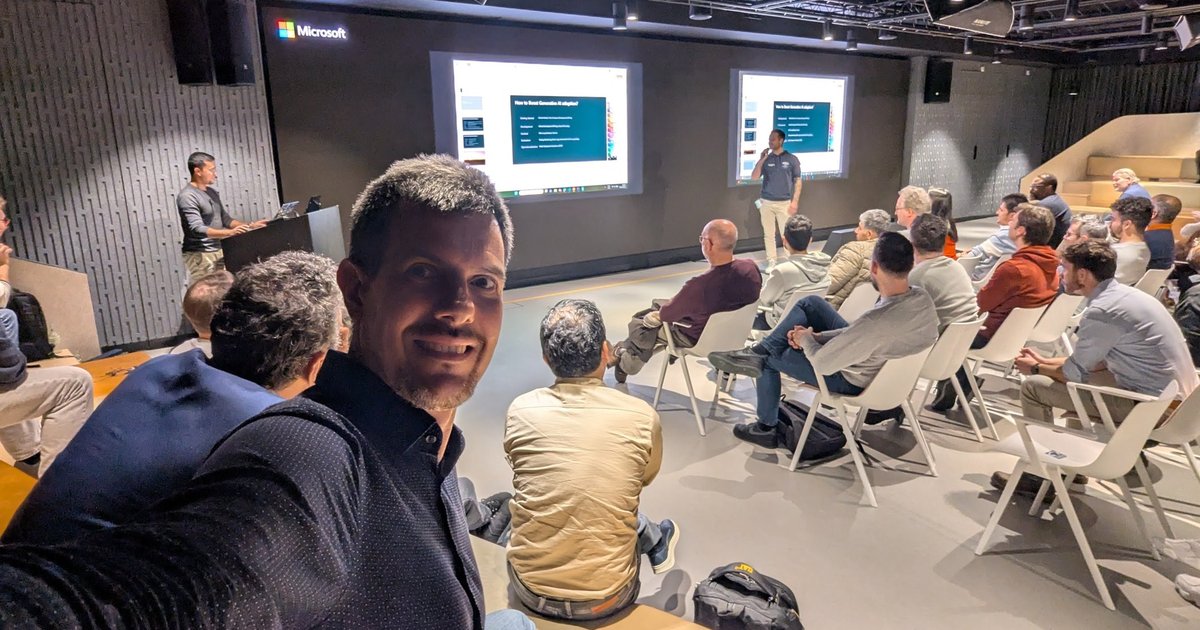
In the afternoon I sat in a hall where the audience listened through headphones, which made the room almost silent. The session slides, in order:
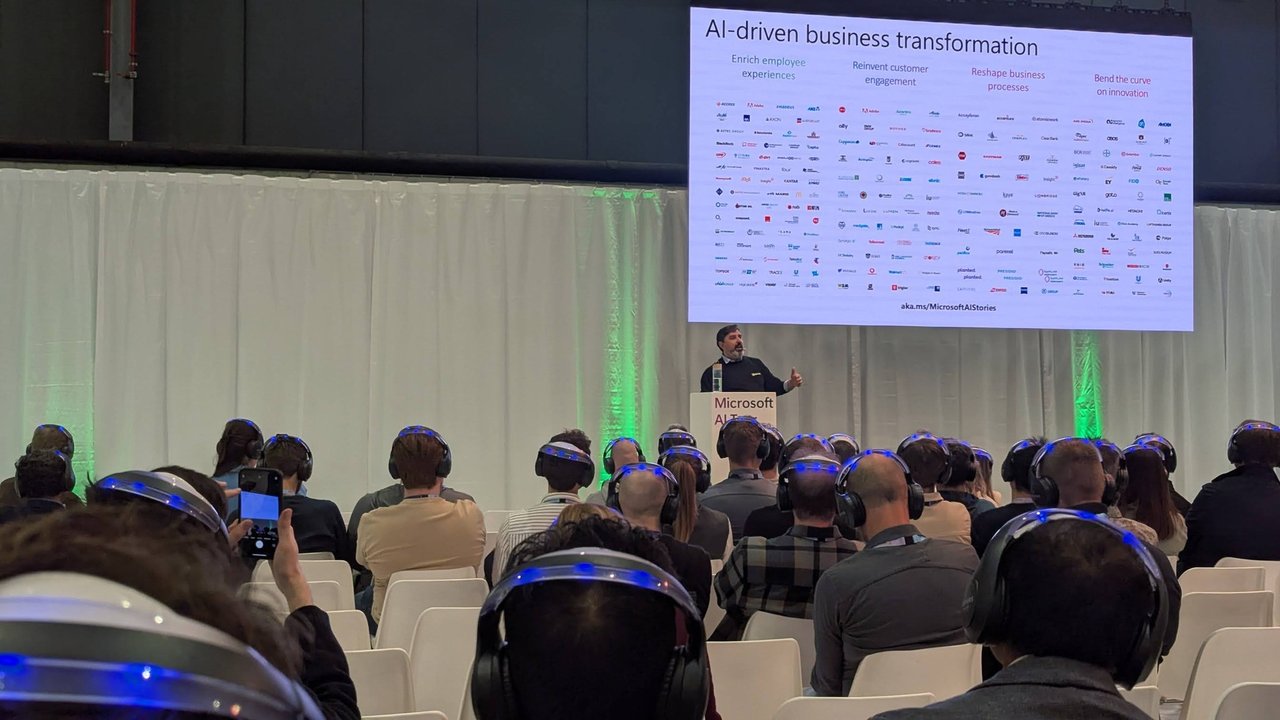
The AI-driven business transformation slide: customer logos grouped under enrich employee experiences, reinvent customer engagement, reshape business processes and bend the curve on innovation.
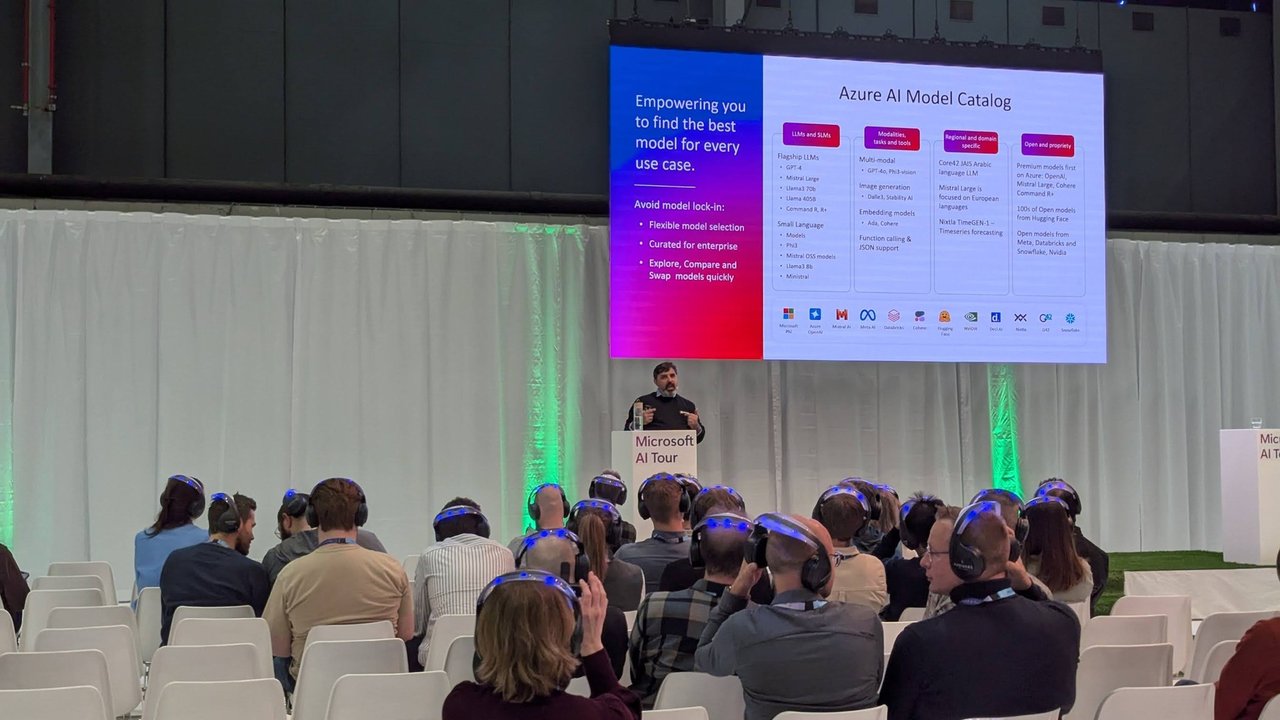
The Azure AI Model Catalog slide: “find the best model for every use case”.
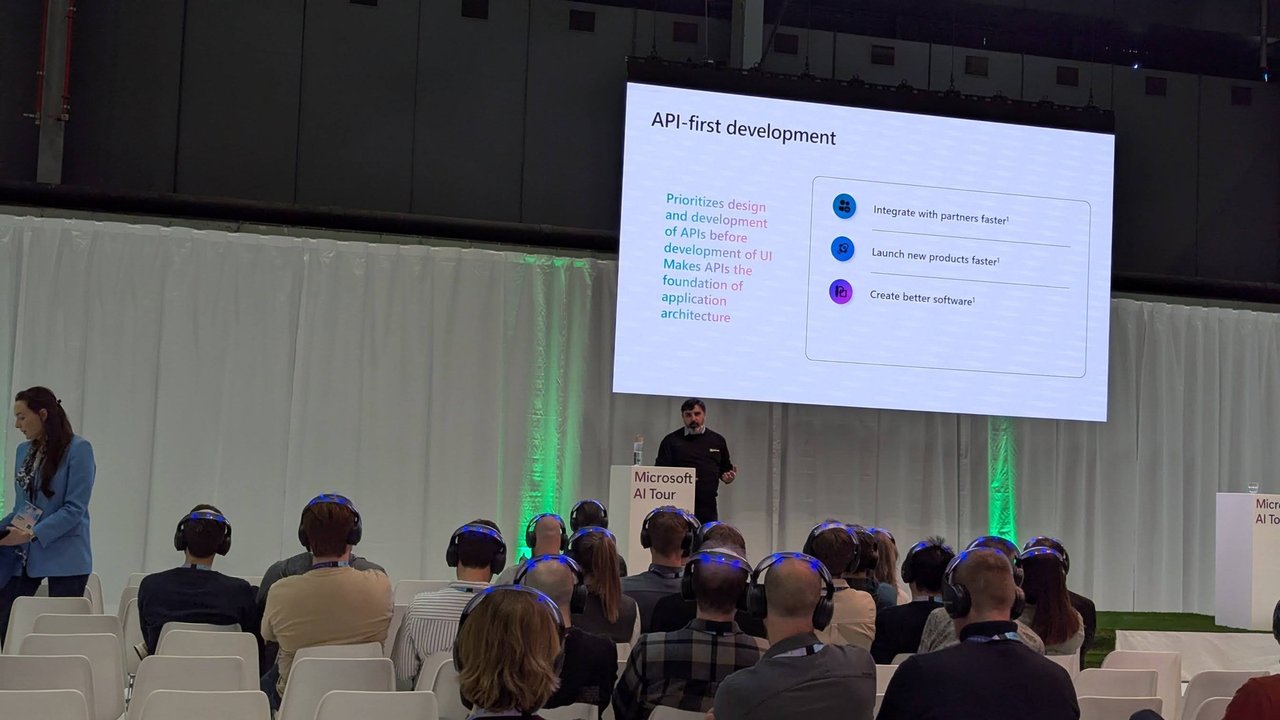
An API-first development slide: design before implementation, so partners integrate faster.
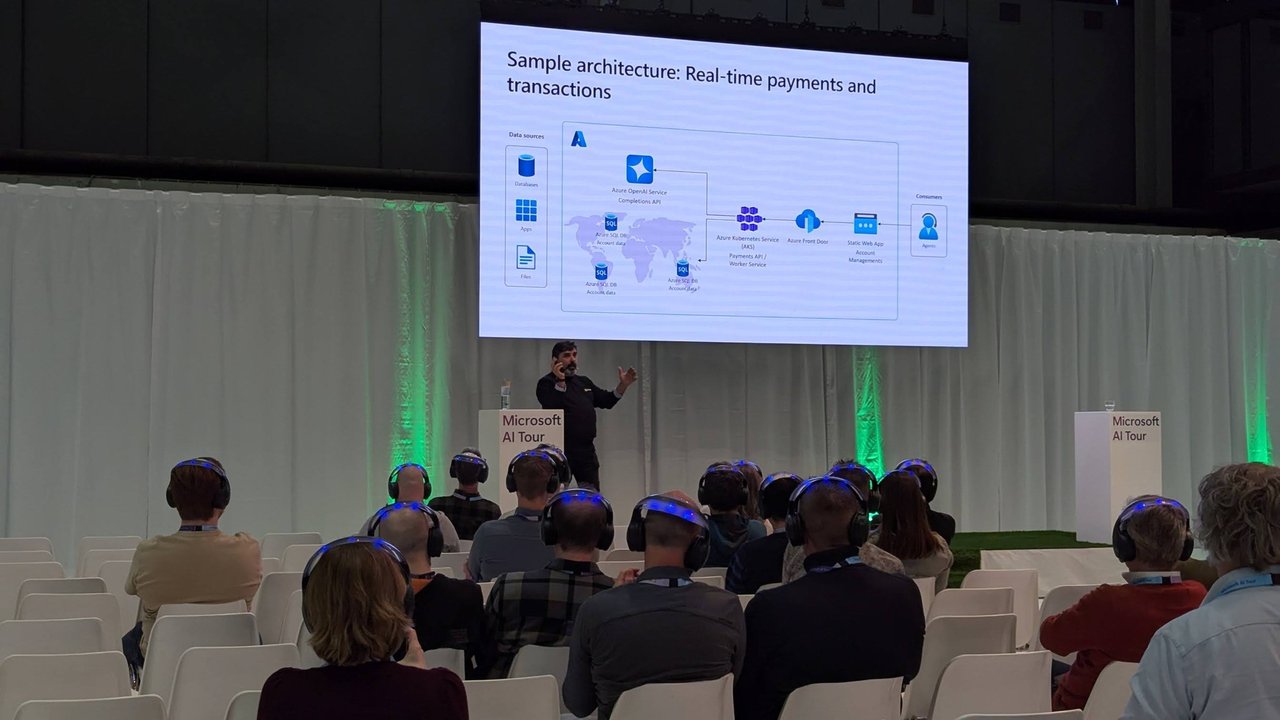
A sample architecture for real-time payments and transactions closed the sequence.
Two more slides from the same session covered the pitch for building new apps on Azure and the Kubernetes angle:
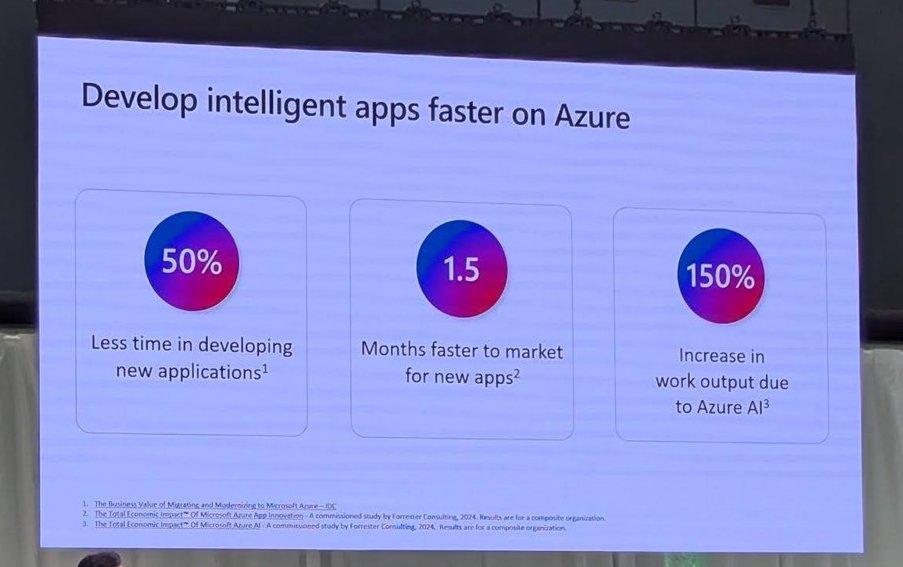
“Develop intelligent apps faster on Azure”: 50% less development time, 1.5 months faster to market and a 150% increase in work output, as claimed on the slide.
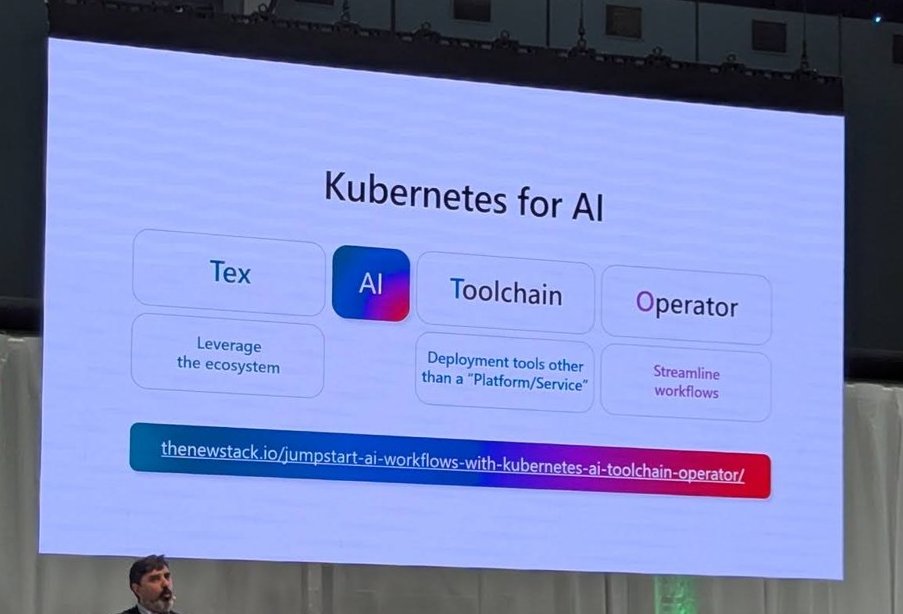
“Kubernetes for AI”: a slide pointing to the Kubernetes AI toolchain operator, with a link to a New Stack article.
The arc was familiar: customer stories first, then the model catalogue, then the engineering consequence that AI features need stable APIs, then a reference architecture for a payments scenario, with Kubernetes for AI as a side note. I did not record this session’s audio, so I will not paraphrase what was said beyond what the slides show.
Takeaways
- Vendor taxonomies of agents (retrieval, task, autonomous) are useful for scoping: what can the agent do alone, and what needs approval?
- Connectors and data access decide whether an agent is useful, which is why SAP, SharePoint and Dataverse featured so prominently.
- Product names move quickly. The Foundry I saw in March 2025 is now Microsoft Foundry, so check the current docs before copying an architecture from a keynote.