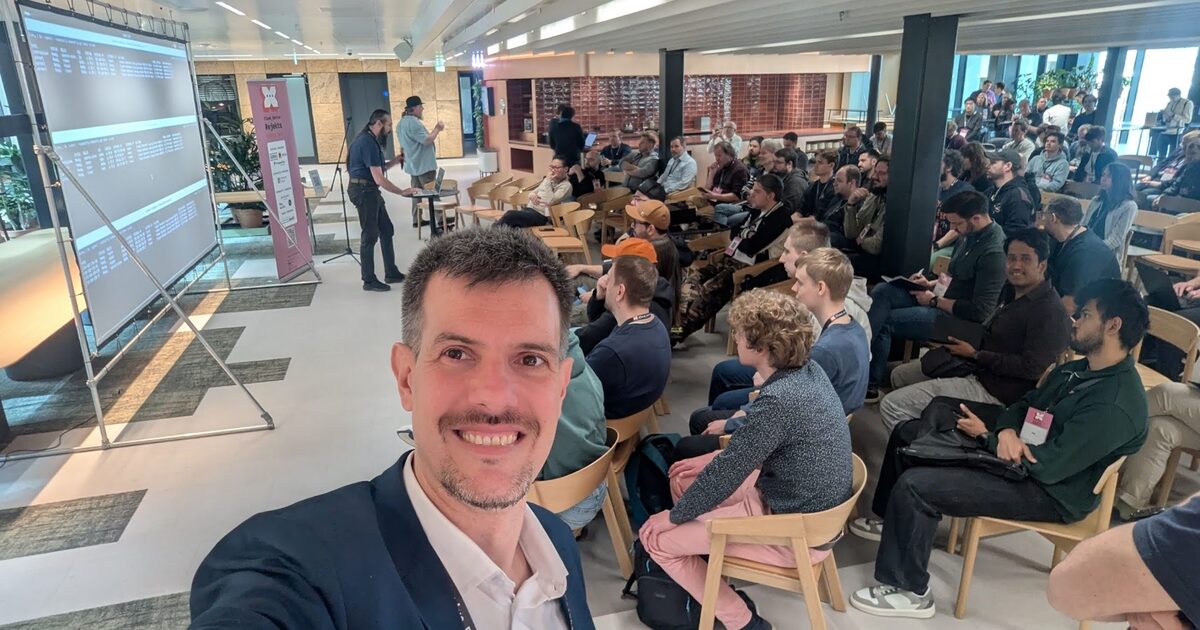
From speaker to Master of Ceremonies
When the Cloud Native Rejekts organizers asked me to be the Master of Ceremonies for the EU 2026 edition in Amsterdam, I did not hesitate for a second. Rejekts is the conference I look forward to the most during KubeCon week — raw, technical, zero marketing fluff, and packed with the kind of people who build the cloud native ecosystem from the ground up.
Co-hosting alongside the brilliant Julia Hahn, we welcomed over 300 engineers into the Miro HQ in Amsterdam on Saturday, March 21, 2026 for a full day of the deepest technical content you will find anywhere outside the main KubeCon venue.
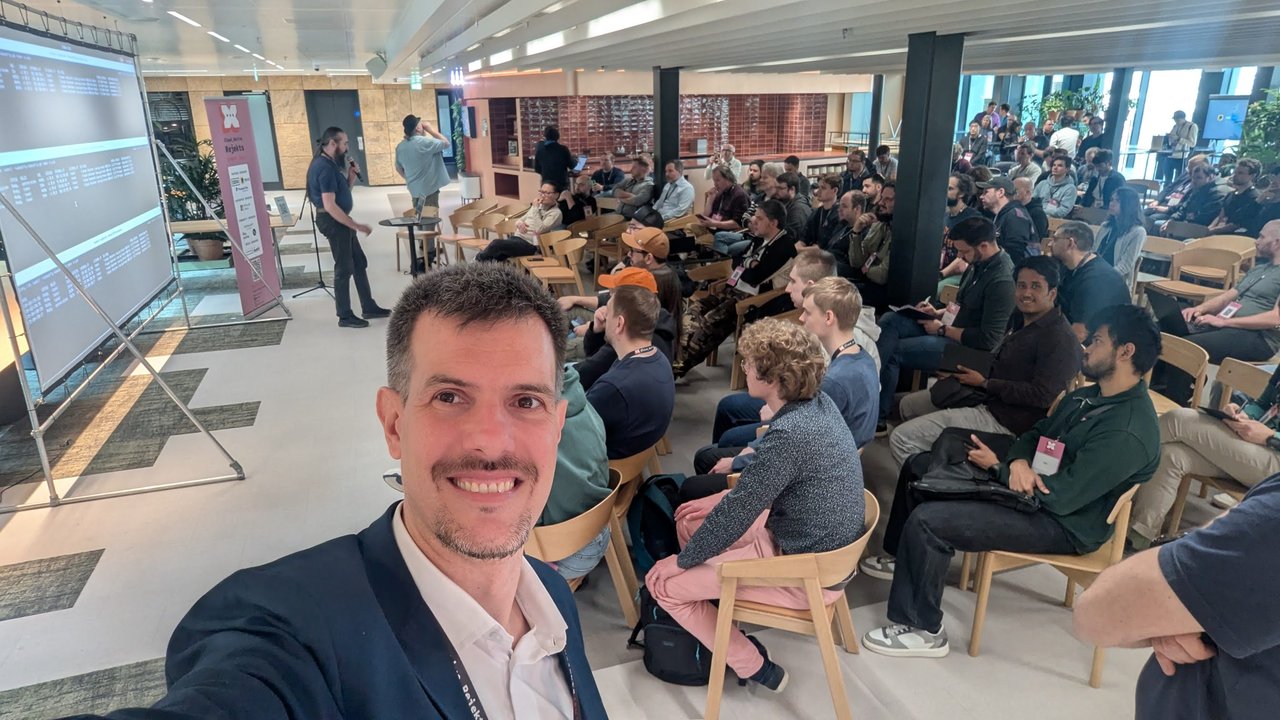
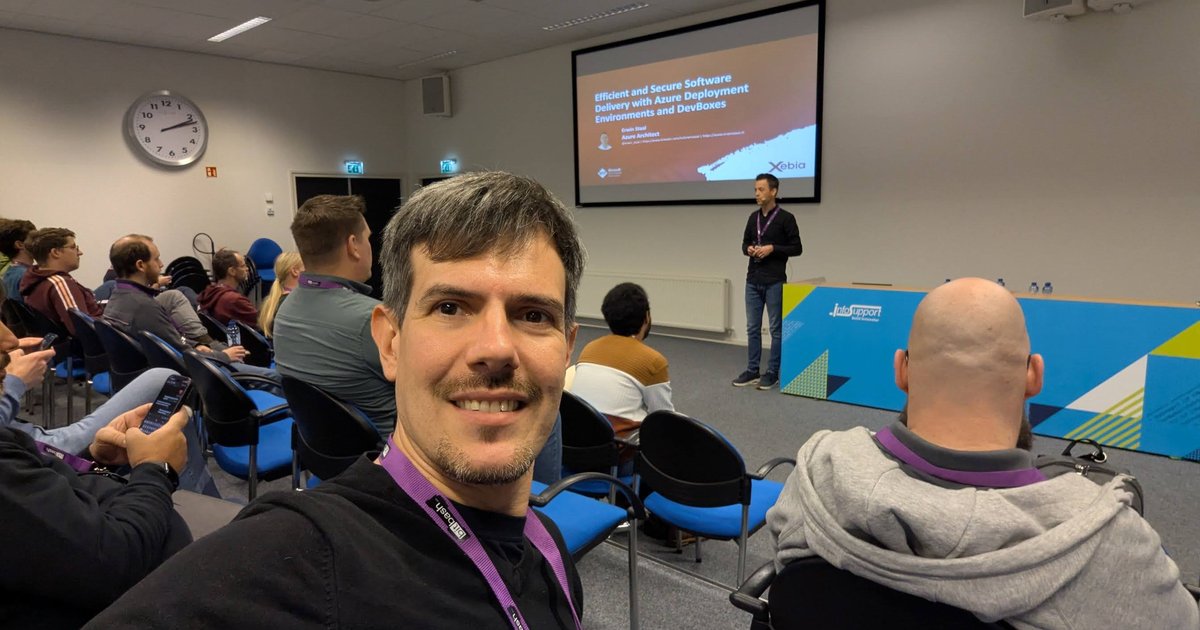
From the MC spot: a full room at Miro HQ before the next session.
What is Cloud Native Rejekts
Cloud Native Rejekts is the ultimate B-side conference. It welcomes talks that were rejected from KubeCon + CloudNativeCon — not because they were bad, but because KubeCon receives thousands of submissions and only accepts a fraction.
The 2026 edition was a landmark moment for the community. After some uncertainty about the future, a new Steering Committee — Aleksandra Nadolski, Marcus Noble, and Laura Santamaria — stepped up to ensure Rejekts continues as a fully community-organized event. A dedicated volunteer organizing team made Amsterdam happen, with sponsors including ProsperOps, Edera, Miro (Partner), Microsoft Azure (Supporter), and Isovalent (Community).
The format includes 30-minute full-length talks and 5-minute lightning talks, creating a fast-paced rhythm that keeps the energy high all day.
The full schedule — 8 hours of deep tech
Here is every session I had the privilege of introducing on March 21. Two parallel tracks running from 10:00 AM to 6:15 PM:
Morning — Room 1
| Time | Talk | Speaker(s) |
|---|---|---|
| 10:00 | Welcome to Cloud Native Rejekts | Opening Remarks |
| 10:25 | Type 1 Fun with Type 1 Hypervisors: The Comeback of Hardware-Backed Isolation | Alex Zenla, James Petersen |
| 11:00 | Cloud-Agnostic Provisioning for Fun and Sovereignty | Thilo Fromm |
| 11:50 | Solving Operator Extensibility: A gRPC Plugin Framework for Kubernetes | John Long, Gabriele Fedi |
| 12:25 | The Self-Improving Platform: Closing the Loop Between Telemetry and Tuning | Graziano Casto |
Morning — Room 2
| Time | Talk | Speaker(s) |
|---|---|---|
| 11:00 | Beyond Tool Sprawl: An Event-Driven Approach to Dynamic Multi-Cloud Operations | Eleni Grosdouli, Gianluca Mardente |
| 11:50 | Beyond Argo Events: Leveraging NATS for Scalable Webhook Management | Or Navon |
| 12:25 | Kernel Observability: The Missing Layer in Cloud Native Engineering | Jed Salazar |
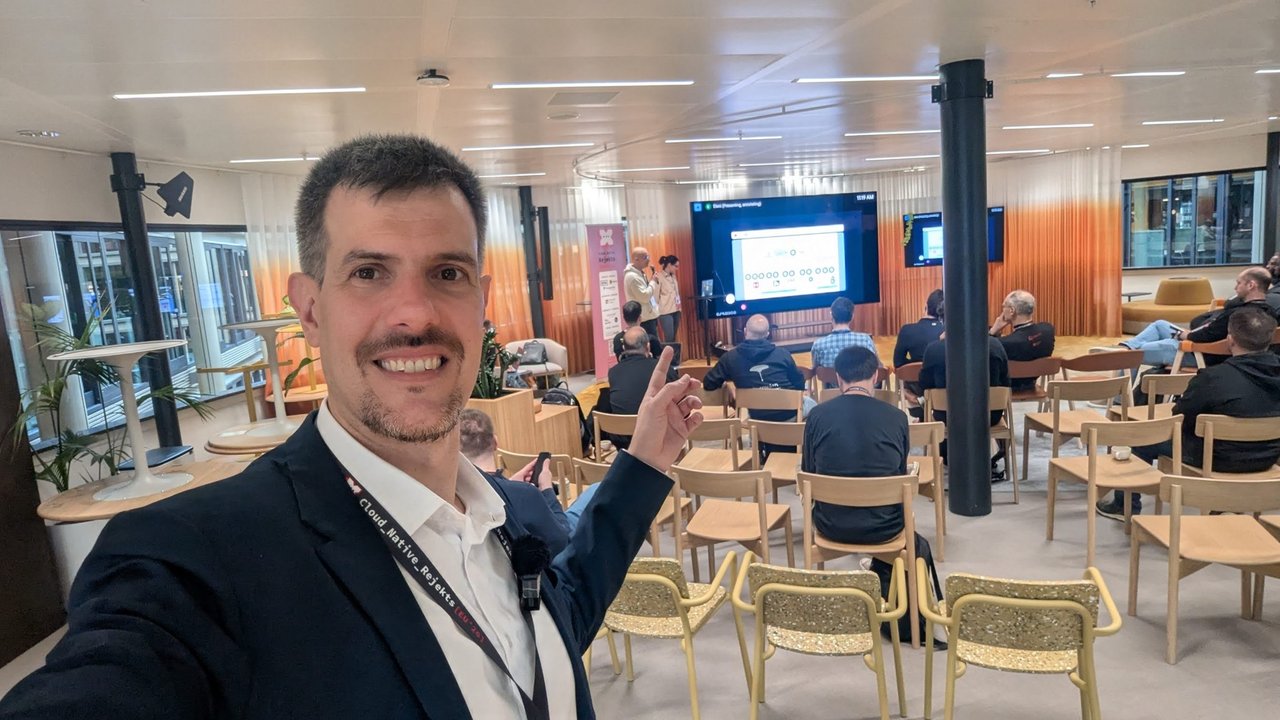
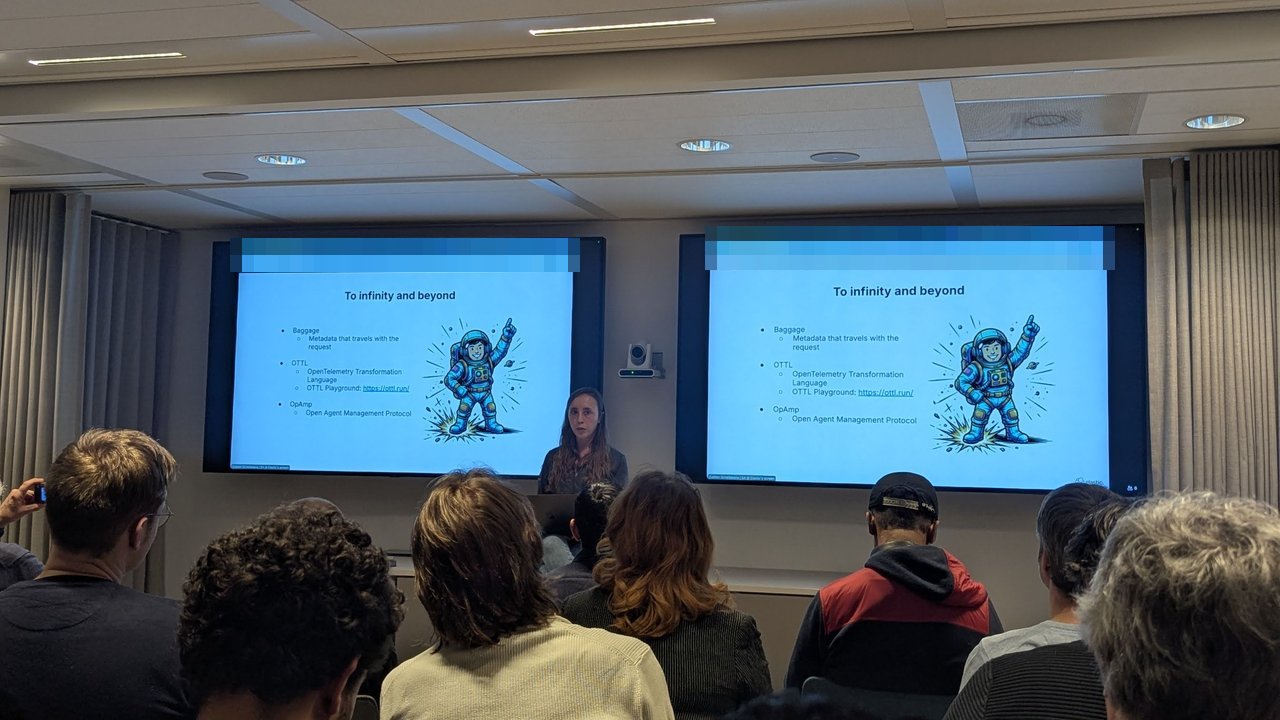
Room 2 in the late morning, with two presenters on stage.
Afternoon — Room 1
| Time | Talk | Speaker(s) |
|---|---|---|
| 14:25 | Pod Right-sizing in the Second Decade of Kubernetes | Abdel Sghiouar |
| 15:00 | Sherlock Pods: Investigating a Compromised Kubernetes Cluster | Maxime Coquerel |
| 15:35 | Push the Boundaries of Kubernetes Multi-Tenancy with Container RuntimeClasses | Rachid Zarouali |
| 16:25 | Building Your Own k0smos, or How to Take Control Over the Control Plane | Roberth Strand, Jussi Nummelin |
| 17:00 | Uncovered: The Hard Truth About OpenTelemetry’s Vendor Neutrality | Adriana Villela, Josh Lee |
| 17:35 | Helm Charts v3: A Preview of What’s Coming Next | Evans Mungai |
| 17:40 | Lightning Talks | Multiple speakers |
| 18:05 | Closing Remarks |
Afternoon — Room 2
| Time | Talk | Speaker(s) |
|---|---|---|
| 14:25 | Unleashing the Tides of Kubernetes Networking by Removing kube-proxy | Tomasz Tarczyński |
| 15:00 | How Chaos Engineering Works: Implementing Failure Injection on Kubernetes with Rust | Yannik Dallenbach |
| 15:35 | Hardening Kubernetes: Our Journey to FIPS Compliance | Louise Schmidtgen, Benjamin Schimke |
| 16:25 | Your Cluster Isn’t Flat: A First-Class API for Real-World Infrastructure Topology | Chen Zicong |
| 17:00 | Achieving Platform Engineering Multi-Tenancy with kcp and Crossplane | Simon Bein, Lovro Sviben |
Followed by the Happy Half Hour — networking drinks where the hallway track truly came alive.
Standout talks from the MC chair
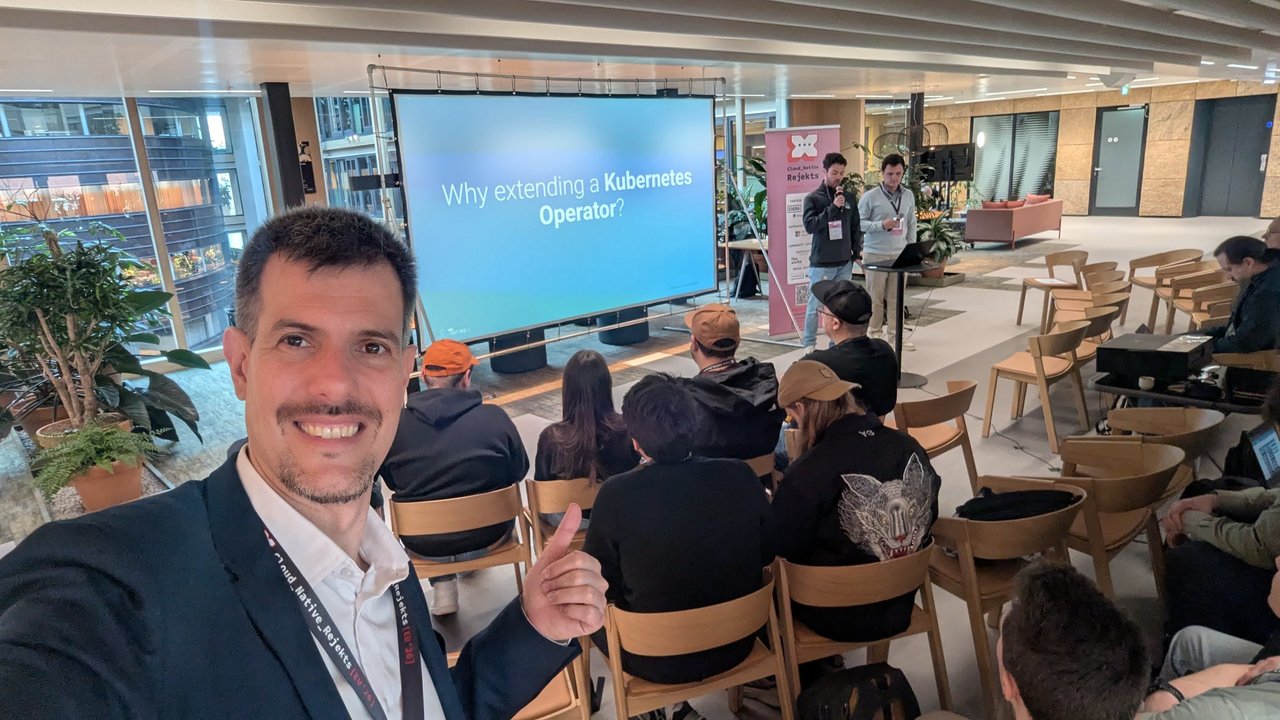
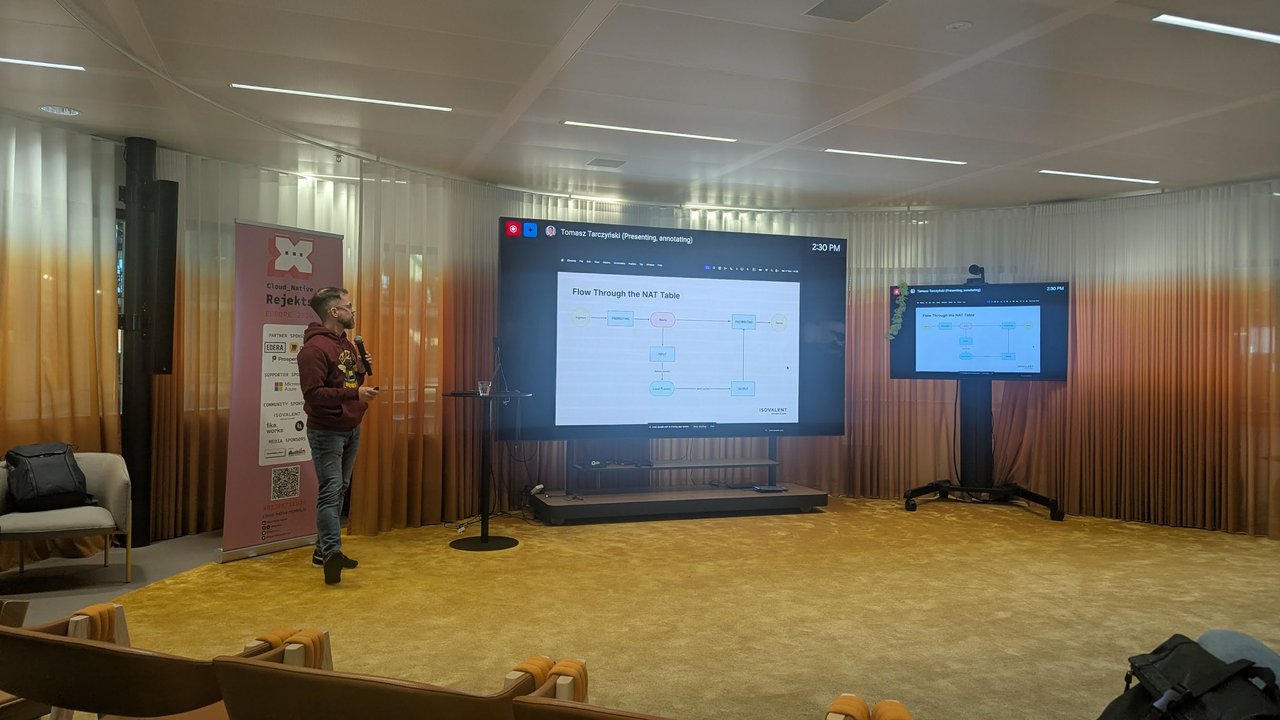
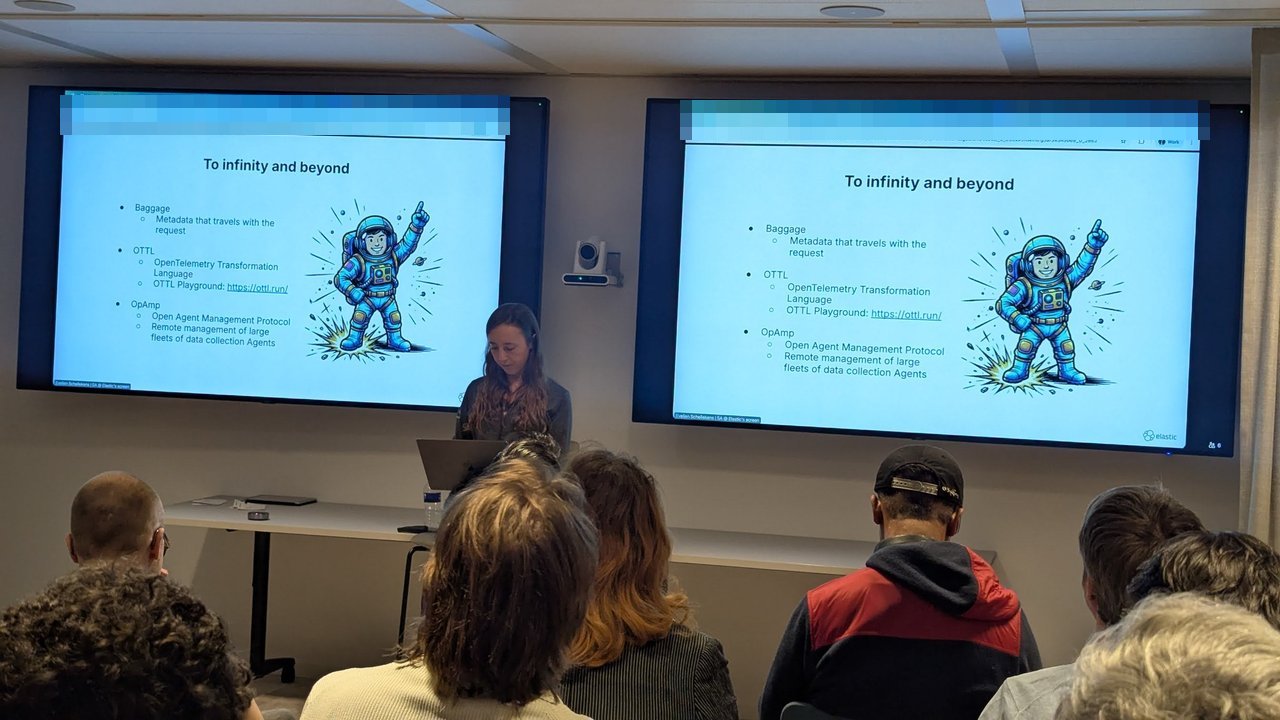
Left: “Solving Operator Extensibility: A gRPC Plugin Framework for Kubernetes”. Right: Tomasz Tarczyński following a packet through ClusterIP in “Unleashing the Tides of Kubernetes Networking by Removing kube-proxy”.
Every talk was excellent, but a few stood out from my vantage point on stage:
Type 1 Hypervisors by Alex Zenla and James Petersen opened the day with a provocative thesis — hardware-backed isolation is making a comeback. After years of container-everything, the pendulum is swinging back for security-critical workloads. Perfect tone-setter for the day.
Sherlock Pods by Maxime Coquerel was incident response storytelling at its finest. Walking through a compromised cluster forensics investigation kept the entire room on the edge of their seats.
The Hard Truth About OpenTelemetry’s Vendor Neutrality by Adriana Villela and Josh Lee was the talk everyone was whispering about during the networking drinks. Honest, uncomfortable, and necessary.
Helm Charts v3 by Evans Mungai in a 5-minute lightning slot — previewing the future of the most widely used Kubernetes package manager. The room exploded with questions.
The MC role — what it actually involves
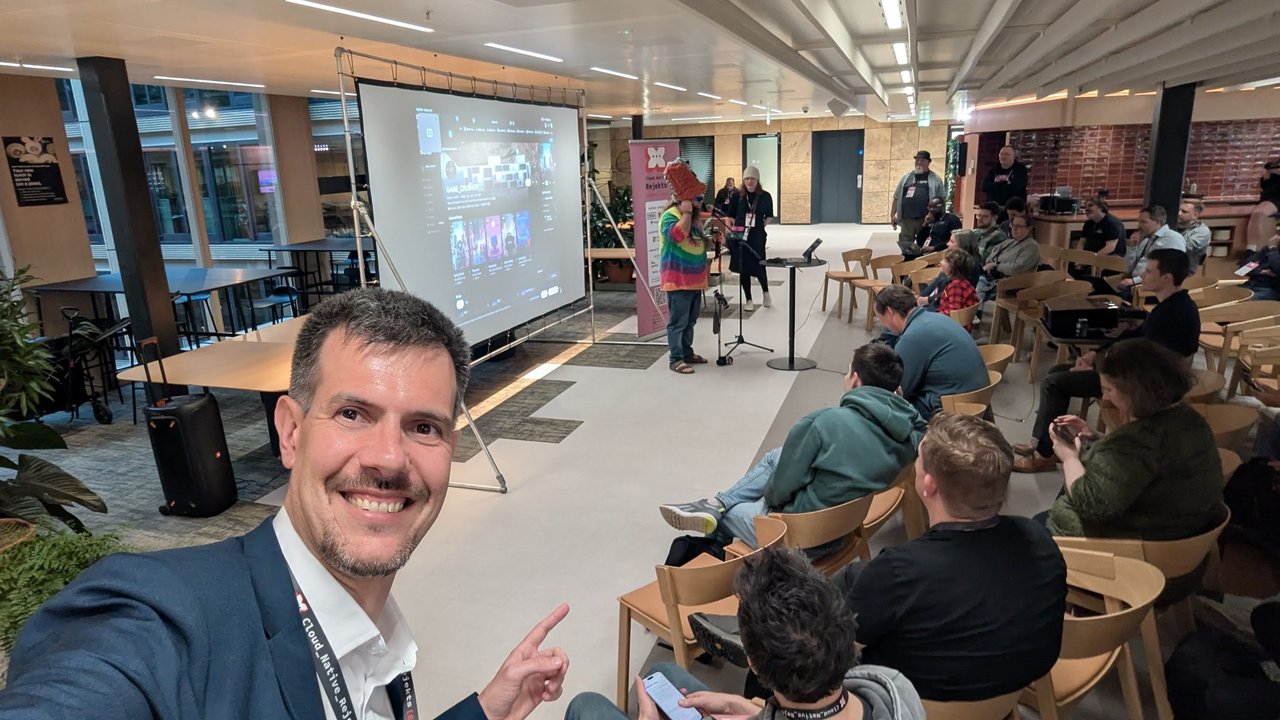
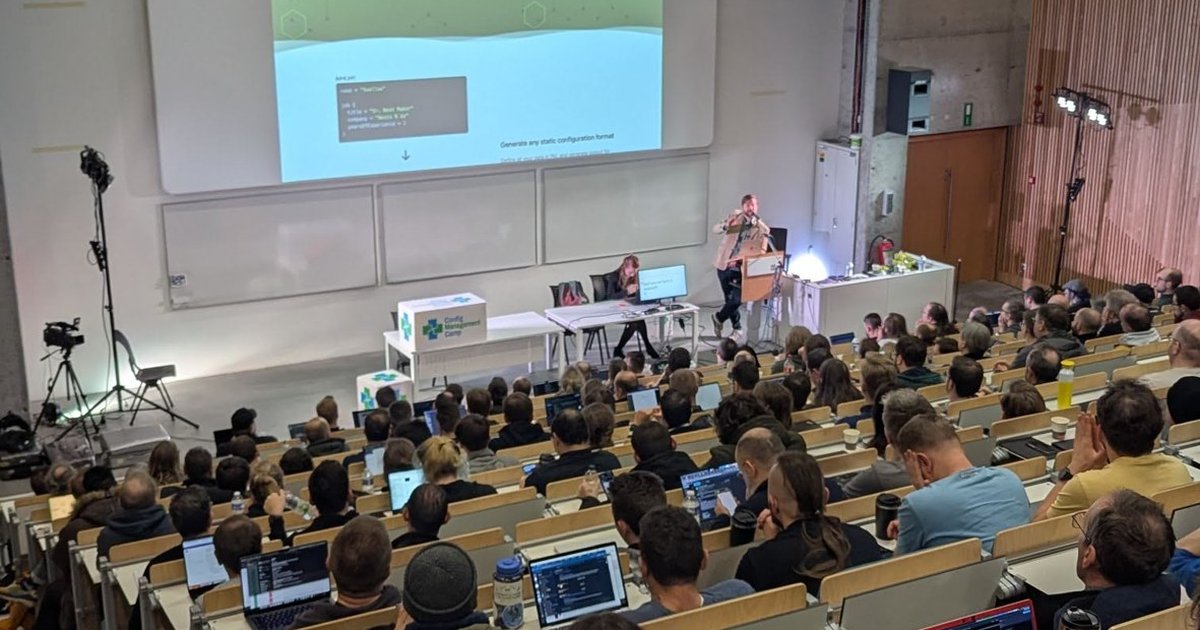
Late afternoon, still a full house.
Being an MC is fundamentally different from being a speaker. When you give a talk, you prepare one story and tell it well. When you MC an entire conference, you become the connective tissue between every session.
Before the event
- Study every single talk abstract — you cannot introduce a speaker properly if you do not understand their topic
- Coordinate with organizers on schedule changes, last-minute speaker swaps, and room logistics
- Prepare transitions — how do you bridge a deep eBPF networking talk to a platform engineering case study without whiplash?
- Rehearse timing — Rejekts runs on a tight schedule across two rooms, and the MC is the clock
During the event
- Set the energy from minute one — the Welcome at 10:00 sets the tone for the entire day
- Introduce each speaker with context that makes the audience lean in
- Manage Q&A — keep questions sharp, redirect when needed, make sure quiet audience members get heard
- Handle the unexpected — projector issues, schedule shifts, speakers running over time
- Keep 300 engineers engaged for 8+ hours — that is a marathon, not a sprint
After the event
- Connect people — the Happy Half Hour is where the real magic happens
- Follow up with speakers — share feedback, amplify their content on social media
- Document lessons for the next edition
A community that refused to die
What made this edition special was the backstory. Cloud Native Rejekts faced real uncertainty about its future. The community stepped up. Volunteers organized Amsterdam from scratch. Sponsors believed in the mission. The new Steering Committee provided guidance while local teams did the hands-on work.
As Marino Wijay put it: “The Cloud Native Rejekts Day -2 conf” is always one of the best parts of KubeCon week. Chris Plank called it “my favourite pre-conference conference.” FikaWorks, a community sponsor, captured it perfectly: “Rejected by the main stage? Not by the community.”
Standing on that stage, watching 300 people choose to spend their Saturday on deeply technical content before the main event even started — that is what open source community looks like in practice.
Why Rejekts matters more than you think
At a 15,000-person KubeCon, you are one face in a massive crowd. At Rejekts, you are in a room where every person chose to be there for the technical depth. The conversations are more honest. The feedback is more direct. The connections are more real.
Some of the best talks I have ever seen at KubeCon week were not at KubeCon — they were at Rejekts.
If you are a speaker whose CFP was rejected, submit to Rejekts. Your talk deserves an audience, and the Rejekts audience is one of the most engaged in the entire ecosystem.
Lessons from the stage
After years of speaking at conferences and now MC-ing Rejekts, here are the patterns I keep seeing:
- Energy is contagious — if the MC is excited, the room follows
- Brevity is respect — nobody came to hear the MC talk; keep intros short and sharp
- Names matter — pronounce every speaker’s name correctly, every time
- Read the room — after a dense technical talk, the audience needs 30 seconds to breathe before the next intro
- The hallway is part of the program — create space for organic conversations between sessions
Join the next edition
Cloud Native Rejekts runs at every KubeCon — EU and NA. The next edition will be at KubeCon NA 2026 in Salt Lake City. Follow the community or check cloud-native.rejekts.io for CFP announcements.
If you are attending KubeCon, block the day before for Rejekts. You will not regret it.