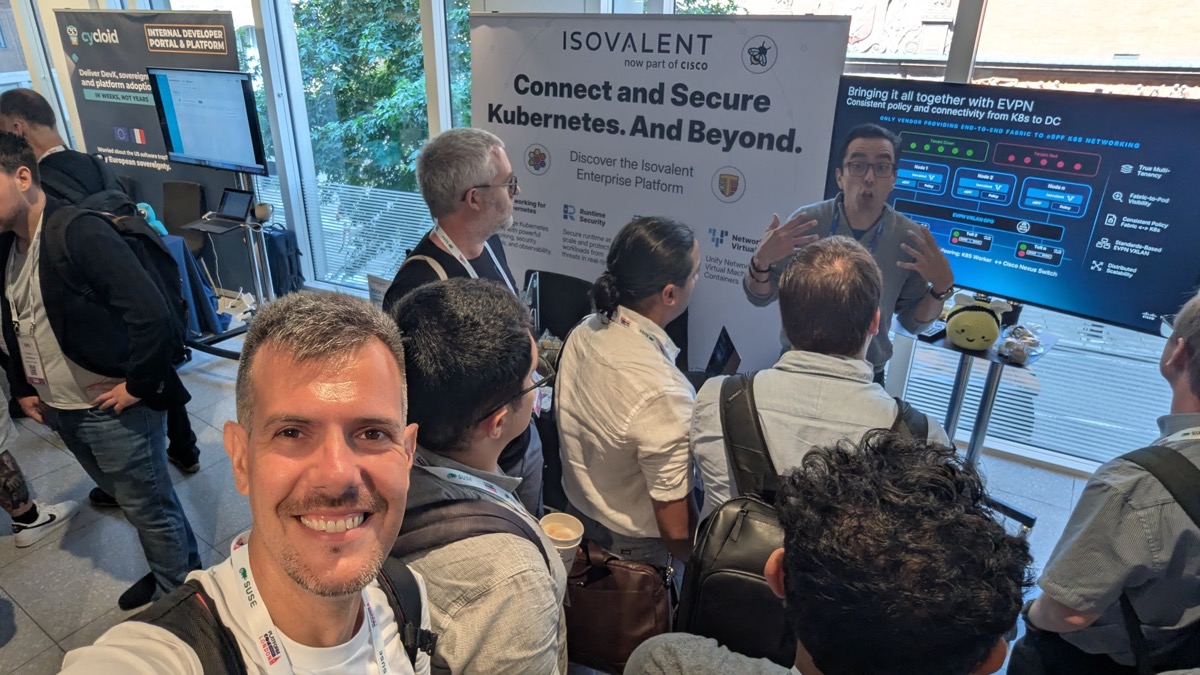
Meeting Luca Galante at KubeCon EU Amsterdam 2026
At KubeCon EU 2026, I had the pleasure of speaking with Luca Galante — one of the people who helped define platform engineering as a discipline and built the community around it.
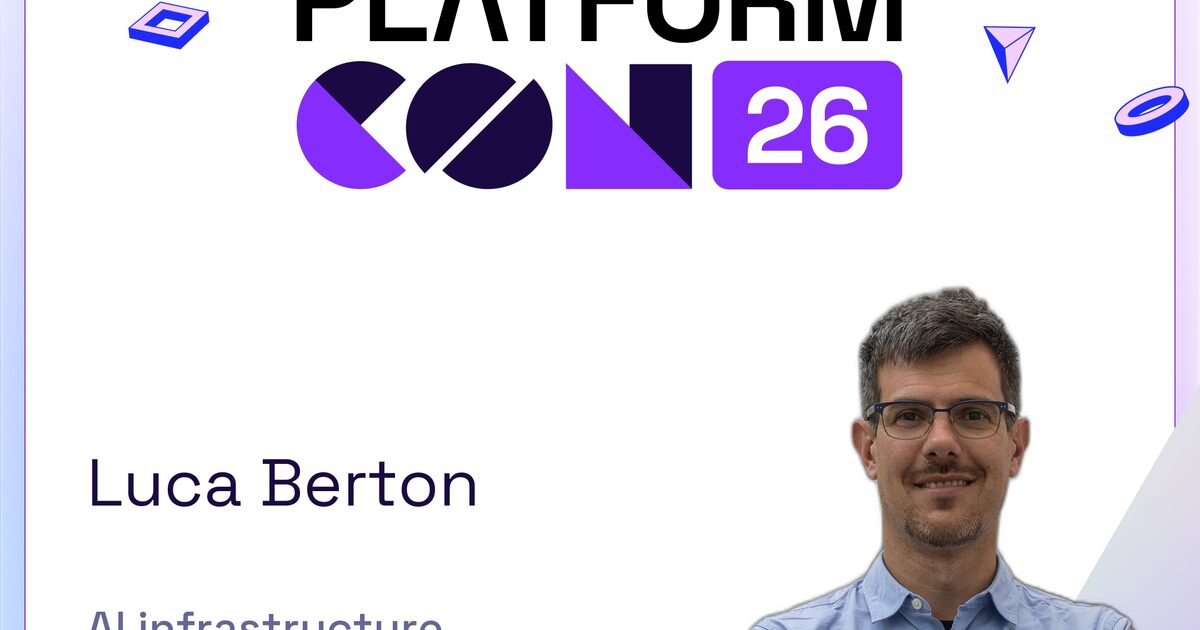
Luca is the driving force behind the Platform Engineering community, PlatformCon, the PlatformCon World Tour, House of Kube, and the growing research work at Weave Intelligence. If platform engineering has a founding story, Luca is one of its main characters.
This conversation is now episode 04 of Udienza, my ten-minute video show with the people who build what you run. The episode page adds the chapters, the takeaways and the full transcript.
How platform engineering started
Luca shared the origin story of the Platform Engineering community — how it evolved from a niche conversation about developer experience and internal tooling into one of the most important movements in the cloud native ecosystem.
What started as a question — “why are developers still struggling with Kubernetes?” — became a movement that now spans thousands of engineers, multiple conferences, a global community Slack, and research initiatives that are shaping how enterprises think about software delivery.
The key events in that evolution:
- PlatformCon — now one of the largest platform engineering conferences in the world
- PlatformCon World Tour — bringing the community to cities globally
- House of Kube — a physical space for platform engineering conversations at major conferences
- Weave Intelligence — research work quantifying the impact of platform engineering on engineering organizations
- Platform Engineering University — learning resources for teams adopting platform engineering
The inflection point: beyond infrastructure
A big part of our conversation focused on the inflection point happening right now. Platform engineering is no longer only about infrastructure and developer experience. It is expanding into:
- Security — shift-left security policies, guardrails-as-code, supply chain integrity
- Observability — unified telemetry, cost visibility, SLO management
- Data — data platforms, feature stores, ML pipelines as platform capabilities
- AI — GPU orchestration, model serving, inference endpoints as platform services
Platform engineering is becoming the operating model for the modern enterprise — not just a team that manages Kubernetes clusters, but the foundation that every engineering team builds on.
AI is increasing the need for platform engineering
This was one of the most important points Luca made. There is a common misconception that AI will replace the need for platforms. The reality is the opposite: AI is dramatically increasing the need for platform engineering.
Here is why:
The prototype-to-production gap
AI can accelerate development. A developer with GitHub Copilot or Claude Code can build a prototype in hours. But moving from a fast prototype to a production-ready, enterprise-grade system still requires:
- Strong platforms with clear abstractions
- Golden paths that encode best practices
- Guardrails that prevent common mistakes
- Solid architecture that scales under real load
Without these, AI-assisted development creates more code faster — but not necessarily better code. The gap between “it works on my laptop” and “it runs in production at scale” does not shrink just because the code was written faster.
The throughput multiplier problem
Agentic workflows, AI workloads, and AI-assisted coding can create a massive increase in throughput. More code, more services, more deployments, more infrastructure changes — all happening faster than ever.
Without the right platform foundation, this acceleration creates:
- Bottlenecks — CI/CD pipelines, review processes, and deployment gates become the constraint
- Fragile systems — fast code without architectural guardrails leads to brittle, hard-to-debug services
- “Frankenstein” architectures — each team makes different choices, creating an unmaintainable patchwork
Platform engineering provides the rails that keep this acceleration productive instead of chaotic.
From internal developer platforms to agentic development platforms
We explored one of the most forward-looking ideas in the conversation: the evolution from Internal Developer Platforms (IDPs) to Agentic Development Platforms.
Traditional IDPs serve human developers — they provide self-service interfaces, golden paths, and abstractions that make it easier for people to deploy and operate software.
But what happens when the “developers” are also AI agents? When agentic systems are writing code, creating pull requests, and deploying services autonomously?
Platform teams will need to support a new world where developers and agents generate software at a much higher speed. This means:
- API-first platform interfaces — agents interact through APIs, not UIs
- Machine-readable guardrails — policies that agents can understand and comply with programmatically
- Automated compliance verification — checking that agent-generated code meets organizational standards
- Audit trails for autonomous changes — tracking what was changed, by whom (or what), and why
This is not theoretical. Companies are already building these capabilities, and the platform engineering community is actively defining the patterns.
Platform teams and data teams are converging
Another important topic was the convergence between platform teams and data teams. As AI becomes more central to enterprise software, the traditional separation between “infrastructure platform” and “data platform” is breaking down.
Organizations need unified platform layers that support:
- Infrastructure provisioning and lifecycle management
- Application deployment and traffic management
- Data pipelines and feature engineering
- Security policies and compliance enforcement
- Observability and cost management
- AI model serving and inference endpoints
The platform team of 2027 will look very different from the platform team of 2024. It will be a cross-functional discipline that spans the entire software delivery lifecycle — from code to model to production.
Getting involved
Luca shared several ways to get involved in the platform engineering community:
- PlatformCon — the flagship conference (I am speaking there this year as well)
- Platform Engineering Slack — thousands of practitioners sharing knowledge daily
- Weave Intelligence — research and benchmarking for platform engineering maturity
- Platform Engineering University — structured learning paths for teams and individuals
- PlatformCon World Tour — in-person events in cities worldwide
Key takeaways
- Platform engineering is the operating model for modern enterprise — not just an infrastructure team
- AI increases the need for platforms — faster code generation demands stronger guardrails and golden paths
- The prototype-to-production gap persists — AI helps write code, platforms help ship it safely
- Agentic development platforms are next — IDPs must evolve to serve both humans and AI agents
- Platform and data teams are converging — unified platform layers will span infrastructure, apps, data, and AI
- Community drives the discipline — PlatformCon, Slack, research, and education are accelerating adoption
Big thanks to Luca for joining the show.