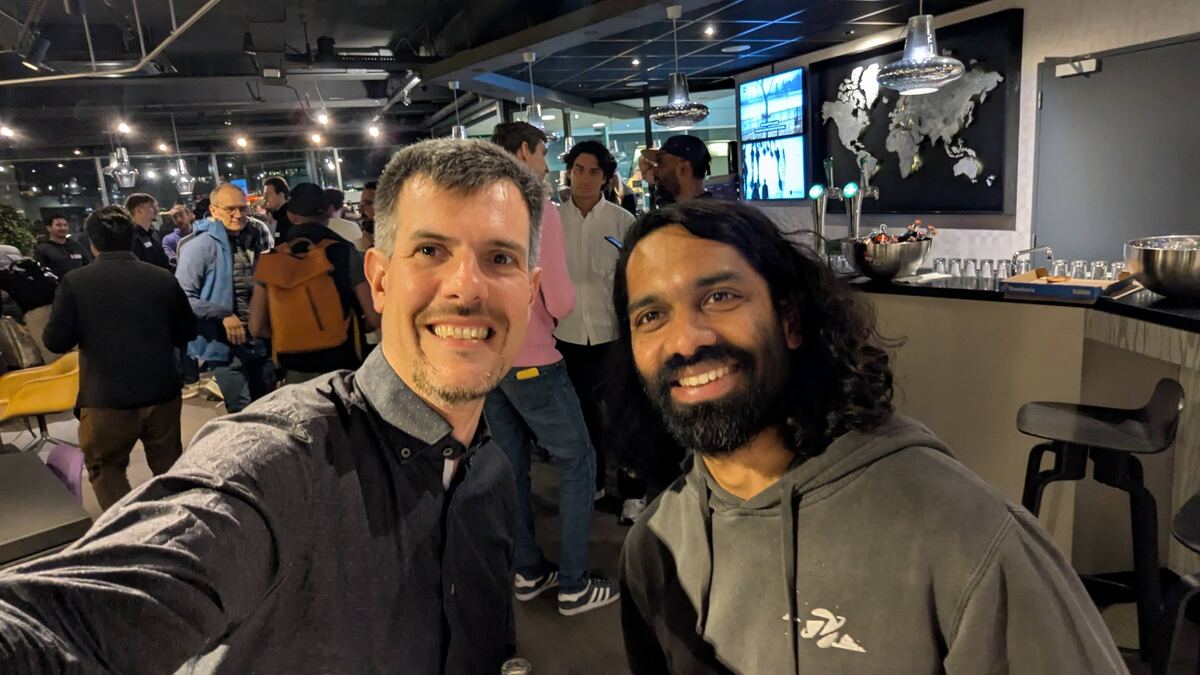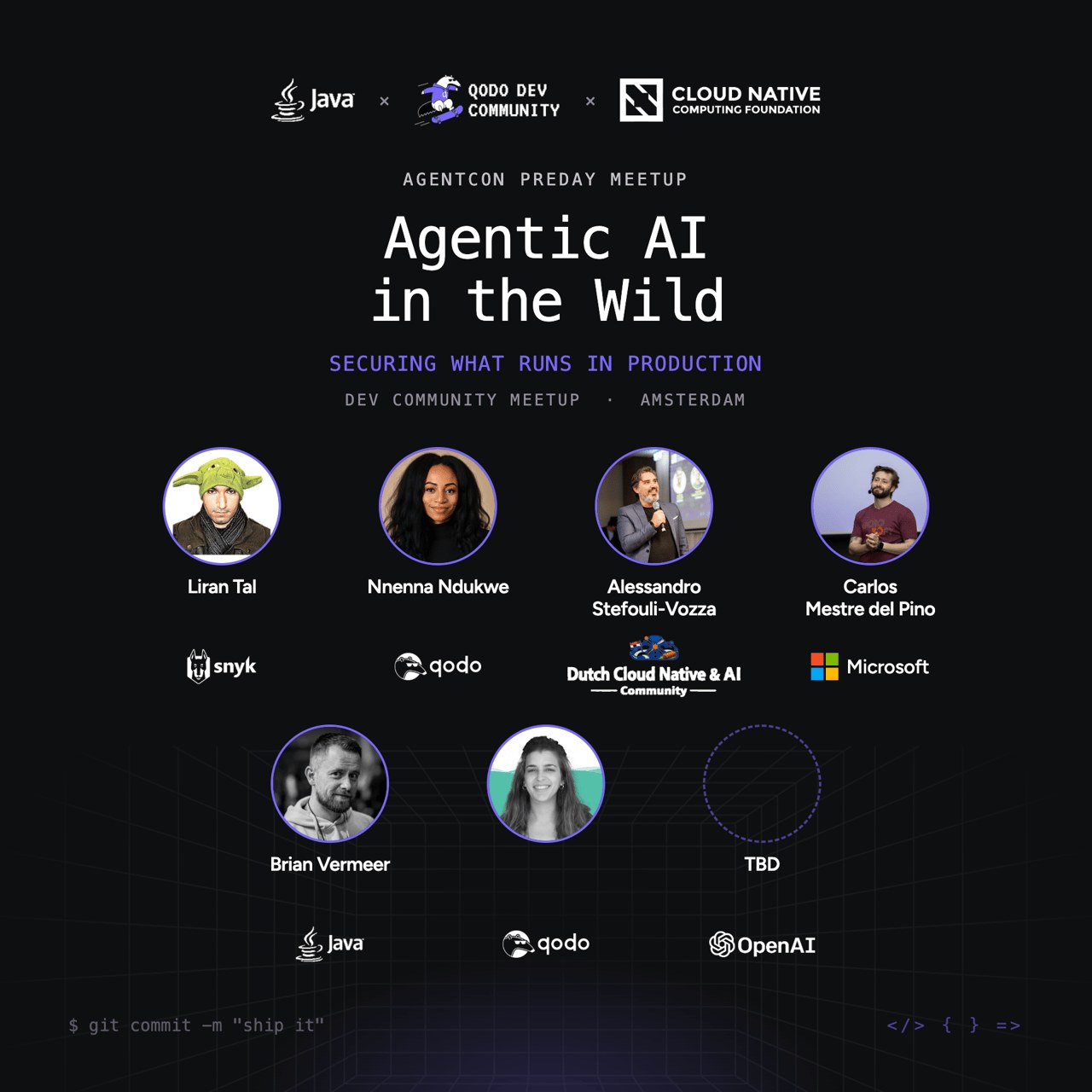
Great evening at the LangChain NL KubeCon meetup in Amsterdam on Building Autonomous Systems. What made this session valuable was the focus on the part that actually matters: what happens after the demo.
Beyond the Demo: Production Agentic AI
Agentic AI is easy to discuss in theory, but much harder to make reliable in production. The conversation around runtime architecture, observability, safety, failure modes, and durable memory was exactly the right one.
The meetup brought together AI engineers and platform builders for a discussion grounded in real implementation questions — not just hype. This is the kind of event where you leave with concrete architectural patterns, not just buzzwords.
Sessions
Strong presentations from four teams tackling different facets of autonomous systems:
LangChain — Agent Runtime Architecture
The LangChain team presented their latest thinking on how to structure agent runtimes for reliability. Key themes:
- Stateful execution — agents need durable checkpoints, not just stateless request/response
- Branching and recovery — when an agent fails mid-task, how do you resume without starting over?
- Observability-first design — every agent decision should be traceable in production monitoring
- Human-in-the-loop interrupts — the ability to pause, inspect, and redirect agent behavior at any point
Qodo — Sandboxed Deep Agents
Qodo showcased their approach to sandboxed agent execution — running AI agents in isolated environments where they can experiment freely without risk:
- Isolated execution environments for code generation and testing
- Safety boundaries that prevent agents from affecting production systems
- Deep analysis agents that explore multiple solution paths in parallel
- Confidence scoring — agents report uncertainty, humans decide when to trust
SurrealDB — Knowledge-Graph Memory
SurrealDB presented a fascinating approach to agent memory using knowledge graphs:
- Graph-based memory instead of flat vector stores — relationships between facts are first-class
- Temporal awareness — agents know when they learned something and whether it might be stale
- Multi-agent shared memory — multiple agents can contribute to and query the same knowledge graph
- Durable memory across sessions — agents remember context from days or weeks ago
This addresses one of the biggest gaps in current agent architectures: most agents have amnesia between sessions, or rely on naive RAG that loses relational context.
AWS — Hidden Failure Modes
AWS covered the failure modes that do not show up in demos but kill production agent deployments:
- Cascading failures — one bad agent decision triggers a chain of downstream errors
- Silent degradation — agents producing plausible but wrong outputs with high confidence
- Resource exhaustion — unbounded agent loops consuming compute and API credits
- Observability gaps — knowing that something failed vs knowing why
My Biggest Takeaway
The real challenge in autonomous systems is not just model quality. It is designing the surrounding system — retrieval, guardrails, execution environments, memory, and platform controls — so agents can operate predictably in real-world environments.
This maps directly to what I see in platform engineering for AI: the model is maybe 20% of the problem. The other 80% is:
- Runtime isolation — agents need sandboxes, not shared environments
- Guardrails — OWASP-style security controls at the agent level
- Execution environments — Kubernetes pods, serverless functions, or containers per agent task
- Memory architecture — beyond vector stores to structured knowledge
- Platform controls — quotas, rate limits, cost boundaries, kill switches
That is where the next wave of differentiation will be built. Not in model capabilities (those are commoditizing fast), but in the platform layer that makes agents production-safe.
Why This Matters for Infrastructure Teams
If you are a platform engineer or SRE, agentic AI is coming to your infrastructure whether you plan for it or not. The teams that build the right abstractions now — sandboxed execution, observable agent runtimes, resource-bounded loops, and durable memory — will be the ones that ship reliable autonomous systems.
The teams that skip this and go straight from demo to production will learn expensive lessons about context architecture and failure modes.