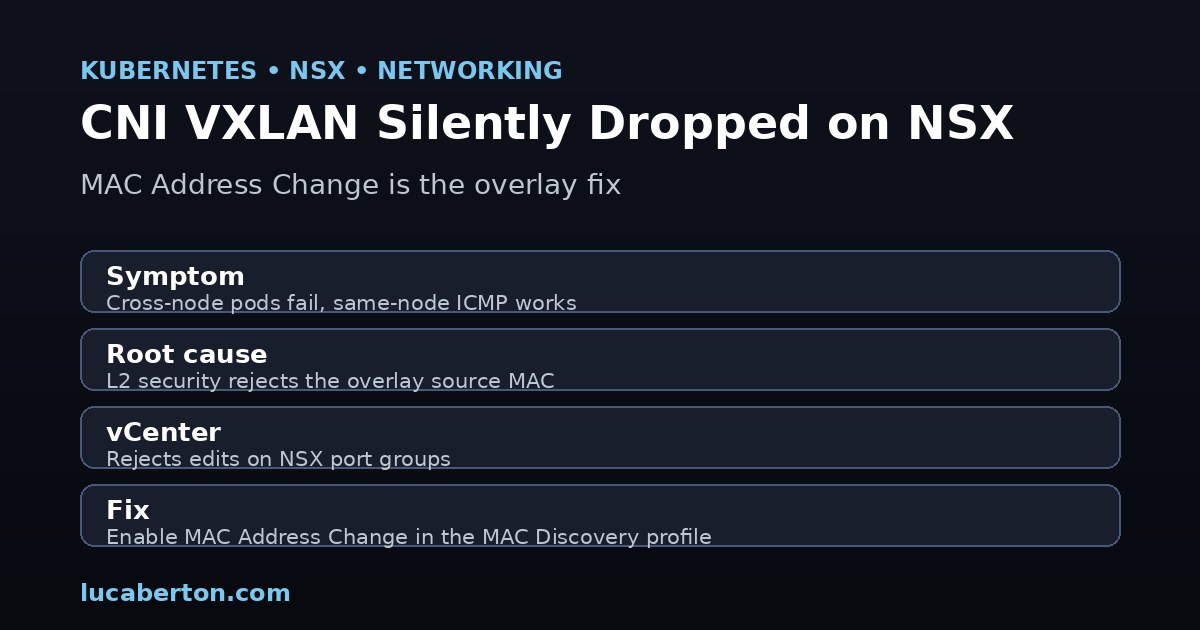
If your Kubernetes nodes run as VMs on an NSX-backed segment and cross-node pod-to-pod traffic suddenly stops while same-node traffic and plain ICMP still work, you are almost certainly looking at a Layer 2 security policy silently dropping the overlay-encapsulated frames. This is documented VMware behavior, not a CNI bug, and the fix is a two-checkbox change in NSX Manager.
Here is the exact symptom, why it happens, and the step-by-step fix.
The Symptom: Cross-Node Pods Can’t Talk
The signature is very specific:
- A pod on node A cannot reach a pod on node B, even though both are on the same Kubernetes Service and the network policy allows it.
- Traffic between two pods on the same node works fine.
- Plain ICMP between the nodes (the VM NICs) works fine.
- Running
tcpdumpon both ends tells the whole story: the VXLAN packet leaves node A, arrives at node B’s physical NIC, but never reaches the target container on node B.
That last point is the giveaway. The packet is not being routed wrongly and it is not being firewalled at L3/L4 — it is being accepted by the hypervisor’s physical NIC and then discarded before delivery because the frame’s source MAC does not match what the port-group security policy allows.
Why the Overlay Needs a Different Source MAC
Most Kubernetes CNIs build a tunnel between nodes. Calico, Flannel, and Cilium all support a VXLAN (or Geneve) overlay that encapsulates pod traffic in UDP. The default CNI port for VXLAN is UDP 8472.
When node A sends a VXLAN frame to node B, the outer Ethernet frame carries:
- a destination MAC of node B’s VTEP (the node’s own vNIC MAC), but
- a source MAC that is the VTEP interface’s MAC on node A — and that VTEP MAC is not the MAC that vCenter/NSX has recorded as “belonging” to the VM’s vNIC.
In other words, the VM sends traffic whose source MAC differs from its own vNIC. That is exactly what the port-group security policy is designed to block, which is why the frames are dropped at the destination.
Confirming the L2 Security Signature
Capture the overlay traffic on the destination node’s physical interface while you generate cross-node pod traffic:
# On the destination node, watch VXLAN (UDP/8472) arrive
sudo tcpdump -n -i eth0 udp port 8472
In the broken state you will see the encapsulated frames hit the NIC but the inner packet never gets delivered to the pod. Compare with same-node traffic, which is fine, and a raw ping between node VMs, which is also fine. That contrast — overlay fails, everything else passes — is the fingerprint of a rejected forged/MAC-changed transmit, not a routing or CNI configuration problem.
vSphere’s Default Port-Group Security Policy
Every vSphere port group has a security policy with three elements:
- Promiscuous mode
- MAC address changes
- Forged transmits
By default all three are set to Reject. You can read the effective values through the vCenter API on the port group’s config.defaultPortConfig.securityPolicy:
allowPromiscuous: false
macChanges:      false
forgedTransmits: false
For a Kubernetes overlay you need macChanges and forgedTransmits set to Accept. Promiscuous mode can stay false — it is not required. Broadcom KB 427110 (“Forged transmits and MAC address changes on a port group”) documents this: both settings default to Reject, and a port-group-level override is sufficient — you do not have to change the whole distributed switch.
Why You Can’t Fix It From vCenter on an NSX Segment
Here is the catch. If the segment is NSX-managed, vCenter will refuse to apply the change. The vCenter API rejects it explicitly:
Updating or removing an NSX port group from vCenter is not allowed.
This is expected, and Broadcom KB 394260 (“Configuring L2 port security settings on an NSX backed portgroup”) explains why: NSX-T applies L2 security through segment profiles, not the classic vCenter port-group policy. So the change has to be made in NSX Manager, not vCenter.
The Fix: NSX MAC Discovery Segment Profile
In NSX Manager, the relevant control is the MAC Discovery Segment Profile, which exposes the equivalent of both vCenter settings under a single switch:
- Go to Networking → Segments.
- Find the segment your Kubernetes nodes are attached to (for example an NSX-backed segment such as
172.19.6.0/24). - Open Edit → Segment Profiles → MAC Discovery.
- Attach (or create) a profile with MAC Address Change enabled.
- Also enable MAC Learning if it is not already on — several CNI setups rely on it, and it has no downside for this workload.
The NSX field MAC Address Change is the equivalent of vCenter’s Forged Transmits / MAC Address Changes. Turning it on lets the VM emit VXLAN frames whose source MAC differs from its vNIC MAC, and the destination node finally delivers the encapsulated pod traffic.
Don’t Trust the Default Profile
One subtlety: the NSX default MAC Discovery profile actually ships with MAC Address Change enabled. So if your segment is silently dropping overlay traffic, a custom profile with it disabled is almost certainly bound to the segment. Before changing anything, check which MAC Discovery profile is attached to the segment — if it is a custom one, that is the object you need to edit.
Verify the Fix
After attaching the corrected profile, prove the overlay works end to end:
# Confirm the target pod lives on a different node
kubectl get pods -o wide

# On the destination node, watch VXLAN (UDP/8472) arrive
sudo tcpdump -n -i eth0 udp port 8472

# From a temporary pod, hit a pod that is scheduled on another node
kubectl run curl-test --image=curlimages/curl --rm -it --restart=Never -- \
  sh -c 'curl -s -o /dev/null -w "%{http_code}\n" http://<pod-ip-on-another-node>:<port>'
The tcpdump session should now show the VXLAN frame arriving and the inner packet reaching the container, and the curl from the temporary pod should return 200 (or whatever the service returns). Same-node traffic and raw ICMP were already fine, so once cross-node pod traffic succeeds the case is closed.
Why This Applies to Every CNI Overlay
This is not Calico-specific, Flannel-specific, or Cilium-specific. Any CNI that uses a VXLAN or Geneve overlay — Calico (VXLAN mode), Flannel (default VXLAN backend), Cilium (VXLAN/Geneve encapsulation) — encapsulates pod traffic with a source MAC that is not the VM’s vNIC MAC. The moment those VMs sit on an NSX segment whose MAC Discovery profile rejects MAC address changes, cross-node pod networking breaks in exactly this silent way. The remediation is the same everywhere: enable MAC Address Change on the segment’s MAC Discovery profile.
Related Resources
- Broadcom KB 427110 — Forged transmits and MAC address changes on a port group
- Broadcom KB 394260 — Configuring L2 port security settings on an NSX backed portgroup
- VMware NSX documentation — Understanding MAC Discovery Segment Profile