Kubernetes is now mainstream enterprise infrastructure. The CNCF’s 2025 Annual Cloud Native Survey reported that 82% of container users run Kubernetes in production, and 66% of organizations hosting generative AI models use Kubernetes for at least some inference workloads.
In Germany, the conversation is not only about scale. It is also about data protection, operational resilience, provider jurisdiction, BSI guidance, auditability, portability, and technological autonomy.
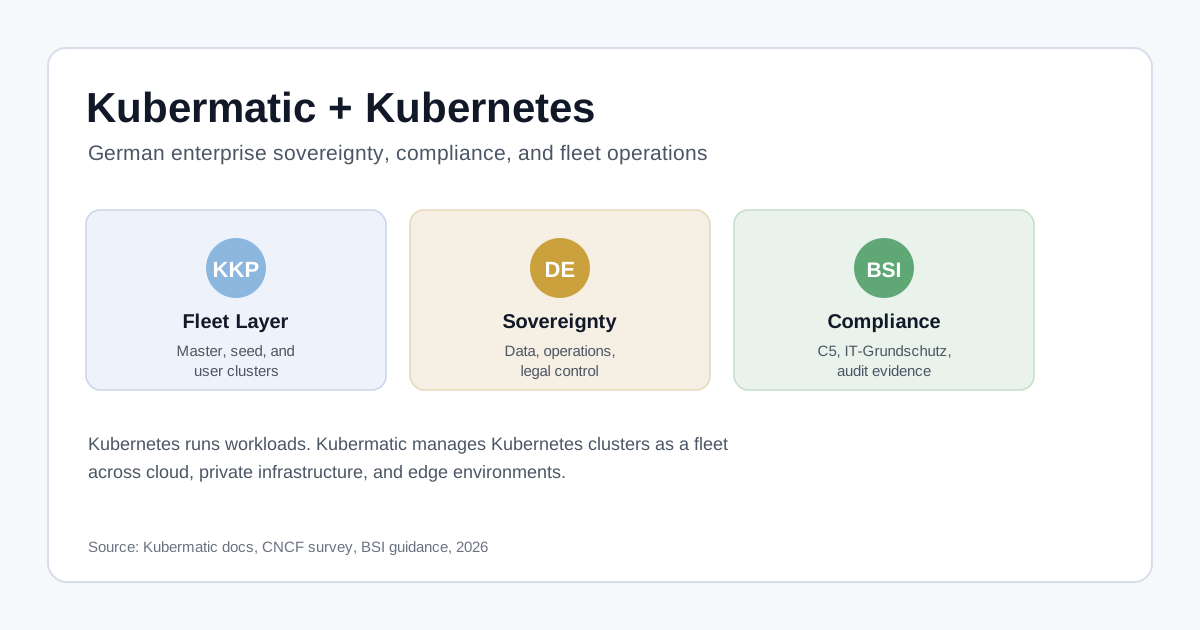
That is where Kubermatic Kubernetes Platform, usually shortened to KKP, becomes interesting. Kubermatic is not a German fork of Kubernetes. It is a German-built platform for managing Kubernetes clusters as a fleet.
The distinction matters:
Kubernetes manages workloads inside a cluster. Kubermatic manages Kubernetes clusters across infrastructure.
Why Germany Changes the Kubernetes Conversation
The Kubernetes API is the same in Berlin, Frankfurt, Amsterdam, Singapore, and Virginia. What changes in the German market is the operating model around it.
German organizations often need to answer questions such as:
- Where do control planes, worker nodes, backups, metrics, logs, and audit events live?
- Which legal entity provides the cloud or managed service?
- From which countries can support engineers access the environment?
- Are BSI C5 reports, ISO 27001 certifications, and audit evidence available?
- Can workloads be moved away from the provider without a multi-year migration?
- Does the platform support GDPR, NIS2, DORA, or sector-specific obligations?
- Can the organization still operate during a provider, region, or management-platform failure?
Kubernetes can help because it offers an open workload model and can run on public cloud, private cloud, bare metal, German providers, and edge infrastructure. But Kubernetes does not make a platform sovereign or compliant by itself.
Running worker nodes in Frankfurt does not solve sovereignty if logs, backups, identity, billing metadata, support exports, or encryption-key operations are controlled elsewhere.
Where Kubermatic Fits
KKP is designed for organizations that need to operate many Kubernetes clusters across different locations and providers.
It provides a central layer for:
- Cluster provisioning
- Kubernetes lifecycle management
- Worker-node management
- Multi-cloud and hybrid-cloud operations
- Project and user management
- Self-service cluster creation
- Policy enforcement
- Monitoring, logging, and alerting integration
- Backup and restore workflows
Applications running on a KKP-managed cluster still use normal Kubernetes resources: Deployments, Services, ConfigMaps, Secrets, Ingress or Gateway resources, Helm charts, operators, and GitOps controllers. The application API remains Kubernetes.
The abstraction is mainly at the cluster lifecycle and fleet governance layer.
That is a useful boundary. Platform teams can standardize cluster creation, identity, versions, policies, and provider integrations without forcing developers into a proprietary application runtime.
The KKP Architecture: Master, Seed, and User Clusters
Kubermatic separates the platform into three main concepts.
The master cluster stores central platform information such as users, projects, credentials, and Kubermatic control components.
A seed cluster hosts control-plane components for user clusters. This can include the Kubernetes API server, scheduler, controller manager, and etcd.
A user cluster is the Kubernetes cluster presented to the team or customer. Its worker nodes run application workloads, while parts of its control plane are operated from the associated seed cluster.
This design can improve utilization when an organization manages many clusters. Instead of running a dedicated control-plane VM set for every cluster, KKP centralizes much of that control-plane operation in seed clusters.
The trade-off is that seed clusters become critical shared infrastructure. Their capacity, failure domains, network paths, DNS, certificate handling, and upgrade process require serious platform-engineering design.
KKP also has specific networking implications. Because parts of the user-cluster control plane run in the seed, connectivity between user-cluster workers and seed-hosted control-plane components must be planned deliberately. Kubermatic supports multiple expose strategies, including NodePort and LoadBalancer patterns, and uses proxy components to connect user clusters to their control-plane services.
That means a KKP proof of concept should not stop at “can it create a cluster?” It should test real network boundaries, firewall rules, DNS, certificate behavior, and failure recovery.
Infrastructure Choice Is the Main Sovereignty Lever
KKP supports a broad set of infrastructure providers, including AWS, Azure, Google Cloud, OpenStack, VMware vSphere, Nutanix, Hetzner, and Open Telekom Cloud. It can also work with infrastructure connected through kubeadm.
That matters in Germany because many organizations do not want one hosting answer for every workload.
A realistic German platform may need to support:
- Public cloud for globally scaled applications
- German or EU cloud providers for sovereignty-sensitive workloads
- Private OpenStack or VMware infrastructure
- Factory or edge clusters
- Disaster-recovery sites
- AI clusters with GPUs
- Development clusters with lower availability requirements
Kubermatic can provide a consistent management layer across those environments. It does not remove the need to evaluate each provider. Storage, networking, load balancers, managed databases, availability zones, C5 reports, support access, and cost models still differ.
The platform gives choices. The organization still has to make responsible choices.
Sovereignty Is More Than Data Residency
Digital sovereignty is often reduced to “the data is in Germany.” That is too narrow.
A better assessment separates at least five dimensions:
| Dimension | Question |
|---|---|
| Data sovereignty | Where are data, metadata, logs, traces, metrics, backups, and registry artifacts stored and processed? |
| Operational sovereignty | Who can administer the platform, and from which jurisdictions can support actions occur? |
| Legal sovereignty | Which legal entities, subcontractors, and jurisdictions govern the service? |
| Technological sovereignty | Can the organization inspect, replace, operate, or migrate critical components? |
| Exit sovereignty | Can workloads and data move within a defined time and cost boundary? |
Kubernetes helps with technological and exit sovereignty because the workload model is open and widely implemented. But a Kubernetes platform can still become locked into proprietary databases, identity services, storage classes, load balancers, observability products, or cloud-specific controllers.
Kubermatic helps when it is used to preserve infrastructure optionality. It does not guarantee sovereignty if deployed on top of dependencies the organization has not evaluated.
Compliance: Kubernetes Is Not the Control Framework
Kubernetes is not a compliance product. It can implement controls, but auditors assess the full technical and organizational system.
For German enterprises, a Kubernetes platform strategy should be mapped against:
- GDPR data protection requirements
- BSI IT-Grundschutz, including the APP.4.4 Kubernetes module
- BSI C5 expectations for cloud providers
- NIS2 implementation and incident-readiness obligations
- DORA for financial-sector resilience
- EU Data Act portability and switching expectations
- Internal security and risk-management policies
The practical Kubernetes questions are specific:
- Is
etcdencrypted? - Who can read Kubernetes Secrets?
- Are audit logs retained and exportable?
- Are control-plane and workload logs classified correctly?
- Are backups tested, not just scheduled?
- Are privileged workloads blocked by default?
- Are container images signed or at least traceable to source?
- Can teams prove which image digest ran in production?
- Are network policies enforced by the selected CNI?
- Are emergency administrator actions logged?
- Can the platform be rebuilt from version-controlled definitions?
KKP can centralize parts of this model through cluster templates, identity integration, policy enforcement, monitoring, and backup workflows. But the control design remains the responsibility of the platform and security teams.
The German Provider Landscape
German organizations now have more Kubernetes deployment options than “run EKS in Frankfurt” or “build everything yourself.”
Common options include:
- Managed Kubernetes on global hyperscalers such as AWS, Azure, Google Cloud, and Oracle Cloud
- Sovereign or EU-focused cloud offerings
- German providers such as IONOS, STACKIT, T-Systems, plusserver, and SysEleven
- Self-managed Kubernetes on private infrastructure
- Fleet-management platforms such as Kubermatic
- Lightweight Kubernetes at edge sites
Each option has a different trade-off.
Hyperscalers provide deep service catalogues and mature automation. German and European providers may provide stronger local contracting, support, and data-centre alignment. Self-managed Kubernetes gives maximum control but shifts all lifecycle responsibility to the organization. Fleet platforms such as KKP sit above those choices and help standardize them.
The wrong decision is to choose based on nationality or feature lists alone. The right decision is to test sovereignty, operations, compliance evidence, portability, resilience, and cost under realistic conditions.
A Reference Operating Model
A mature German Kubernetes architecture should define cluster classes instead of creating clusters one by one.
Examples:
- Standard internal applications
- Internet-facing applications
- Regulated workloads
- AI and GPU workloads
- Development and testing
- Edge environments
- High-availability production
Each class should have documented defaults for:
- Networking
- Ingress or Gateway API
- Storage
- Backup and restore
- Audit logging
- Retention
- Identity and RBAC
- Pod Security enforcement
- Image provenance
- Observability
- Cost allocation
- Upgrade cadence
Kubermatic can help turn those patterns into self-service cluster templates and policy-backed workflows. That is where platform engineering becomes valuable: not in giving every team unlimited cluster access, but in creating a paved road that covers most application needs.
When Kubermatic Is a Strong Fit
Kubermatic is most compelling when an organization:
- Operates many Kubernetes clusters
- Uses more than one infrastructure provider
- Needs on-premises, edge, or private-cloud support
- Wants self-service Kubernetes for internal teams
- Needs centralized lifecycle, identity, and policy management
- Wants to preserve access to upstream Kubernetes APIs
- Has a platform team capable of operating master and seed infrastructure
It is less compelling when the organization only needs one or two clusters, has fully standardized on one managed Kubernetes service, or does not have the operational capacity to run another critical platform layer.
KKP reduces one class of complexity, but it introduces another: the management plane becomes critical infrastructure.
What to Test in a Proof of Concept
A useful Kubermatic proof of concept should test more than basic cluster creation.
At minimum, validate:
- Master and seed failure recovery
- User-cluster control-plane connectivity across real network boundaries
- Kubernetes and worker-node upgrades
- Identity-provider integration and role mapping
- Provider-specific provisioning and deletion behavior
- Cluster template governance
- Policy enforcement and exception handling
- Backup restoration into a separate environment
- Monitoring volume at projected fleet size
- API-driven or GitOps-based provisioning
- Migration or export procedures
- Cost allocation by project, namespace, or cluster
The goal is not to prove that Kubermatic can create a Kubernetes cluster. The goal is to prove that your organization can operate it safely for years.
My Take
Kubermatic is interesting because it addresses a real German enterprise problem: Kubernetes is already the standard, but operating it across cloud, private infrastructure, regulated environments, and edge locations is hard.
Its strongest value is not that it is German. The stronger value is that it can provide a self-hostable, infrastructure-independent control layer around upstream Kubernetes.
For sovereignty-sensitive organizations, that matters. It means the platform team can choose where management components run, which providers are exposed, how clusters are standardized, and how governance is applied.
But Kubermatic should not be treated as a magic sovereignty button. The same hard questions remain: where data lives, who can access it, how backups are restored, whether provider dependencies are understood, and whether the platform team can operate the management layer during failure.
The best German Kubernetes strategy is not “one sovereign cloud for everything” or “one hyperscaler for everything.” It is a clear operating model: classify workloads, define cluster classes, automate the paved road, test recovery, document dependencies, and keep credible exit options.
Kubermatic can be a strong part of that strategy when the organization has enough Kubernetes scale to justify fleet management and enough platform maturity to operate it well.
Related Articles
- Digital Sovereignty and EU Cloud Strategy
- Data Residency in Multi-Cloud Kubernetes
- Kubernetes in the Right Place: CTO Guide
- Platform Engineering Business Case
- Kubernetes Multi-Cluster Management
Sources
- Kubermatic Kubernetes Platform documentation: Seed clusters
- Kubermatic Kubernetes Platform documentation: Enterprise Edition terminology
- Kubermatic Kubernetes Platform documentation: Networking
- CNCF Annual Cloud Native Survey 2025
- BSI IT-Grundschutz APP.4.4 Kubernetes
- BSI Cloud Computing Compliance Criteria Catalogue (C5)
- AWS European Sovereign Cloud announcement