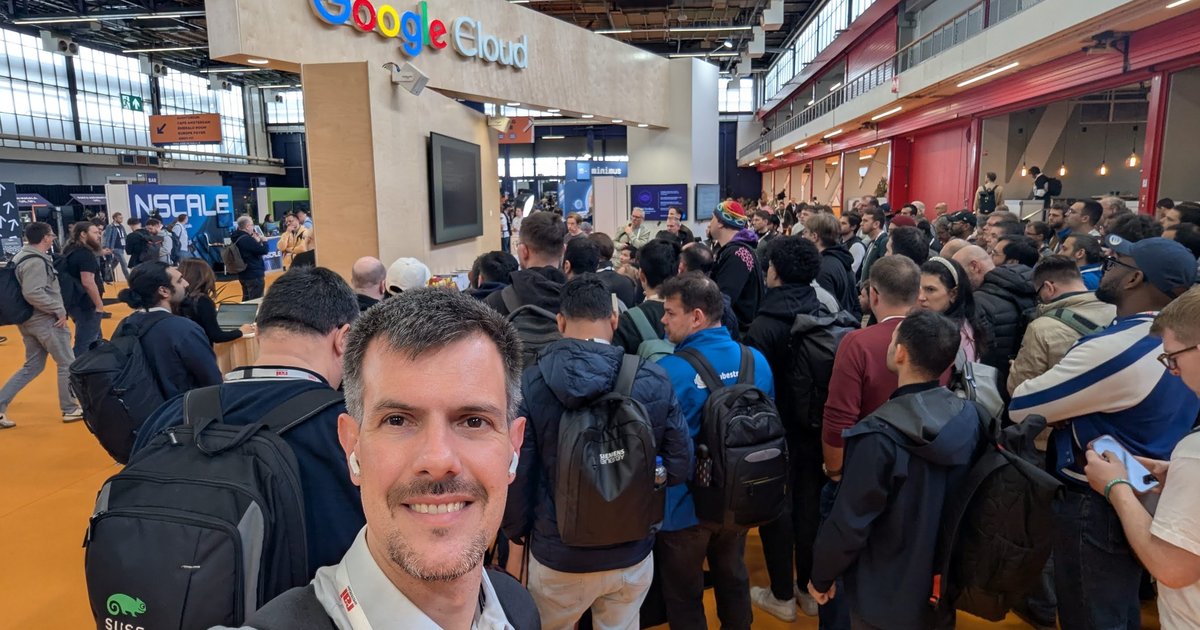
Between talks at KubeCon + CloudNativeCon Europe 2026 (RAI Amsterdam, 23 to 26 March), and on the Sunday before it, I kept recording one-minute clips for my channel. I’d stop someone in a corridor or at a booth, ask what brought them to KubeCon, and let them talk. Several of those conversations already have their own posts, including my clips with Paulo Menon of Red Hat. This one collects fifteen shorter ones that didn’t, grouped by theme. Each section summarises what the person said on camera, and product claims are the vendor’s own. For the rest of the week, see my week-in-photos recap and the co-located day talks.
Community and contributors
Atul: a first KubeCon, a day after Rejekts
The first clip of the week came on Sunday 22 March, the day before the co-located events, when I went to RAI to pick up my badge. There I met Atul, who had travelled from Hyderabad in India for his first KubeCon. He had been at Cloud Native Rejekts the day before too, and on camera he kindly thanked me for supporting it and for helping get the community and the event back on track. I co-hosted the stage there, and Rejekts is run by volunteers; I wrote about the two days in my notes as MC. Atul’s plan for the week was simple: meet people and “discuss something interesting”. The registration hall was still quiet at that hour. A sign at the desks asked people to pick up their badge before heading to the Maintainer Summit.
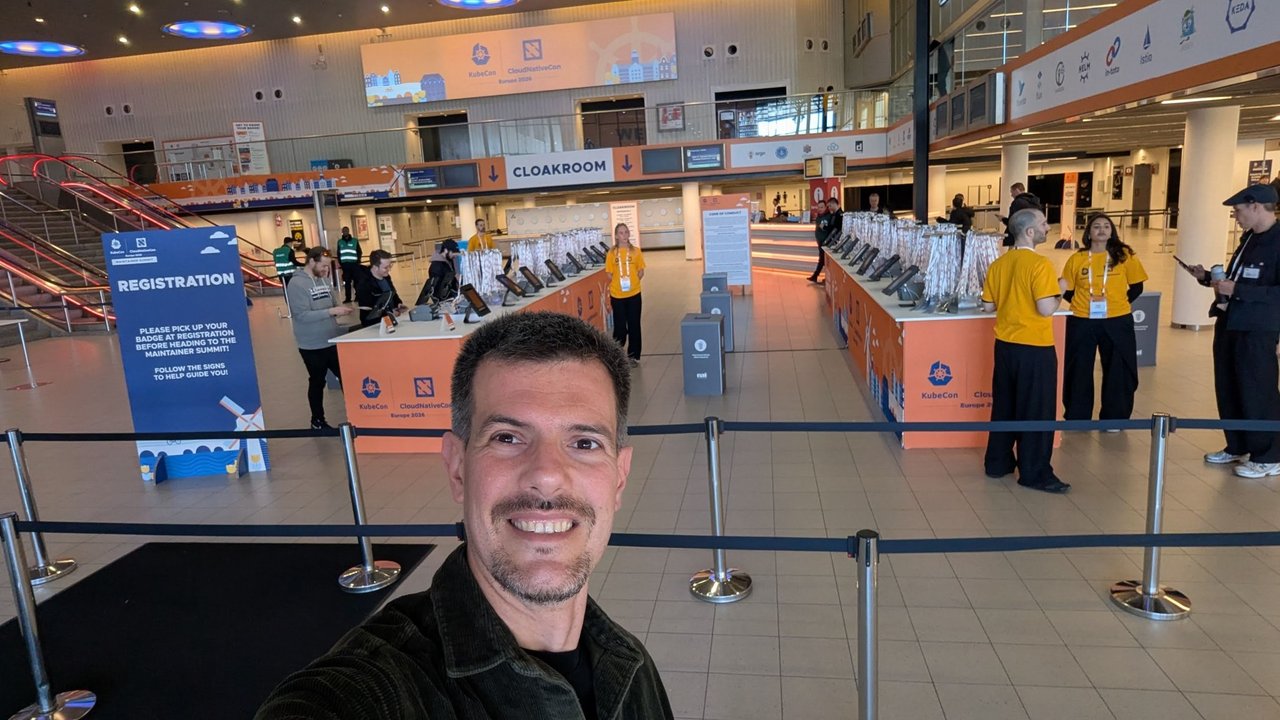 The registration hall on Sunday 22 March, a few minutes before I met Atul.
Ganesh: BackstageCon, Kyverno and FluxCon
Ganesh was the first person I caught on Monday, the co-located day. His plan was BackstageCon, plus two talks by friends of his: one on Kyverno and one on Flux, both at FluxCon as far as he knew. The timing suited Kyverno. I mentioned on camera that it had just graduated in the CNCF, and the foundation announced the graduation officially the next day, Tuesday 24 March. A little after our chat I passed the sign for KyvernoCon (room E108, 13:25 to 17:45), so policy as code had a room of its own on Monday. I wrote more about what graduation means for Kyverno.
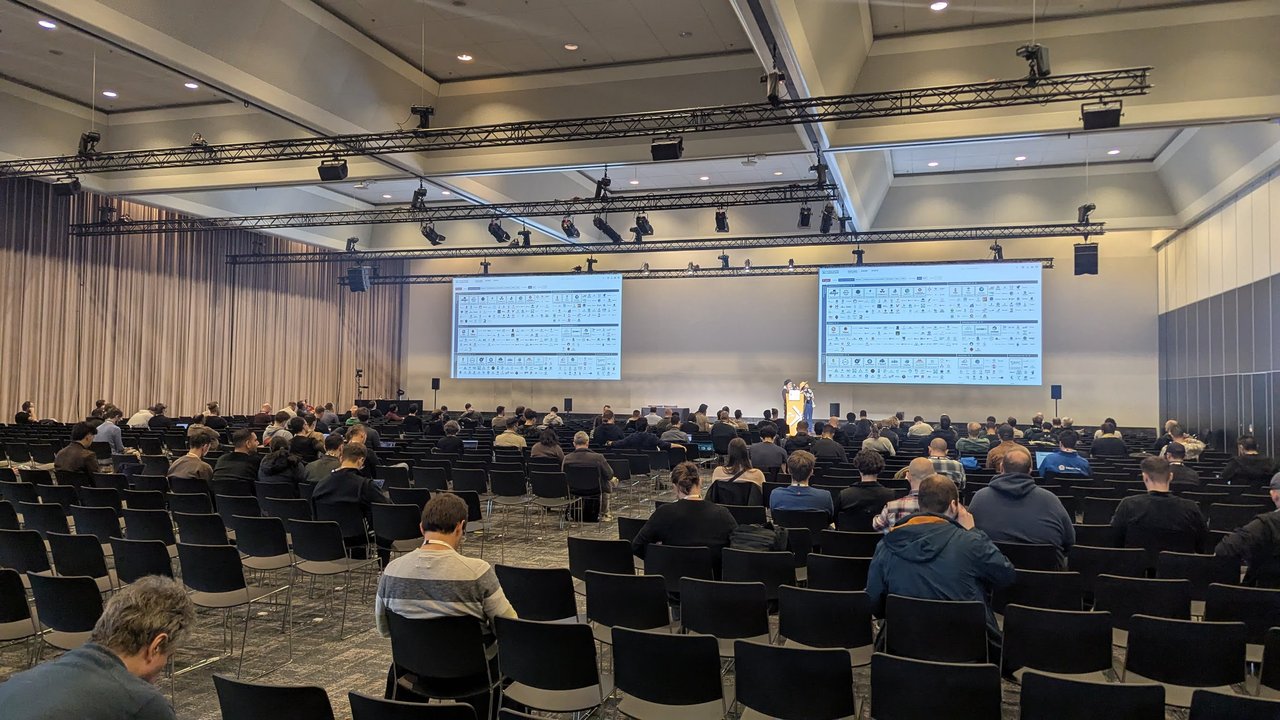 One of the co-located event rooms on Monday, a few minutes after I spoke with Ganesh.
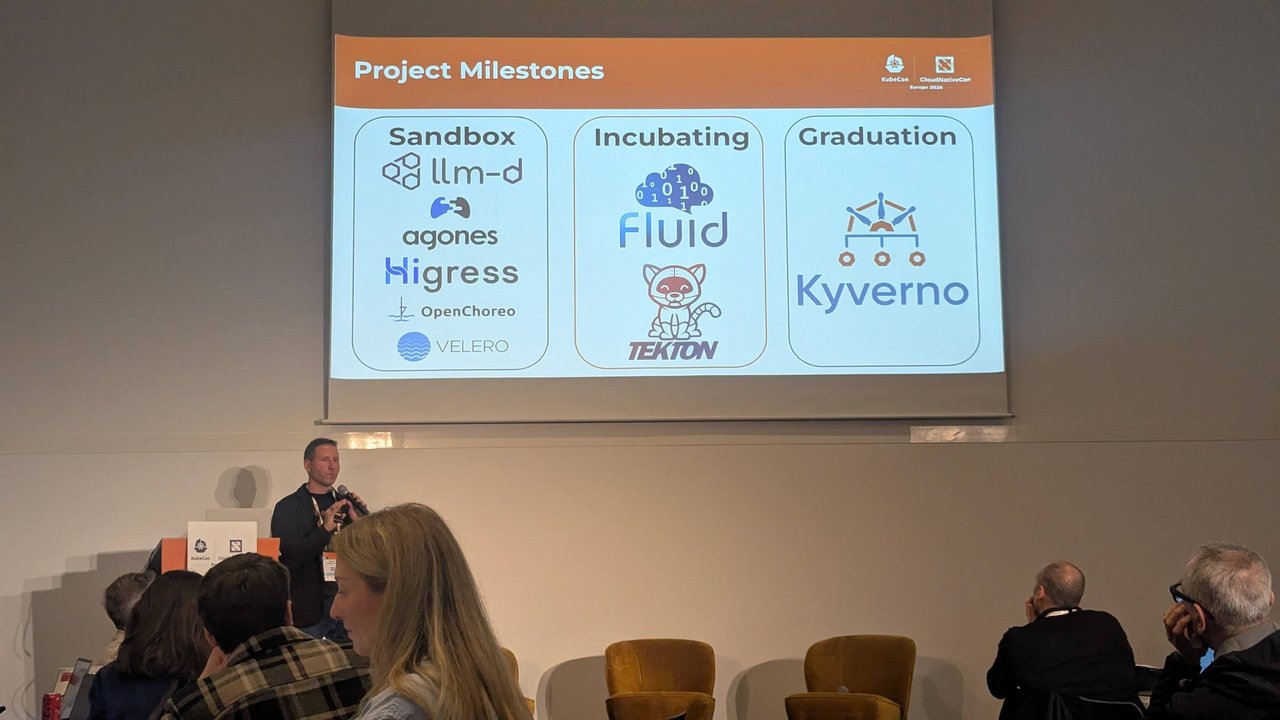 On Tuesday, a CNCF stage slide put Kyverno alone in the Graduation column.
Noah: the non-code contributors guide
Noah told me he wouldn’t miss KubeCon for the world. In his words, it is “a big part of my heart and a big part of my being”. Almost all of his contribution work has been in Kubernetes itself. He has also done some side work across CNCF projects on what he called overarching things, such as the non-code contributors guide. That kind of guide matters if you think contributing to open source only means sending pull requests. For an idea of what such a guide covers, the Kubernetes contributor site has a Non-code Contributions page. It lists community education, meetups and events, documentation, release notes and GitHub management as ways in. It’s a good page to send to anyone who thinks they aren’t technical enough to help.
Fabrizio Sgura: certifications as a way into the community
I introduced Fabrizio Sgura as one of the most certified people I met at KubeCon 2026. He doesn’t see the certificates as the point. To him they show that you can join the community and become a specialist, but the interesting part is the relationships. Through people you can be more than an expert: you can become a mentor, or find mentors for your own projects. He recommended coming to conferences to everyone. On the future he said “Not with AI immediately, but with AI for sure.” He argued that we need to use our own brain first and the artificial one second. He uses AI himself, but he thinks we aren’t ready yet.
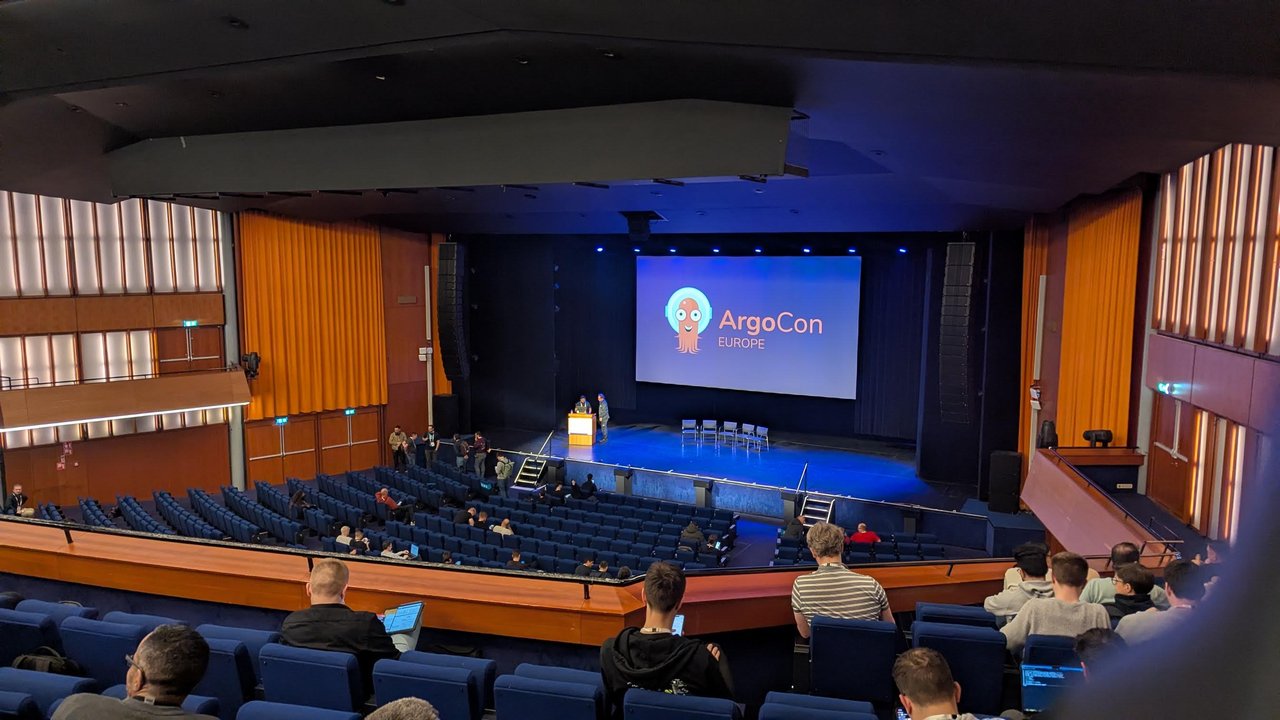 ArgoCon Europe filling up on Monday afternoon, a few minutes after my chat with Fabrizio.
Colleen: Merge Forward and the people
Colleen, who travels to conferences and makes videos at them, told me her goal for the week was simply to meet more people. She pointed to the push for inclusion through the CNCF Merge Forward community and groups such as Friends of Dorothy, Deep Roots and the Neurodiversity community. Merge Forward is the CNCF community group that brings these together, along with groups like Women in Cloud Native and Deaf & Hard of Hearing. Her argument was that keynotes, trends and new reports reach you anyway. They matter less than the people and why they come. She admitted it might sound like a cliché, but “meeting people is the reason why I always come here”. She also mentioned the Merge Forward channel on the CNCF Slack.
Christopher: party links and AI
On Monday afternoon I bumped into Christopher next to the sign listing the day’s co-located events: two Observability Day tracks, a sovereign cloud day, KyvernoCon, WasmCon, CiliumCon, FluxCon and the Project Lightning Talks. He told me he had come looking for me because of the KubeCon party links I had posted. He had reposted them because, in his words, everybody kept asking him “Chris, where’s the good parties at KubeCon?”, and “sharing is caring”. Beyond the parties, he said he was keen to hear more about what I was doing with AI. That was the topic of the week, and we agreed to pick it up over the following days. If you’re planning a KubeCon week of your own, my side events guide collects the evening events around this edition.
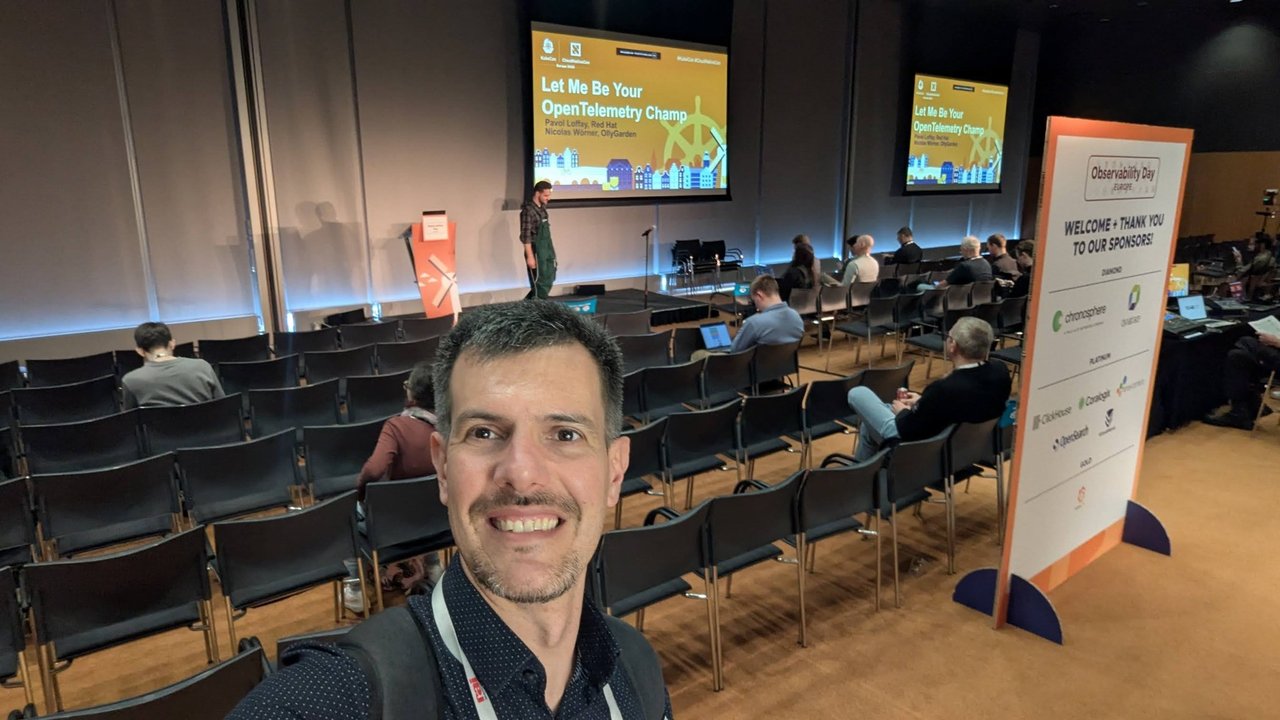 Observability Day Europe on Monday afternoon, a few minutes after I met Christopher.
Faseela K: a co-chair’s day-one recap
On Tuesday afternoon I spoke with Faseela K, Cloud Native Developer at Ericsson Software Technology and one of the event’s three co-chairs, with Abby Bangser and Lin Sun. Her summary of day one: amazing objects on the keynote stage as well as live demos, with AI and agentic architectures almost everywhere. The CNCF’s transparency report later described a full-size electric glider and live drone demos on that stage. She was just as excited about the community side: the Merge Forward gathering, the Women in Community gathering, and the CNCF Ambassadors breakfast that morning. Her verdict: “the energy and the momentum is really high”. The report puts attendance at nearly 13,500, with 44% attending for the first time.
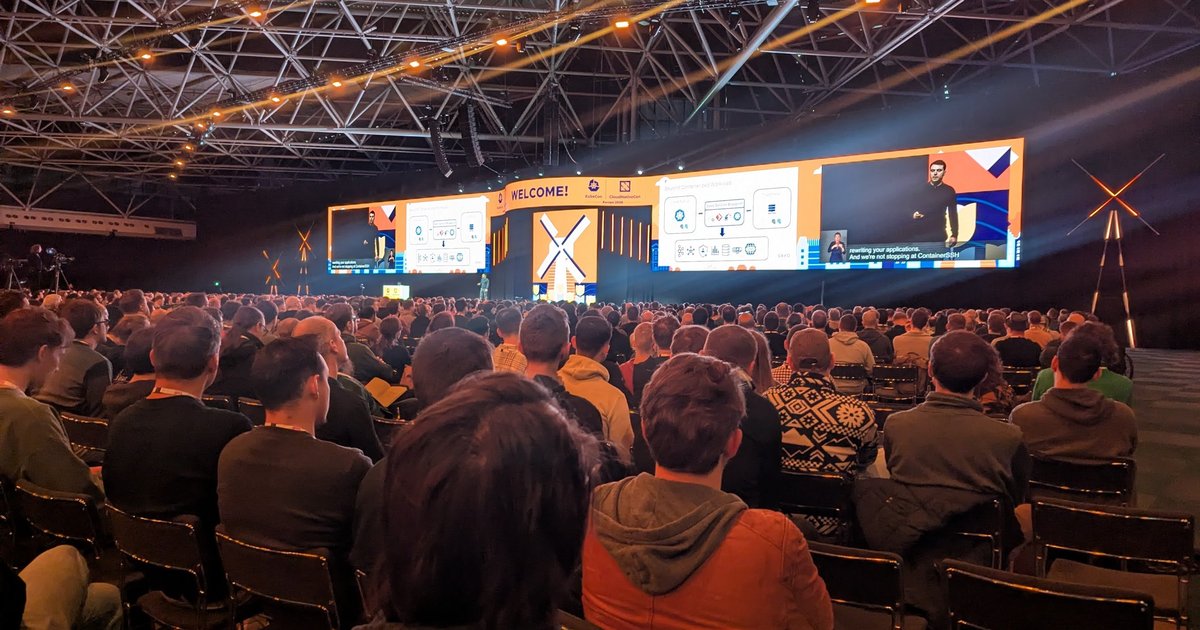
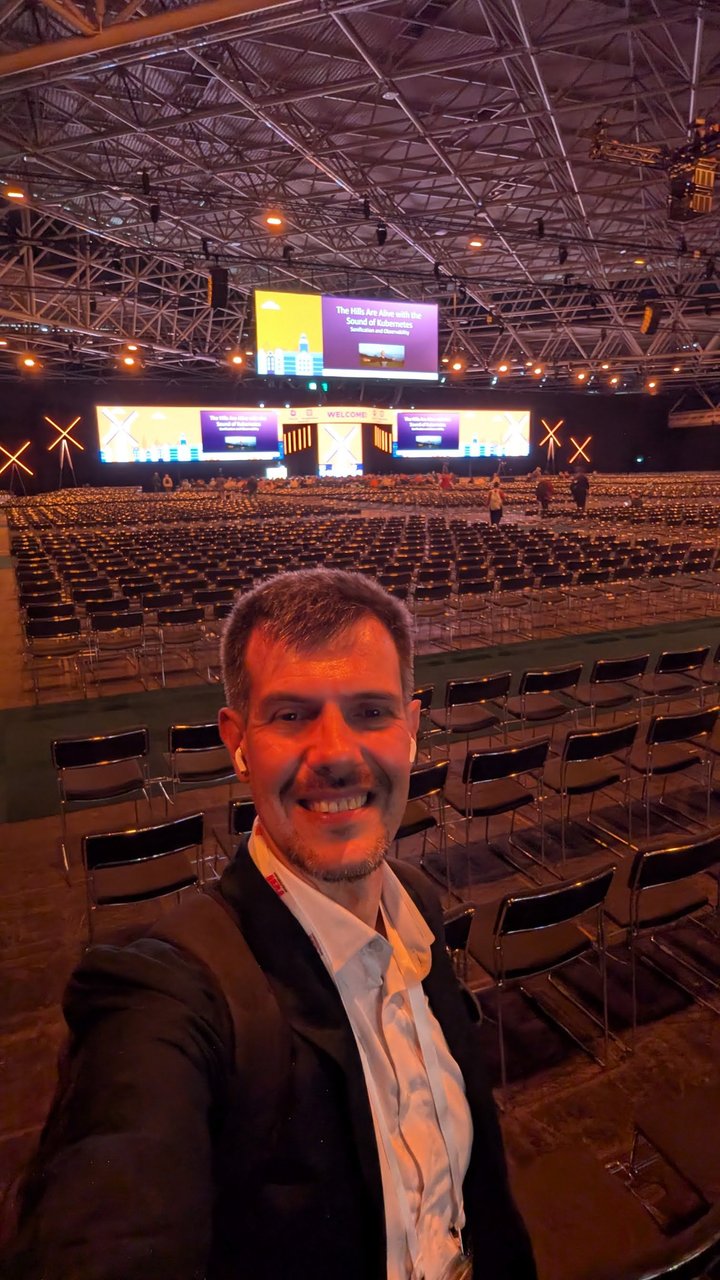 A main session hall on Tuesday afternoon, about fifteen minutes after I spoke with Faseela.
AI, observability and the bigger picture
Ghassan (Shiftbase): from cloud native to AI native
Ghassan, from the Dutch workforce-scheduling software company Shiftbase, was happy with the programme: “all the topics are tip top”. What he expected to take away was AI. In his view the focus this year was artificial intelligence and how it can make your life easier, maybe even “changing the mindset of cloud native to AI native”. A CNCF stage slide the next day gave some numbers behind that shift. It put cloud native developers at 19.9 million, up 28% in six months, and AI cloud native developers at 7.3 million, up 3%. On those figures, AI builders are still a minority of the cloud native crowd, which is a useful reality check on how far the shift Ghassan described has gone.
CJ, a technology journalist: European open source and sovereignty
On Tuesday morning I met CJ, a journalist covering the event. He wanted to learn how large open source is becoming in Europe, how that connects to sovereignty and federated data, and how to grow and innovate beyond the big hyperscalers. On AI he was blunt. Progress is at a breakneck pace, but there’s still “so much superfluous hyperbole”. He meant people making claims they can’t back up about a future nobody knows yet. His answer was to take it one day, one month, one year at a time. Sovereignty came up in many of my conversations that week, including with Pepijn Oomen on sovereign cloud.
Kasper (Dash0): OpenTelemetry in production
On the Sunday evening before the conference, I recorded a quick clip with Kasper from Dash0, which builds an observability platform around OpenTelemetry. His message was that OTel is growing. According to Kasper, the latest CNCF survey found that 49% of respondents already run OpenTelemetry in production and another 26% are evaluating it, so “the demand for OTEL is out there”. He invited people to the Dash0 booth on the expo floor, number 760. The other Dash0 conversation I had that week, with Sven on open standards and lock-in, goes deeper into the product.
My take: once half of the respondents run it in production, OTel adoption is no longer a strategic bet but a skills question. In the teams I work with, the time goes into collector pipelines, semantic conventions and sampling decisions, not into installing the SDK.
Claire (Chronosphere): AI-guided troubleshooting
On Monday I talked to Claire from Chronosphere, now a Palo Alto Networks company. According to Claire, Chronosphere was showing AI-guided troubleshooting built on its temporal knowledge graph. That sits on a unified observability platform for metrics, events, logs and traces, and she said the company’s control plane helps customers optimise their data by 84%. Her argument was that building and innovating with AI creates a ton of telemetry, and you don’t need all of it. Chronosphere’s pitch is to help you understand what that data is worth, so “You pay for the data that you’re persisting, not just ingesting.” The team was demoing at booth 331 once the expo opened on Tuesday.
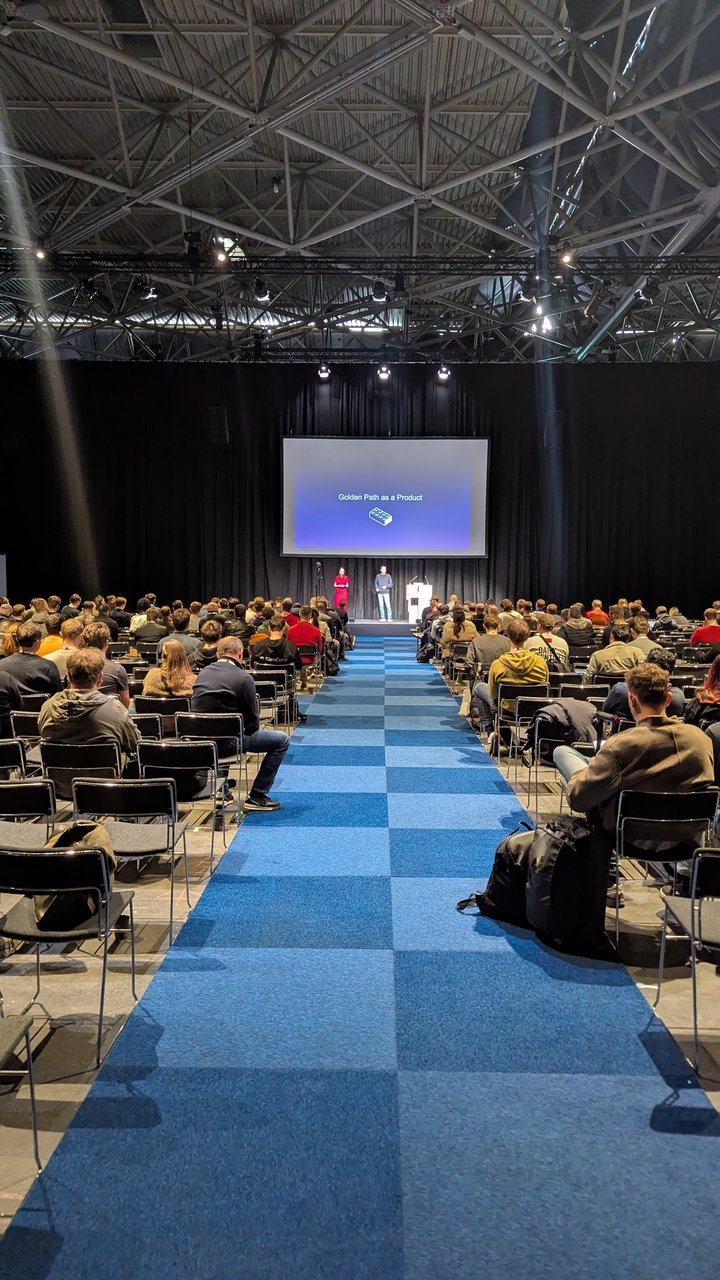 Platform Engineering Day on Monday, shortly after my conversation with Claire.
Erez (Sawmills): cutting telemetry volume in the stream
On Wednesday afternoon on the expo floor, Erez from Sawmills made a similar case from another angle. According to Erez, Sawmills analyses telemetry (logs, traces, events and metrics) in the stream. It looks for low-value and low-quality data, duplicates and redundancy, and high cardinality, then optimises it. The figures he gave were about 80% less log volume and a 40 to 60% cut in metric cardinality. More details are on sawmills.ai.
My take: Claire’s and Erez’s pitches are about ownership as much as tooling. If nobody decides which telemetry is worth keeping, a pipeline only moves the bill somewhere else. Start by checking which dashboards and alerts actually query the data. A vendor’s percentage only means something against your own baseline.
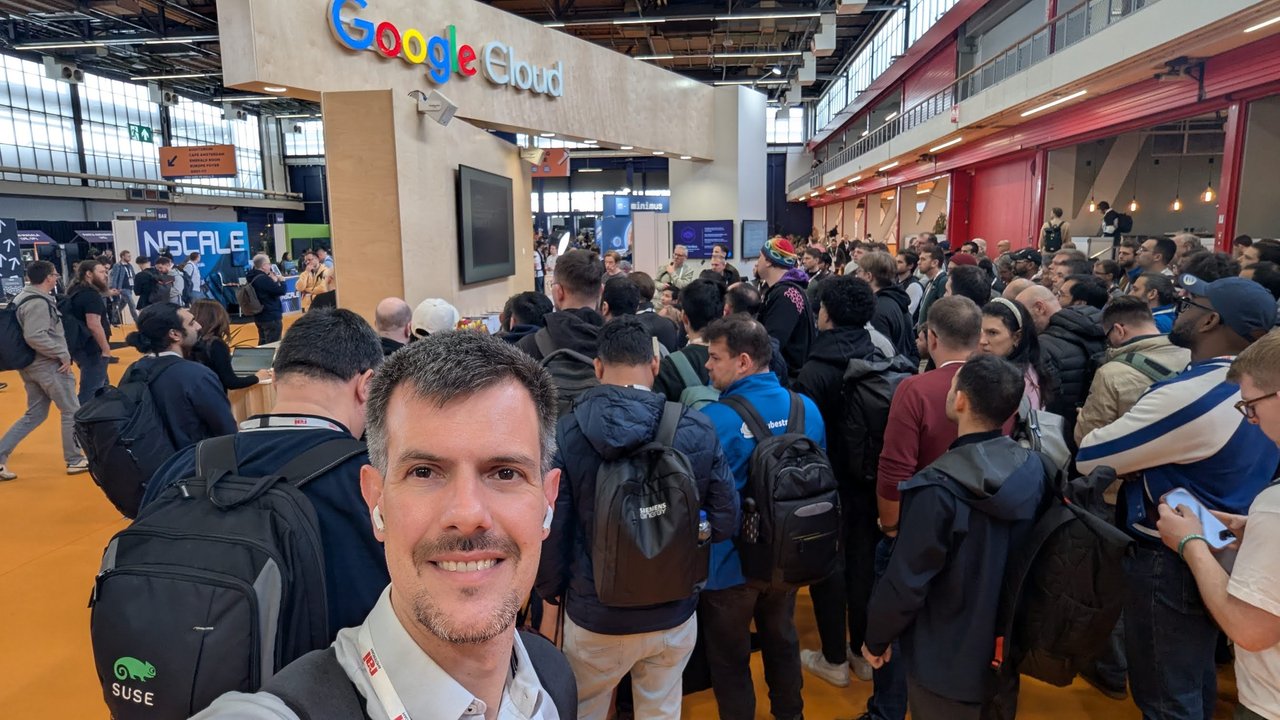 The expo floor on Wednesday afternoon, a minute before I met Erez.
Platforms and edge
Anthony (Spectro Cloud): edge in a box
Anthony (“Ant”) showed me Spectro Cloud’s edge-in-a-box demo: three x86 microcomputers running a Kubernetes cluster. He presented it as a full-stack deployment that could go almost anywhere, such as a ship or the base of a wind farm. The cluster can be completely separate from your on-premises environment. It’s managed from a control plane elsewhere and set up fully declaratively, so if the network link drops, it keeps working. The demo app told us how happy we were, and a GPU in the box can run workloads that need number crunching. According to Anthony, the setup scales to thousands of nodes. Spectro Cloud runs it for brands with thousands of stores, powering their in-store screens, and on-premises as well as at the edge.
My take: the interesting part is the declarative model, not the three small boxes. When a site loses its uplink, the cluster should keep running the last desired state. That’s the first thing I’d test in any edge pilot: pull the network cable and see what still works.
 The KubeCon + CloudNativeCon Europe 2026 screen on Monday evening, shortly after the Spectro Cloud demo.
Qinwen Zheng (openFuyao): software for mixed compute clusters
On Tuesday afternoon I stopped at the Huawei stand, where the openFuyao project was being shown. The brochure on the stand described openFuyao as an “Open-Source Community for Diverse Compute Cluster Software”. Its website adds Kubernetes-based orchestration and scheduling across CPUs, GPUs and NPUs. Qinwen Zheng, listed on the booth schedule as a cloud-native software development engineer, pointed me to the reference architecture on the brochure and invited everyone to join the community. He was also giving a short open talk on the stand three times that week: “inferNex: Open, Efficient, and Future-oriented Cloud-native LLM Inference Acceleration System”. The openFuyao site describes InferNex as a Kubernetes-native AI inference framework.
My take: mixed fleets of CPUs, GPUs and NPUs are becoming normal, and the scheduler is where portability is won or lost. When I evaluate a stack like this, I check how much of it stays upstream Kubernetes.
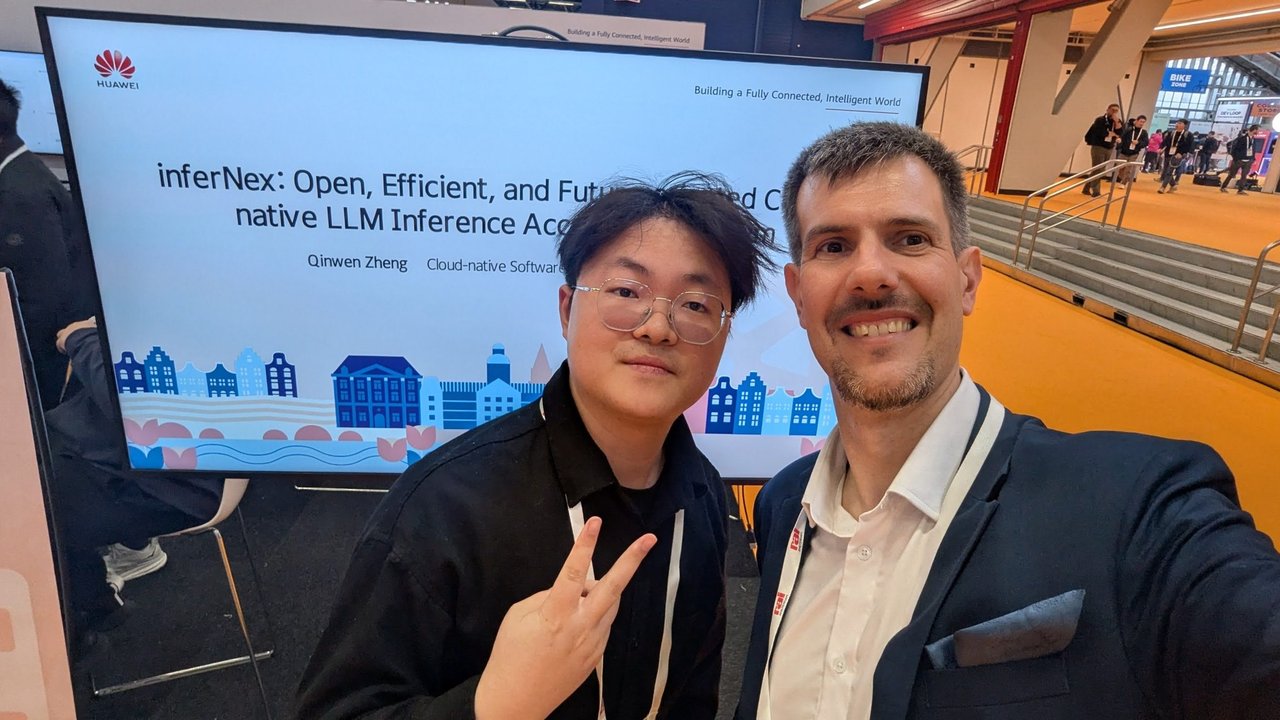 With Qinwen Zheng in front of his inferNex title slide on the Huawei stand.
A Kubernetes cluster in a cat carrier
Monday’s most memorable demo came from an attendee who didn’t give a name on camera: a Kubernetes cluster in a cat carrier. Their reasoning: “if it can keep a cat alive, it can probably keep a Kubernetes cluster alive”. Inside was a Framework 12 laptop running Talos Linux, with Kubernetes running locally. One pod runs a Cloudflare tunnel. A local app mounts a camera, does basic object detection on the CPU and streams the video back out. There’s no acceleration, which is why the stream lags slightly. It lasts about three hours on battery and tethers through a phone. When I asked about use cases, the answer was “Use cases to make people smile.”
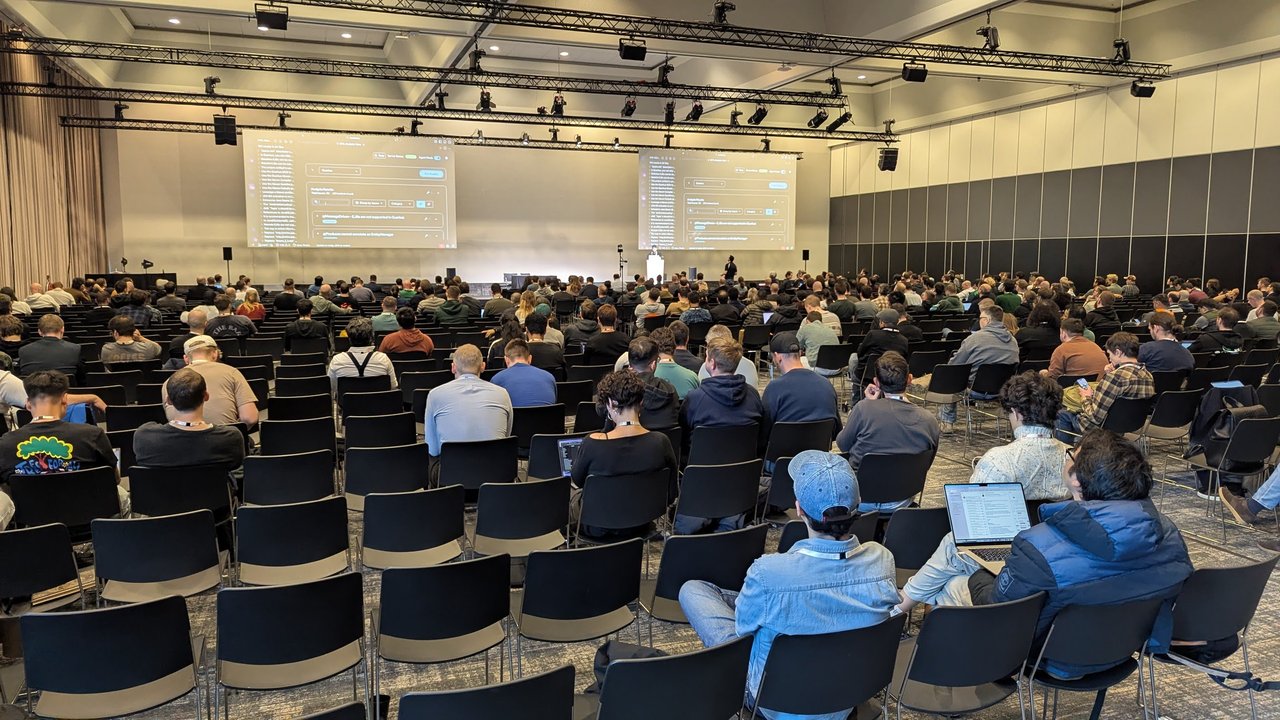 A full co-located session on Monday afternoon, a few minutes after the cat-carrier demo.