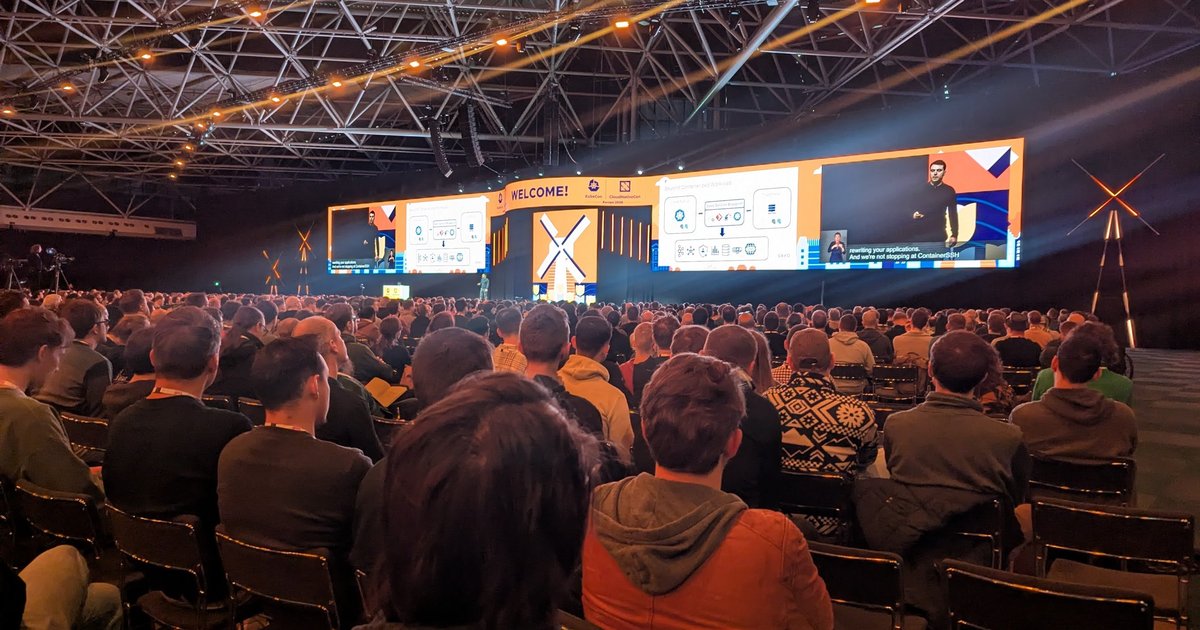
My week-in-photos recap of KubeCon + CloudNativeCon Europe 2026 at RAI Amsterdam is about the people, the book signings and my own talk. This post covers the slides: what was actually on screen in the keynotes and sessions I sat in on, from Tuesday 24 to Thursday 26 March. Several of the talks and companies already have a post of their own, so for those you’ll find one line and a link.
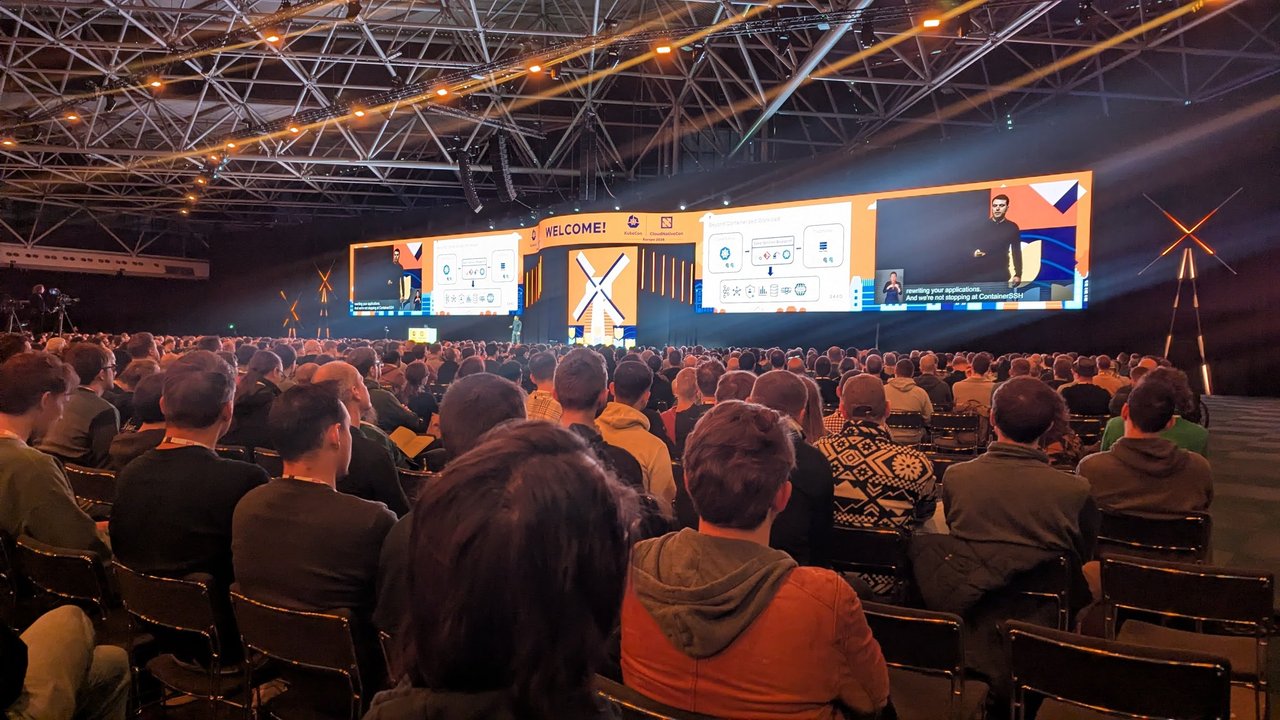
Wednesday morning in the keynote hall. The live captions read “And we’re not stopping at ContainerSSH”.
Tuesday 24 March: the CNCF press conference and a PodDisruptionBudget warning
On Tuesday, straight after our Kubernetes Recipes signing at the vCluster booth, I went to the CNCF press conference. I photographed most of the slides, and most of them already have a post on this site:
- The Inference Gold Rush, The $24.8 Billion Cost of Inaction (LF Research, “Revealing the Hidden Economics of Open Models in the AI Era”) and The Maturity Paradox (82% Kubernetes adoption against only 7% daily AI deployment, and 66% of GenAI on Kubernetes): see The AI Inference Challenge and Inference Gold Rush.
- It’s Why We’re All Here (19.9M cloud native developers, 7.3M AI cloud native developers, 13.35k attendees): see KubeCon Amsterdam 2026 in Numbers.
- NVIDIA Doubles Down on CNCF (Platinum Member, $3.8M cloud GPU donation, the Kubernetes GPU DRA driver contribution) and AI Conformance (a 70% surge in certified offerings): see NVIDIA Goes Platinum at CNCF and Kubernetes AI Conformance.
- Platform Engineering Tools Maturing for AI-Driven Infrastructure (28% of organisations have a dedicated platform engineering team): see CNCF Platform Engineering Technology Radar.
- Project Milestones, llm-d and Kyverno: see llm-d Joins the CNCF, Fluid and Kyverno’s graduation.
Two more slides are worth noting. Closing the Talent Gap with Training listed 15 certification programmes, 3,500 Kubestronauts globally, 330k individuals certified, and a process update to certification advancement and recertification. Clearing Tech Debt for AI Innovation had two boxes next to the Kubernetes logo: “Transition to Gateway API for production” and “Preview: Kubernetes 1.36 coming in April”. The Project Milestones slide is worth listing in full. Under Sandbox it showed llm-d, Agones, Higress, OpenChoreo and Velero. Under Incubating it showed Fluid and Tekton. Under Graduation it showed Kyverno. Tekton came back on Thursday.
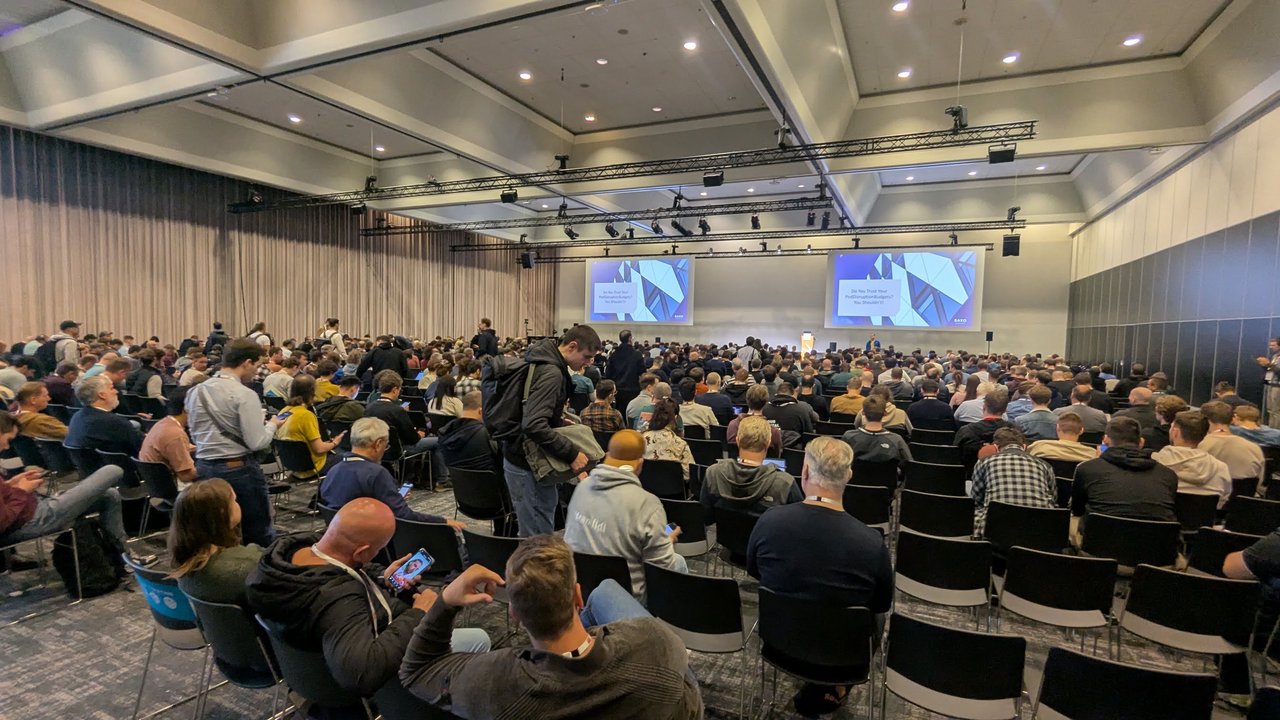
A breakout room filling up for “Do You Trust Your PodDisruptionBudgets? You Shouldn’t!”, with Saxo branding on the title slide.
After the press conference I looked into a breakout room as it filled up for “Do You Trust Your PodDisruptionBudgets? You Shouldn’t!”, a Saxo-branded session.
My take: a PDB is a promise about voluntary disruptions, and most clusters have plenty of ways to break it. PDBs belong in the same review as readiness probes and replica counts. A minAvailable that can never be met will block node drains. A PDB on a single-replica Deployment gives you no protection at all. Both look fine in a pull request.
Minutes later the main keynote hall was almost empty between sessions. The screens showed the title slide for “The Hills Are Alive with the Sound of Kubernetes: Sonification and Observability”.
On the expo floor, the Huawei booth had a printed “Huawei Booth Open Speech” programme under the banner “Powering the Agentic Future”. It listed three short technical talks, the first two scheduled several times across the three days: “Beyond Training: Volcano for Inference & Agents”, “Telco AI Infrastructure: Moving from Cloud Native to AI Native” and “inferNex: Open, Efficient, and Future-oriented Cloud-native LLM Inference Acceleration System”.
At 16:15 I gave my own session on multi-tenant GPUs on OpenShift AI with NVIDIA KAI. The abstract is in Speaking at KubeCon Europe 2026, and the photos from the stage are in On Stage at KubeCon EU 2026.
Wednesday 25 March: keynotes from Saxo, SNCF and Red Hat
On Wednesday the keynote stage had a huge “WELCOME!” banner and an orange windmill.
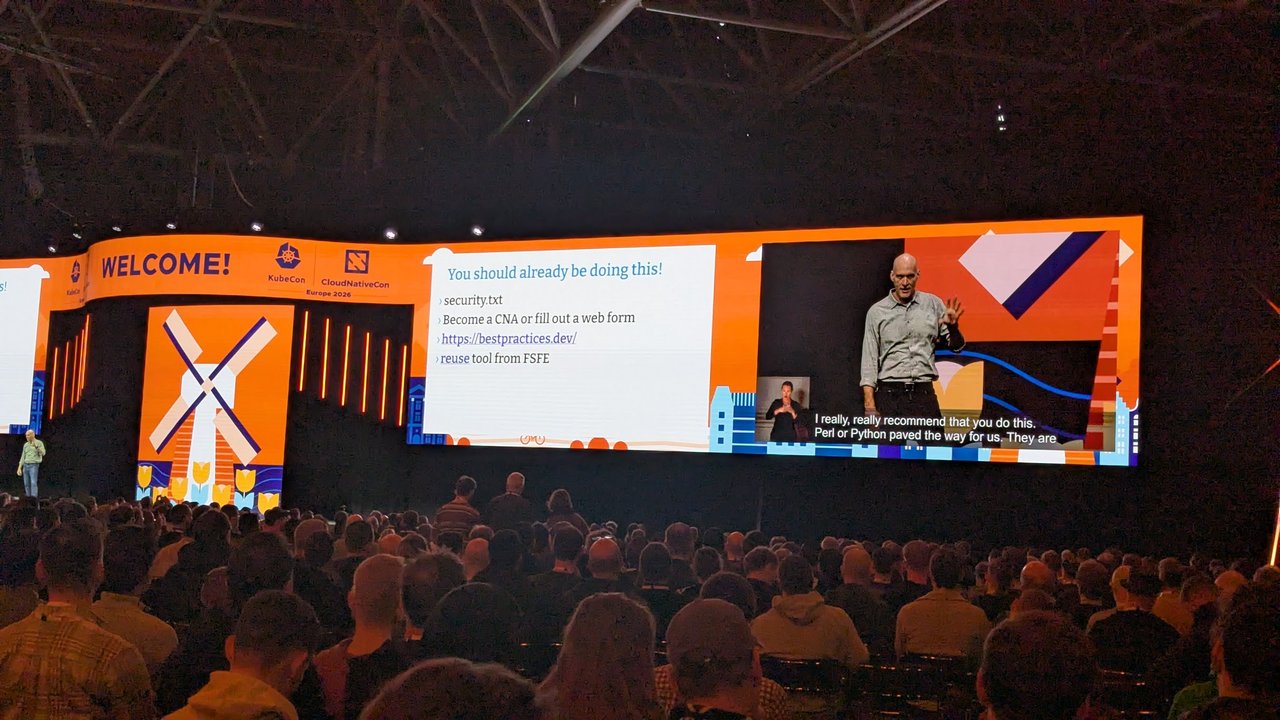
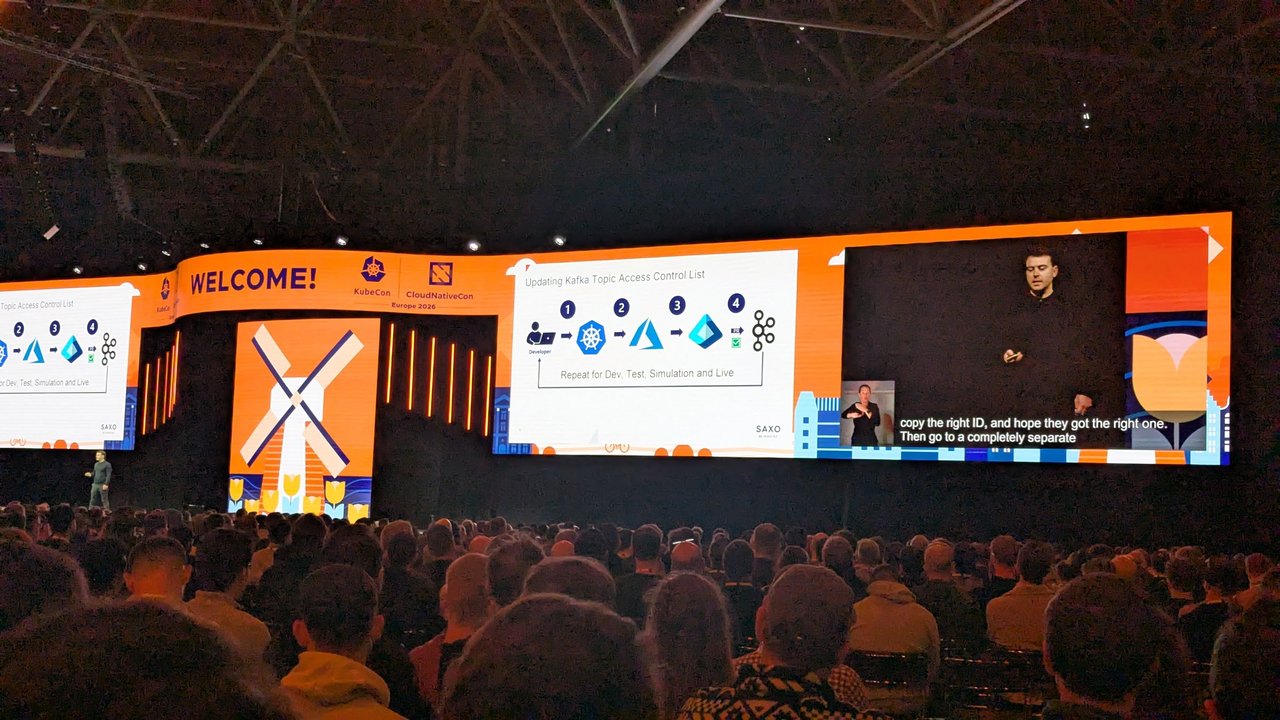
Left: a security checklist for open source projects. Right: the Kafka ACL process Saxo set out to replace.
“You should already be doing this!” One of the first keynote slides I photographed was a short checklist:
- a
security.txtfile - “Become a CNA or fill out a web form”
- bestpractices.dev
- the
reusetool from the FSFE
The live captions read “I really, really recommend that you do this. Perl or Python paved the way for us.” My take: most of this list is an afternoon’s work per repository. A published security contact and machine-readable licence headers are the first things a downstream security or compliance team checks.
Saxo: from Kafka tickets to a service blueprint. The Saxo slides told a platform story that many platform teams will recognise. “Updating Kafka Topic Access Control List” showed four numbered steps from a developer icon to Kafka, passing through the Kubernetes logo, two Azure icons and an approval step. The bottom of the slide read “Repeat for Dev, Test, Simulation and Live”, and the captions described someone having to “copy the right ID, and hope they got the right one. Then go to a completely separate…”.
The next slide, “Beyond Containerized Workload”, put a Saxo Service Blueprint in the middle. On one side sat cloud native workloads on Kubernetes, and on the other “Traditional” servers. Below it was a row of icons for platform capabilities, including Kafka, identity, metrics, databases and DNS. The captions said that the blueprint built for the cloud native ecosystem “is now extending to on premise”, with “And we’re not stopping at ContainerSSH” a few seconds later. My take: this is what a golden path looks like once it works. One declaration covers the access, the topics and the DNS, instead of four portals per environment.
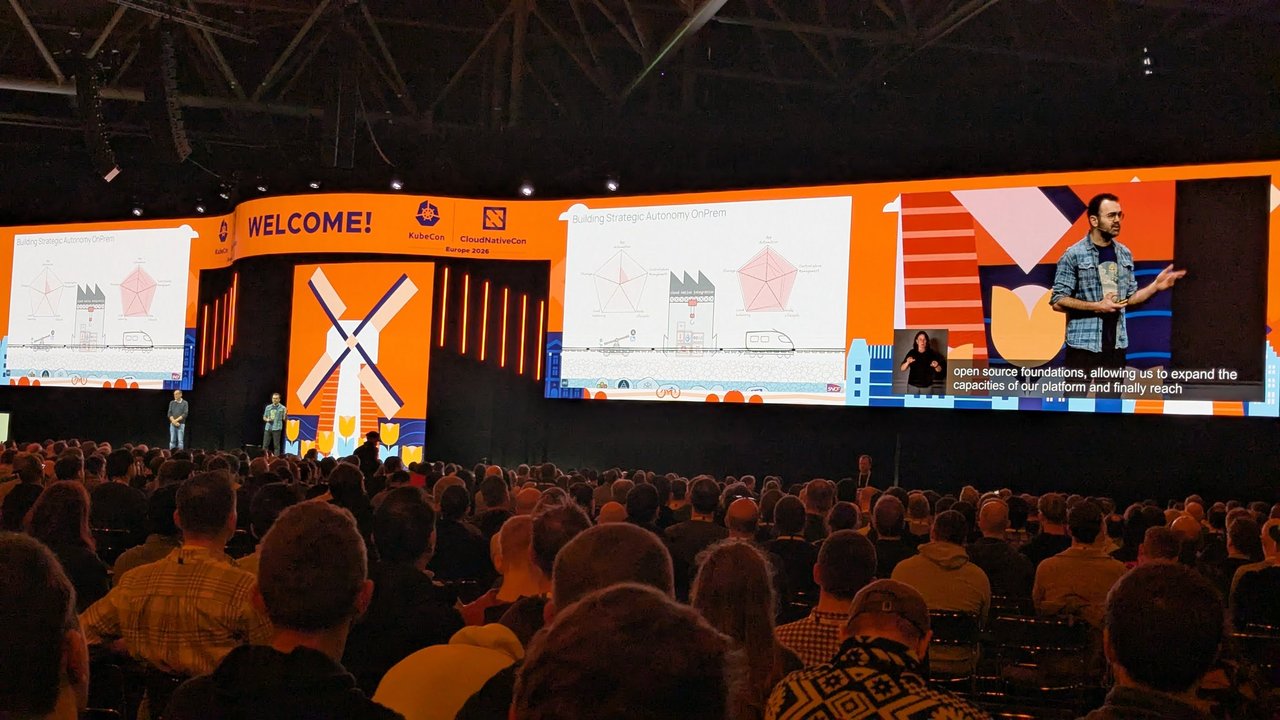
SNCF’s “Building Strategic Autonomy OnPrem” slide, from a draisine to a high-speed train.
SNCF: strategic autonomy on premises. Next came SNCF, with two speakers on stage. The first slide introduced the company as “among world leaders in mass transit, high-speed passenger transport and freight logistics”, with four figures:
- 284,000 employees worldwide, 75% in France
- 5 million passengers every day
- 15,000 trains operated every day
- 2,000+ applications in production
Next to the figures were four words: Security, Reliability, Safety, CyberSecurity. “Building Strategic Autonomy OnPrem” then drew the journey as two radar charts with five axes: App Automation, Control-plane Management, Node Lifecycle, Load Balancing and Storage. The left chart was almost empty, next to a hand-pumped rail cart. The right chart was almost full, next to a high-speed train. Between them stood a factory labelled “cloud native integration”. The captions credited “open source foundations, allowing us to expand the capacities of our platform”.
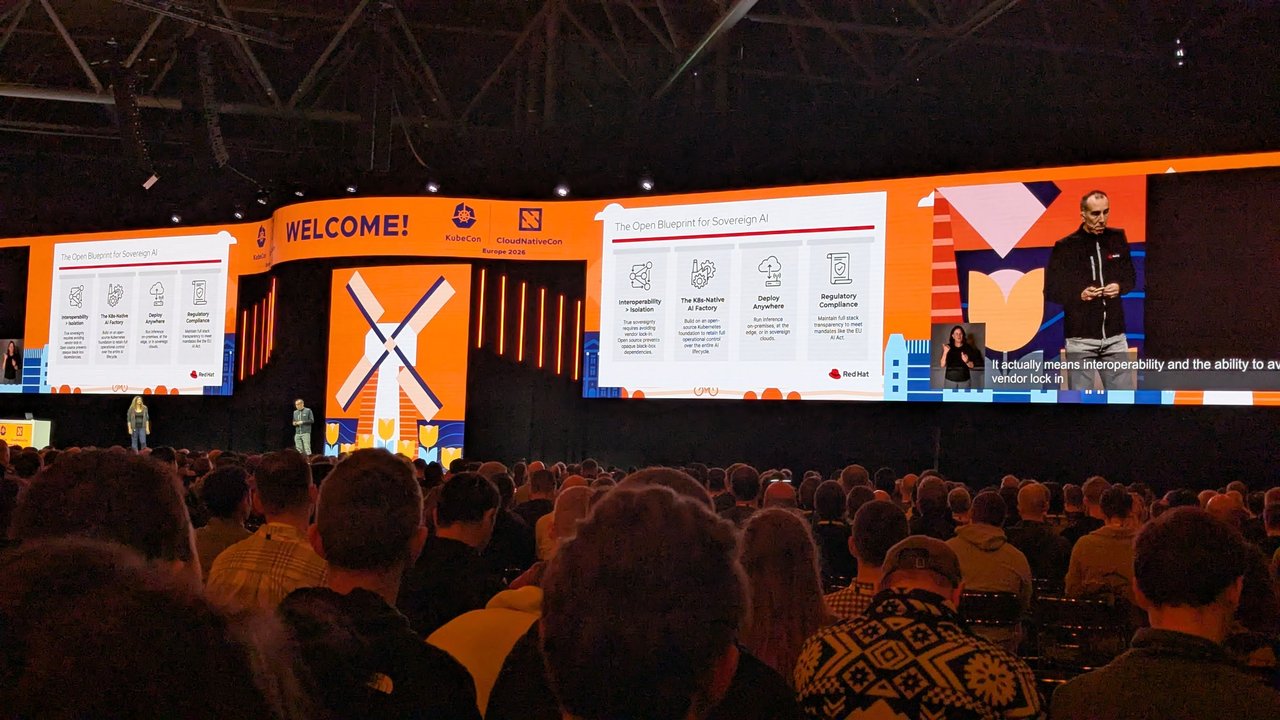
Red Hat’s “The Open Blueprint for Sovereign AI”, with the EU AI Act named in the last column.
Red Hat: the open blueprint for sovereign AI. A few minutes later a Red Hat slide, “The Open Blueprint for Sovereign AI”, set out four pillars:
- Interoperability > Isolation: “True sovereignty requires avoiding vendor lock-in. Open source prevents opaque black-box dependencies.”
- The K8s-Native AI Factory: “Build on an open-source Kubernetes foundation to retain full operational control over the entire AI lifecycle.”
- Deploy Anywhere: “Run inference on-premises, at the edge, or in sovereign clouds.”
- Regulatory Compliance: “Maintain full stack transparency to meet mandates like the EU AI Act.”
The captions summed it up: “It actually means interoperability and the ability to avoid vendor lock in.” My take: put this next to the SNCF radar charts and the morning had one argument. Sovereignty is a set of platform capabilities you build and run yourself, not a hosting location. I’ve written more about that in Geopatriation: why data localisation is reshaping IT.
Wednesday afternoon: the expo floor and a platform engineering meetup
My Wednesday afternoon photos are all from the expo floor, and the stands in them already have their own posts. Cielara’s booth said “The Future of DevOps is Foresight”, stack8s’s stand read “One Platform, Unified Control Plane”, echo.ai’s wall read “Making your job boring” and I also stopped at Rootly. In the early evening I went to the Advancing Platform Engineering on AI, K8s and the Product Mindset event.
Thursday 26 March: a Tekton CI factory story
On the last day the corridor banner by Hall 12 read “KEEP CLOUD NATIVE MOVING”. The same line came back at KubeCon Japan 2026 as the title of the opening keynote. I passed the OpenObserve booth on the way. Its wall listed observability layers from frontend and “AI & LLM” down to network and infrastructure.
The session I photographed most on Thursday was a CI migration story in a large, busy breakout room, with two speakers on stage. It was told in chapters.
“Where Our Journey Began: Managing Chaos” described the classic setup: a centralised Jenkins controller, fixed-capacity static agents, containerised workloads in Kubernetes, and manual release approvals. Three problems followed:
- Scalability: static agents couldn’t handle burst loads efficiently.
- Management: “Plugin hell” made updates difficult, and managing agents became a full-time job.
- Consistency: configuration drift and a sprawl of custom Jenkinsfiles across many microservices.
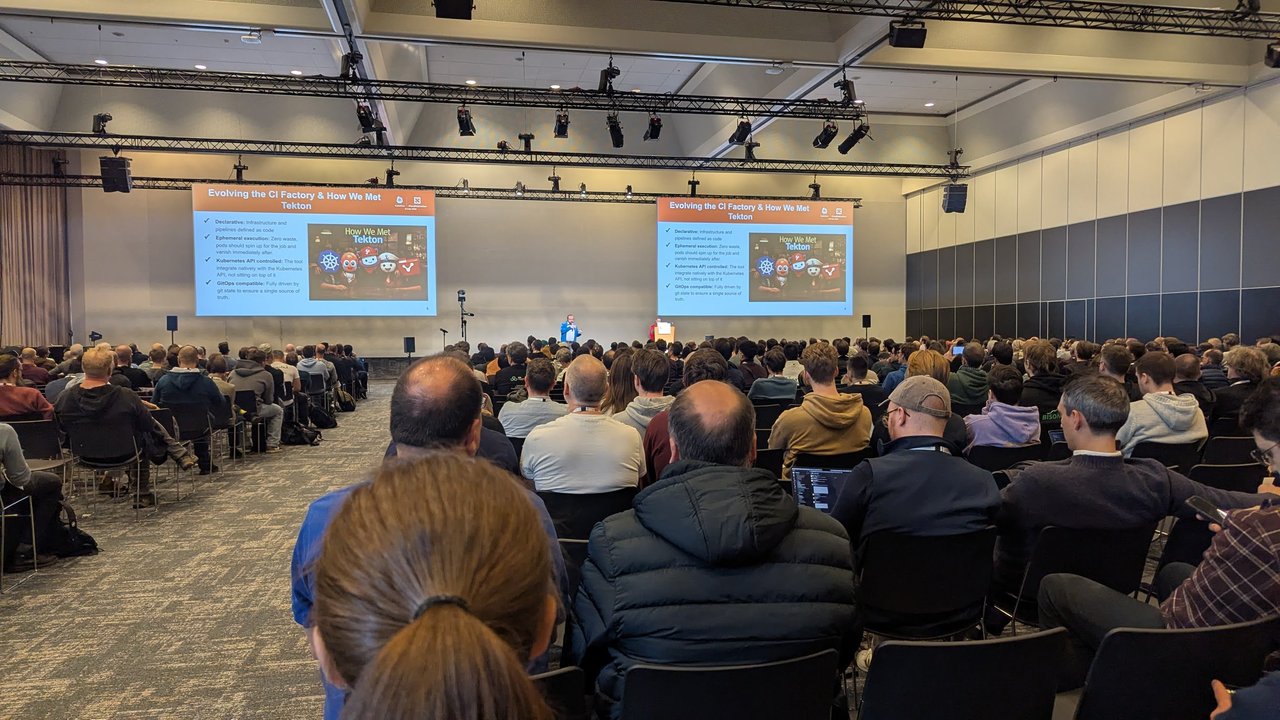
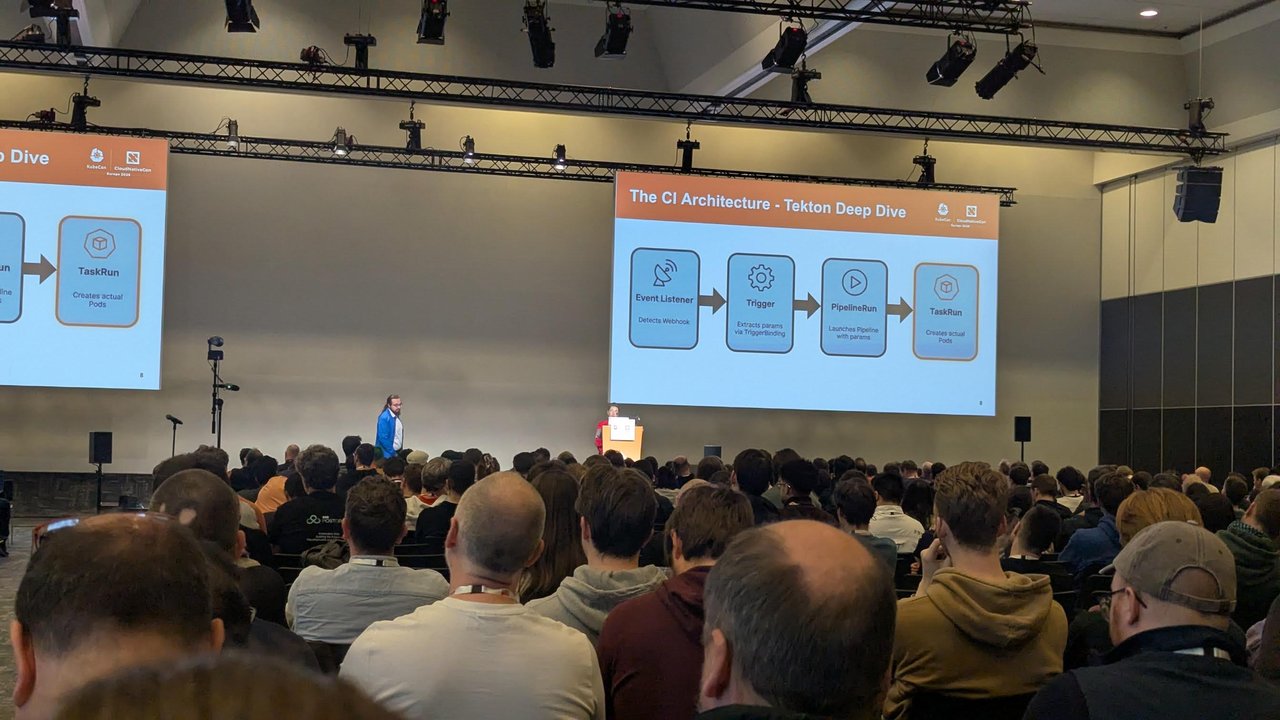
Left: the requirements that led the team to Tekton. Right: the event-driven flow from webhook to pods.
“Evolving the CI Factory & How We Met Tekton” listed what the replacement had to be:
- Declarative: infrastructure and pipelines defined as code
- Ephemeral execution: zero waste, pods spin up for the job and vanish immediately after
- Kubernetes API controlled: the tool integrates natively with the Kubernetes API, not sitting on top of it
- GitOps compatible: fully driven by git state, to ensure a single source of truth
“Kubernetes way of CI/CD” set the Tekton cat in the middle of five properties: Security (Kubernetes native secrets and RBAC), Efficiency (ephemeral execution, zero resource waste when idle), a Unified pipeline architecture (“1 pipeline, 1 webhook”), Decoupled logic (pipeline logic separated from implementation details), and Scalable and Event Driven.
“The CI Architecture – Tekton Deep Dive” drew the flow in four boxes. An Event Listener detects the webhook. A Trigger extracts params via TriggerBinding. A PipelineRun launches the pipeline with those params. A TaskRun creates the actual pods.
My take: the “1 pipeline, 1 webhook” box is the part to copy. Moving to Tekton without consolidating pipelines would only swap one Jenkinsfile sprawl for another, this time written in YAML. The Tuesday Project Milestones slide had just listed Tekton as incubating. My analysis of Tekton’s incubation covers what that means for adopters.
In the evening I crossed town for the LangChain NL KubeCon meetup on building autonomous systems, which has its own write-up.
What the slides added up to
Across the three days, the slides kept coming back to three themes:
- Platforms are absorbing the non-container estate. Saxo extended its blueprint to on-premises and traditional workloads, and SNCF scored its platform on node lifecycle and load balancing, not just app automation.
- Sovereignty means control. SNCF and Red Hat both framed it as open source foundations you operate yourself.
- CI is becoming a Kubernetes workload like any other. Ephemeral, declarative and driven by the API, as the Tekton talk and the press conference’s project list both showed.