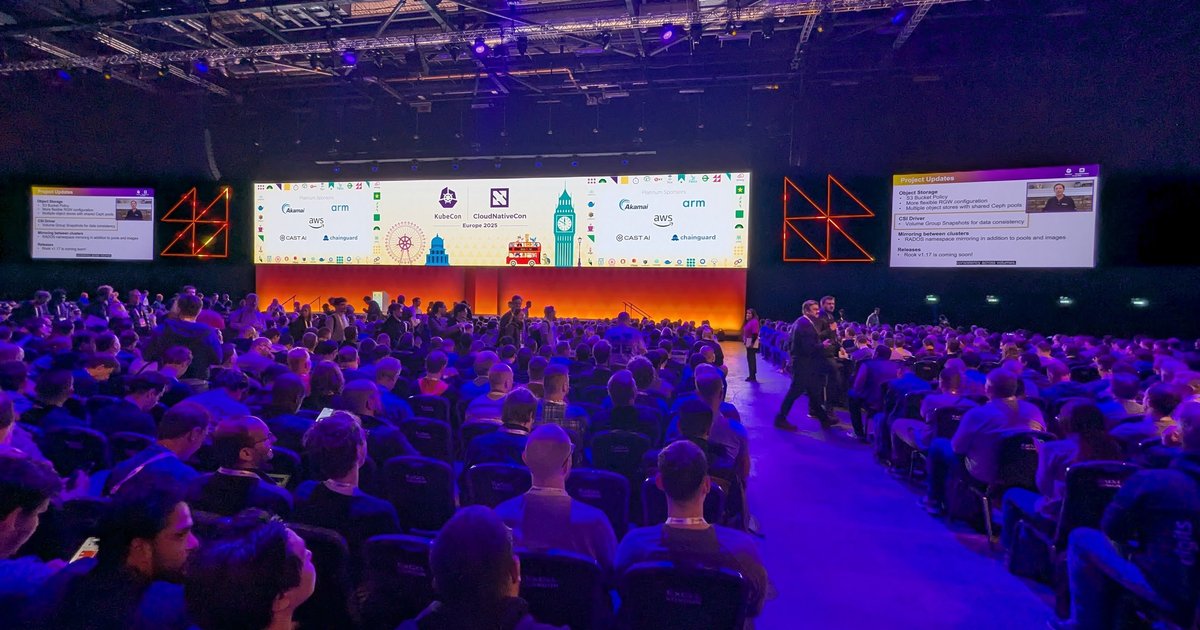
Between talks at KubeCon + CloudNativeCon Europe 2025 at ExCeL London I stopped people on the floor, switched the camera on and asked them to introduce themselves. This post summarises twelve of those short clips, in my own words. Each person introduced themselves on camera, and I only attribute product claims to the person who made them. Where someone gave only a first name, I kept it at that. The talks I watched have their own posts, starting from the KubeCon Europe 2025 hub.
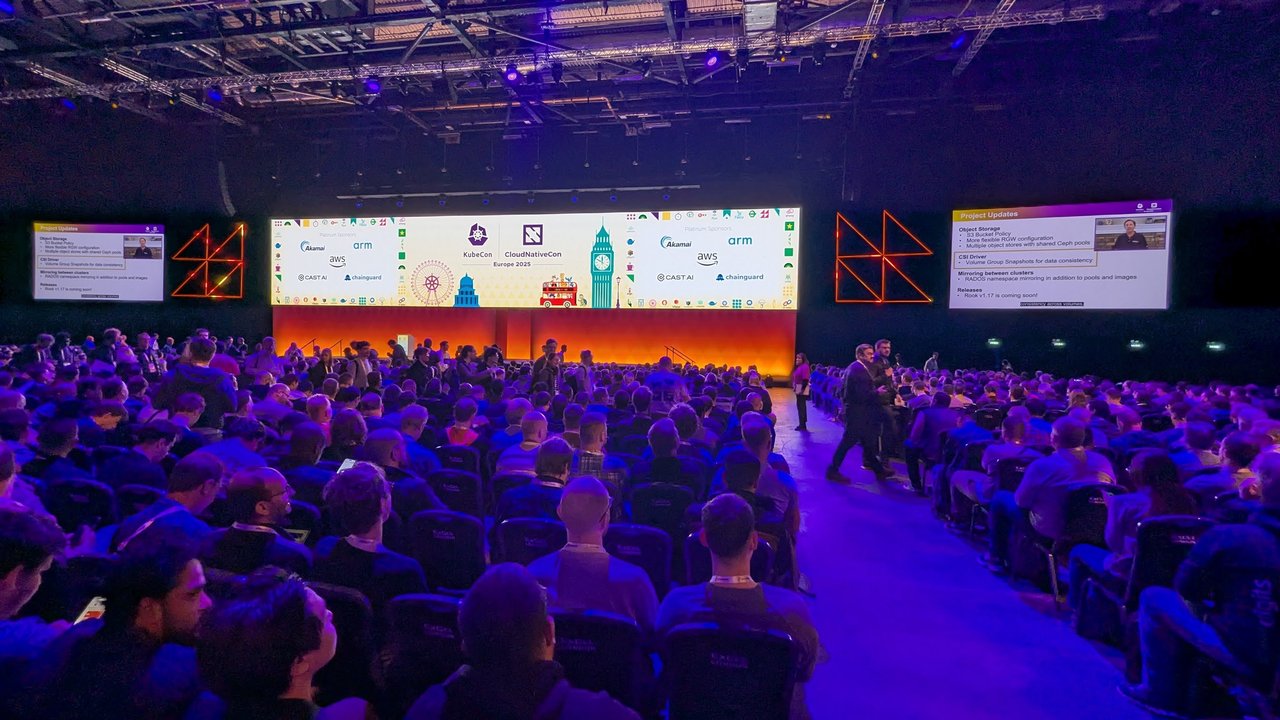
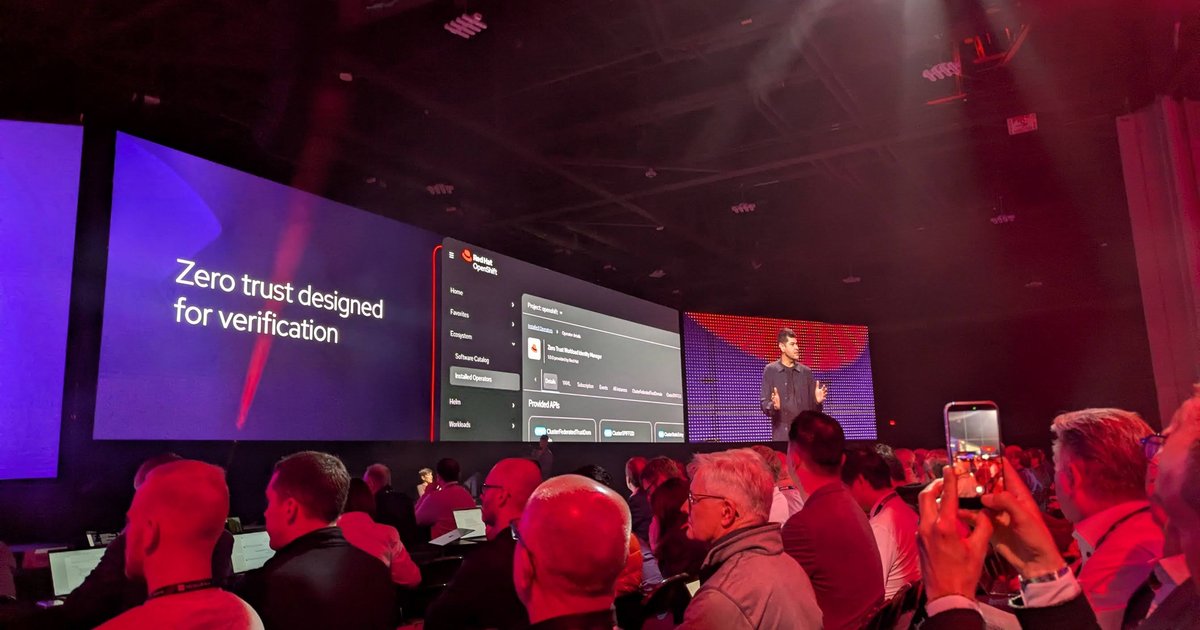
The main hall during a keynote session. The booths and hallways were where the conversations below happened.
Wednesday 2 April: the Red Hat booth and its neighbours
Aubrey, product marketing manager for OpenShift at Red Hat. She said KubeCon is a big event for Red Hat to talk to customers, and the booth message was a consistent OpenShift experience from edge to cloud to on-premises. According to her, AI came up in every conversation, including at OpenShift Commons the day before, and Red Hat’s answer is that OpenShift is a platform ready to run any workload, with OpenShift AI on top. Knative and Kubeflow were the projects she named when I asked about frameworks. She said it was too early to point at one AI use case, because customers are still exploring and mostly want a secure, stable base. The next stop she mentioned was Red Hat Summit in Boston in May.
Ronen, product manager for OpenShift Virtualization at Red Hat. The pitch: run virtual machines inside pods on a Kubernetes cluster, side by side with containers, with one control plane, one set of tooling and the same monitoring, while existing automation such as Ansible keeps working. He said many customers are looking for alternatives in the virtualization market, which makes it a very hot topic. My take: that is the same conversation I have with infrastructure teams every week. See Red Hat Summit Connect Utrecht 2025 for more on the topic from the Netherlands.
David Safaii, Trilio. He said Trilio is a Kubernetes-native data protection platform covering Kubernetes, KubeVirt and OpenStack for backup, disaster recovery and application mobility. His framing was that you restore an application and its data by re-orchestrating it at a point in time, and that the speed of re-orchestration is what matters in a disaster. He also saw the move away from incumbent virtualization platforms as a reason for teams to modernise applications over the next couple of years.
Kelly, Testkube. Testkube runs any kind of test (API, front end, unit, JMeter, Postman and others) inside your own Kubernetes clusters and scales them with the cluster, in parallel or together. The first use case she sees is pulling tests out of CI/CD pipelines such as GitHub Actions so they stop clogging the pipeline. She said the agents are open source.
Nicolas Frankel, Loft Labs (vCluster). He introduced vCluster as a low-level building block: virtual clusters inside a host cluster. His examples were isolation when namespaces are not enough, especially for cluster-wide CRDs, multi-tenancy with a virtual cluster per customer, and short-lived clusters for CI/CD. He contrasted a minimal managed cluster that, in his recent GKE experience, takes five to seven minutes to start with a virtual cluster that starts in under a minute on one shared host. He described the open source version as covering the core and the pro version adding things like CRD syncing and a dashboard. More on the project: vCluster documentation.
Lee Skillen, co-founder and CTO at Cloudsmith. The topic was software supply chain security. He agreed that the SolarWinds incident raised awareness, mentioned Log4j as another example, and said attacks can come from anywhere in the ecosystem, so security has to be maintained through the whole chain and built into the pipeline. He said Cloudsmith is a community member of the OpenSSF and, as far as he believed, had just submitted a document on the OWASP top 10 risks as they apply to CI/CD, not yet published at the time.
Nicky Pike, developer relations lead at Coder. Coder is a cloud development environment: the workspace that developers would have on a laptop is moved to a central place, on public cloud, private cloud or your own servers. The benefits he listed were faster onboarding, source code that is not spread across hundreds of laptops, and better build times because the work happens on a server. He compared it to VDI for development without the latency, and said the browser version of VS Code was a contribution from Coder.
Thursday 3 April: Kubeflow and KitOps
Kimonas, Canonical (Charmed Kubeflow). He leads work on Charmed Kubeflow and said the focus is keeping up with upstream and making Kubeflow the simplest open source way to click and deploy. His view of the LLM hype: it is a good moment to remember that Kubeflow is an end-to-end platform covering training, feature engineering, serving and evaluation for several user personas with isolation and scaling on Kubernetes. He also pointed at the model registry work done with Red Hat.
Matteo, OpenShift AI engineering at Red Hat. We spoke at the Kubeflow booth. He talked about pooling compute resources through Kubernetes instead of everyone owning a powerful workstation, and about the rise of the AI engineer as the meeting point of DevOps, MLOps and data science. He mentioned KServe with serving runtimes such as vLLM for keeping models private, and wanted container-style signing and attestation applied to models, so that when an audit comes you can show which model was deployed. He also saw Java developers getting tools such as LangChain4j and MCP support on Quarkus. My take: model provenance is going to be a compliance question before it becomes a technical fashion.
Gorkem, CTO at Jozu and KitOps maintainer. KitOps packages models, datasets and configuration as ModelKits, which are OCI artifacts, so existing registries, pipelines and tools like Cosign can secure the AI/ML supply chain. He described Jozu Hub as a UI for ModelKits on top of an OCI registry, with model scanning, container generation and diffs between ModelKits, and said the CNCF project itself works without it. The CNCF blog post KitOps 1.0 release by Jozu’s CTO describes the project’s move toward the CNCF.
Friday 4 April: the community side
Faseela K, cloud native developer at Ericsson. She introduced herself as a member of the CNCF Technical Oversight Committee, and she was one of the KubeCon + CloudNativeCon Europe 2025 co-chairs. She said the conference had a very large audience. For newcomers who want to contribute she suggested starting from the CNCF landscape, looking for “good first issue” labels, and using the LFX mentorship programme, and she mentioned a new mentorship opportunity launched that week for underrepresented groups.
Dana Fine, Qodo. She said she works at Qodo promoting its open source initiative and is a CNCF community leader and KCD leader in Israel. She described PR-Agent, Qodo’s open source tool that reviews pull requests, describes changes and suggests fixes, and said Qodo was offering free hosting for open source projects together with Google Gemini. That is her description of the offer, so check the current terms. She also talked about getting more women speakers into community events and cutting plastic waste at them.
Closing the loop
The thread through all twelve conversations was how many different layers need attention before AI workloads are boring: virtualization and backup underneath, isolation and supply chain in the middle, model packaging and provenance on top, and a community that makes it possible to contribute. I also recorded my own week-after takeaways, which I summarised in the KubeCon Europe 2025 hub.