The numbers do not lie
KubeCon + CloudNativeCon Europe 2026 in Amsterdam just wrapped, and the numbers tell a story that every technology leader needs to hear. Cloud native is not a trend anymore — it is the foundation. And AI infrastructure is building on top of it faster than anyone expected.
Here are the numbers that matter.
Cloud native ecosystem
The Q1 2026 State of Cloud Native Development report dropped during the keynote, and the growth is staggering:
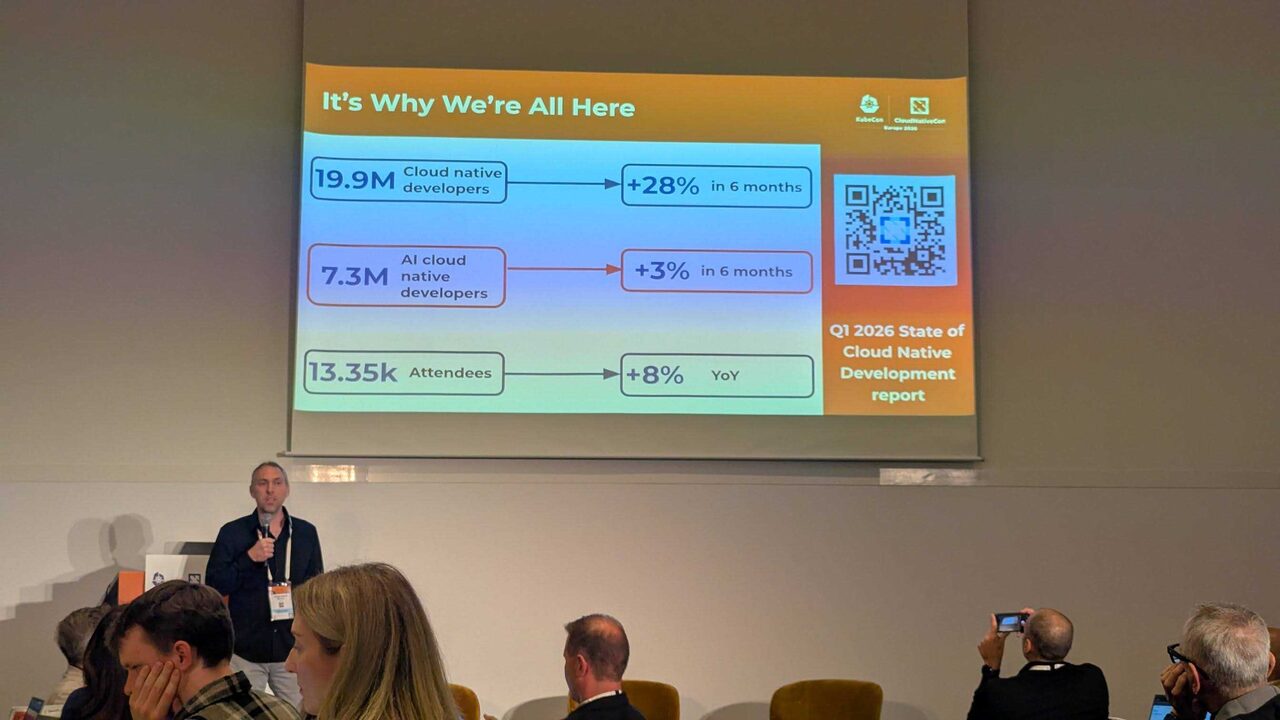
- 19.9 million cloud native developers worldwide
- +28% growth in just 6 months
- 7.3 million AI cloud native developers
- +3% growth in AI cloud native developers in 6 months
- 13,350 attendees at KubeCon EU 2026 — +8% year over year
Let those numbers sink in. Nearly 20 million developers are now building on cloud native technologies. That is not a niche — that is the mainstream. And 7.3 million of them are specifically working on AI workloads in cloud native environments.
Platform engineering goes mainstream
The platform engineering movement is no longer a conference track — it is an organizational reality:
- 28% of organizations now have a dedicated platform engineering team
- 15 certification programs across the CNCF ecosystem
- 330,000 individuals certified in cloud native technologies
- 3,500 KubeStronauts globally — the elite multi-certified practitioners
When more than a quarter of organizations have a dedicated platform team, the debate is over. Platform engineering is not a buzzword — it is how modern companies ship software. The developer burden of tool sprawl and 24-hour DevOps waits is driving this adoption faster than any vendor marketing ever could.
AI infrastructure: the inference boom
The AI infrastructure numbers were perhaps the most eye-opening. This is not about training anymore — it is about inference at scale:
- $255 billion projected inference market by 2030
- 67% of AI compute expected to go to inference in 2026
- 2,000+ contributors to vLLM — the open-source inference engine
- $5.0 billion Baseten valuation
- $4.0 billion Fireworks valuation
- $2.5 billion Modal valuation
- $1.2 billion+ combined valuation for Inferact + RadixArk
The inference market is exploding because every AI model that gets trained eventually needs to serve predictions. And serving predictions at scale — with low latency, high throughput, and cost efficiency — is fundamentally an infrastructure problem. A Kubernetes problem. A GPU multi-tenancy problem.
This is exactly why my talk on multi-tenant GPUs on bare metal drew a packed room. The industry is hungry for patterns that make GPU infrastructure shareable, efficient, and safe.
The framework: Safe, Fair, Efficient
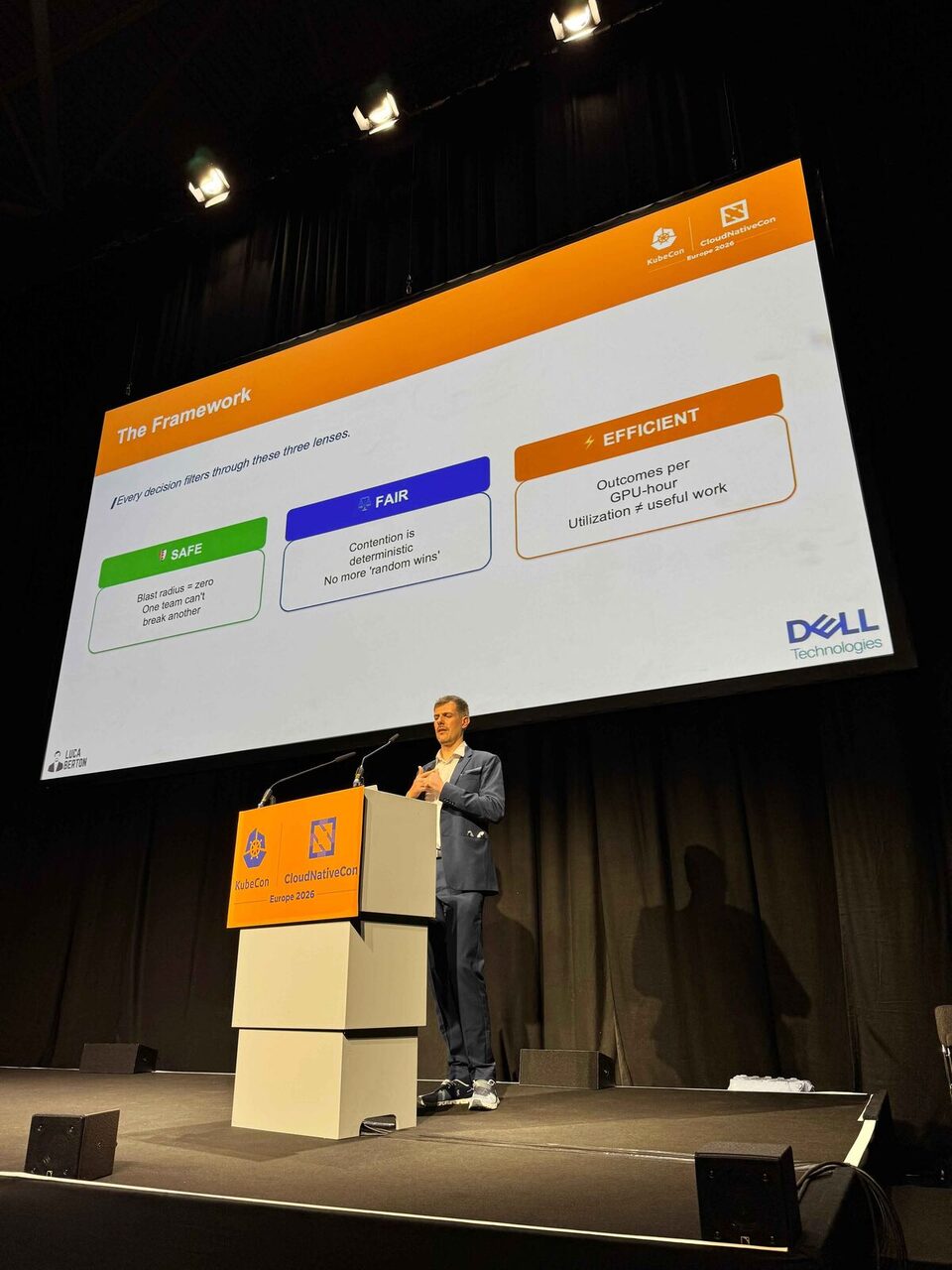
Every decision in our multi-tenant GPU infrastructure filters through three lenses:
- Safe — blast radius equals zero. One team cannot break another.
- Fair — contention is deterministic. No more “random wins” in GPU scheduling.
- Efficient — outcomes per GPU-hour matter. Utilization does not equal useful work.
This framework is not theoretical. It is how we run NVIDIA H200 GPUs on bare metal OpenShift AI at Dell Technologies, serving multiple teams with different workloads, different SLAs, and different priorities — all on shared infrastructure.
The full slide deck is available for download.
The convergence is real
The biggest takeaway from KubeCon 2026 is not any single number — it is the pattern across all of them:
Cloud native (19.9M developers) + Platform engineering (28% with dedicated teams) + AI infrastructure ($255B inference market) = a unified stack.
The companies building AI applications are not inventing new infrastructure from scratch. They are building on Kubernetes. They are using GitOps for deployment. They are running GPU operators for hardware management. They are adopting platform engineering for developer experience.
These are no longer adjacent trends. They are converging into a single, coherent technology platform — and KubeCon 2026 in Amsterdam was the moment that convergence became undeniable.
What this means for your organization
If you are a technology leader reading these numbers, here is what to do:
Invest in platform engineering now. 28% of organizations already have dedicated teams. If you do not, you are falling behind.
Plan for inference, not just training. 67% of AI compute going to inference means your GPU strategy needs to prioritize serving, not just model development.
Build on cloud native. With 19.9M developers in the ecosystem, the talent pool, tooling, and community support for cloud native is unmatched.
Multi-tenancy is not optional. GPUs are too expensive to dedicate to single teams. Safe, fair, and efficient sharing is the only economically viable path.
Certify your teams. 330K certified individuals and 15 programs means there is a clear learning path. KubeStronauts are the gold standard.
Download the full slide deck from my KubeCon talk. Read about the companies and leaders shaping cloud native, or book a consultation to discuss your AI infrastructure strategy.