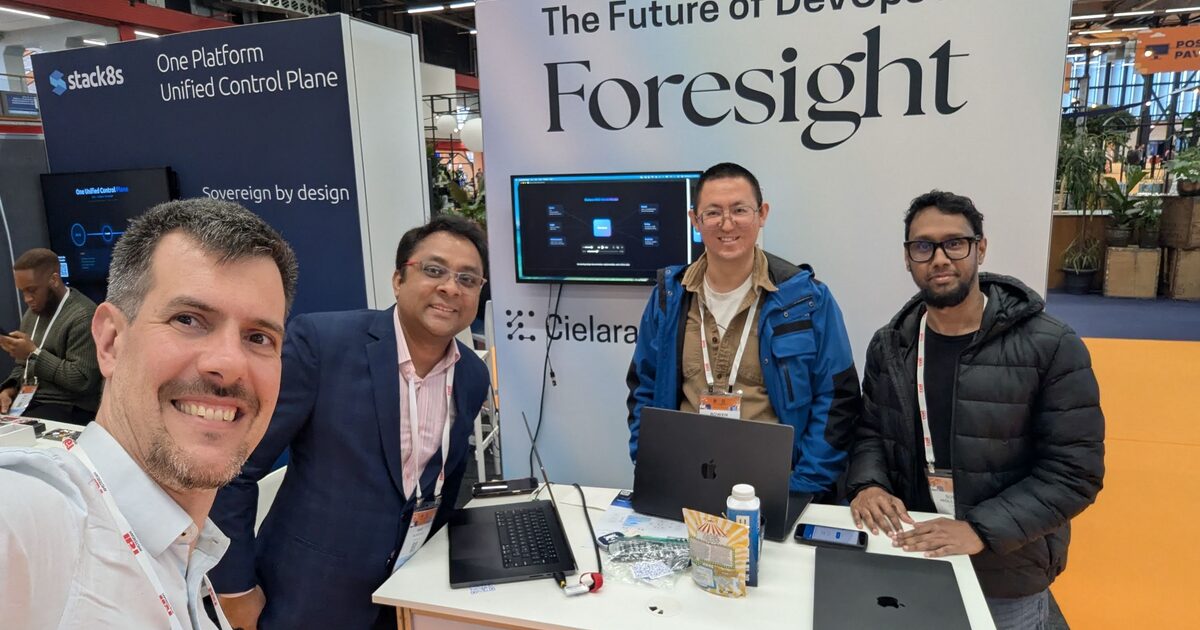
Great conversation at KubeCon with Jim Zemlin from The Linux Foundation.
2026: The Year AI Reshapes Software Creation
One theme stood out clearly: 2026 could be the year when generative AI meaningfully reshapes how software gets built. Not just by making developers faster, but by changing the role of software creation itself — from writing every line manually to increasingly architecting systems with AI as part of the build process.
This is not a distant prediction. We are already seeing it play out at KubeCon:
- Cielara AI building world models for context-aware code review
- Qodo sponsoring free AI code reviews for open-source projects
- Tools like Claude Code with hooks, MCP servers, and SDK integration transforming developer workflows
- The Agent Client Protocol standardizing how AI agents interact with development environments
The Open Source Angle
What I found especially interesting was the open source angle.
If coding agents keep improving at this pace, open source communities will have a real opportunity to write better code, move faster, and lower barriers to contribution. At the same time, this will raise important questions around:
- Responsibility — who is accountable when AI-generated code introduces a vulnerability?
- Authorship — how do we attribute contributions that are human-guided but AI-generated?
- Governance — how do maintainers review pull requests at scale when AI can generate them faster than humans can evaluate them?
- Code quality — how do we ensure AI-generated contributions meet project standards?
That combination of acceleration and accountability will define a lot of what comes next.
AI Makes Open Source More Critical
My takeaway: AI will not reduce the importance of open source. It will make strong open ecosystems even more critical — because transparency, collaboration, and shared standards become more valuable as software creation becomes more automated.
Consider the implications:
- Transparency — when AI generates code, you need to be able to inspect, audit, and verify what it produces. Open source provides that by default.
- Shared standards — as CNCF CTO Chris Aniszczyk noted, the community-driven approach to solving AI infrastructure challenges keeps innovation open and decentralized.
- Collaboration — AI tools trained on open source code create value that flows back to the ecosystem. The Linux Foundation’s role in governing these dynamics becomes more important, not less.
- Trust — in a world where AI can generate convincing but incorrect code, trusted open source projects with strong review processes become essential infrastructure. Content provenance matters for code too.
About Jim Zemlin
Jim Zemlin’s career spans three of the largest technology trends of the last decade: mobile computing, cloud computing, and open source software. As Executive Director of The Linux Foundation, he works with the world’s largest technology companies — including IBM, Intel, Google, Samsung, and Qualcomm — to define the future of computing across servers, cloud, and devices.
His position at the vendor-neutral Linux Foundation gives him a unique aggregate perspective on the global technology industry. He is a regular keynote speaker at industry events and advises a variety of technology startups.
Looking Ahead
The intersection of AI and open source is going to be one of the defining themes of the next few years. The organizations and communities that get the governance right — maintaining quality and trust while embracing AI acceleration — will shape the future of software.
Thanks, Jim, for the conversation and for the perspective. Exciting times ahead for everyone building at the intersection of AI, cloud native, and open source.
Related Posts
- CNCF CTO Chris Aniszczyk: From Internet Scale to Agentic AI
- Cielara AI: Context-Aware Code Review
- Claude Code: Complete Guide to Hooks, MCP, and SDK
- Agent Client Protocol: The LSP Moment for AI Coding Agents
- Content Credentials: Building Trust in the Age of Generative AI
About the Author
I am Luca Berton, AI and Cloud Advisor. I help enterprises navigate the intersection of AI, open source, and cloud native infrastructure. Book a consultation.