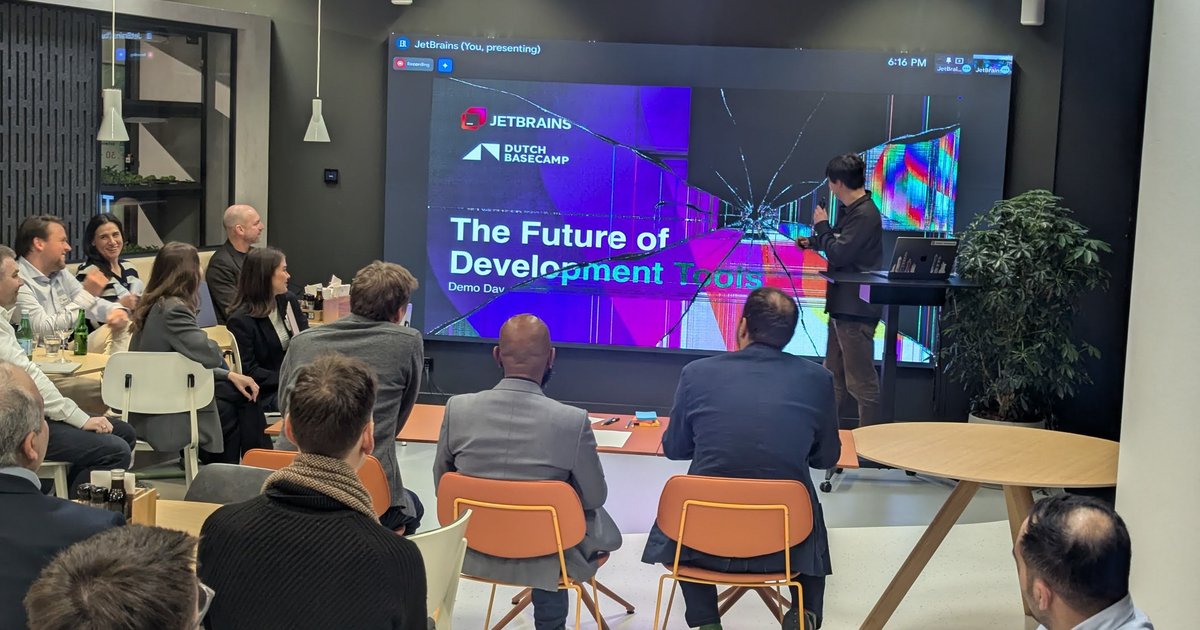
On Tuesday 9 December 2025 I went to “The Future of Development Tools: Demo Day”, run by JetBrains and Dutch Basecamp in Amsterdam. I wasn’t speaking or judging. I was a guest in the audience, which made it a relaxed way to see what a group of early-stage developer-tool companies were building at the end of 2025.
The evening had three parts: a short keynote, an introduction to the judges and prizes, and then a run of startup pitches. This is a throwback written from my photos and the clips I filmed. Pitch details come from the slides and from what the founders said on stage, so product and market claims are theirs, not mine.
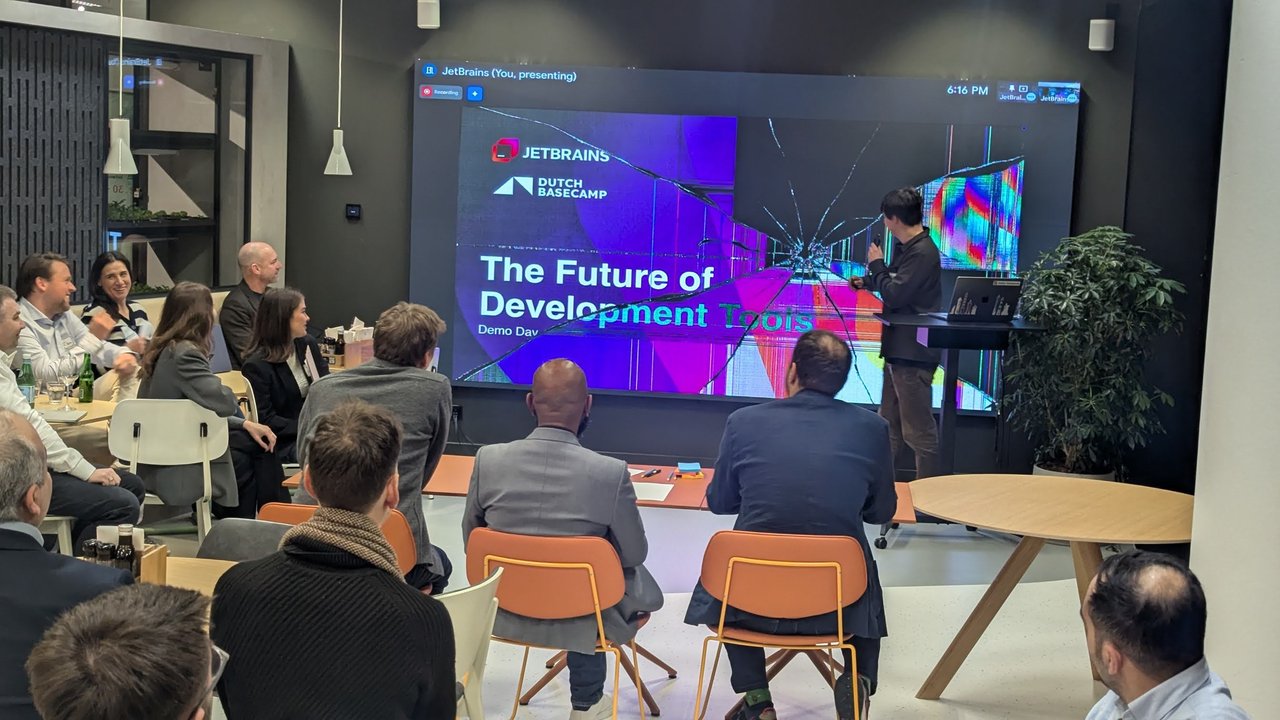
The opening slide: JetBrains and Dutch Basecamp, “The Future of Development Tools”, Demo Day.
Opening: JetBrains Innovation Hub and Dutch Basecamp
The first clip I filmed is the welcome. The JetBrains host described the Innovation Hub as an internal startup incubator, where employees bring ideas and a few go through a pre-seed round. He added that next year the hub plans to work with external founders and teams as well, which is why the evening was framed as networking.
Dutch Basecamp’s director then introduced her organisation as a non-profit that helps founders, startups and scale-ups expand abroad, and works with policymakers on regulation. She said six countries were represented among the seven finalists. Her advice to European founders was to pick a vertical niche where you have real domain expertise, and to get access to proprietary data, even by working with a partner for free, because defensibility is a big question in AI. She closed by saying that chemistry between founders, and between founder and investor, matters most, and that she had met her own co-founder at a JetBrains event.
Keynote: why human capital still builds the best tech
The keynote was called “Why Human Capital Still Builds the Best Tech”. The title slide named the speaker as a founder called Jasper, but his surname was hidden behind him in my photo, so I’ll leave it at that. His opening slide carried the event’s own branding, “JetBrains DutchBasecamp: The future of development tools demo day”, and a single line: “Why connection matters more than ever in an artificially intelligent world”. He closed on “Let’s build that human connection”.
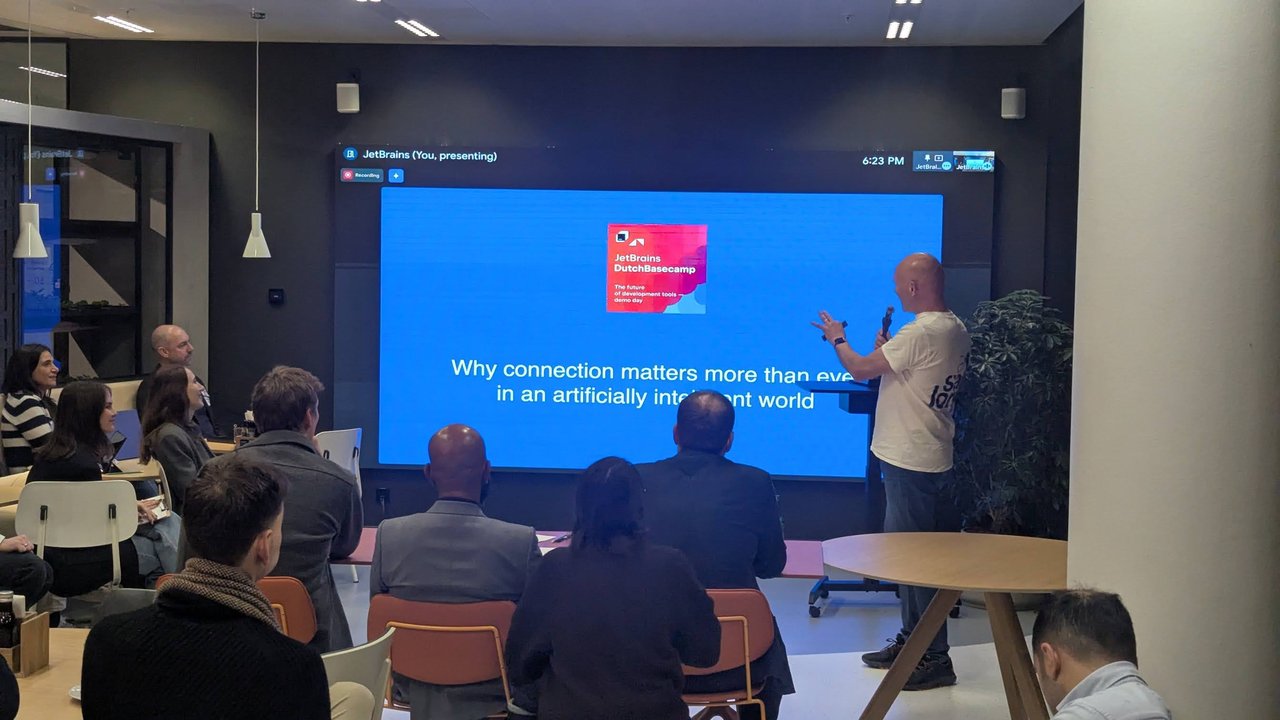
The keynote’s framing slide, before the pitches started.
In the clip from the start of the talk, he told it as a series of stories from his own career rather than as slides. He studied artificial intelligence in Amsterdam and then worked in a bar, which he still recommends to students because you learn to deal with people in the moment. His first company wrote simple rules over big organisations’ payment data to find duplicate supplier payments, and he said he and his co-founder expected machines to make the business obsolete within five years, but it kept running because machines keep making mistakes and people still draw the conclusions. A later product that recognised clothing in TV shows worked technically but nobody could afford to pay for it. His conclusion was that technology keeps being predicted to replace everyone and that this has not happened. In his work he presents AI as support for people, for example helping to inspect roads or sort waste, not as a replacement. He also mentioned a community initiative that brings people around AI together to meet each other, not to talk about the tech. I’m leaving out the personal anecdotes and the names of his companies, because I can’t verify the spelling from the recording.
It was a useful counterweight to the rest of the night. Almost every pitch that followed involved AI agents, generated code or both, and the keynote opened with the case for people and relationships.
My take: I see the same thing in platform engineering work. Tools spread faster when there’s a person who explains them, answers questions in the team channel and takes the blame when a pilot goes wrong. Tools that only arrive as a licence tend to get used much less.
Judges and prizes
The host then introduced the judges. The slide listed Kirill Skrygan, CEO of JetBrains, and Alex Zverev, JetBrains InnovationHub Coordinator, plus a third judge, a startup advisor whose name the host was standing in front of in my photo.
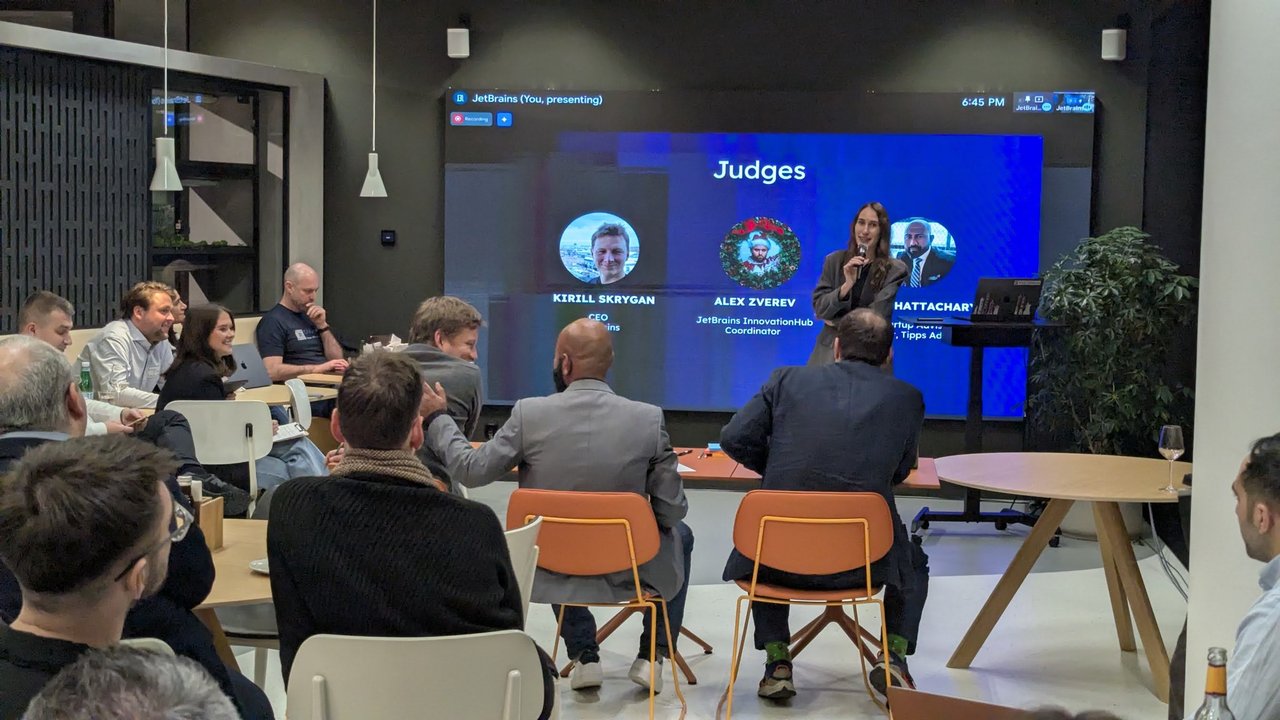
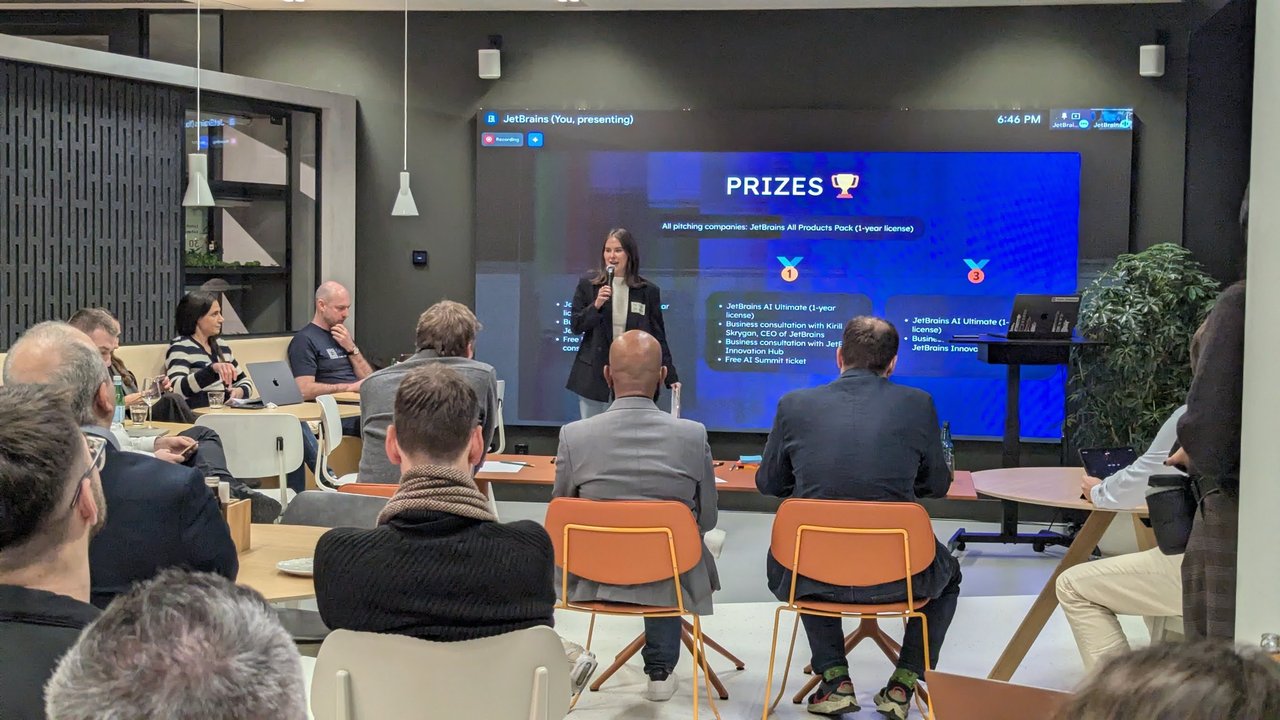
The judges and the prizes, presented just before the first pitch.
The prizes slide promised every pitching company a JetBrains All Products Pack (1-year license). The host read the prizes aloud too. As I heard it, the first three places also got JetBrains AI Ultimate for a year and a consultation with the Innovation Hub, second place added a consultation with Dutch Basecamp, and first place added the consultation with Kirill Skrygan and a free ticket to the AI Summit next year. That matches the slide. The first-place package listed a JetBrains AI Ultimate licence for a year, a business consultation with Kirill Skrygan, a business consultation with the JetBrains Innovation Hub and a free AI Summit ticket. The third-place column also started with JetBrains AI Ultimate and a consultation with the Innovation Hub. The results come in the next section.
Seven pitching companies
The “Pitching companies” slide listed the line-up and where each company was based:
- OneHorizon, Eindhoven, Netherlands
- Tolli, Portland, Oregon, USA
- SirDash, Berlin, Germany
- SaasCade, Dublin, Ireland
- CodeBoarding, Zurich, Switzerland
- AiSentr, London, UK
- a seventh entry in the right-hand column, mostly hidden behind the host. Only “…ky” was visible, and onky pitched later in the evening.
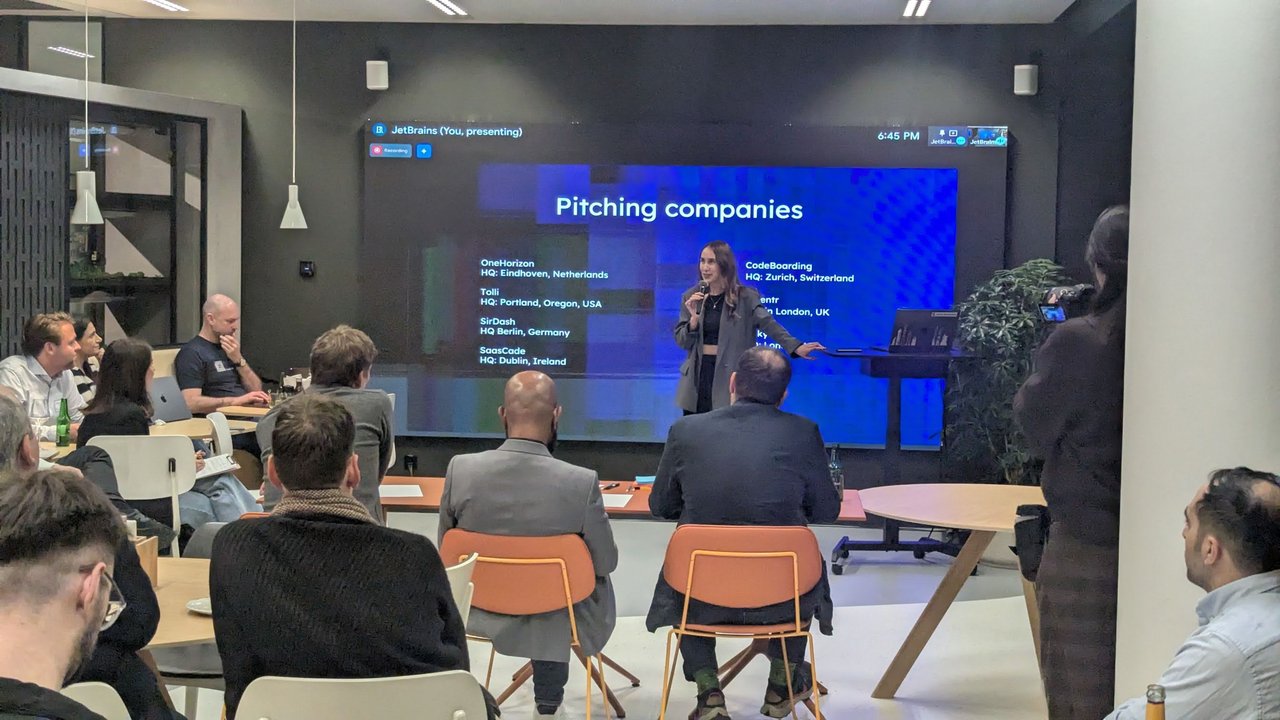
The line-up: teams from the Netherlands, Germany, Ireland, Switzerland, the UK and the US.
I didn’t photograph every pitch, so some get more space here than others.
One Horizon
One Horizon from Eindhoven went first. The slide showed the One Horizon logo next to a screenshot of the product, with a panel titled “Daily Re…” cut off at the edge. That’s all I can read from my photo, but I filmed the pitch and the Q&A.
According to the founder, developers dislike the admin around tickets, status fields and meetings, and One Horizon connects to the tools they already use and writes a “done list”, an AI-generated daily narrative of what happened, so nobody has to update status by hand. It plugs into Slack and is not meant as a rip-and-replace tool. They had launched a beta about a month before and, with no marketing spend, had around 40 weekly active users across about five teams. They planned to raise a seed round, with a plan for small teams, pay-as-you-grow and enterprise tiers.
The judges’ questions were direct. On acquisition, the answer was events and onboarding teams one by one, then selling up to the organisation, with referrals and “pitch it to your manager” flows. On competition, the founder said Jira-style tools focus on planning and they focus on progress reporting. When a judge asked why OpenAI would not just build this, the answer was the accumulated “work graph”: years of what was done, useful for hiring, spotting knowledge gaps and understanding why a service was built the way it was. Revenue was not the focus for next year, growth was.
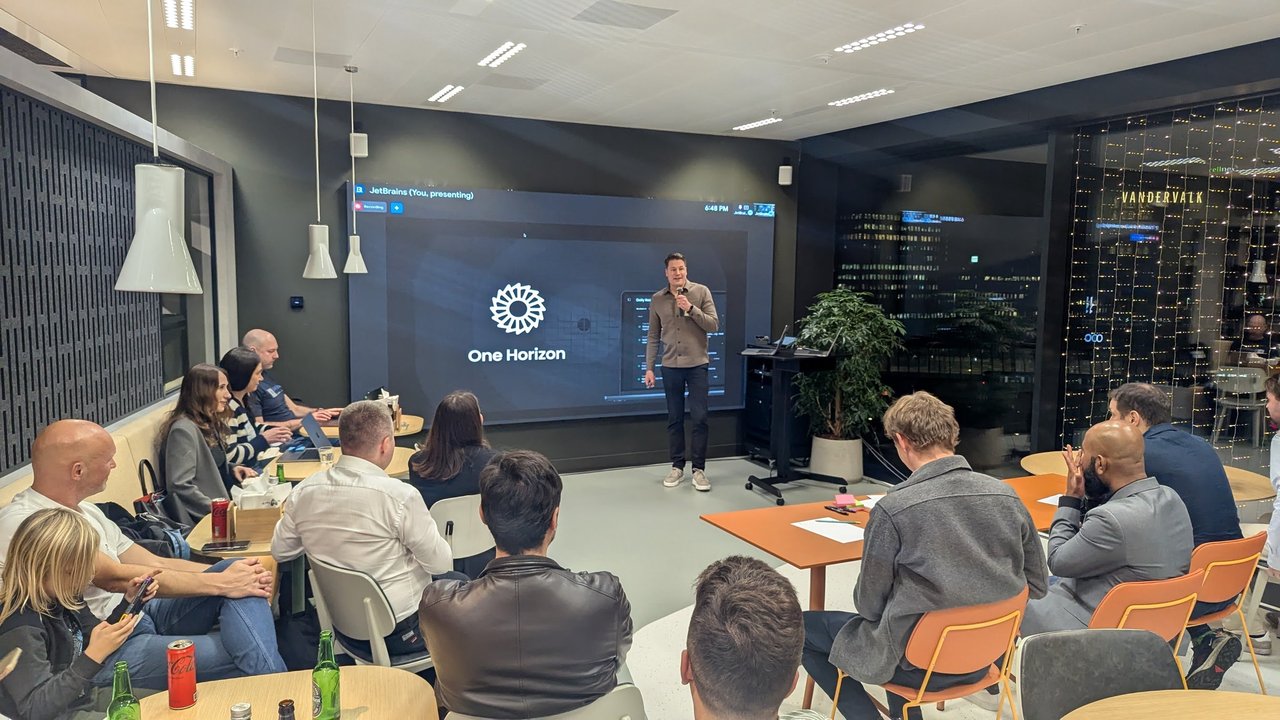
One Horizon opening the pitches.
Tolli, and a slide about the money
Tolli ended on an appendix of “Supplemental Slides” for the Q&A, with tabs for Go-To-Market, Ideal Customer, Pilot, Engineer Research, 10X Engineer, EU AI Regulation and “Invest…” (cut off). I’ve left that photo out because the slide also had contact details on it.
From the pitch: the founder argued that metrics such as pull requests, commits, story points and lines of code no longer say much about engineers, and that existing engineering-productivity tools mostly report activity. Tolli connects to systems such as GitHub and Jira, runs a machine-learning model over how engineers solve problems and handle complexity, and aims to find and grow high-potential engineers. It is a per-engineer subscription. In the Q&A, one person who said they were a product designer thought the price looked high compared with the tools engineering teams already pay for, and asked how it would be justified to CTOs. The founder said they would come back with an answer, which I thought was a fair thing to say.
Later, a pitch ended on a slide called “What $500K Gets You: Key Milestones & Business Targets (2026)”. It was the SirDash pitch: my photo taken a minute later shows the SirDash product on screen. It listed a €2M ARR target by the end of 2026, market validation with growth targets of “2x in Q2 / 3x in Q3”, product maturity and team growth. SirDash demoed a chat interface that turns questions such as “show me the customers according to the region” into tables and charts. In the Q&A, a judge pushed on the semantic layer: how does the system know what “retention” or “product” means for a given company? The founder agreed it was the hard part, said they do that metadata work manually with data marts rather than letting AI do it, and that it takes about a week for a mid-size enterprise with a few hundred tables and is harder for the biggest ones. My take: that answer matches what I see in data and AI projects, where the semantic layer is the real work and the model is the easy bit. Each pitch had to explain both the product and the ask, with the judges taking notes at a table in the front row.
SAAScade: visual spec-driven development
SAAScade from Dublin was the pitch I spent the most time thinking about afterwards. Its main slide put “Visual spec-driven development” in the middle, with “Spec-anchored” and “Source of truth” underneath, and a ring of capabilities around it:
- DDD: easy to understand, ubiquitous language
- Testing: first-class BDD tests, CI/CD
- Secure APIs: REST, GraphQL
- Real-time collaboration: UX-first, task based, workflows, predictable
- High performance: cloud native, scalable, microservices, modular monolith, best practices, reliable, C#, Python, OpenTelemetry
- AI: MCP servers, agents
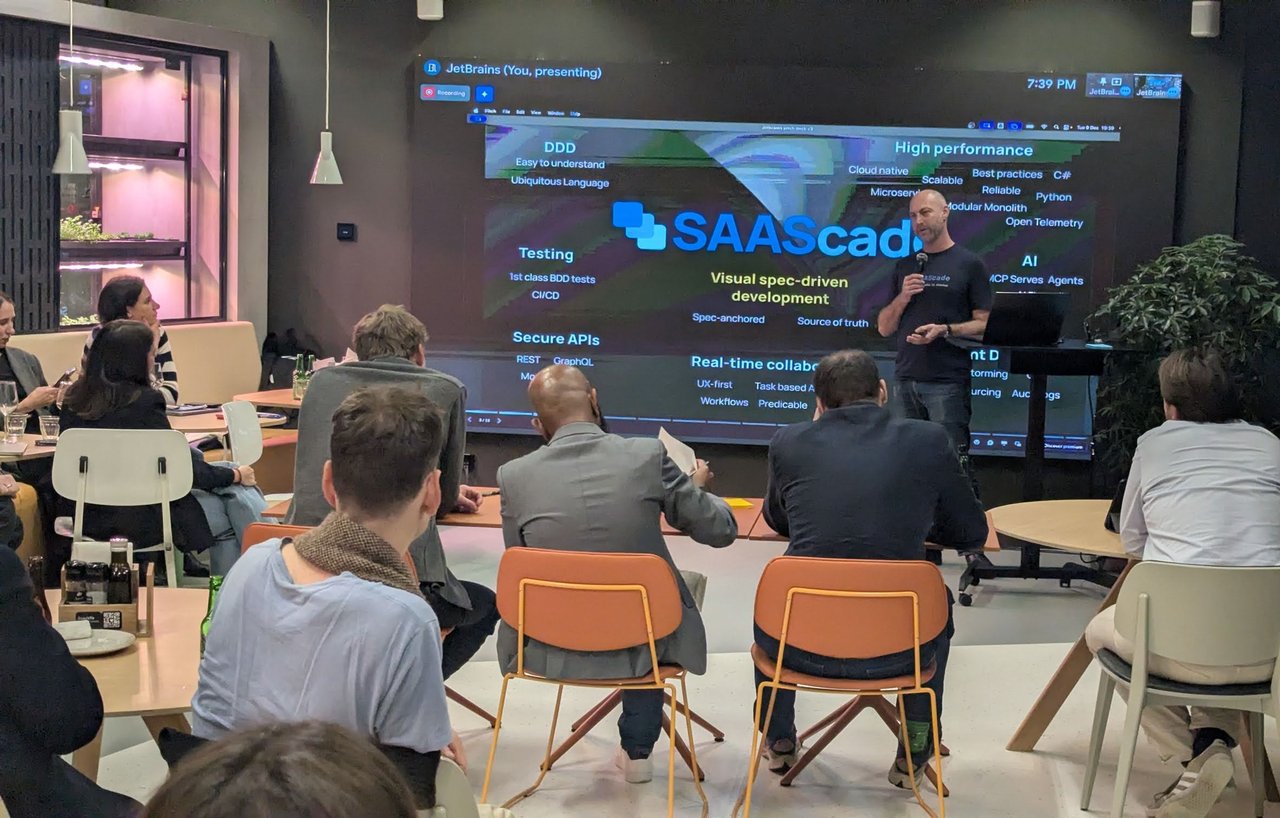
SAAScade’s capability map, with the judges in the two orange chairs.
A later slide showed the designer itself. It’s a canvas where you model entities such as Country, Customer (ID, first name, last name, date of birth, email, postal address), Address and Order with line items, and connect them to a flow that starts from an “Authenticated user” node. The closing slide summed it up as “Low-code for Pros”.
The founder opened by describing a rescue job on a project where seven teams were heading in seven directions, which pushed him to make the design the source of truth and generate code from it. He argued that existing low-code tools aim at non-technical users, produce CRUD-style software, leave you stuck on the last stretch and lock you in. SAAScade instead generates from curated templates, is event-sourced so data is never destroyed and audit trails come for free, and uses an event-driven architecture. He said it suits regulated industries and real-time data. These are vendor claims, so I’d want to see them against a real project.
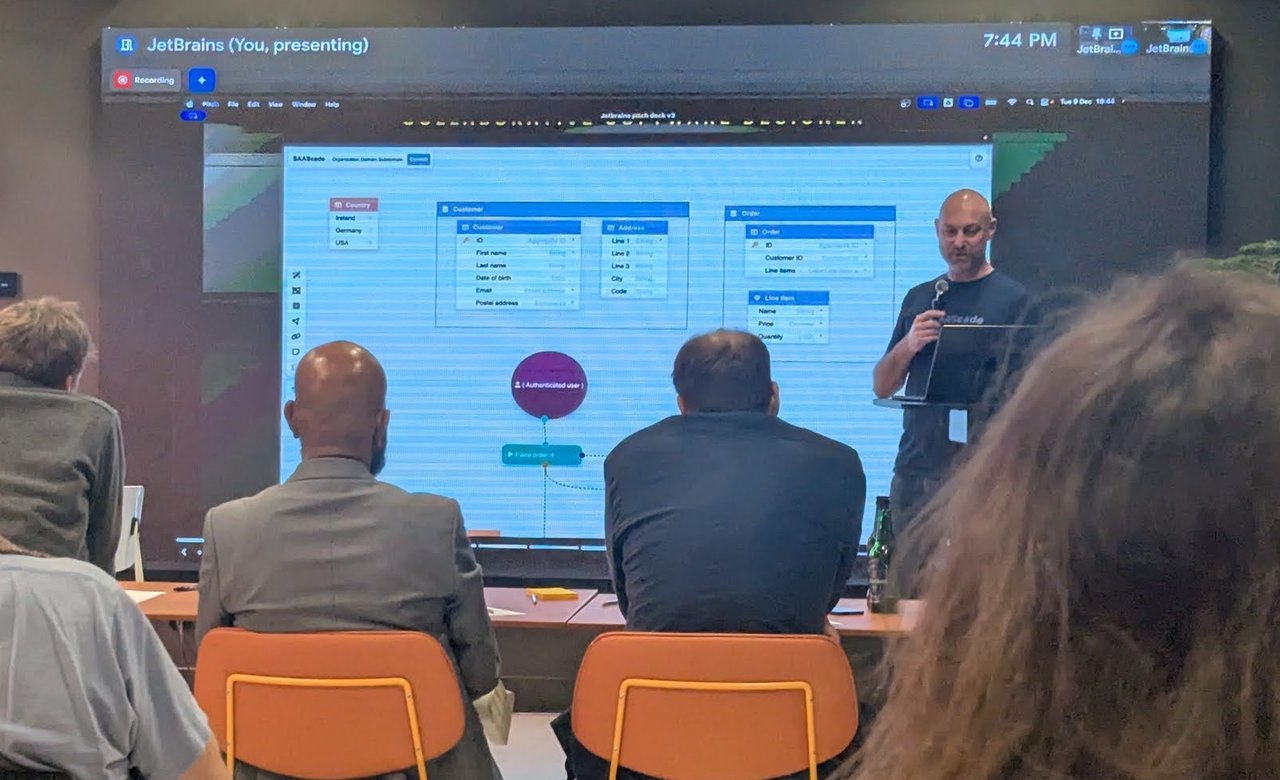
The SAAScade designer: the domain model and a flow on the same canvas.
My take: “Spec-driven” was everywhere in 2025, usually meaning markdown specs that steer a coding agent. I wrote about one version of that from the Datadog User Group’s Kiro talk. SAAScade’s version makes the spec a visual domain model and generates from it. That idea goes back a lot further than LLMs. What has changed is that the “AI: MCP servers, agents” corner is now part of the pitch.
CodeBoarding
CodeBoarding from Zurich pitched “CodeBoarding makes codebases explorable for everyone”, with three audiences side by side: Engineers, Technical PMs and Product owners. The “How it works” strip had three steps. The first was about zooming from a module to a service. The second was “Connect code → team → business impact”. The third was “Always current, across…” (the rest was off the edge of my photo).
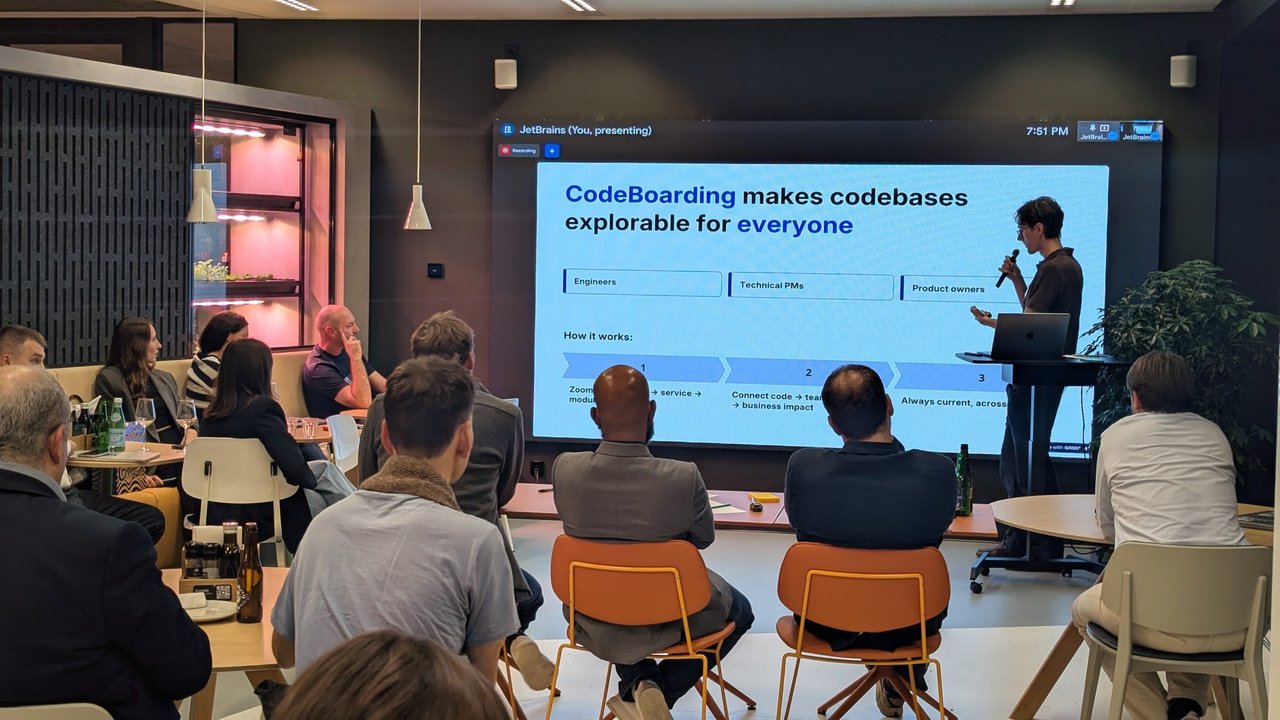
CodeBoarding: one view of the codebase for engineers and non-engineers.
Its business slide was titled “Three moats that compound over time”. It had three columns: Network Effects, Switching Costs (“accumulate organizational context”, “embed to team vocabulary”, “deep integrations”) and a third, partly hidden by a lamp, that included “collect human feedback”. I’m not publishing that photo because the room’s guest Wi-Fi details were on a table sign in the foreground.
AiSentr and onky
AiSentr, from London, opened with “Introducing your business’ ultimate team player”. The founder said the product targets business users such as department owners, not developers, who build an AI agent in a few minutes. In the live demo he built an agent with a trigger, a CRM contact and a Slack message, using the platform’s integrations (about 150, according to him). Asked how they compete with Atlassian, he said they mostly integrate with it, since its users are closer to engineering teams, and that they come up against Microsoft Copilot in deals. The last pitch I photographed was onky: “Agentic App Workspace: Build, run, and collaborate on apps – all in a secure environment.”
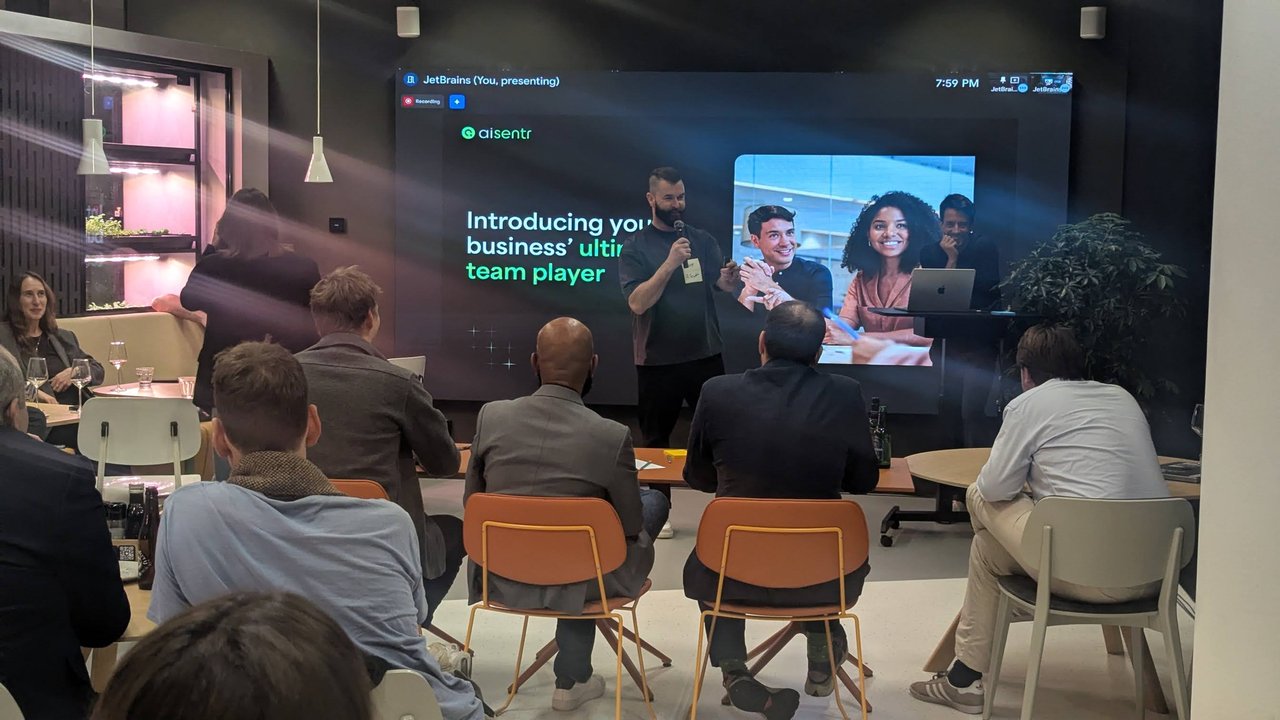
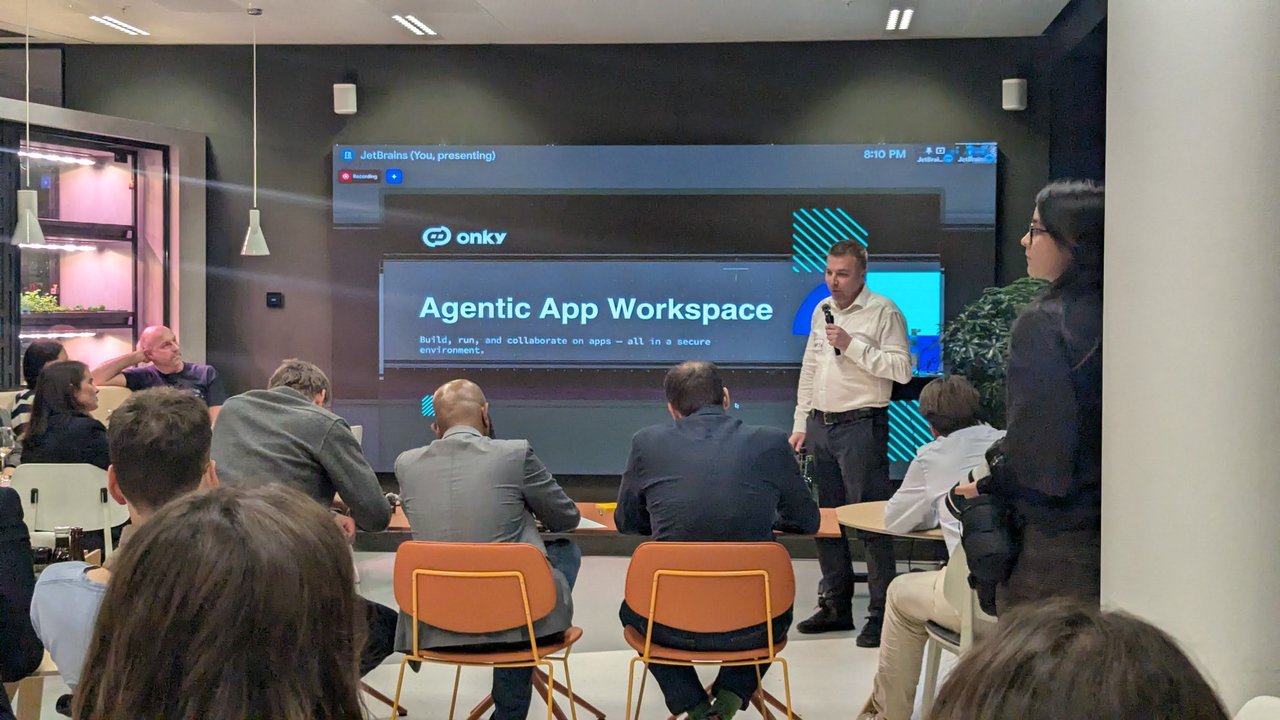
AiSentr and onky, both pitching AI that works alongside a team.
I filmed no clip of onky’s pitch. The CodeBoarding clip I have is only its opening: it asks the audience to picture visualising the largest repository they have worked on, with a dependency graph for engineers and a high-level view of the business logic for product managers.
The results
The prizes were announced informally after the pitches, and I filmed two short clips of it. As I heard it, third place went to onky and second place to One Horizon. I didn’t film the first-place announcement, so I can’t say who won.
What I took away
Looking at the line-up as a whole, three themes kept coming up:
- Making existing code understandable: CodeBoarding’s explorable codebases for engineers and product owners.
- Specs and models as the source of truth: SAAScade’s visual, spec-anchored designer.
- Agents in a controlled space: onky’s secure agentic app workspace, and the “team player” framing from AiSentr.
My take: the tools I’d bet on are the ones that make generated or inherited code easier to understand and govern, not just faster to produce. That’s also why the keynote fit. Every one of these products still needs a team that trusts it enough to change how they work.