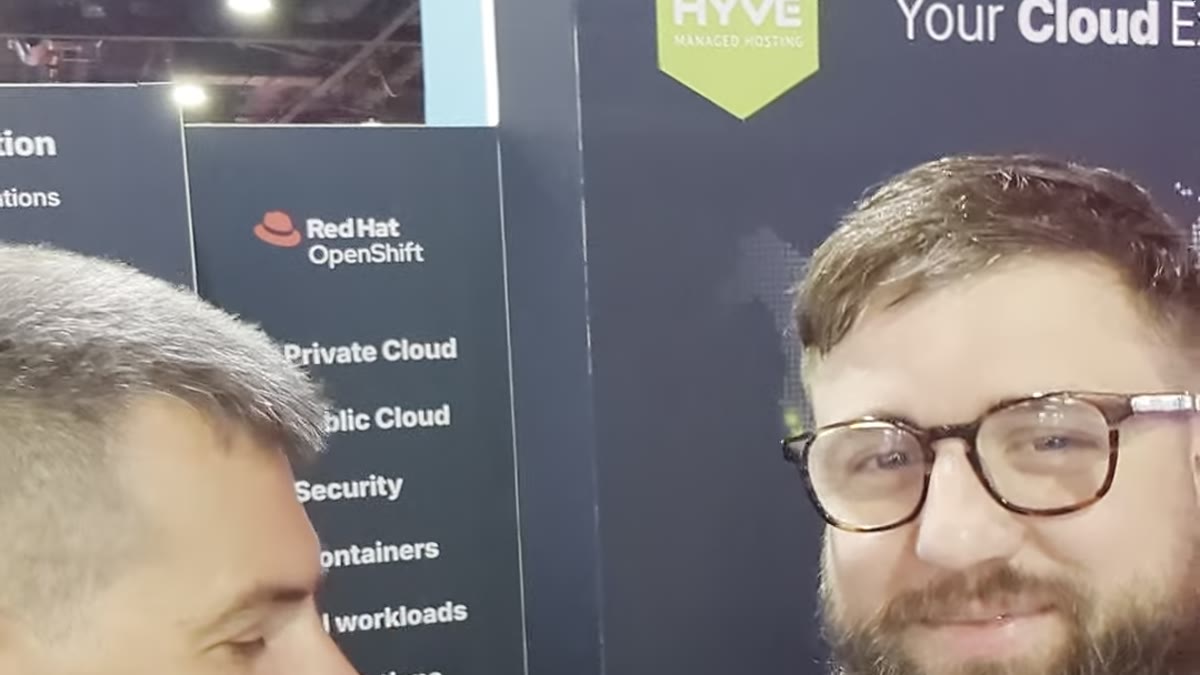
Sovereign cloud kept coming up in nearly every hallway conversation I had at Red Hat Summit 2026 in Atlanta, so when I ran into Jack Ridgway of Hyve Managed Hosting on the show floor, I sat down to get the longer version of the story. Hyve is a managed cloud hosting provider with infrastructure and data centers worldwide, currently running three offices and expanding to a fourth — and Jack’s day-to-day sits right at the intersection of the three themes I kept hearing about all week: sovereignty, VMware displacement, and agentic AI.
Why Sovereign Cloud Is Everywhere Right Now
I have written before about the three layers that “sovereign” actually has to satisfy: data sovereignty (where the bytes physically sit), operational sovereignty (who operates the infrastructure), and software sovereignty (whether a foreign government can compel access regardless of geography — the CLOUD Act problem that a hyperscaler’s EU region alone does not solve). GDPR, Schrems II, the EU Data Act, and the Cyber Resilience Act have turned that from a compliance slide into a procurement requirement for banks, healthcare providers, government agencies, and defense contractors.
That is exactly the gap a managed hosting provider like Hyve is built to fill. Hyve’s portfolio spans private, public, and hybrid cloud, plus dedicated servers and broader infrastructure services — which matters because sovereign requirements rarely apply to an entire estate. A customer typically needs one regulated workload locked down to EU-controlled infrastructure while the rest of the business keeps running wherever it is cheapest or fastest. A pure hyperscaler struggles to offer that split cleanly; a managed provider with data centers across multiple jurisdictions and full control over who operates them can. That flexibility is why sovereign cloud has moved from a niche ask to one of the busiest conversations on the show floor.
VMware-to-OpenShift Migration: A Business Line, Not a Favor
One specialty Jack called out is VMware-to-OpenShift migration, and it is worth being concrete about why that has become a standing service line rather than an occasional request. Since Broadcom’s acquisition of VMware, enterprises have faced steep licensing changes and bundling that pushed a lot of long-time virtualization customers to actively shop for an exit. Red Hat has been positioning OpenShift Virtualization as that landing zone, and the momentum showed up at this very Summit: Everpure won Virtualization Transformation Partner of the Year at the Red Hat Ecosystem Innovation Awards specifically for riding this wave, and the category itself only exists because so many partners are now doing this migration at scale.
For a managed hosting provider, that is a natural fit rather than a side project. Hyve already runs the private and hybrid cloud infrastructure these workloads need to land on, and a VMware exit is rarely just a lift-and-shift — it is re-architecting storage, networking, and operations around Kubernetes primitives while keeping production VMs running throughout. That is exactly the kind of bespoke, infrastructure-heavy engagement a managed provider is positioned to own end to end, instead of a customer stitching together a migration tool, a hosting contract, and a support desk from three different vendors.
Agentic AI on OpenShift AI: The Next Layer on Top
On the AI side, Hyve is building agentic capabilities into its platforms, leaning heavily on OpenShift AI — and Jack said it was one of the topics buzzing loudest across the show floor. That sequencing makes sense: once a managed hosting provider has already migrated a customer’s workloads onto OpenShift and is operating that infrastructure day to day, adding agentic capabilities on OpenShift AI is a logical next layer rather than a separate product. The provider already owns the platform, the observability, and the operational relationship — the same foundation agentic AI needs to act safely inside a customer’s environment, especially when that environment also has to stay within sovereign boundaries.
True to form, Hyve’s engagements are bespoke across all of this: the team scopes requirements, use cases, and infrastructure needs before speccing an exact solution, rather than selling a fixed package and hoping it fits. Worth a look at hyve.com if sovereign cloud, VMware migration, or agentic AI on OpenShift is on your roadmap.
Related Reading
- Red Hat Summit 2026 in Atlanta: Open Source Meets AI
- Sovereign Cloud: Building EU-Compliant Infrastructure That Actually Works
- Meet Pepijn Oomen: Building Europe’s Sovereign Cloud at KubeCon 2026
- Redpill Linpro at KubeCon EU 2026: Sovereign Cloud
- Operationalizing OpenShift Virtualization at Red Hat Summit 2026
About the Author
I am Luca Berton, AI and Cloud Advisor. I work at the intersection of platform engineering, cloud security, and enterprise AI deployments. Book a consultation.