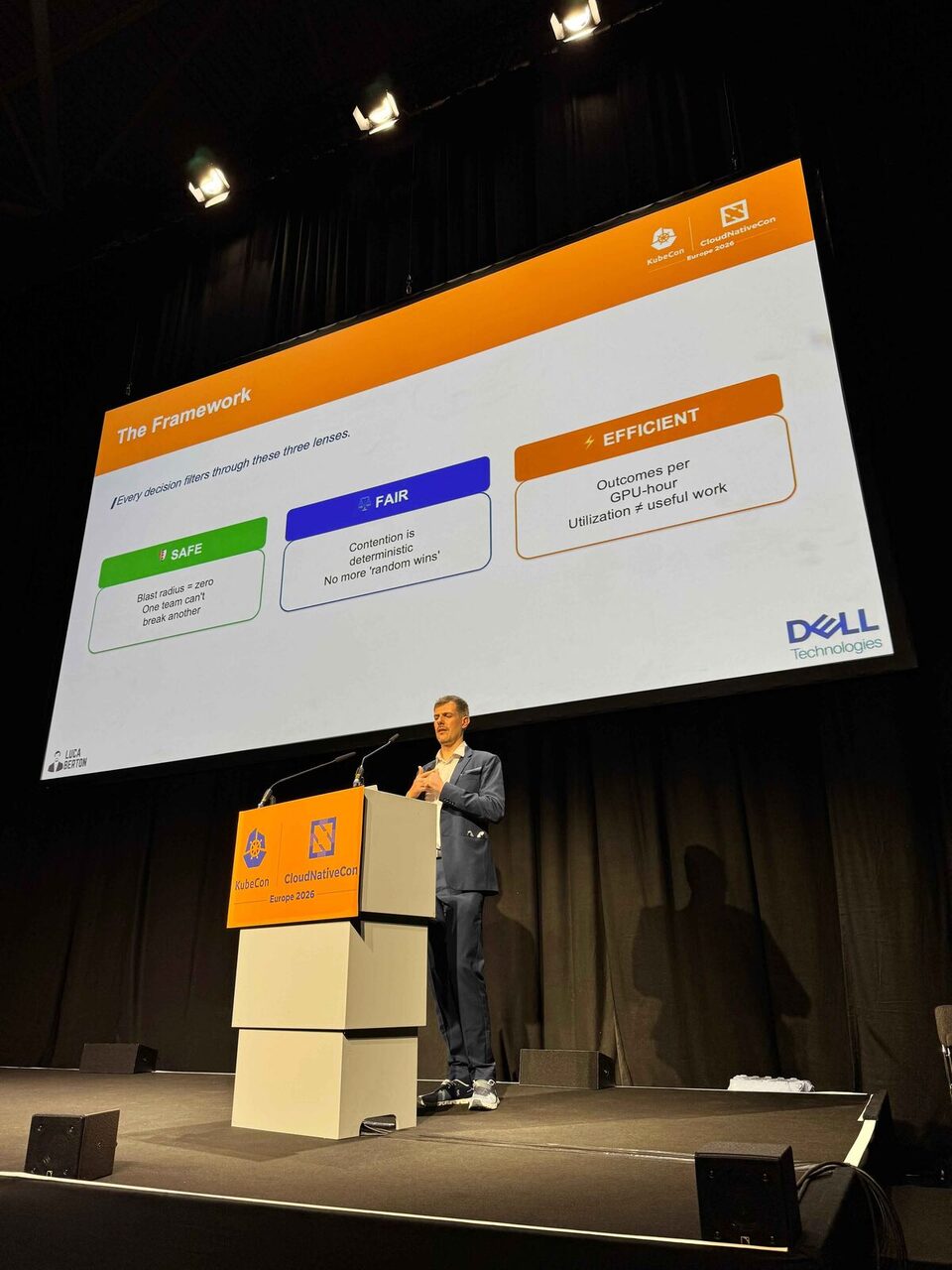
The numbers at KubeCon Europe 2026 were staggering. In just five months — October 2025 to February 2026 — the AI inference sector attracted billions in venture capital. This is not hype. This is where the money is moving, and Kubernetes is at the center of it.
The Market: $255 Billion by 2030
The inference market is projected to reach $255 billion by 2030, growing at 19.2% CAGR from $106 billion in 2025. The shift is dramatic:
- 2023: 33% of AI compute went to inference
- 2026: 67% of AI compute goes to inference
Training gets the headlines. Inference gets the revenue.
Five Months That Changed Everything
Between October 2025 and February 2026, the inference startup ecosystem exploded:
Baseten (Model Serving) — $5.0B valuation, $300M raised (January 2026) The highest-valued pure inference company. Their model serving platform handles deployment, autoscaling, and GPU orchestration.
Fireworks AI (Inference Cloud) — $4.0B valuation, $250M raised (October 2025) Inference-as-a-service with optimized serving for popular open models. Their speed on Mixtral and LLaMA models set industry benchmarks.
Modal Labs (Serverless GPU) — $2.5B valuation (in talks), $50M ARR Serverless GPU compute that developers love. You write Python, Modal handles the infrastructure. $50M in annual recurring revenue is real traction.
Modular (Compiler/Runtime) — $1.6B valuation The Mojo language creators building a unified AI compiler stack. Their bet: inference performance comes from the compiler, not just the hardware.
Inferact — $800M valuation (January 2026) RadixArk — $400M valuation (January 2026) Both spun out of the same Berkeley lab. Combined valuation of $1.2 billion in the same week.
Tensormesh — Seed stage Even at the earliest stages, new inference startups keep appearing.
Why Inference Is Harder Than It Looks
Training a model is expensive but straightforward: throw GPUs at data until the loss converges. Serving that model to millions of users is where the real engineering happens.
LLM inference is fundamentally different from traditional API serving:
- Autoregressive generation — each token depends on all previous tokens
- KV cache growth — memory usage grows linearly with conversation length
- Variable cost per request — a 10-token prompt costs orders of magnitude less than a 10,000-token prompt
- Latency sensitivity — users are watching tokens stream in real time
Standard load balancers, autoscalers, and service meshes were not designed for this.
The Four Technical Pillars
1. Disaggregated (xPyD) Serving
The breakthrough architecture that separates prefill (processing the prompt) from decode (generating tokens):
User Prompt → [Prefill Pod: x GPUs] → KV Cache → [Decode Pod: y GPUs] → TokensWhy disaggregate?
- Prefill is compute-bound — needs raw GPU FLOPS to process the prompt in parallel
- Decode is memory-bound — generates one token at a time, needs GPU memory bandwidth
- Different hardware profiles — prefill wants compute-dense GPUs, decode wants memory-bandwidth GPUs
- Independent scaling — scale prefill and decode separately based on traffic patterns
The “xPyD” notation means x prefill pods, y decode pods. A 2P4D configuration runs 2 prefill instances and 4 decode instances, optimized for workloads with shorter prompts but longer generations.
llm-d, the new CNCF sandbox project, implements this natively on Kubernetes using LeaderWorkerSet for multi-pod orchestration.
2. Kubernetes-Native Inference
The Gateway API Inference Extension (GAIE) makes Kubernetes inference-aware:
apiVersion: inference.networking.x-k8s.io/v1alpha1
kind: InferencePool
metadata:
  name: llama3-70b
spec:
  targetPortNumber: 8000
  selector:
    matchLabels:
      app: llama3-inference
  endpointPickerConfig:
    extensionRef:
      name: inference-epp
---
apiVersion: inference.networking.x-k8s.io/v1alpha1
kind: InferenceModel
metadata:
  name: llama3-70b
spec:
  modelName: meta-llama/Llama-3-70B
  pool:
    name: llama3-70b
  criticality: critical
This is not a sidecar or a proxy hack. It is native Kubernetes API resources that route inference traffic based on model state, cache locality, and queue depth.
3. Tiered Prefix Caching
When multiple requests share a common prefix (system prompt, few-shot examples, document context), the KV cache for that prefix can be reused:
Tier 0: GPU HBM    — hot prefixes (system prompts, active conversations)
Tier 1: CPU RAM    — warm prefixes (recent but not active)
Tier 2: NVMe SSD   — cold prefixes (available for reuse)
Tier 3: Network — shared prefix store across nodesImpact: For chatbots with a standard system prompt, prefix caching eliminates 80-90% of redundant computation. For RAG applications where documents are prepended to every query, it is even more dramatic.
The routing layer must be prefix-aware — sending a request to a pod that already has the relevant prefix cached is orders of magnitude faster than cold-starting the computation.
4. Multi-Accelerator Support
The inference gold rush is also a hardware war:
- NVIDIA H100/B200 — the default, best software ecosystem
- AMD MI300X — competitive on memory bandwidth, better price per GB
- Google TPU v5e — cost-effective for large batch inference
- Intel Gaudi 3 — targeting the mid-range inference market
- Custom ASICs — Groq, Cerebras, SambaNova for specialized workloads
A production inference platform cannot be locked to one vendor. The cost arbitrage between accelerators is significant — AMD MI300X offers 192GB HBM3 versus H100’s 80GB HBM3, making it better suited for large models that are memory-bound during decode.
Kubernetes with GPU Operator and multi-tenant scheduling provides the abstraction layer to schedule across heterogeneous hardware.
What This Means for Platform Teams
You Are Building an Inference Platform Whether You Know It or Not
Every enterprise adopting AI internally is building inference infrastructure. The question is whether you do it with ad hoc scripts or with a proper platform.
The stack is converging on:
- Model storage: OCI registries with ORAS/Harbor
- Data caching: Fluid for model weight acceleration
- Inference serving: llm-d with disaggregated architecture
- Security: Kubescape 4.0 for AI workload scanning
- Orchestration: Kubernetes with GAIE and KV-cache-aware routing
Build vs Buy
The $5B valuations are a signal: inference-as-a-service is a real business. But so is building in-house:
Buy (Baseten, Fireworks, Modal) when:
- You serve open models without customization
- Volume is variable and hard to predict
- You need to ship in weeks, not months
Build (Kubernetes + llm-d + vLLM) when:
- You serve fine-tuned or proprietary models
- Volume justifies dedicated GPU capacity
- Data residency or compliance requires on-premises
- You need full control over cost optimization
For most enterprises, a hybrid approach works: buy for experimentation, build for production workloads that justify dedicated infrastructure.
The vLLM Factor
Behind many of these startups is vLLM, the open-source inference engine with 2,000+ contributors, adopted by every major hyperscaler including Amazon. vLLM provides:
- PagedAttention for efficient KV cache management
- Continuous batching for throughput optimization
- Tensor parallelism for multi-GPU serving
- Speculative decoding for latency reduction
vLLM is to inference what NGINX was to web serving — the engine everyone builds on top of. The startups add scheduling, autoscaling, routing, and business logic around it.
My Prediction
By end of 2026:
- The inference market will have more venture capital invested than the training market
- Disaggregated serving (xPyD) will be the default architecture, not the exception
- Kubernetes will be the standard control plane for inference, via GAIE and llm-d
- At least one of the $4-5B startups will IPO or be acquired by a hyperscaler
The gold rush is real. The infrastructure is Kubernetes.
Related Resources
- llm-d: CNCF Distributed LLM Inference
- 7 CNCF Predictions for 2026
- AI on Kubernetes in Production (10-Part Series)
- Multi-Tenant GPUs on Bare Metal
- GPU Kubernetes Guide
- NVIDIA GPU Operator
- Kubernetes AI Conformance
- AI Model Weight Distribution
- Token Economics for AI
- Autoscaling AI Inference
About the Author
I am Luca Berton, AI and Cloud Advisor. I presented on GPU scheduling at KubeCon EU 2026 and help enterprises design inference platforms. Book a consultation to architect your inference infrastructure.