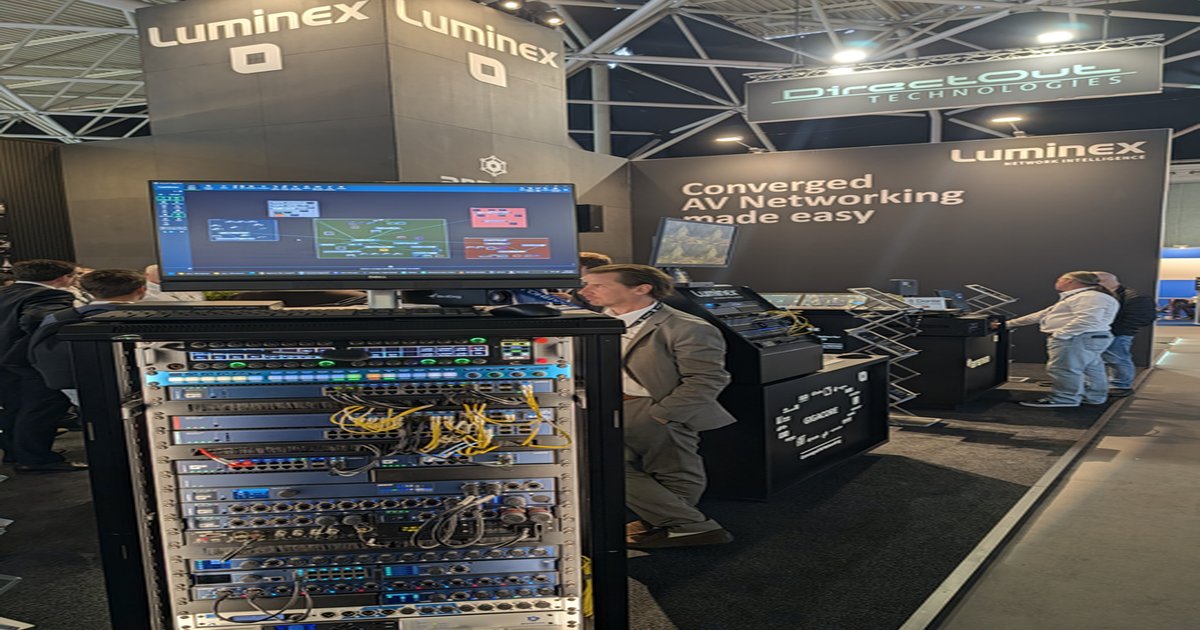
When I walked the IBC 2026 show floor, the word on everyone’s lips wasn’t just “AI” — it was “operational reality.” The “look what this AI can do” demos have given way to “here is how this AI scales to millions of concurrent streams.”
The shift from novelty to infrastructure is the defining story of IBC 2026, and nowhere is that more evident than across the media production value chain.
AI from contribution to distribution
LiveU’s VP of Product Marketing Roy Hasson summed it up: “AI has moved decisively from experimentation to operational reality. The trials broadcasters ran in the years after the Covid-19 pandemic have matured into genuine workflow transformation.”
On the contribution side, AI is helping broadcasters manage remote, distributed, and hybrid workflows more intelligently — matching the right technology and teams to individual use cases. In production, multi-layered models blend AI, hybrid human-AI workflows, and cloud-native processes. And in distribution, intelligent orchestration ties it all together, allowing productions to move seamlessly from planning to air.
LiveU’s new LiveU IQ (LIQ) intelligence layer — built natively into the LU900Q production unit — uses AI alongside historical transmission data and eSIMs to dynamically switch mobile network operators in real time. “The highest-performing available network in any location, even in traditionally challenging environments like stadiums at peak moments,” Hasson noted.
Where to draw the line
But Hasson also drew clear boundaries: “Where I’d draw the line is anywhere AI starts making editorial or truth decisions rather than technical ones. AI should be making broadcasting more reliable, not more creative.”
This human-in-the-loop approach is echoed across the industry. As Hasson put it: “AI should be making broadcasting more reliable, not more creative.”
The Delta Protocol: Reframing live streaming
The Delta Protocol Accelerator project — championed by EBU, RAI, IET, SMPTE, SBA, and DAZN alongside participants Google Cloud, V-Nova, Eluvio, and NeoViews — is perhaps the most ambitious rethink of the streaming architecture.
Rather than transmitting pixel by pixel, Delta Protocol moves devices to generate the viewing experience from AI-defined scene data. The approach offers a blueprint for a more sustainable ecosystem, addressing hyper-personalisation for viewers, cutting the cost and complexity of delivery, and closing off the routes that make piracy possible.
Netflix opens its production toolkit
Anna Mallett, VP Production for EMEA at Netflix, announced at the IBC Conference that the streamer’s Media Production Suite is being opened to third-party tool integration. “We’re making it safe and easy for people to explore,” she said.
The platform already supports AI-driven features like automated transcription, shot identification, and character dialogue attribution — demonstrated on productions like Formula 1: Drive to Survive, where footage is tagged and transcribed as soon as it hits the cloud.
“The next chapter for MPS involves integrating AI-driven tools that automate time-consuming tasks,” Mallett explained. “Tools that can identify errors, such as equipment in shot, generate transcripts at the end of each take, attribute dialogue to characters, and make different characters searchable within footage.”
Agentic AI gets practical
Across the show, vendors were demonstrating agentic AI systems that go beyond simple automation:
- Mediaproxy’s LogServer now features extensive AI integration designed to redefine traditional workflows, automating routine human checks, enhancing real-time event detection, and giving operators smarter tools for live transmission.
- Interra Systems added Maestro, a built-in AI assistant to its Baton Captions platform, providing contextual product answers alongside automated AI generation of content summaries and scene tags.
- Dalet’s Dalia platform combines conversational AI with an orchestration layer and multi-agent framework, translating natural language user intent into structured, executable workflows.
- SDVI’s Rally platform introduced an agentic AI interface that coordinates complex supply chain tasks.
Content authentication and provenance
As AI-generated content becomes more sophisticated, the industry is investing heavily in content authenticity. Unified Streaming’s Trusted Media adds verifiable authenticity information to live, on-demand, and virtual channel streams, embedding C2PA information into just-in-time streaming workflows — publisher identity, source attribution, editorial context, and responsible AI disclosures.
This addresses a growing need as video is increasingly generated or manipulated by AI across multiple platforms, and as European media organisations adapt to the EU AI Act’s transparency requirements for AI-generated and manipulated content.
AI for media asset management
Limecraft’s version 2026.4 introduced team-based access control and GPU-accelerated processing, while Profuz Digital’s Lapis platform added AI-assisted search across all data types. These tools are making it possible for organisations to unlock value from their existing archives — as Netflix’s approach of creating a searchable archive of half a million hours of video demonstrates.
The human-AI collaboration model
What emerged clearly from IBC 2026 is that the most successful AI deployments aren’t about replacing humans — they’re about amplifying human creativity. As film editor Ant Boys (known for The Great and Veep) observed: “I think editors’ jobs will be okay unless something drastic changes. I’m particularly interested in AI’s organisational potential.”
The key is using AI to handle the mechanical parts — finding shots, transcribing dialogue, tagging content — so that humans can focus on creative decisions. As Boys noted, the ability to organise things and make them accessible is “really exciting.”
I am Luca Berton, AI and Cloud Advisor. I work at the intersection of cloud security, platform engineering, and enterprise AI deployments. Book a consultation.