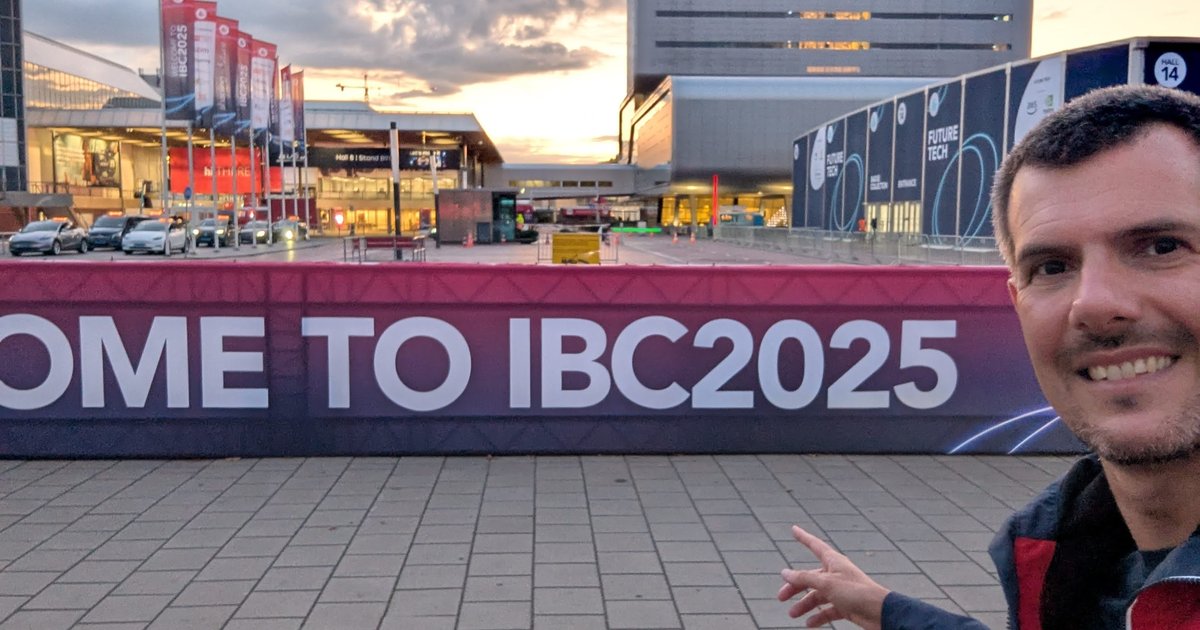
From 12 to 15 September 2025 I walked the halls of IBC 2025 at the RAI in Amsterdam. IBC is a broadcast and media show, not a cloud-native conference, but a lot of what I saw was infrastructure: vector search over media archives, AI in the streaming delivery path, video over IP networks and private 5G for live production.
These notes come from my photos of slides, stands and product cards, plus the short videos I recorded on the floor. I only name people whose names appeared on a slide.
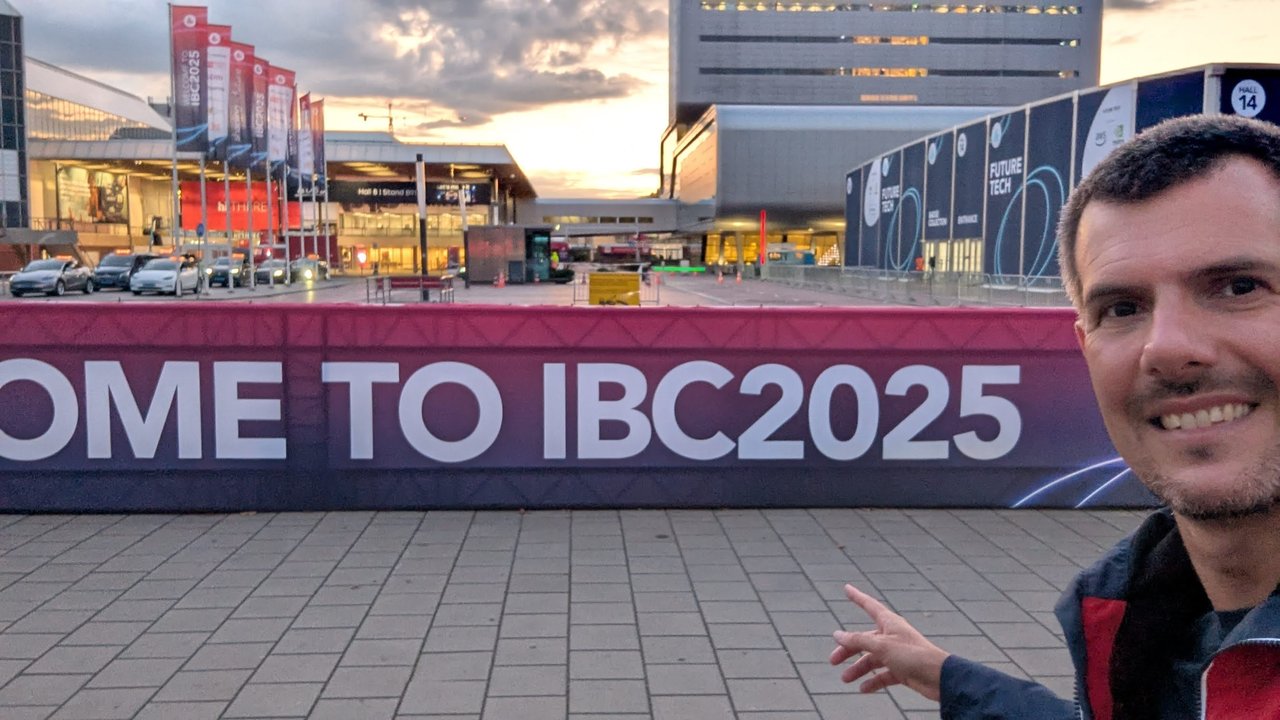
The RAI on the Wednesday evening before the show, with the Welcome to IBC2025 banner already up and the Future Tech hall on the right.
Day 1: AWS media search with S3 Vectors and OpenSearch
The most useful slide of the first day was on an AWS screen: “Demo Architecture (Search)”, a semantic search over a media archive. The numbered flow on the slide went like this:
- Authenticated users reach a custom application hosted on Amazon ECS through Amazon CloudFront and an Application Load Balancer.
- The user enters a search phrase to search the media archive.
- The application vectorises the phrase with Amazon Bedrock, using the Twelve Labs Marengo model.
- Search with S3 Vector Index: the application queries an S3 vector index with that embedding to find the top K matches (KNN search) through the S3 Vector API. Metadata filtering is applied afterwards, and the results come back with a preview in a web player.
- Search with Amazon OpenSearch integrated with S3 Vector Index: the application calls Bedrock again to build an OpenSearch API query with a Claude 4 model, and sends that query plus the search vector to Amazon OpenSearch Service.
- OpenSearch runs a KNN query with metadata filtering to find the top K and returns the results, again with a preview.
The media itself sits in Amazon S3.
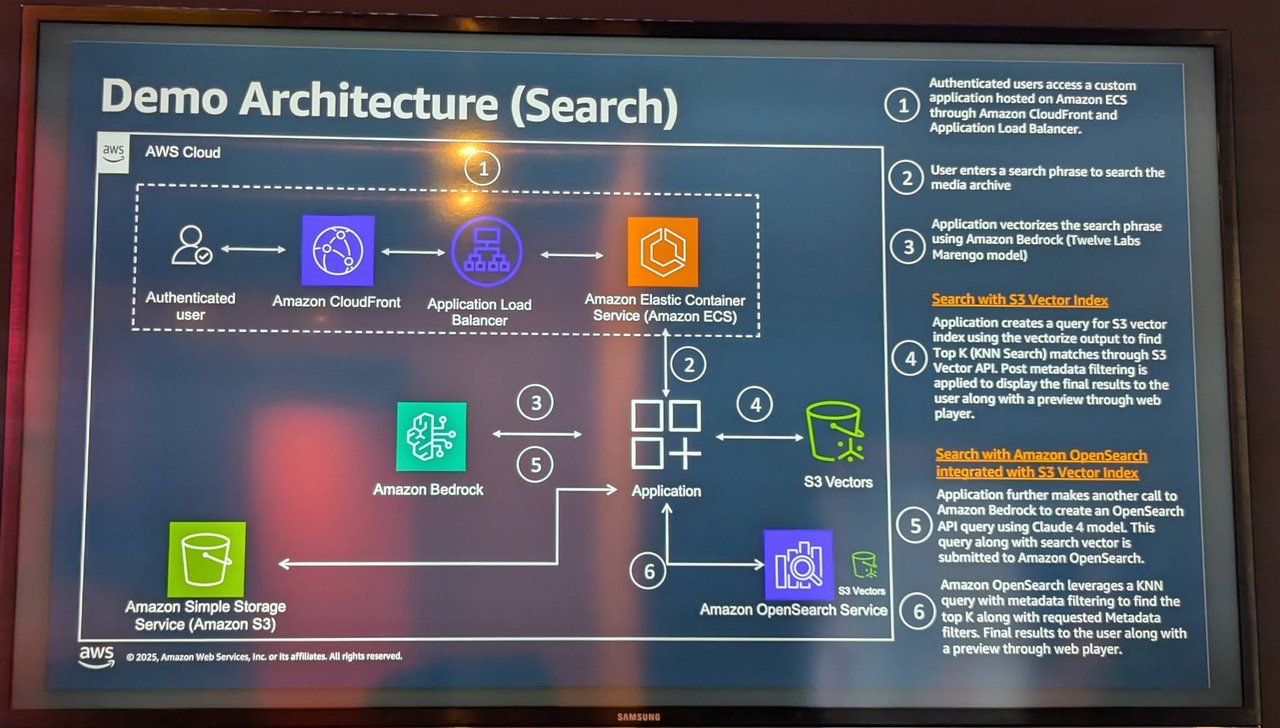
Two search paths over the same embeddings: straight to an S3 vector index, or through OpenSearch backed by S3 Vectors.
I checked the slide against the Amazon S3 Vectors documentation. S3 Vectors adds vector buckets, a new bucket type, and vector indexes inside them, where you run similarity queries. You can attach metadata to each vector and filter on it. AWS quotes sub-second latency for infrequent queries and as low as 100 milliseconds for more frequent ones, and says S3 Vectors “is ideal for workloads where queries are less frequent”. The same page lists the OpenSearch Service integration for workloads that need hybrid search, aggregations, advanced filtering or faceting, and Bedrock Knowledge Bases as the RAG option. That explains why the demo showed both paths.
My take: this is the pattern I’d use for a media archive. Most archive queries are rare and bursty, so cheap object-storage vectors are a good default. You add OpenSearch only where you need richer queries, filters or higher QPS. The Claude step in path 5, turning a phrase into a structured OpenSearch query, is the part I’d test hardest. A bad query plan returns confident nonsense. I compared the self-hosted options in vector databases on Kubernetes: Qdrant, Milvus and pgvector.
The rest of day 1 was the classic IBC mix: Signiant (“Move Large Files Fast”), a Blackmagic Design area with a SMPTE-2110 IP sign over a monitor wall running 1080p59.94, Zero Density’s virtual-production stage, and a SIRUI 1.33x auto-focus anamorphic S35 cine lens (20mm T1.8). In the short clip I recorded that afternoon I said I was “quite impressed how many big companies, how many small producers are here in this gigantic venue”. That held for all four days.
Day 2: AI in the streaming path
On 13 September I sat in on a panel on one of the show-floor stages. The first slide I photographed was “Streaming without limits: going beyond delivery”:
- “Video rules the web”, with a share of all traffic that I couldn’t read reliably in my photo.
- “Streaming live, multilingual, moderated, ultra-low-latency content is a growing challenge.”
- “CDNs move the data but don’t think about it. AI brings the intelligence to understand, adapt, and protect your streams.”
A timeline below it, “Evolution of streaming requirements (2010 → 2025)”, went from adaptive bitrate streaming (HLS, DASH) in 2010, to the rise of streaming platforms such as Netflix and YouTube in 2015, to the start of AI adoption in 2020 (low latency, basic auto-captions, moderation with delay), to “AI & Edge mainstream” in 2025: real-time captions, live moderation and AI delivery optimisation.
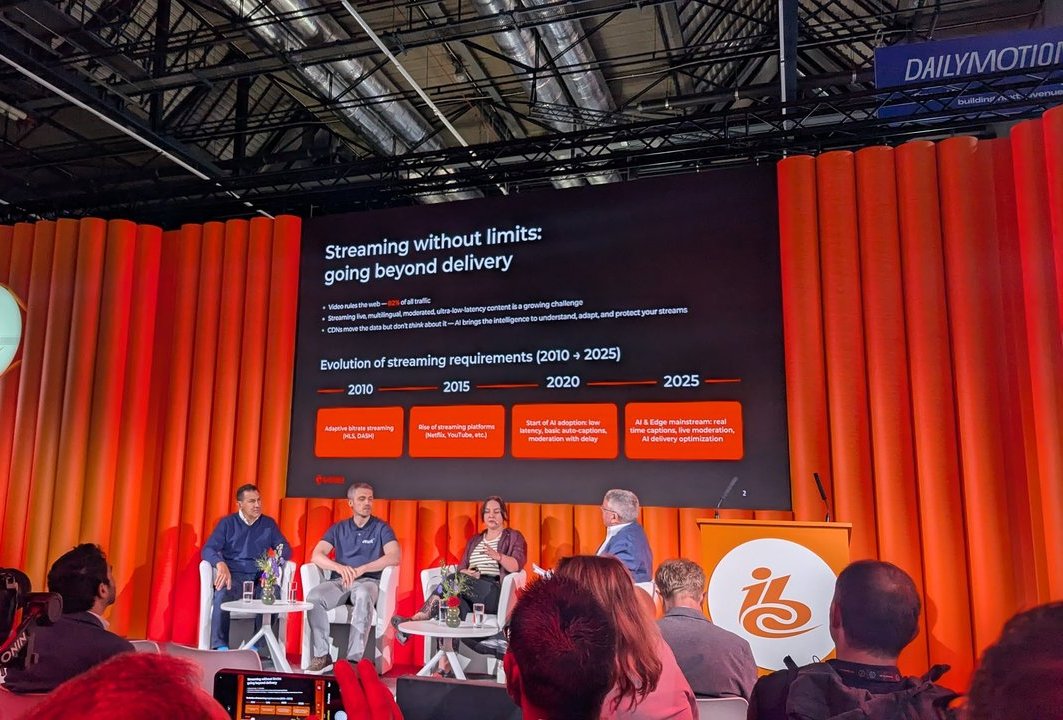
From HLS and DASH in 2010 to “AI & Edge mainstream” in 2025, according to the panel’s timeline.
The next slide, “AI for QoS and QoE”, made four claims: scale traffic automatically to avoid buffering, AI bitrate control for smooth and stable streams, detect anomalies instantly to keep quality high, and smarter transcoding that cuts costs and boosts performance. Under it was a chart of a hit ratio swinging between 0% and 100% across a morning, at 15-minute intervals from 03:30 to 09:15.
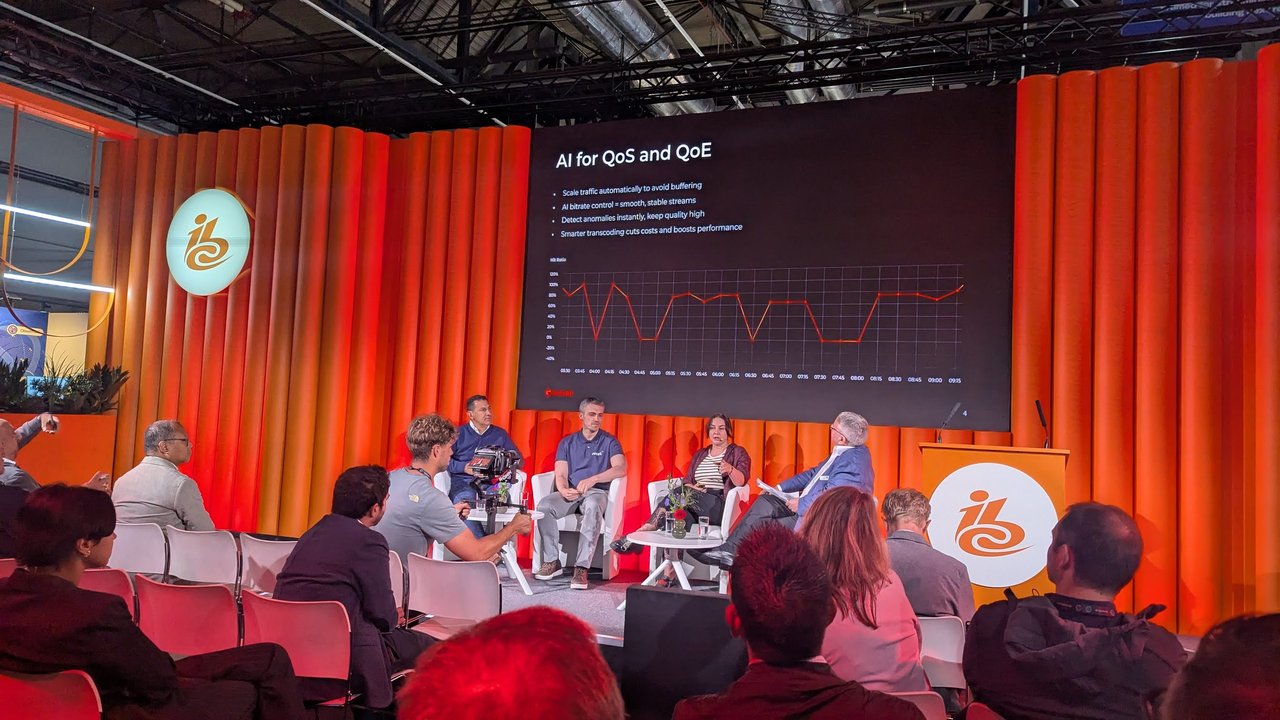
The hit-ratio chart was the most honest thing on the slide: the problem is the drops, not the average.
My take: everything on that slide is an observability and autoscaling problem. Anomaly detection on cache-hit ratio, rebuffering and bitrate is the same work as SLO alerting on any platform. The difference is that viewers notice in seconds. I’d start with good telemetry and simple thresholds before reaching for a model.
The same stage also hosted a SaaS playout company. Its slide read “Who: Veset”, “Since: 2011”, “From: Latvia”, “Focus: SaaS cloud playout, Veset Nimbus”. In a separate session that afternoon, recorded on my phone, a speaker who edits in DaVinci Resolve described the assistive AI he relies on: tools that classify sound effects and attach metadata to clips, and tools that separate a voice from background noise. In his words, these handle the “mundane, menial jobs” and make noisy sets workable without taking away the creative part.
On the floor, Vislink showed private 5G network solutions with acromove and Grass Valley. The stand listed four promises: an end-to-end solution for live coverage, a flexible and scalable network, secure and reliable live video transmission, and rapid deployment.
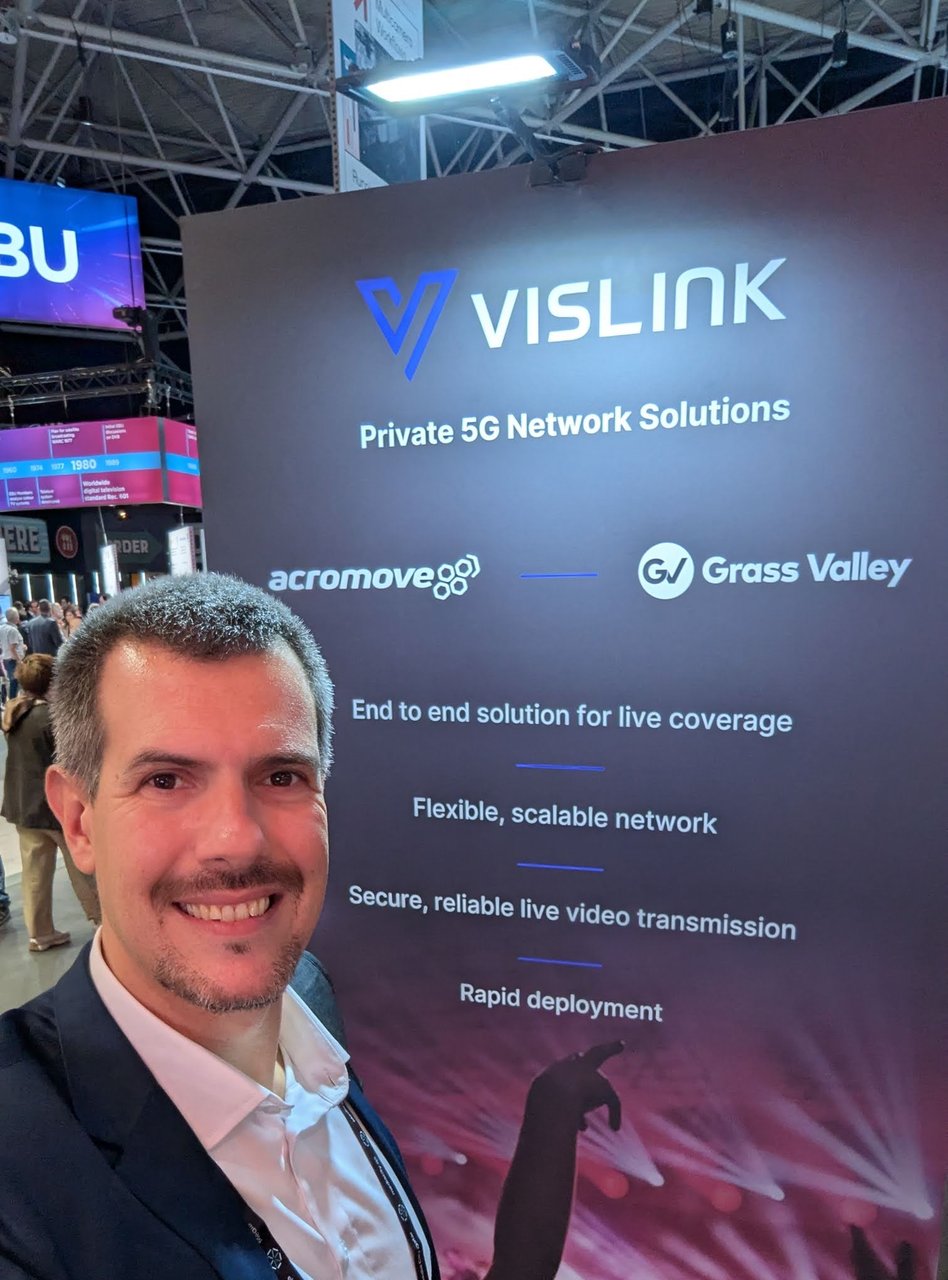
Private 5G for live production: a dedicated network instead of competing with the crowd’s phones for bandwidth.
Other stops that day: OBSBOT’s Tail 2 (“4K Live Production, AI-Powered PTZR”, MSRP €1499), Western Digital’s WD Red Pro and Ultrastar drives, a LucidLink and AWS “Audio innovation” podcast studio, Wowza, Zattoo (“Launch OTT”), and stands promoting GITEX and MWC Doha.
Day 3: ST 2110 on a PCIe card
On 14 September I went through the creator-gear halls: Samyang’s AF 16mm F2.8 P FE lens, Lexar storage, Visico’s LED-50AII bi-colour panels, a Raubay collapsible chroma-key screen (“set up in 10 seconds”), Feelworld PTZ cameras, Zhiyun fill lights, Shure, Fotopro tripods, and a YoloLiv stand advertising the “industry’s first & only 4K video switcher under $2,000”. That last one is the vendor’s claim, not mine.
The stand I spent longest at was Matrox Video. The wall read “Developer Products: 100/25/10 GbE · ST 2110 · IPMX · Multi-Channel 12G-SDI · XAVC Hardware Codec”. The cards included the Matrox X.mio5 D25, described as an “ST 2110 dual 25GbE NIC plus on-board video processing for IP workflows from HD to 4K”, and the quad-port X.mio5 Q25.
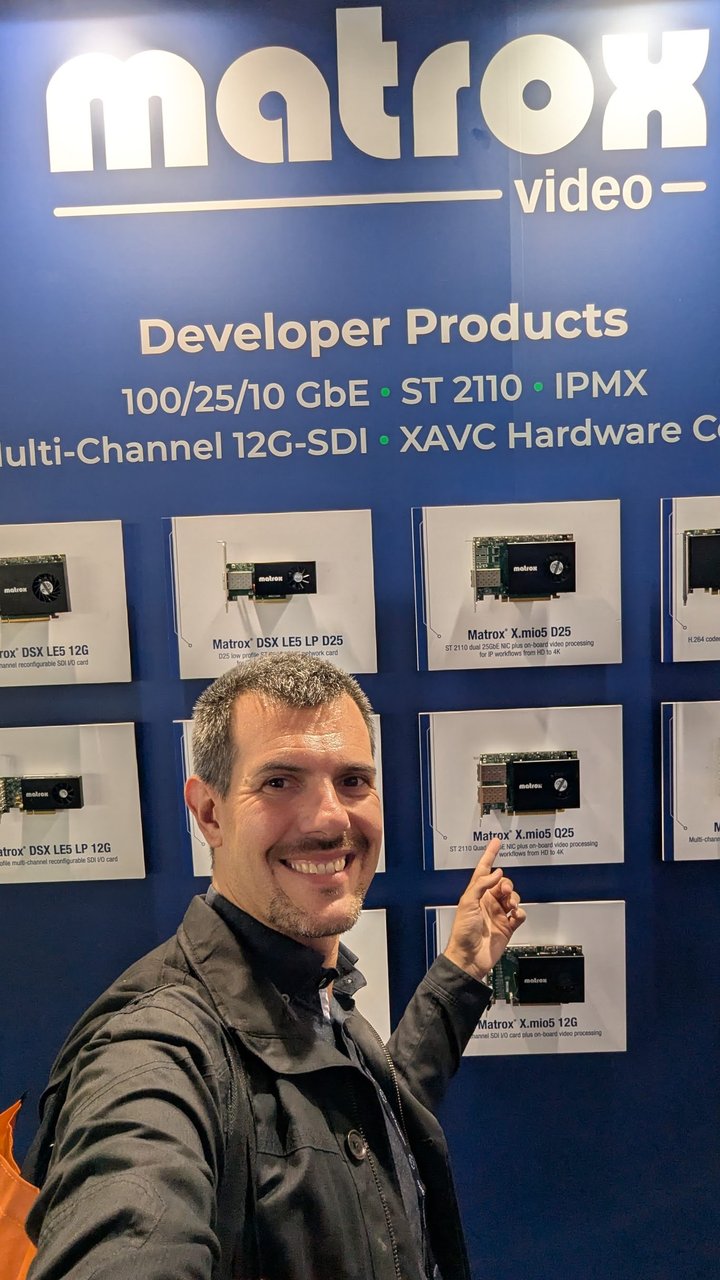
Matrox’s developer products wall: SMPTE ST 2110 and IPMX on 25GbE NICs with on-board video processing.
In the clip I recorded there, I pointed out that if you’re as old as me you remember Matrox for PC graphics cards. Now the same name ships cards that move broadcast signals over quad 25 Gigabit Ethernet.
My take: ST 2110 is where broadcast meets the data centre. Uncompressed video becomes multicast flows on a switched network, with PTP timing. The skills that matter are network engineering, timing and automation, the same ones platform teams already have. A NIC with on-board video processing is the broadcast version of the offload cards we see for AI and storage traffic.
Day 4: cinema cameras for small crews
The last day was cameras. On the Nikon stand a production company presented why they shoot with the Nikon ZR. The slide listed “Less rigging”, “Reliable auto focus”, “Good in low light”, “Good sound recording”, “Good stabilization” and “Varied and good…” (cut off in my photo). In the part I recorded, the speaker said that proxy files upload automatically to Frame.io from the camera, so their editor can start cutting while they’re still filming. They also said the compressed RAW files are light enough to edit on a laptop, and that the camera’s scratch audio was good enough for final sound design. They showed a short ice-cream commercial shot in Norway with the ZR. A card on the stand offered a launch deal: €150 worth of selected video accessories with the ZR until 31 December 2025.
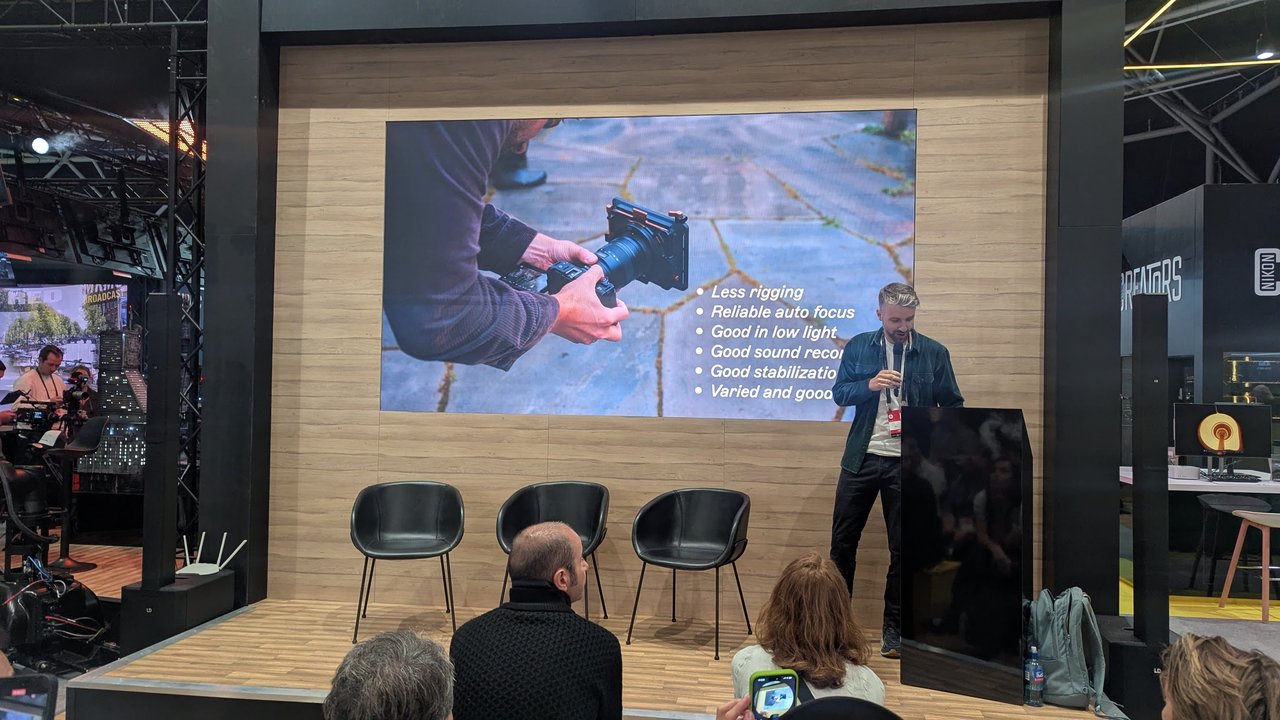
A creator session on the Nikon stand: the arguments were about crew size and workflow, not sensor specs.
Canon’s card for the EOS C50 called it “built for creators that work under pressure” and listed a full-frame 7K CMOS sensor, open-gate internal 12-bit RAW, 32MP stills at up to 40 fps, 15+ stops of dynamic range with dual base ISO (800/6400), 4:2:2 10-bit XF-HEVC S, XF-AVC S and XF-AVC, 7K 60P / 4K 120P / 2K 180P, CFexpress Type B and UHS-II slots, and timecode plus 2× XLR. Nearby, SmallRig had a product-launch programme, and Fortinge showed NDI teleprompters (“Next-Gen Teleprompters, Future-Ready Today”).
My take: the camera story and the cloud story were the same story. Camera-to-cloud proxies, NDI on a teleprompter and ST 2110 on a NIC all assume the network is part of the production. Once that’s true, the people running the network and the storage are part of the production too.
A year later
I went back for IBC 2026 and wrote it up as a series. The IBC 2026 hub covers the show floor. The infrastructure behind modern content delivery notes that MoQ (Media over QUIC) stands had tripled since IBC 2025. How AI is reshaping media production and camera innovation and virtual production pick up the threads from this post.