Pay for Wi-Fi 7, enjoy the Wi-Fi 8 experience
At the Huawei Summit 2026, one of the most compelling announcements was the new AirEngine Wi-Fi 7 product lineup — with a twist. Huawei is positioning these as “pre Wi-Fi 8” access points: buy them today at Wi-Fi 7 pricing, and get hardware that is already designed to deliver capabilities heading toward the Wi-Fi 8 standard.
This is a smart investment protection play. Organizations deploying enterprise Wi-Fi today face a common dilemma: buy Wi-Fi 7 now and risk a forklift upgrade when Wi-Fi 8 arrives, or wait and miss the performance benefits. Huawei’s answer is to build the bridge into the hardware itself.
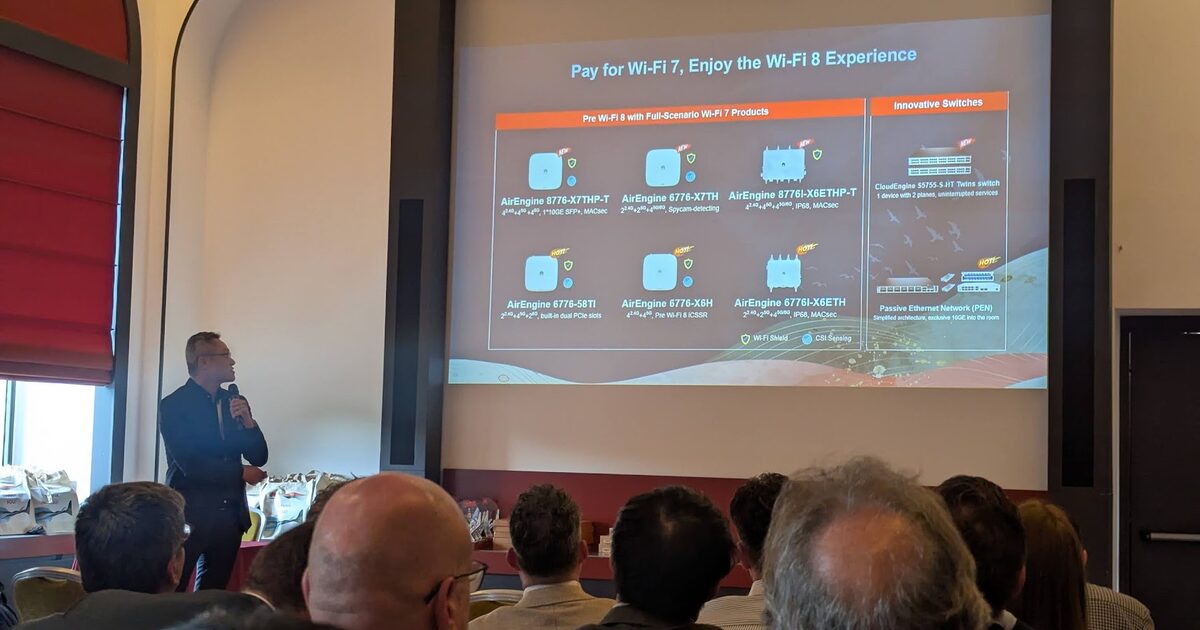
The AirEngine lineup
Huawei presented a full-scenario Wi-Fi 7 portfolio covering indoor, outdoor, industrial, and high-density environments. Here is what stood out from the presentation:
Flagship: AirEngine 8776-X7THP-T
The top of the line for high-density enterprise environments:
- Tri-band radio: 4×4 + 4×4 + 4×4 across 2.4 GHz, 5 GHz, and 6 GHz
- 1×10GE SFP+ uplink — fiber backhaul for maximum throughput
- MACsec encryption — wire-speed Layer 2 encryption on the wired uplink
- Wi-Fi Shield and CSI Sensing capabilities
For campus environments, convention centers, stadiums, or large office floors where hundreds of concurrent clients are the norm, the 10GE fiber uplink eliminates the wired bottleneck that plagues many Wi-Fi 6E/7 deployments. There is no point having multi-gigabit wireless if the AP’s wired connection is a 1GE copper port.
AirEngine 6776-X7TH — with spycam detection
One of the most unusual features in an enterprise AP: spycam detection. The 6776-X7TH can detect hidden cameras using Wi-Fi signal analysis — identifying the characteristic transmission patterns of covert recording devices.
- Tri-band: 2×2 + 2×2 + 4×4
- Spycam-detecting capability
- Targeted at hospitality, corporate meeting rooms, and sensitive environments
This is a feature born from real demand. Hotels, executive boardrooms, and government facilities increasingly need to sweep for surveillance devices. Building the detection capability into the Wi-Fi infrastructure itself means it runs continuously without requiring separate sweeps or dedicated equipment.
AirEngine 8776I-X6ETHP-T — outdoor industrial
Purpose-built for harsh environments:
- 4×4 + 4×4 + 4×4 tri-band radios
- IP68 rated — dust-tight and waterproof (submersion-rated)
- MACsec on the wired uplink
- Designed for manufacturing floors, logistics yards, ports, and outdoor campuses
This connects directly to the Huawei Software-Defined Factory story. Factory floors with AGVs, robotic arms, and IoT sensors need Wi-Fi that survives dust, moisture, temperature extremes, and vibration — while delivering the low-latency, high-reliability connectivity that industrial automation demands.
AirEngine 6776-58TI — dual PCIe slots
- 2×2 + 4×4 + 2×2 radio configuration
- Built-in dual PCIe slots for expansion
- IoT gateway capability
The dual PCIe slots are interesting because they transform the AP into an edge compute and IoT gateway. You can add Bluetooth LE, Zigbee, or custom IoT radio modules directly into the access point — eliminating the need for separate IoT gateways scattered across the ceiling.
AirEngine 6776-X6H — pre Wi-Fi 8 ICSSR
- 4×4 + 4×4 dual-band with pre Wi-Fi 8 capabilities
- ICSSR (Intelligent Coordinated Spatial Spectrum Reuse) — a technology heading toward Wi-Fi 8 standardization
ICSSR is one of the key Wi-Fi 8 features. It allows neighboring APs to transmit simultaneously on the same channel by coordinating their spatial streams — dramatically increasing network capacity in dense deployments without requiring additional spectrum.
AirEngine 6776I-X6ETH — outdoor with MACsec
- 2×2 + 2×2 + 4×4 tri-band
- IP68 weather protection
- MACsec wire-speed encryption
Innovative switches: CloudEngine S5755-S-HT Twins
Alongside the APs, Huawei presented the CloudEngine S5755-S-HT Twins switch — a single device with 2 independent control planes providing uninterrupted services. If one control plane fails, the other takes over with zero packet loss.
This is critical for environments where the network switch is the single point of failure for an entire floor or building wing. Traditional switch stacking provides some redundancy, but the Twins architecture goes further by maintaining two fully independent forwarding engines in a single chassis.
Passive Ethernet Network (PEN)
The final piece of the puzzle: Passive Ethernet Network (PEN) — a simplified architecture that delivers exclusive 10GE into the room.
Traditional enterprise networking requires active switches on every floor. PEN replaces the floor switches with passive optical splitters, extending 10GE fiber from the building core directly to the room-level access point or endpoint. The benefits:
- Simplified architecture — fewer active devices to manage and power
- Exclusive bandwidth — each endpoint gets dedicated 10GE, not shared
- Lower opex — passive splitters have no moving parts, no firmware, no management overhead
- Future-proof cabling — fiber infrastructure supports bandwidth upgrades without recabling
For new building construction or major renovations, PEN can significantly reduce the total cost of network infrastructure while delivering higher per-endpoint bandwidth.
Wi-Fi Shield and CSI Sensing
Two security and sensing features run across the AirEngine lineup:
Wi-Fi Shield provides wireless intrusion detection and prevention — identifying rogue APs, evil twin attacks, deauthentication floods, and other wireless threats. Rather than deploying dedicated wireless IDS sensors, the production APs perform security monitoring alongside their primary role.
CSI Sensing (Channel State Information) uses Wi-Fi signals to detect motion, presence, and environmental changes without cameras. The AP analyzes how wireless signals reflect off objects and people in the environment, enabling:
- Occupancy detection for smart building management
- Intrusion detection in secured areas
- Fall detection in healthcare environments
All without a single camera — addressing privacy concerns while providing environmental awareness.
Key takeaways
- Pre Wi-Fi 8 at Wi-Fi 7 pricing — investment protection for enterprise deployments
- 10GE fiber uplinks on flagship models eliminate the wired bottleneck
- Spycam detection built into enterprise APs — a first for the industry
- IP68 outdoor models for industrial and factory environments
- Dual PCIe IoT expansion turns APs into edge gateways
- ICSSR pre-Wi-Fi 8 enables coordinated spatial reuse for dense deployments
- Twins switch architecture — two control planes, zero packet loss failover
- Passive Ethernet Network simplifies building infrastructure with dedicated 10GE per room
The Wi-Fi 7 to Wi-Fi 8 transition is happening, and Huawei is making sure customers who buy today are not left behind when the standard finalizes.