Huawei Storage Storm Shield Program
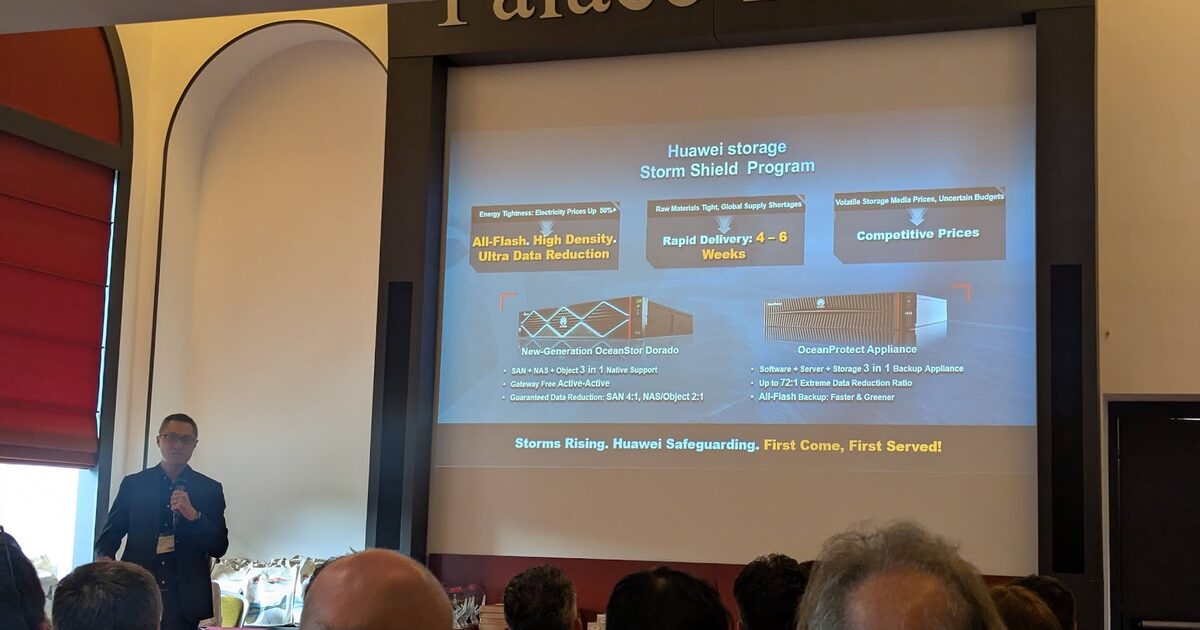
At the Huawei Summit 2026, Huawei unveiled the Storage Storm Shield Program — a direct response to three forces squeezing enterprise storage budgets right now:
- Energy tightness — electricity prices up 50%+ in many European markets
- Raw materials tight, global supply shortages — lead times for storage hardware stretching to months
- Volatile storage media prices, uncertain budgets — flash pricing swings making capacity planning unpredictable
The Storm Shield Program addresses all three with a clear value proposition: all-flash performance, 4–6 week delivery, and competitive pricing.
New-generation OceanStor Dorado
The centerpiece of the announcement is the new-generation OceanStor Dorado — Huawei’s flagship all-flash storage platform. What makes this generation different is the 3-in-1 unified architecture:
SAN + NAS + Object in one platform
Traditional enterprise storage forces you to buy separate systems for block (SAN), file (NAS), and object storage. Each system has its own management plane, its own capacity pool, and its own licensing model. The OceanStor Dorado eliminates this with native support for all three protocols in a single system.
This is not a gateway translation layer bolted on top of block storage. It is native multi-protocol support, which means:
- No protocol translation overhead — each workload speaks its native protocol directly
- Unified capacity pool — no stranded capacity on single-purpose systems
- Single management plane — one team, one interface, one set of policies
Gateway-free active-active
High availability in traditional storage requires external gateway appliances to coordinate between active sites. OceanStor Dorado provides gateway-free active-active replication — both sites serve read and write I/O simultaneously without additional hardware in the data path.
For enterprise environments running databases, ERP systems, or AI training pipelines, this means:
- Zero RPO (Recovery Point Objective) — no data loss on site failure
- Near-zero RTO (Recovery Time Objective) — automatic failover without manual intervention
- No gateway bottleneck — the replication engine is built into the storage controllers
Guaranteed data reduction
Huawei is making a bold commitment with guaranteed data reduction ratios:
| Workload type | Guaranteed reduction |
|---|---|
| SAN (block) | 4:1 |
| NAS / Object | 2:1 |
These are not theoretical maximums — they are contractual guarantees. If your environment does not achieve these ratios, Huawei makes up the difference. For capacity planning, this means you can confidently size your purchase at 25% (SAN) or 50% (NAS/Object) of your raw data footprint.
The data reduction stack combines:
- Inline deduplication — detecting duplicate blocks before they hit the flash
- Inline compression — reducing block size without post-processing overhead
- Intelligent tiering — placing data on the optimal flash tier based on access patterns
- Thin provisioning — allocating physical capacity only when data is actually written
OceanProtect Appliance
The second product in the Storm Shield lineup is the OceanProtect Appliance — a purpose-built backup and data protection platform.
3-in-1 backup appliance
OceanProtect combines software + server + storage in a single appliance. No separate backup software licenses, no separate media servers, no separate storage targets. One box, one purchase, one support contract.
72:1 extreme data reduction
The headline number is extraordinary: up to 72:1 data reduction ratio for backup workloads.
How does this work? Backup data has fundamentally different characteristics than primary data:
- High redundancy — daily full backups contain 95%+ identical data to the previous day
- Structured patterns — database dumps, VM snapshots, and file backups have predictable structure
- Temporal locality — recent backups share most of their content with each other
OceanProtect exploits all three properties with a purpose-built deduplication and compression engine. At 72:1, a petabyte of logical backup data occupies approximately 14 TB of physical capacity.
All-flash backup — faster and greener
Traditional backup targets use spinning disk for capacity. OceanProtect uses all-flash storage, which delivers:
- Faster backup windows — flash write speeds eliminate the backup window bottleneck
- Faster recovery — restoring from flash is dramatically faster than spinning disk, reducing RTO
- Lower power consumption — flash uses a fraction of the energy per TB compared to spinning disk
- Smaller footprint — fewer rack units per petabyte of effective capacity
In an environment where electricity prices are up 50%, the energy efficiency of all-flash backup is not just a feature — it is a direct cost reduction.
Why this matters for AI infrastructure
Storage is often the forgotten bottleneck in AI infrastructure planning. Teams spend months selecting GPUs and optimizing model architectures, then discover that their storage layer cannot feed data fast enough.
The OceanStor Dorado’s unified SAN + NAS + Object architecture is particularly relevant for AI workloads:
- Training data often lives in object storage (S3-compatible) — OceanStor serves it natively
- Checkpointing requires high-throughput file storage (NAS) — same system, same capacity pool
- Database-backed feature stores need low-latency block storage (SAN) — no separate purchase
A single OceanStor Dorado can serve all three tiers of the AI data pipeline without protocol translation or data movement between systems.
The delivery advantage
In a market where enterprise storage lead times can stretch to 12–16 weeks, Huawei’s 4–6 week delivery commitment is a significant competitive differentiator. For organizations planning data center refreshes, new AI clusters, or disaster recovery expansions, cutting 2–3 months off the procurement timeline can be the difference between hitting a project deadline and missing it.
Key takeaways
- OceanStor Dorado is a true 3-in-1 — SAN + NAS + Object native, not a gateway translation
- Gateway-free active-active eliminates external HA appliances
- Guaranteed data reduction — 4:1 SAN, 2:1 NAS/Object (contractual)
- OceanProtect achieves 72:1 backup reduction — purpose-built dedup for backup workloads
- All-flash backup saves energy — critical when electricity is up 50%
- 4–6 week delivery — half the lead time of many competitors
- Storm Shield addresses the trifecta — energy costs, supply shortages, and price volatility
The storage market is being reshaped by energy costs, supply chain constraints, and the explosive data growth driven by AI workloads. Huawei’s Storm Shield Program is a direct answer to all three.