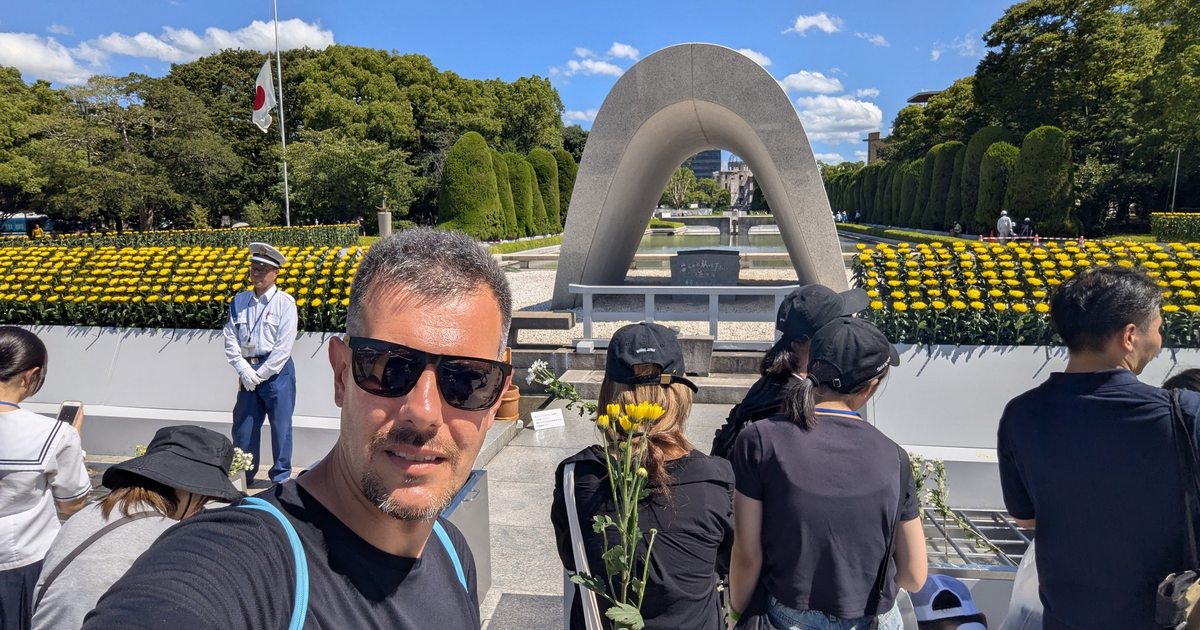
I set my alarm for 6 AM to get a seat under the main pavilion. On 6 August in Hiroshima, that is not early enough to be comfortable, and it is exactly early enough to understand why you came.
I have spoken at a lot of conferences. I have sat in a lot of audiences. This was not that.
The ceremony runs on a schedule the city has kept for decades
The Peace Memorial Ceremony happens every year on 6 August, from 8:00 to 8:50 AM, in front of the Cenotaph for the A-bomb Victims at Peace Memorial Park. At 7:55 there is a ceremonial offering of water. Then the sequence begins: the opening, the dedication of the Register of the Names of the Fallen Atomic Bomb Victims, the address, the dedication of flowers.
Then 8:15.
That is the minute the bomb detonated in 1945. The Peace Bell rings. Sirens go off across the whole city — not just the park, the city. And for sixty seconds, everyone stops. People at the ceremony grounds, people in their kitchens, people at their desks. The silence is not polite. It has weight to it.
After that comes the Peace Declaration, delivered by the Mayor of Hiroshima and sent to every country on earth. Then the release of the doves, the Commitment to Peace read by children, messages from guests, and the Hiroshima Peace Song.
120 nations, Taiwan, and the European Union
Walking in, I picked up the official roster: List of Participating Countries and Regions (As of August 1). It runs two dense columns.
Albania, Angola, Argentina, Armenia, Australia, Austria, Azerbaijan, Bangladesh, Belarus, Belgium. Down through Kosovo, Kuwait, Laos, Latvia, Lesotho, Liberia, Libya. Across to Malaysia, Mali, Malta, the Marshall Islands, Mauritania, Mexico, Mongolia, Morocco. Ending with Uruguay, Uzbekistan, the Vatican, Venezuela, Viet Nam, Zambia, Zimbabwe.
120 countries. Plus Taiwan and the European Union, listed separately at the bottom.
The Italian Republic is on that list. So is the United States of America. So is the Russian-adjacent bloc and the states that do not agree with each other about very much else. For fifty minutes a year, that disagreement is parked.
What the speakers actually said
I heard the Mayor of Hiroshima and the Prime Minister of Japan. Both returned to the same theme: that the young people in that park need to carry this memory forward, because the people who lived it will not be here to carry it much longer.
The United Nations spoke about cooperation between governments and nations — and about why that cooperation matters more now, not less.
All of it landed. But the part that stayed with me was not a head of state.
The two people who were actually there
After the ceremony I went to the International Conference Center Hiroshima, in the Cosmos Room two floors down, for Special A-bomb Testimony 2026 — eyewitness accounts delivered in English, free, no registration.
Two speakers:
Keiko Ogura, Director of Hiroshima Interpreters for Peace. Born 4 August 1937. She was eight years old, a second-grade elementary school student, standing on the road near her house in Ushita, 2.4 km from the hypocenter, when the flash lit the sky.
Kazuhiko Futagawa, of the Hibakusha In-Utero Network. Born 1 April 1946 — eight months after the bombing. On 7 August 1945, his pregnant mother walked into the ground zero area looking for her missing husband and daughter. She was exposed to radiation doing it. He was born carrying what she absorbed.
Ogura is 88. Futagawa is 80. Do that arithmetic and you understand the urgency in every speech that morning. Within a decade or so, there will be no one left alive who can say I was there. After that it is all secondhand — archives, recordings, and whatever we bothered to internalise while we still had the chance to ask questions in person.
Why I went, and why I would tell you to
I work in automation and AI platform engineering. Nothing about my job requires me to be in Hiroshima on 6 August. That is sort of the point.
We build systems. We optimise them, ship them, scale them, and argue about them online. It is easy to work an entire career inside that frame and never once step outside it to look at what happens when a very advanced technical achievement gets pointed at a city.
The night before the ceremony I walked the park. The Children’s Peace Monument was lit against a dark sky, its glass cases packed with folded paper cranes sent from people all over the world — still arriving, eighty-one years on. Sadako Sasaki was two when the bomb fell and twelve when leukaemia killed her. She folded cranes because a story said a thousand of them would make her well.
People are still folding them for her.
If you want to attend
The ceremony is open to the public and costs nothing. There is no parking at Peace Memorial Park — the city asks you to take public transport. From Hiroshima Station take streetcar no. 2 toward Hiroden-miyajima-guchi or no. 6 toward Eba and get off at Genbaku Dome-mae. By bus, no. 3 or no. 21 to Fukuro-machi, then a five-minute walk. Traffic around the park is regulated on 6 August, so budget extra time.
And get there early. I woke at 6 AM and still barely made the pavilion.
The line that matters
The Cenotaph carries one sentence:
Let all the souls here rest in peace, for we shall not repeat the evil.
Note the pronoun. Not they. We.
That is the whole argument, compressed into ten words. It does not assign the crime to a defeated enemy or a previous generation. It puts it on everyone standing there reading it — including the ones who build the technology.
The youth should be aware, and build our future together. That was my takeaway walking out of the park, and I have not been able to improve on it since.
Thank you, Hiroshima. 🕊️