On Thursday 26 March 2026, the last day of KubeCon + CloudNativeCon Europe at RAI Amsterdam, I recorded a short interview with Guido Laout, who introduced himself as the sales director covering the Netherlands and Flanders at OVHcloud. We talked about European digital sovereignty, what people were asking at the OVHcloud booth, and where he thinks the topic is heading.
A week at the booth
Guido was open about how he spent the week: he didn’t make it to a single talk. He was at the booth the whole time, talking with people who wanted to know more about OVHcloud’s services, its capabilities and, above all, the sovereignty side of the story.
That makes him a good person to ask what the demand actually looks like, because he heard it first-hand, conversation after conversation.
Why sovereignty demand keeps growing
When I asked how he sees demand developing, Guido described sovereignty as a response to growing concerns about digital autonomy, data processing and privacy, and about not being exposed to non-domestic laws. In his words, with every month that passes, “the topic gets hotter and hotter.”
His read is that many organisations have become so used to working with the hyperscalers that they are now asking a simple question: what else is out there? A lot of people, he said, are actively looking at the alternatives.
Managed services, not only infrastructure
According to Guido, KubeCon was a good place to show that OVHcloud has a mature public cloud offering, with the managed services people expect from a large provider:
- Managed databases: PostgreSQL, MongoDB and MySQL
- Managed Kafka, OpenSearch and Valkey
- Managed Kubernetes
He said many visitors were surprised when he walked them through OVHcloud’s regions and the breadth and depth of the portfolio. He was happy with the conversations the team had during the week, and he sees explaining who OVHcloud is as an important story to tell in the current geopolitical climate.
Exit plans and dependency risk
The most interesting part of the interview came when I asked about the future. Guido thinks many enterprises, governments and companies are hoping the sovereignty question will go away sooner rather than later, because it’s hard to tackle. He doesn’t expect that to happen.
Instead, he sees a growing awareness of how dependent we have become on other continents, other countries and a small number of suppliers. The direction, as he described it, is towards:
- understanding those dependencies and the risks they carry
- mitigating some of those risks, for example by moving workloads to a European provider such as OVHcloud, or back on premises
- having an exit plan, so you can keep running if uncertain times come
His summary: “we’re only at the beginning of the sovereignty topic.”
My take: an exit plan only counts if you have tested it. In the platform work I do, the part that makes it realistic is the managed service list Guido described. PostgreSQL, Kafka, OpenSearch, Valkey and conformant Kubernetes are open-source engines and APIs that run on many providers and on premises. If your platform sticks to those, plus declarative automation for the clusters and the data services, moving is a project, not a rewrite. The dependencies that hurt are the proprietary services nobody wrote down, so the first step is an inventory.
AI on Kubernetes, from the booth
From what I was seeing at the event, it felt like Kubernetes was becoming the operating system for AI, so I asked Guido if his visitors saw it that way. He was candid that those conversations don’t usually come to him, as he is, in his words, not that technical. His observation was broader: a lot of people are investigating AI capabilities in their workloads, with or without Kubernetes, and there has been a huge spotlight on AI throughout the event.
My take: sovereignty and AI meet in the same place, the data. Teams that want to run inference or fine-tuning on sensitive European data have to answer the same questions about jurisdiction and dependencies that Guido described. They just have GPUs in the mix too.
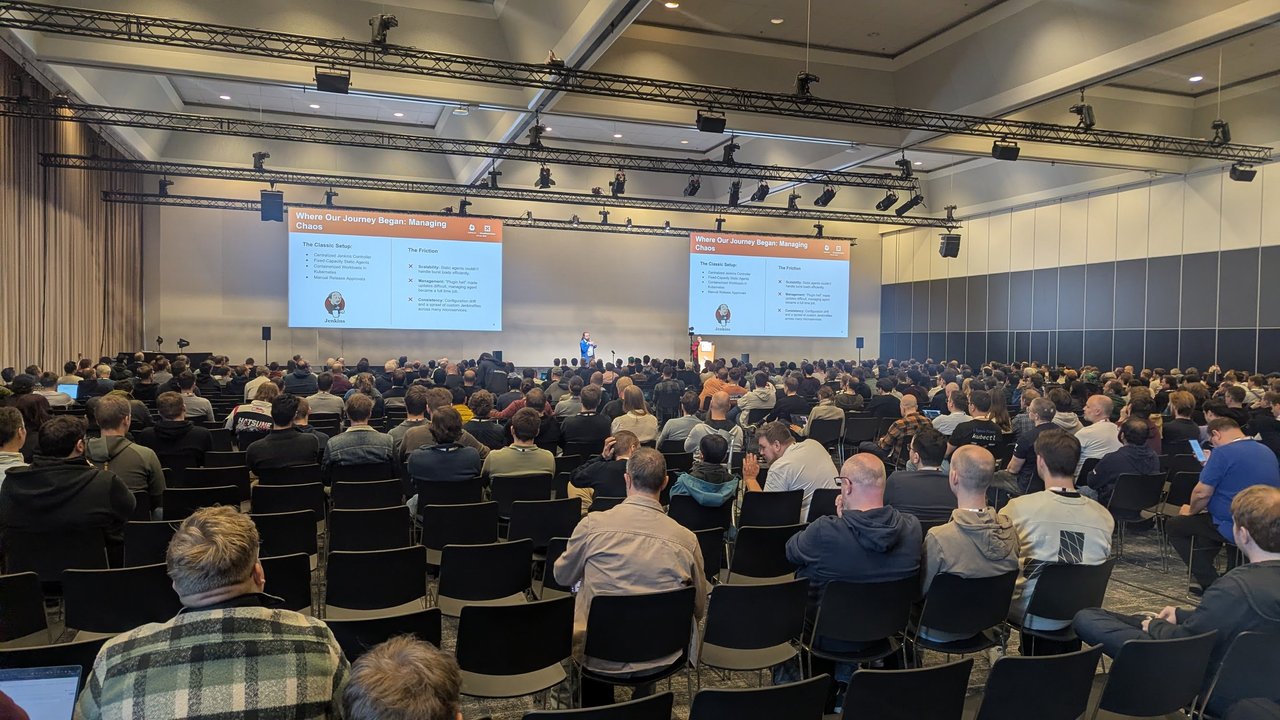
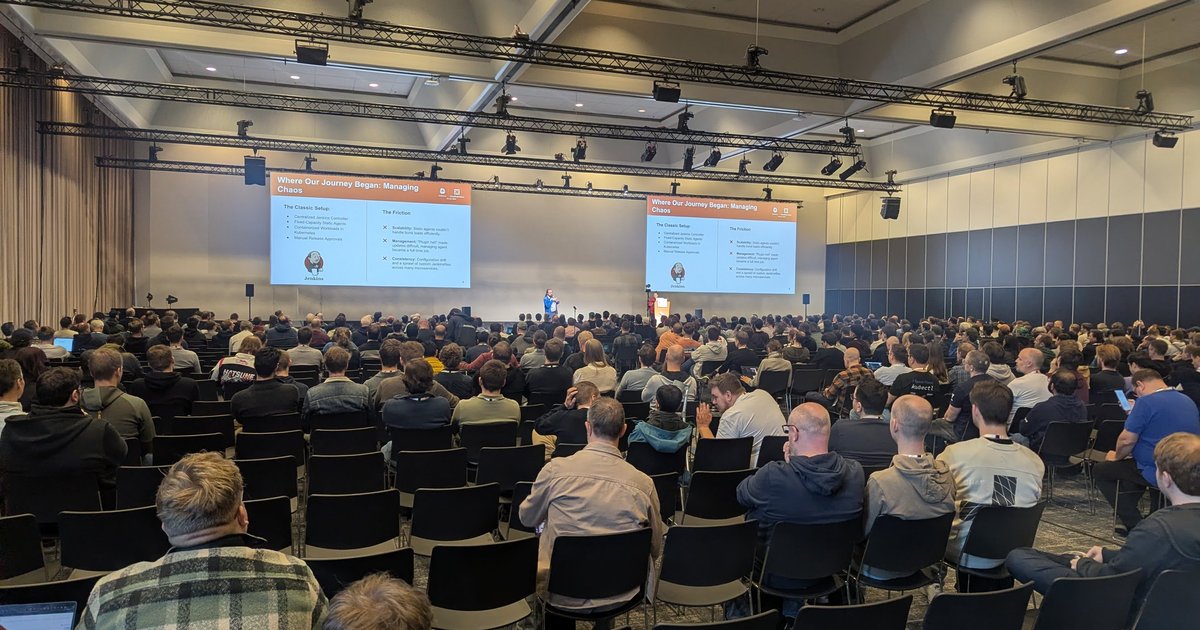
A full session hall on the Thursday of KubeCon Europe 2026, the day of this interview.