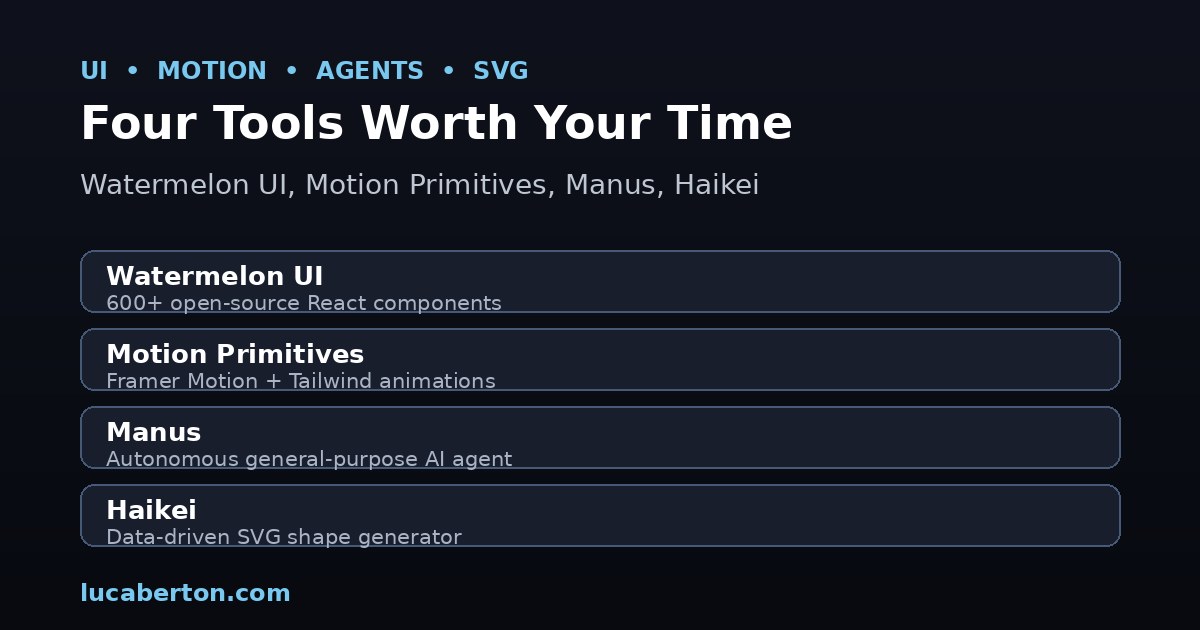
Building software in 2026 means assembling a stack of small, sharp tools rather than one giant platform. Four tools I keep coming back to right now cover very different layers of that stack: Watermelon UI for components, Motion Primitives for animation, Manus for autonomous execution, and Haikei for design assets.
They are not competitors. They solve adjacent problems, and together they sketch what a modern build-and-ship workflow looks like.
Quick Overview
| Tool | Layer | What it does best |
|---|---|---|
| Watermelon UI | UI components | 600+ free React components, animations, sections, and templates |
| Motion Primitives | Animation | Copy-paste Framer Motion + Tailwind primitives for animated interfaces |
| Manus | Autonomy | A general AI agent that plans, acts, and delivers artifacts |
| Haikei | Design assets | Data-driven SVG shapes and backgrounds, no signup |
Watermelon UI: A Studio-Quality React Registry
Watermelon UI is an open-source React component registry built on Tailwind and Radix. The headline numbers are 600+ components, 100+ animations, and a growing set of sections and full-page templates. The pitch is simple: copy, paste, and ship, with no strings attached.
What makes it interesting is the breadth. Most component libraries give you buttons, inputs, and dialogs. Watermelon UI extends into dashboards, blocks, and production-ready page templates, so you can assemble an entire application surface without rebuilding the same scaffolding every time.
Theming works the way you would expect from a Tailwind-first project: you tweak CSS variables and design tokens, and every component inherits your brand. That keeps it consistent with how teams already run Tailwind, rather than forcing a new theming system.
Choose Watermelon UI when you want to move fast on application UI and you are already comfortable in the React plus Tailwind plus Radix ecosystem. It is a strong fit for dashboards, marketing pages, and internal tools where you would rather compose than construct.
Motion Primitives: Animation as Reusable Components
Motion Primitives is an open-source UI kit for building animated interfaces with Framer Motion (now motion) and Tailwind CSS. It is built for React, Next.js, and Tailwind, and it follows the same copy-paste philosophy as the modern component-registry movement.
The value is in the primitives. Instead of hand-rolling enter and exit animations, scroll reveals, morphing elements, and interruptible transitions, you drop in a component that already handles the timing, easing, and accessibility. It is in beta, but it is released regularly and stays free.
This complements Watermelon UI well. Where Watermelon gives you the static building blocks, Motion Primitives gives you the motion layer that makes those blocks feel alive. You can build a perfectly functional interface with neither, but pairing a clean component set with deliberate motion is what separates a polished product from a plain one.
Choose Motion Primitives when animation is part of the experience, not an afterthought, and you want reusable, customizable, accessible motion without writing the same transition code repeatedly.
Manus: From Answer to Action
Manus is a general autonomous AI agent. The positioning is deliberate: it calls itself an action engine that goes beyond answers to execute tasks, automate workflows, and extend human reach. Rather than only chatting, it plans a task, breaks it into steps, uses tools, and produces a deliverable.
Concretely, the product spans building websites, creating slides and games, doing design work, running browser operations, and performing wide research. It ships as a web app with desktop and mobile clients, a team plan, an API, and integrations such as Slack. For builders, the API is the interesting part: it turns “an agent that does the work” into something you can embed in a product or pipeline.
This is a different layer from the previous two. Watermelon UI and Motion Primitives are things you use while building. Manus is something you delegate to so it builds. Used together, you can imagine an agent assembling a first draft with components and motion, then handing you a working surface to refine.
Choose Manus when the bottleneck is execution, not design decision-making: research compilations, first-draft websites and slides, repetitive browser workflows, and any task that is easier to specify than to perform by hand.
Haikei: SVG Assets Without the Design Detour
Haikei is a web app for generating unique SVG design assets: waves, blobs, grids, gradients, peaks, steps, symbols, and more. It is free, needs no signup, and exports to PNG or SVG so you can keep working in any vector tool, CMS, or codebase.
The practical win is speed. Instead of opening a design editor to hand-draw a hero wave or a background blob, you pick a generator, set your canvas size, add brand colors, and roll the dice until the shape fits. It is built for UI design, slide decks, blog posts, and social media, and it adapts to common canvas sizes out of the box.
Haikei is the connective tissue for the other three. A Watermelon UI page, a Motion Primitives animation, or a Manus-generated site all need backgrounds and visuals; Haikei produces those in seconds without pulling you out of flow.
Choose Haikei when you need production-ready visuals fast and you do not want to context-switch into a heavy design tool for a single background or illustration.
How They Fit Together
These four tools map cleanly onto a build pipeline:
- Design the surface with Haikei assets for backgrounds and shapes.
- Compose the interface with Watermelon UI components.
- Animate the experience with Motion Primitives.
- Delegate the grunt work to Manus when you need a draft, research, or a repetitive task executed end to end.
None of them is a mandatory dependency. Each one is optional, sharp, and easy to try. That is exactly the appeal: you adopt the layer you need, leave the rest, and swap pieces as your stack evolves.
Final Thoughts
The most useful tools in 2026 are not the biggest platforms. They are the small, focused ones that do one job extremely well and play nicely with everything else. Watermelon UI, Motion Primitives, Manus, and Haikei each occupy a distinct slot, and together they cover a surprising amount of the path from idea to shipped product.
If you are starting something new this week, pick one, build with it, and add the others only when the gap actually appears.