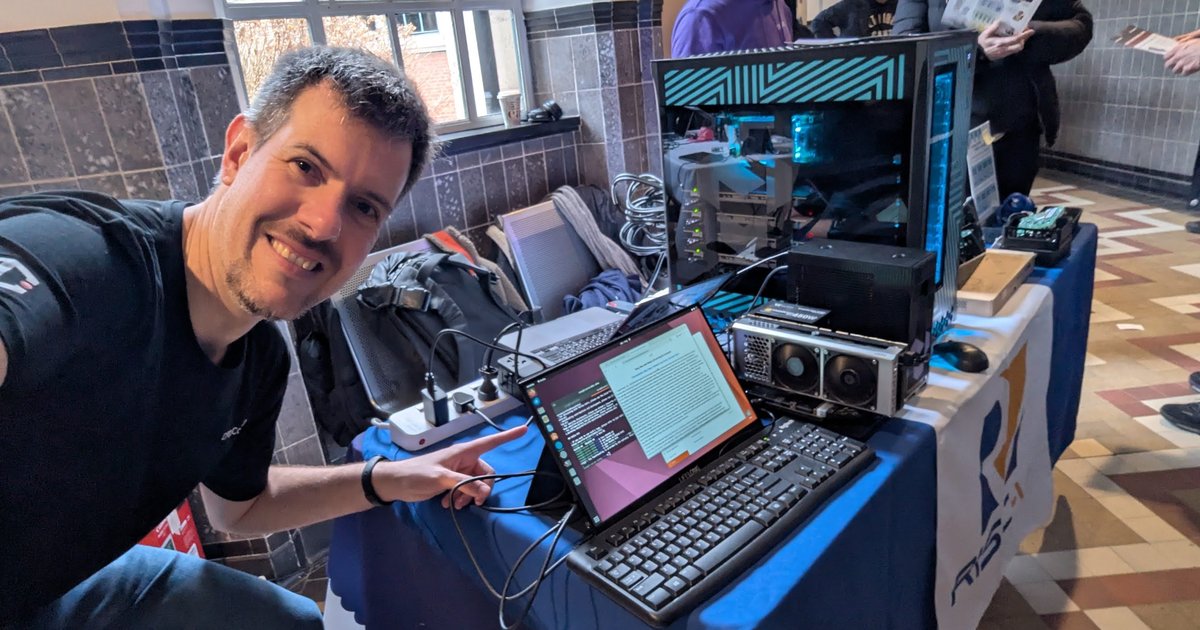
FOSDEM 2026 filled the ULB campus in Brussels on 31 January and 1 February, and between talks I kept recording short clips for my channel. I’d stop at a stand or in a corridor, ask what people were working on, and let them talk. My conversation with Monty Widenius has its own post. This one collects the shorter ones, grouped by theme. Each section summarises what the person said on camera, and product claims are their own. For the weekend as a whole, see my FOSDEM 2026 recap and the devroom talks I saw.
Community
Carlo Sacchi (Azure Italia Podcast): a first FOSDEM
On Saturday lunchtime I met Carlo Sacchi from the Azure Italia Podcast, an Italian-language show about Azure. We spoke English anyway. It was his first FOSDEM, and he had just bought the T-shirt to make it official. His approach was to wander, and sometimes find a room with a talk worth listening to. He described tons of people and a great vibe. We were in the community area, among the sponsor stands, and the queues for the devrooms were long. When I called his show the biggest Italian technology podcast, he played it down: in his own field he’s the only one, and he hopes the most important. You can find the podcast on Spotify, Apple Podcasts and YouTube. He was also heading to KubeCon in Amsterdam.
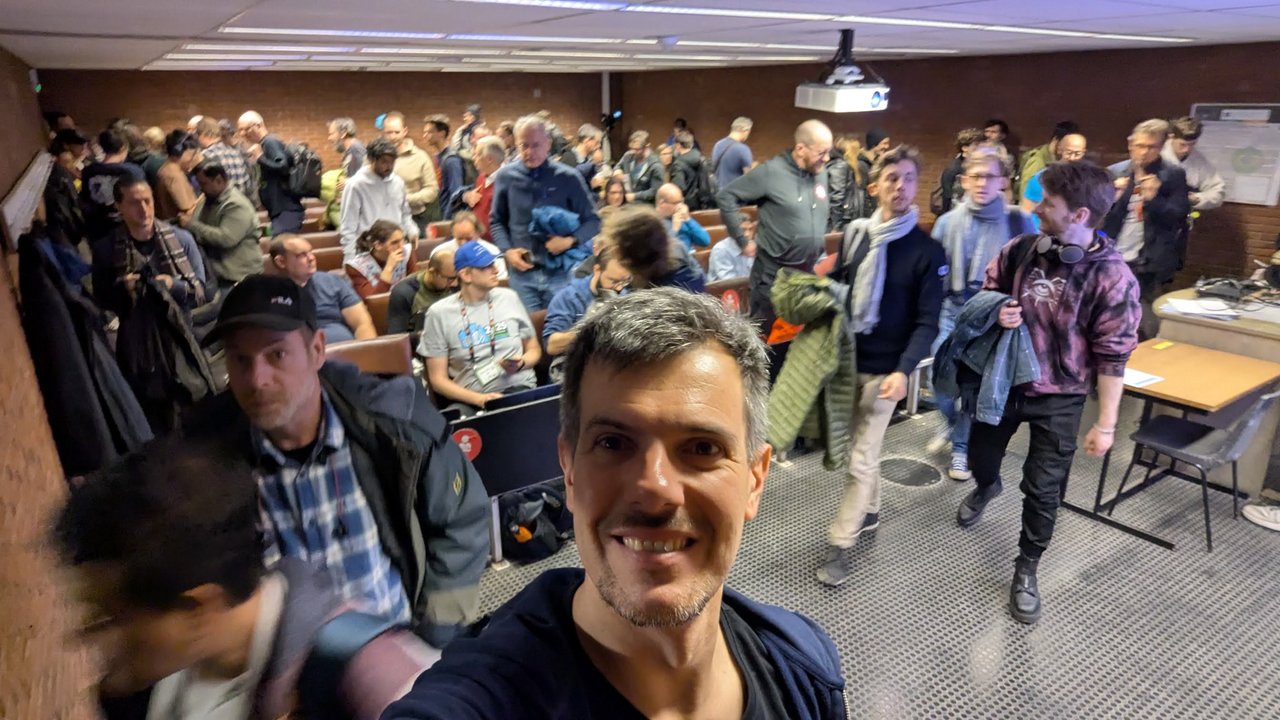 A packed room on Saturday, ten minutes before I met Carlo.
Michal (Weblate): translations connected to Git
A few minutes later I stopped at the Weblate stand. Michal described Weblate as a localisation platform. You can use it to translate software, or even books: he held up one that had been translated in Weblate. You connect any content to your Git repository, and Weblate makes it easy for translators to contribute. According to Michal, thousands of open source projects are translated there, including big ones like LibreOffice. Getting started is simple: log in on the website and find the projects you’re interested in. If you use open source software, it most likely supports localisation, so you can make it easier for people in your native language. All you need is your language and English. The starting point is weblate.org.
Policy and sovereignty
Sabina: the EU funding to come
Sabina works in European funding, having worked in open source before, and it was her first FOSDEM. She works as a freelancer in a grant office, not for the European Commission. She helps foundations and other organisations coordinate cooperation projects and proposals to access funding. She was following the tracks that explain how the forthcoming European funding for open source will be structured and made accessible. That will take a while, but she said some instruments already exist. Her question for the weekend was about impact. If a fund of the size she mentioned, 360 million euros, becomes available for open technology and maintenance, what changes within ten years? EU funding works on that horizon, she explained: it sets up an ecosystem of cooperating organisations and scientific results. Answering it also helps you pitch a project to the Commission. Two funding talks I saw are in my devroom notes.
Boris Baldassari (Eclipse Foundation): guardian of the commons
I met Boris Baldassari, Open Source Service Specialist at the Eclipse Foundation, a year after our FOSDEM 2025 interview. In his view a lot has changed for open source in Europe, and 2026 will be a big year. People are realising how important open source is for sovereignty and for the reliability of the services we use. Data and software sovereignty go together: with extraterritorial laws in some countries, you need the full stack and the data within your walls. He said “the Eclipse Foundation really acts as a guardian of the commons”, a neutral place that enforces the rules when many players share a project. It works on the Cyber Resilience Act (CRA) through the Open Regulatory Compliance (ORC) Working Group. It isn’t only companies, he added: states, academia and associations count too, and cascading funding reaches grassroots groups. That, he believes, is where Europe’s power lies.
Aurélie (Eclipse Foundation): OCX 2026 at The EGG
Aurélie from the Eclipse Foundation invited everyone to OCX (Open Community Experience) 2026 in Brussels, 21 to 23 April. Her list of topics was long: automotive, Java, IoT, compliance with the CRA (the Eclipse Foundation is heavily involved there), AI and tooling. The venue was The EGG, close to Brussels-Midi, the international train station. She said it’s called The EGG because it incubates a lot of startups. She expected nine sessions running at the same time, plus workshops, fun activities and, this being Belgium, good food. The Eclipse Foundation’s full agenda later counted nearly 150 sessions. The event has taken place since. The next edition, OCX 2027, is listed on ocxconf.org for 13 to 15 April 2027 at Tour & Taxis, again in Brussels.
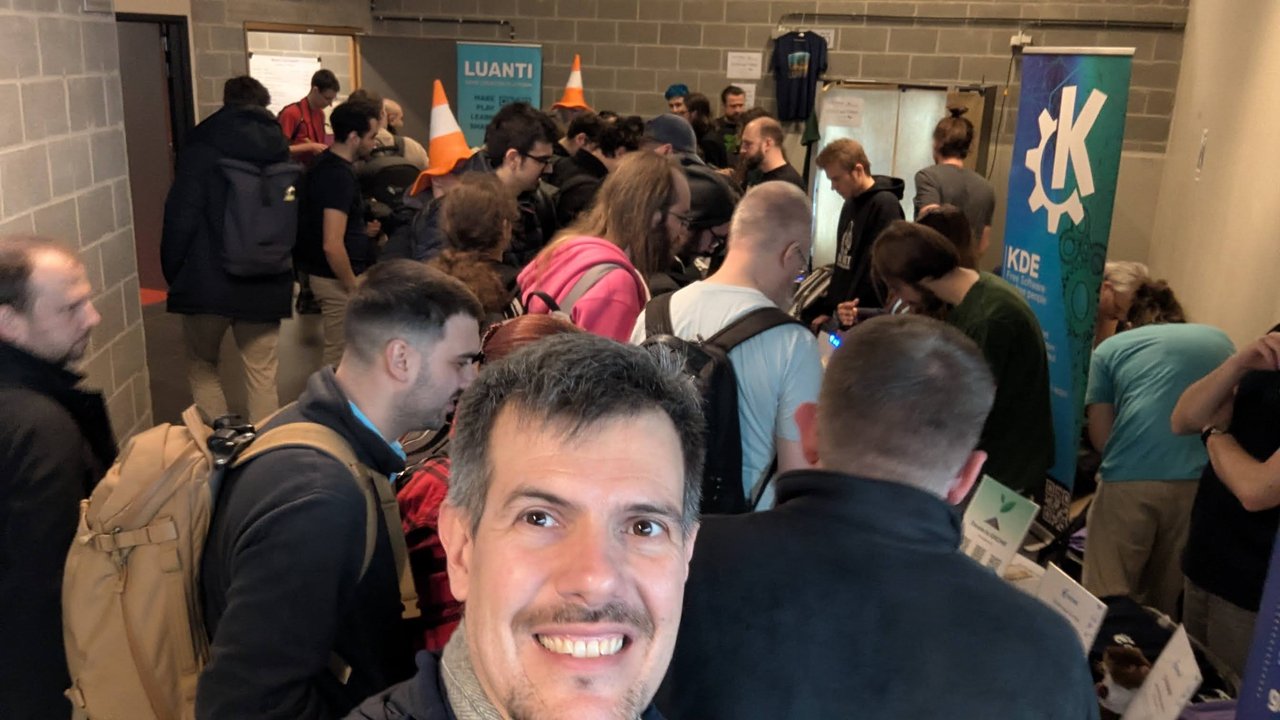 The stands on Saturday, a few minutes after my chat with the TODO Group.
The TODO Group: the OSPO book and the CRA
At the stand shared by OpenSSF, Linux Foundation Europe and the CNCF, I spoke with two people representing the TODO Group. They described it as a group of open source program office (OSPO) practitioners who spread best practices on security, projects and open source strategy in companies, foundations and universities. The community wrote an OSPO book together. You could pick up a copy at the stand, and the PDF and online versions are on todogroup.org. For one of them, most of 2026 would go on the CRA. It “doesn’t sound very exciting”, but it fundamentally affects how companies consume open source, and so the communities too. They pointed to LF Europe, which represents the interests of many open source communities. The other added that the CRA is about vulnerabilities: not only reporting them, but getting better at putting fixes out.
Databases
Percona: twenty years of open source databases
At the Percona stand the first take didn’t go to plan, so we did it again. The Percona engineer I spoke to explained that the company turns 20 in 2026. It works on four databases, MySQL, MongoDB, PostgreSQL and Valkey, plus tools and solutions around them. Its main interest is delivering databases as open source, and he said the aim is to keep everything open source. I told him I’d used a lot of MySQL with Percona’s patches over the years, and how fast they made things. He answered that the name comes from performance and consulting, “so performance should be in the first place”. Percona’s own about page confirms it was founded in 2006.
Magnus Hagander (PostgreSQL): mid-cycle, I/O and pgvector
At the PostgreSQL stand, with the elephant behind us, I spoke with Magnus Hagander, a member of the PostgreSQL core team and president of PostgreSQL Europe. They were half a year past the last major release, and he noted that “nobody jumps on the first one”. FOSDEM PGDay had run on the Friday, and about seven more events would follow before summer, including Helsinki on 24 March and Paris on 26 March. He pointed to the read and write (I/O) changes in the September release, PostgreSQL 18. pgvector and other extensions are driving vector and hybrid workloads. One talk at their event asked what happens if parts of pgvector move into core. Extensions can iterate faster, he said: a new PostgreSQL every year, a new pgvector every couple of months. To keep up, read postgresql.org and the Planet PostgreSQL aggregator.
My take: in most of my RAG projects the vector store doesn’t need its own database. pgvector next to your relational data keeps backups, access control and joins in one place. The release cadence Magnus described also means the extension improves between PostgreSQL releases, so pin and test its version like any other dependency.
Linux and infrastructure
Francisco Triviño (Red Hat): FreeIPA, Keycloak and trusts
Francisco Triviño works at Red Hat on upstream FreeIPA, and on Sunday he helped run the Identity and Access Management devroom, which he said had 15 talks. On Saturday he explained the landscape. FreeIPA is the open source identity management system similar to Microsoft Active Directory, built on traditional protocols and infrastructure like Kerberos. Keycloak is more for cloud applications, with modern authentication and authorisation protocols. The two can be integrated through experimental features. SSSD is the client side. On the roadmap: FreeIPA already supports trusts with Active Directory, and the team wants trusts between independent FreeIPA deployments too. The other big piece of work is moving every component to post-quantum crypto algorithms, which he called “a big rock for us”. To get involved, open issues on the FreeIPA GitHub repositories or join the mailing list.
Thomas Woerner (Red Hat): ansible-freeipa
Francisco then passed the microphone to Thomas Woerner, the main developer of ansible-freeipa. Francisco set the scene: FreeIPA can run on a single server, but real deployments are usually topologies with replicas and services such as DNS and a certificate authority (CA), and they’re hard to deploy by hand. ansible-freeipa simplifies that. Thomas’s latest addition was support for system accounts (sysaccounts), a recent FreeIPA feature. The project’s 1.16.0 release in January 2026 lists sysaccount management with the new ipasysaccount module. He corrected me when I asked about Ansible itself: he works on ansible-freeipa, not Ansible. Most of the management work goes through the IPA API. Deployment is more work, because the project has to handle more of those steps itself. On Sunday he also spoke in the identity devroom, on a new CA backend for FreeIPA.
My take: identity is often the last part of the stack still built by hand. A replica topology in an inventory file means you can rebuild it when you need to and review every change in Git. That’s the same argument I make for automating any piece of infrastructure.
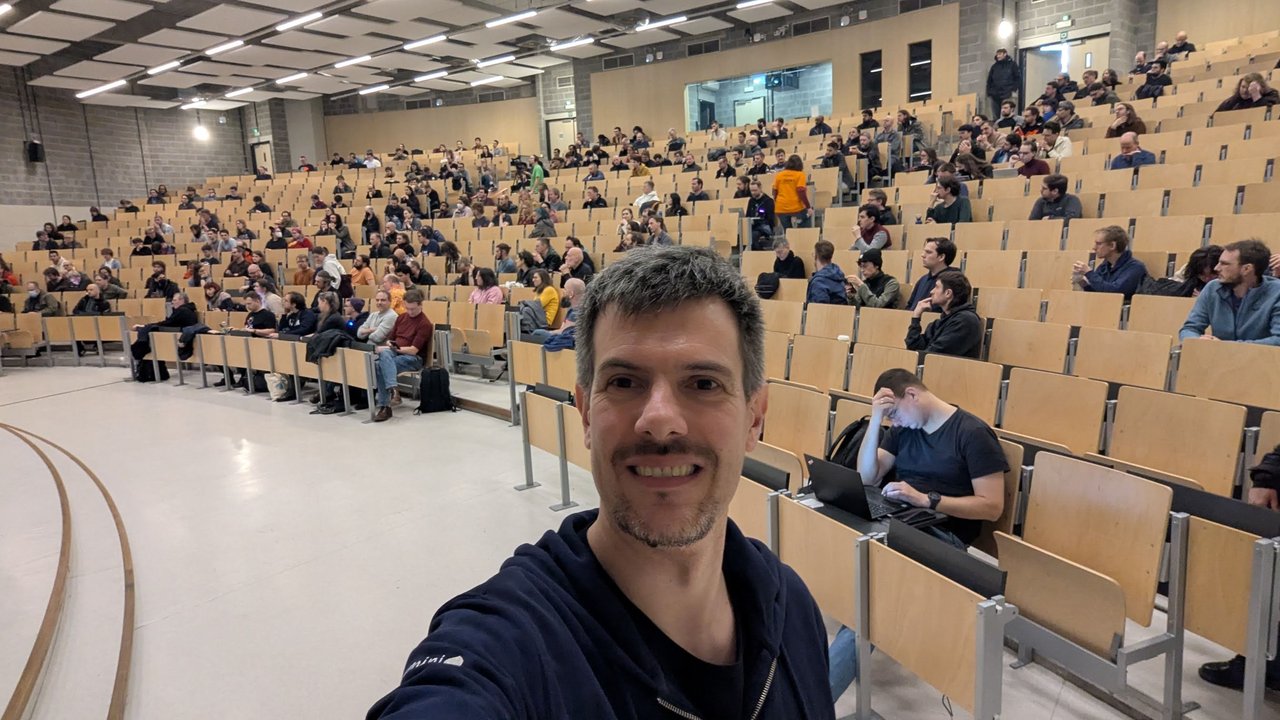 A big auditorium on Sunday, four minutes before I met Ian at the Foreman stand.
Ian Ballou (Foreman): bootc and image-mode machines
At the Foreman stand on Sunday I met Ian Ballou, who works on Katello, the content management part of the Foreman project. A lot of his current work is on immutable images: bootc machines, how they interact with Foreman, and how you use and manage container images in that ecosystem. bootc is quite new, he said. You can use it with RHEL 10 and RHEL 9, and the team is still learning how people want to use it, so they’re always looking for feedback. The place for that is community.theforeman.org. The stand also had the latest version of Foreman to show. The following Monday, Ian was on the CfgMgmtCamp schedule in Ghent with a talk on the future of bootable containers in Katello.
An Ansible release-management contributor: The Bullhorn and a mentorship programme
On Sunday afternoon I ran into a familiar face from the Ansible community, who didn’t give a name in the clip. I wasn’t going to make it to CfgMgmtCamp in Ghent this year, and they told me what I’d miss. There would be an Ansible track and the Ansible contributor summit, which they called the most interesting part for Ansible contributors. They also work on The Bullhorn, the Ansible contributor newsletter, and on releases. Their message was that release management is done entirely in the open. They’re asking new people to join through a release manager mentorship programme. If you’ve ever wondered how an Ansible release gets made, this is a way in. The place to start is forum.ansible.com, where The Bullhorn is published.
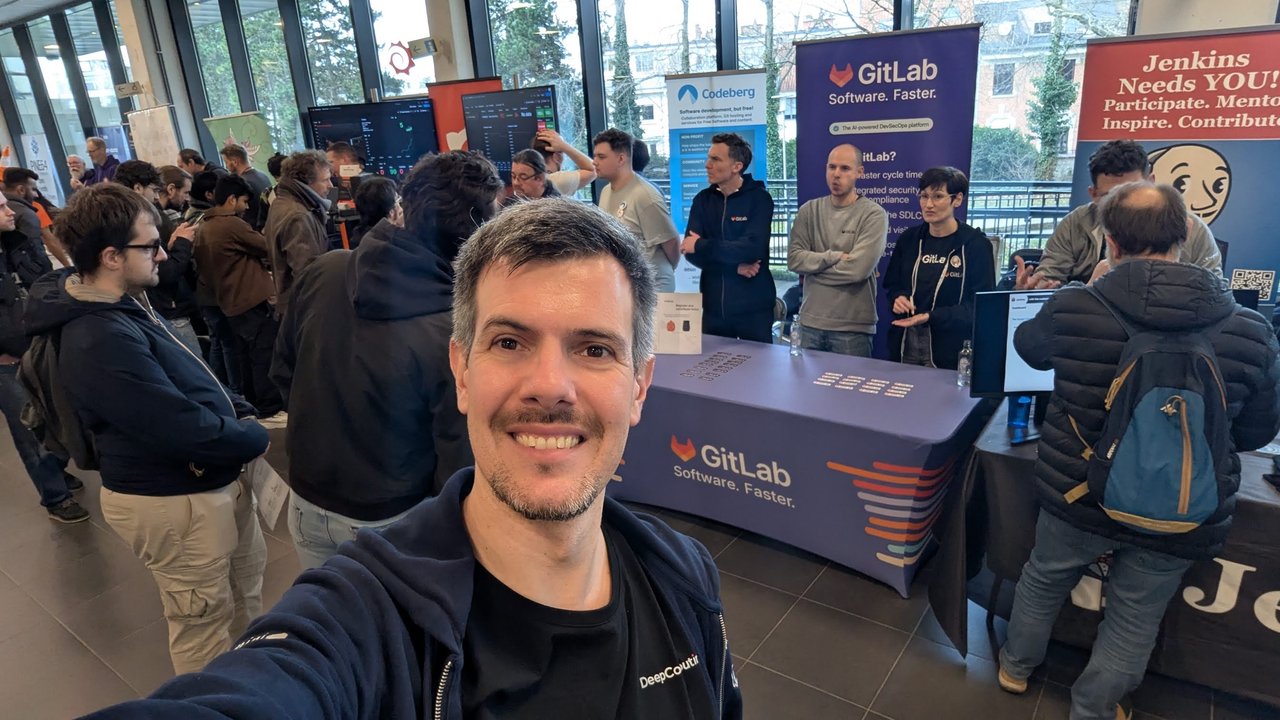 The stands on Sunday, a few minutes before the Ansible chat.
Hardware
Yuning Liang (DeepComputing): a 16-core Framework mainboard and K3
On Sunday morning I spoke with Yuning Liang, founder of DeepComputing, at the RISC-V stand. It was the company’s second FOSDEM. During the event, he said, it launched its new 16-core mainboard for the Framework laptop, the third generation. He’d given around five talks; the FOSDEM schedule lists five under his name, from Android porting and eBPF observability to pre-silicon kernel upstreaming. His aim was to get help from the community on applications, AI, the kernel and debugging. “Now we’re feeling the hardware is getting there,” he said, and he was also there for RISC-V International. He showed me a K3 board, which he described as 16 cores and 60 TOPS of AI, on the RVA23 standard. DeepComputing’s own announcement of the DC-ROMA RISC-V Mainboard III describes the SpacemiT K3 as an 8-core RVA23 CPU at up to 2.5 GHz with up to 60 TOPS.
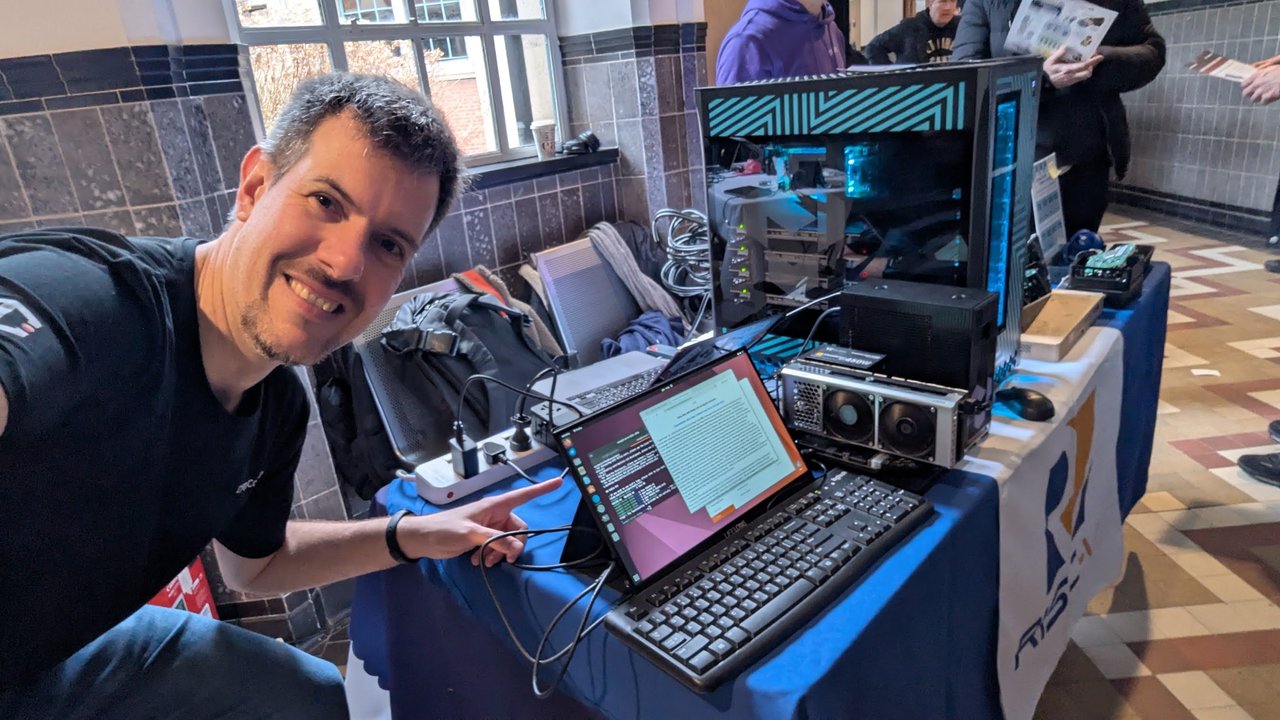
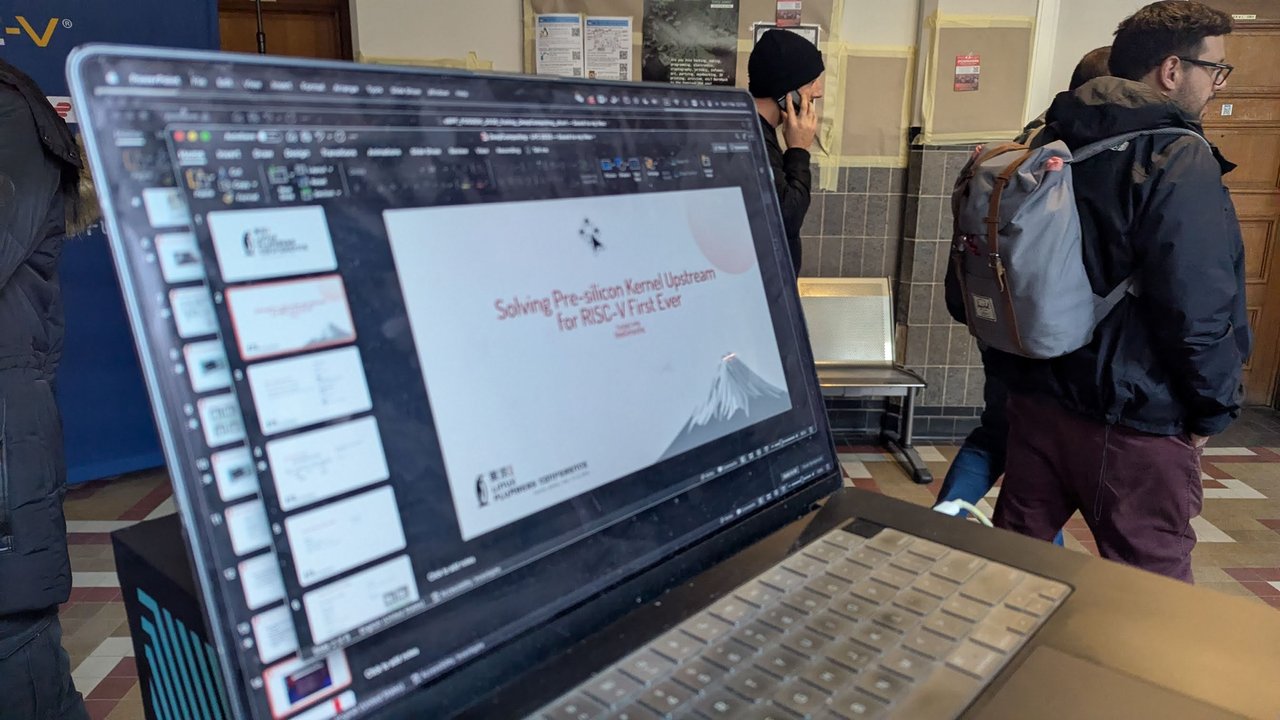
The RISC-V stand a few minutes after the interview, and later the deck for Yuning’s Sunday talk, open on a laptop.
A Fedora RISC-V maintainer: build servers and boards
My last interview, after a false start, was with one of the two speakers of Saturday’s “State of the Arch: Fedora on RISC-V” talk in the RISC-V devroom. I’ve written up that talk from the slides. He was quick to say it isn’t just him: he represents the work of a whole community of people. The talk covered the past year of Fedora on RISC-V. That included the challenges of building the most recent Fedora release and the move to a new build system server. It also reviewed the hardware: the most important boards today, their upstream status, the boards used to build Fedora, what to buy if you’re just starting, and what’s coming. Like Yuning, he mentioned RVA23. To contribute, join the Fedora RISC-V Matrix channel or the discussion on the Fedora forum. The talk’s page on the FOSDEM schedule has more details.